Last updated 2026-07-09
TL;DR
OSHA requires fall protection railings when workers face falls of 4 feet or more in general industry (29 CFR 1910.29) and 6 feet or more in construction (29 CFR 1926.502). The top rail sits 42 inches high (plus or minus 3 inches), takes 200 pounds of force, and needs a midrail. Rooftop railings meet the same specs but add wind load and anchor demands.
What does OSHA actually require for fall protection railings?
If a worker can fall 4 feet or more in a general industry workplace, you need fall protection. In construction, that trigger is 6 feet. Guardrail systems are one of OSHA's three accepted options, next to personal fall arrest systems and safety nets. Most employers pick railings because they protect everyone on the floor or roof without a harness inspection and a training refresher every time someone walks past a ledge.[1]
For general industry, the controlling standard is 29 CFR 1910.29, rewritten in 2017. For construction, 29 CFR 1926.502(b) covers guardrail systems. They share the same core geometry, but enforcement history and how inspectors apply them differ, so figure out which standard covers your work before you spec a system.[2]
OSHA's own text in 29 CFR 1910.29(b)(1) says a guardrail must withstand "a force of at least 200 pounds (890 N) applied within 2 inches of the top edge, in any outward or downward direction." That 200-pound number catches employers off guard when they try to pass off a rope or a chain as a rail. A chain strung between posts might look like a guardrail. If it deflects more than a couple inches under 200 pounds, it is not one.[1]
The other number to memorize is 42 inches. That is the required top-rail height, plus or minus 3 inches, so 39 to 45 inches is your acceptable window. Drop below 39 inches and you are out of compliance no matter how solid the rail feels.
What are the exact dimensional specs for a compliant guardrail?
A compliant guardrail is a three-part system: top rail, midrail, and toeboard where required. Get all three right and you satisfy the letter of the standard. Miss the midrail or the toeboard and the whole thing is a citation.
Top rail: 42 inches high (plus or minus 3 inches) above the walking-working surface. Withstands 200 pounds applied in any outward or downward direction within 2 inches of the top edge.[1]
Midrail: Set at the midpoint between the top rail and the floor, so roughly 21 inches. Withstands at least 150 pounds of force in any outward or downward direction.[1]
Toeboard: Required whenever tools, materials, or equipment could fall and hit workers below. At least 3.5 inches tall and strong enough to take 50 pounds. This is where a lot of rooftop and mezzanine jobs fall short at inspection.
Post spacing: Neither 1910.29 nor 1926.502 sets a maximum post spacing outright, but the load rating drives the design. Most fabricators run 6 to 8 feet on center to keep the top rail from deflecting past 3.25 inches under a 200-pound load, which is the performance limit for smooth-surfaced rails.
Openings: The midrail, screens, intermediate vertical members, or equivalent have to sit so no opening lets a 19-inch sphere pass through. That sphere test comes from 29 CFR 1910.29(b)(8) and matches the body-fall dimension used across OSHA's walking-working surfaces rules.[1]
Rooftop surface considerations: On a roof, the anchor system matters as much as the rail geometry. Core-drilling into a concrete parapet means an engineer verifies pull-out strength. Non-penetrating weighted base systems need manufacturer load calculations that account for wind uplift at your building's actual height and location, which almost always dwarfs the 200-pound lateral load from the standard.[3]
How do rooftop and roof fall protection railings differ from indoor railings?
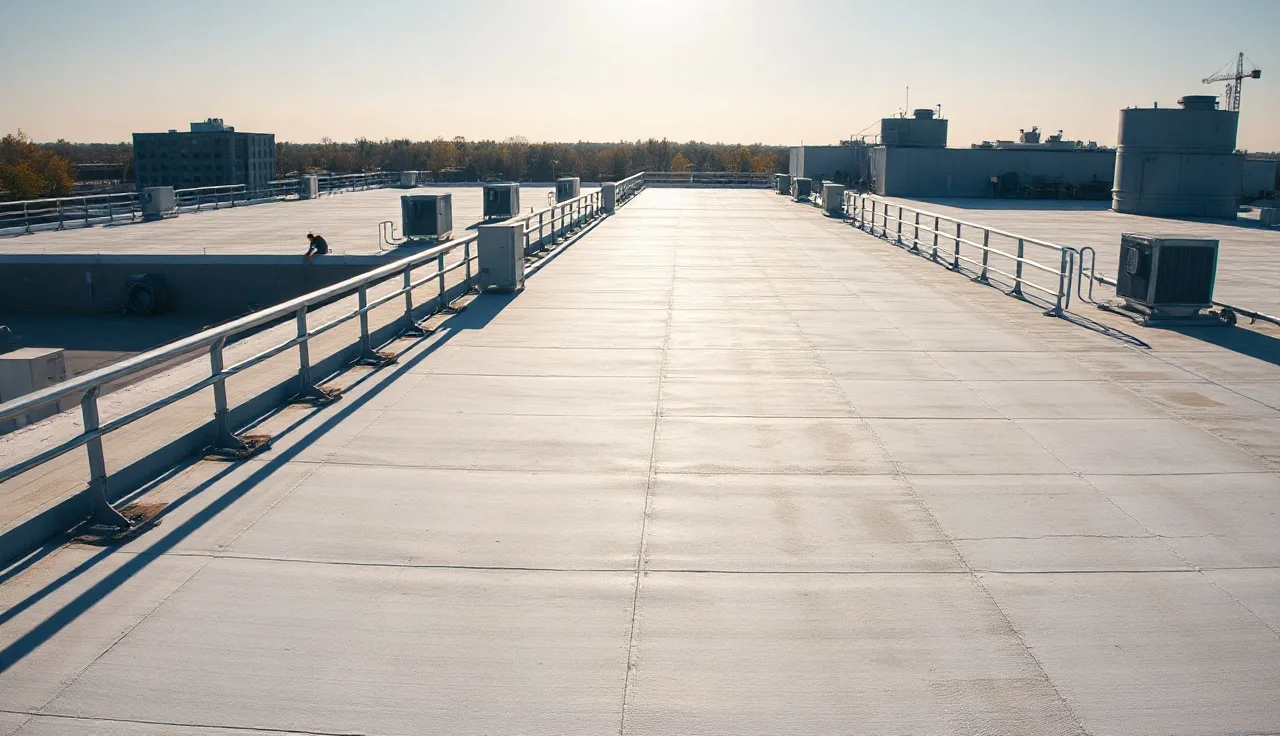
The OSHA dimensions are identical inside and out. A 42-inch top rail is 42 inches on a warehouse mezzanine and 42 inches on a commercial flat roof. What changes on a roof is everything around the rail: anchor forces, corrosion, drainage, and the reality that multiple trades pull sections off and put them back during maintenance visits.
Wind is the biggest practical difference. The 200-pound outward force in the standard is a static person-contact load. A freestanding non-penetrating rooftop railing also has to resist wind load per local building codes, which can run 20 to 40 pounds per square foot of surface area depending on how the jurisdiction adopts ASCE 7. A 42-inch railing running 100 feet along a parapet has roughly 350 square feet of projected surface. At 30 psf, that is 10,500 pounds of wind force the base system has to hold without sliding or tipping. OSHA's 200-pound person load is trivial next to that. Size a non-penetrating system for OSHA alone and it will skate across the roof in the first real storm.[3]
Corrosion runs a close second. Rooftop rails eat UV, rain, freeze-thaw cycles, and sometimes chemical discharge from HVAC units. Galvanized steel or powder-coated aluminum are the common picks. Stainless steel is the long-term move in coastal air, but the price gap is real. Most aluminum systems from reputable makers meet structural requirements and hold up in most North American climates.
Roof railings also have to reckon with the membrane. Building owners are right to be nervous about drilling through a roof membrane. Non-penetrating ballasted systems solve that, but they have to be engineered for wind and inspected on a schedule to confirm nobody moved the ballast blocks. A ballasted system that passes on day one can fail two years later after maintenance workers slide the blocks aside and never bring them back.[3]
If your building has a parapet wall, check its height before you buy anything. OSHA lets a parapet 39 to 45 inches high act as the guardrail, no extra railing required, as long as it meets the strength requirements. Plenty of older commercial buildings have 36-inch parapets, which are out of compliance and need either a rail on top or a full parapet rebuild.
What is the trigger height for roof fall protection, and what counts as a roof edge?
The trigger is 6 feet for construction workers and 4 feet for general industry workers doing maintenance on an existing roof. That gap matters more than most employers realize. A roofing crew installing a new membrane falls under 1926.502, so 6 feet triggers protection. A facilities employee going up to swap an HVAC filter falls under 1910.29, so 4 feet is the trigger. If your roof sits only 5 feet above the adjacent surface and your facilities team walks it, you need protection even though a roofing crew would not.[2]
An "unprotected edge" under OSHA is any side or edge with no wall, parapet, or guardrail at least 39 inches high. Skylights are fall hazards too. A standard glass or plastic skylight cover is not a fall-protection surface. Workers fall through them and die. Skylight guards or screens rated for personnel loads are their own OSHA requirement under 1910.29(e).[1]
Leading edge work is a separate case. In construction, the advancing edge of a floor or roof deck being installed has special rules because you cannot always place a conventional guardrail there. That is when fall arrest systems or controlled decking zones come in. For a finished roof with defined edges, a permanent or semi-permanent railing is usually the practical answer and the one inspectors expect to see.
How much do fall protection railings cost?
Prices swing on material, system type (modular versus custom-fabricated), and whether you penetrate the surface or not. These are real market ranges based on industry pricing across 2024 and 2025. Your quote depends on supplier and region.
| System type | Typical cost per linear foot (installed) | Best for |
|---|---|---|
| Galvanized steel, welded/fabricated | $35 to $80 | Permanent indoor mezzanines, loading docks |
| Powder-coated aluminum, modular | $40 to $90 | Rooftops, areas needing corrosion resistance |
| Non-penetrating ballasted rooftop | $50 to $120 | Flat roofs with membrane protection requirements |
| Cable rail (compliant) | $60 to $130 | Aesthetics, large open views |
| Temporary construction guardrail | $10 to $25 (rental/reuse) | Active construction projects |
A 100-linear-foot rooftop job with a non-penetrating ballasted aluminum system usually runs $6,000 to $12,000 installed. Add engineering review, which most jurisdictions require for non-penetrating rooftop systems, and budget another $800 to $2,500 for the stamp.
Now weigh that against a single fall-related citation. OSHA's serious violation penalty, the baseline for a first fall-from-elevation citation, was $16,550 per violation as of 2024, adjusted every year for inflation.[10] A willful or repeated violation can hit $165,514 per instance. The railing almost always costs less than the first citation, never mind the workers' comp claim behind it.
BLS data from 2022 show falls, slips, and trips caused 865 fatal work injuries, about 17 percent of all occupational deaths that year.[5] Falls from roofs and elevated surfaces sit near the top of that list every year. The math on a permanent railing is not complicated.
What materials are allowed for guardrail construction?
OSHA does not name a required material. The standard is performance-based: whatever you build has to meet the load ratings and the geometry. Steel, aluminum, wood, and cable can all be compliant with the right design.
Wood guardrails are still allowed and common on residential construction sites. The 2x4 or 2x6 top rail nailed to 4x4 posts is a familiar sight. Wood needs more frequent inspection because it splits, rots, and takes damage from equipment. For a permanent install, wood is rarely the right call.
Cable rail is popular for looks but demands attention to sag. Under 29 CFR 1910.29, the top rail cannot deflect below 39 inches when 200 pounds is applied. Cables sag. A cable system that is tight on installation day can drift out of spec within a year if nobody maintains tension. If you go cable, buy a system with tension indicators and put a quarterly tension check on the schedule.
Chain is not an acceptable guardrail except in narrow cases, like around machinery where chains must come off for operation, under 1910.29(b)(3)(ii). A chain rail fails the load requirements under normal assessment.
Pipe rail is the old industrial standby. 1.5-inch Schedule 40 steel pipe at sensible post spacing is cheap and clears the standard easily. It is also simple to fabricate, weld, and paint in-house if you have the shop for it.
When can you use a warning line or safety monitor instead of a railing?
On low-slope roofs in construction, OSHA allows warning line systems and safety monitors as alternatives to guardrails under 29 CFR 1926.502(f) and (h). A warning line is a rope, wire, or chain rigged at least 34 inches high (34 to 39 inches for mechanical equipment and material areas) around the work area, set at least 6 feet from the roof edge. Inside the line, workers operate without extra fall protection. Outside it, they need guardrails, fall arrest, or safety nets.[2]
This is where employers get burned. Warning lines are a construction-phase tool. They do not replace permanent railings once the building is occupied and facilities or maintenance workers use the roof. A maintenance employee is a general industry worker, and warning lines are not accepted protection for general industry rooftop work. You need a permanent railing, a fall arrest anchor system, or a locked door.
Safety monitors are more limited still. A safety monitor is a designated person who watches workers and warns them off an unprotected edge. Monitors work only on low-slope roofs, only for roofing operations, and only when other methods are infeasible. Inspectors are skeptical of monitor programs, and the paperwork burden is heavy. For a small business doing routine rooftop maintenance, a permanent railing is simpler and easier to defend.
How do you inspect and maintain a fall protection railing system?
OSHA requires walking-working surfaces, guardrails included, to be inspected "regularly and as necessary" under 29 CFR 1910.22(d). The standard sets no fixed frequency. Most safety professionals run quarterly formal inspections on permanent systems, with quick visual checks before and after any work near the rail.[9]
Here is what a real inspection covers.
Geometry check: Measure top-rail height in several spots. A post clipped by a forklift or pallet truck can lean just enough to pull the top rail below 39 inches without looking obviously wrong.
Load feel: You do not apply a full 200-pound test at every visit, but push firmly on the top rail and at midpoints to catch excessive movement, loose post connections, or cracked welds.
Corrosion and surface damage: On rooftop systems, look for galvanic corrosion where aluminum meets steel, rust at post base plates, and cracked coatings letting moisture in. A small rust spot on a base plate can turn into structural failure inside two or three seasons if the plate is thin.
Anchor integrity: On penetrating systems, confirm every fastener is present and tight. On non-penetrating systems, verify ballast blocks are in their specified spots and counts per the engineering drawing.
Toeboard condition: Toeboards take more abuse than top rails. Check for missing sections, bent-down ends that no longer hold the 3.5-inch height, and gaps at post connections.
Document every inspection in writing: inspector's name, date, deficiencies found, and corrective action taken. If a section fails, repair it immediately or barricade the area until you can. Running an open edge while you wait on parts is a serious citation in waiting.
If you need a written fall protection program to go with the hardware, SafetyFolio's OSHA safety program generator builds a customized written program in about 15 minutes, inspection documentation included.
What OSHA citations are most common for guardrail violations?
Fall protection is OSHA's most cited standard, year after year. In fiscal year 2023, "Fall Protection (General Requirements)" under 1926.501 was the single most cited OSHA standard for the 13th year running, with 7,762 citations.[4] Guardrail-specific citations cluster around a handful of repeat problems.
Wrong height: Top rails below 39 inches, usually because posts got hit and nobody straightened them. This is the easiest violation for an inspector to document. All it takes is a tape measure.
Missing midrail: Employers install the top rail and skip the midrail. A large gap between floor and top rail is a 1910.29(b)(3) or 1926.502(b)(2) violation.
Inadequate strength: Makeshift rails from conduit, rope, or thin EMT that cannot pass the 200-pound test.
Unprotected floor holes and skylights: A rail around an opening that flunks the 19-inch sphere test, or a skylight with no compliant cover or surrounding rail.
Removal without replacement: Sections pulled for deliveries, equipment moves, or maintenance and never put back. Mezzanine loading ledges and rooftop equipment areas are the usual offenders.
Knowing how inspections run, what inspectors hunt for, and how to answer a citation is part of any solid safety program. See our overview of OSHA requirements for how compliance works for small businesses.
Do state-plan states have different railing requirements?
Twenty-eight states and territories run OSHA-approved state plans.[6] A state plan must be "at least as effective" as federal OSHA, which usually means adopting the federal standards verbatim, sometimes with add-ons. A few states go meaningfully further.
California, run by Cal/OSHA (DOSH), has some of the biggest differences. Cal/OSHA's general industry order for guardrails sets a 42-inch top rail, same as federal, but enforces extra requirements around open-sided floors that go past federal thresholds in specific scenarios. Washington (L&I), Oregon (OR-OSHA), and Michigan (MIOSHA) carry their own wrinkles.
Here is the practical advice. If you operate in a state-plan state, look up your state plan's actual standards instead of leaning only on the federal CFR. The differences for guardrails are rarely dramatic, but they exist, and an inspector citing state code will cite the state number, not the federal one. OSHA keeps a directory of every state plan at osha.gov.[6]
For multi-state employers, design to the most stringent standard you touch, which is usually the federal spec (42-inch top rail, 200-pound load). If a state wants more, your research turns it up. If a state only matches federal, you are already there.
How do you write a fall protection program that covers your railing system?
The guardrail standard itself does not demand a written fall protection program, but construction does: 29 CFR 1926.502(k) requires a written plan whenever workers face falls of 6 feet or more. In general industry, a written program is not spelled out for guardrail-only situations, yet OSHA expects written procedures wherever a hazard exists, and the lack of paper makes a citation almost impossible to fight.
A workable written program for a small business with guardrail systems covers:
1. Scope: which locations have guardrail protection, which use other protection, and which are restricted access. 2. Inspection procedures: who inspects, how often, what they check, and where the records live. 3. Maintenance and repair: who has authority to repair, what interim protection covers a rail out of service, and how a system gets approved back into use. 4. Modification control: a flat prohibition on removing or modifying rail sections without authorization and replacement. 5. Training: who gets trained on the plan, when, and how it is documented.
Training and equipment records carry the weight here. If an inspector asks whether your maintenance crew was trained on the fall protection plan before they hit the roof, "yes, we told them" is not a defensible answer. Written training records tied to the specific hazard are what hold up.
SafetyFolio's safety program generator drafts a fall protection program matched to your operations. It handles railing inspection logs, training documentation, and the components that satisfy both general industry and construction, in about 15 minutes instead of a half-day consultant engagement.
What training do workers need before using or working near fall protection railings?
OSHA's construction fall protection training standard is 29 CFR 1926.503. It requires each worker who might face fall hazards to be trained by a "competent person" to recognize those hazards and the procedures to minimize them, before exposure. The training covers the nature of the hazards, the correct procedures for erecting and inspecting fall protection, and the limits of each system.[7]
For general industry, 1910.30 requires training for each worker exposed to fall hazards before exposure, covering the nature of the hazard and how to use fall protection correctly.[8]
A guardrail is often called "passive" protection, since workers do nothing special to stay protected. Training is still required. Workers need to know not to remove sections, not to lean their weight on an obviously damaged rail, not to stack materials against the rail in ways that compromise it, and who to tell when they find a damaged section.
For supervisors and safety leads, OSHA 30 training builds the base knowledge to run a fall protection program. The OSHA 30 construction course spends real time on fall protection. If you manage a site with active fall hazards, OSHA training is worth taking seriously rather than checking a box.
Frequently asked questions
What height requires a fall protection railing under OSHA?
In general industry (29 CFR 1910.29), guardrails are required when workers face falls of 4 feet or more. In construction (29 CFR 1926.502), the threshold is 6 feet. Rooftop maintenance by a facilities employee is general industry work, so the 4-foot trigger applies no matter how the roof was originally built.
How high does a guardrail have to be to meet OSHA standards?
The top rail must be 42 inches high above the walking-working surface, with a tolerance of plus or minus 3 inches. Any top rail below 39 inches or above 45 inches is out of compliance. The midrail sits at roughly the midpoint, and both must meet their required load ratings.
What load rating does a guardrail system have to withstand?
Under 29 CFR 1910.29(b)(1), the top rail must withstand at least 200 pounds of force applied in any outward or downward direction within 2 inches of the top edge. The midrail must take 150 pounds. Toeboards must take 50 pounds. These are minimums; engineered systems usually exceed them.
Can a parapet wall count as a guardrail on a rooftop?
Yes. OSHA allows a parapet wall to serve as the guardrail if it is 39 to 45 inches tall and meets the strength requirements of 29 CFR 1910.29(b)(1). Many older commercial buildings have parapets below 39 inches, which need an added rail section on top of the parapet or another fall protection solution.
Do non-penetrating rooftop railings need to be engineered?
OSHA does not require an engineer's stamp on every railing, but non-penetrating ballasted rooftop systems must be shown to meet both the OSHA person-contact load (200 pounds) and local wind-load requirements. Most jurisdictions want a professional engineer's analysis for non-penetrating systems because of wind uplift. Budget $800 to $2,500 for engineering review on a typical rooftop system.
How often do fall protection railings need to be inspected?
29 CFR 1910.22(d) requires regular inspection of walking-working surfaces but sets no specific interval for guardrails. Most safety professionals run quarterly formal inspections, backed by visual checks before any work next to the rail. After an equipment strike or a serious storm, an unscheduled inspection is warranted. Document each one with date, inspector, and findings.
Are cable guardrails OSHA compliant?
Yes, if properly designed and maintained. Cable rails are a recognized option, but cable sag is the main risk. When 200 pounds is applied, the top cable cannot deflect below 39 inches. Tension needs periodic checks, and most manufacturers recommend quarterly. A cable system with loose tension can fail its geometry requirement without looking broken.
What is the difference between a guardrail and a handrail under OSHA?
A guardrail system protects an open side or edge where a fall hazard exists. A handrail gives a gripping surface along a stairway or ramp. Both can share a structure but serve different purposes with different dimensions. Handrail height under 1910.29(f)(1) is 30 to 38 inches; guardrail top-rail height is 39 to 45 inches.
Can OSHA fine a small business for a missing guardrail?
Yes. Guardrail violations are typically cited as serious, which carried a maximum penalty of $16,550 per violation as of 2024. OSHA adjusts it annually for inflation. Repeat or willful violations can reach $165,514. Small businesses can get penalty reductions up to 70 percent based on size (10 or fewer employees get the largest cut), but the violation still lands on record.
What is a toeboard and when is it required on a guardrail?
A toeboard is a vertical barrier along the floor at the base of a guardrail, at least 3.5 inches tall. It is required under 29 CFR 1910.29(b)(9) whenever tools, materials, or equipment could fall from the edge and strike workers below. On mezzanines above occupied areas and on rooftop equipment platforms, toeboards are typically required and a common finding when missing.
Is a warning line system acceptable instead of a railing for rooftop work?
Warning lines are accepted only for construction roofing operations on low-slope roofs under 29 CFR 1926.502(f). They are not accepted for general industry maintenance on finished roofs. If your facilities team accesses the roof, you need a permanent railing, fall arrest anchors, or restricted access. Warning lines left up after construction are not compliant protection for occupants.
How do I choose between a permanent railing and a personal fall arrest system for rooftop access?
Railings protect every worker automatically, with no donning training or pre-task equipment check. Personal fall arrest systems (harnesses and anchors) require per-worker training, daily equipment inspection, and anchorage rated at 5,000 pounds per user. For rooftop areas used regularly by multiple people, a permanent railing is almost always more practical and more cost-effective over a three-to-five year horizon.
What records do I need to keep for fall protection railing inspections?
OSHA sets no required format, but you have to show inspections happened and deficiencies got fixed. Keep a log with the date, the inspector's name, the locations covered, deficiencies found, and the corrective action and date. A paper binder or a simple spreadsheet both work. Gaps in inspection records are hard to explain during an OSHA inspection and strengthen the inspector's case.
Do I need a written fall protection plan if I only use guardrails?
In construction, yes: 29 CFR 1926.502(k) requires a written plan whenever workers face falls of 6 feet or more, regardless of method. In general industry, a written plan is not explicitly mandated for guardrail-only situations, but the lack of documentation is a liability if a citation is contested. A simple written procedure costs almost nothing and strengthens your defense.
Sources
- OSHA, 29 CFR 1910.29 (Walking-Working Surfaces: Fall Protection Systems Criteria and Practices): Top rail must be 42 inches high (plus or minus 3 inches), withstand 200 pounds of force, midrail required at midpoint capable of withstanding 150 pounds, toeboard at least 3.5 inches.
- OSHA, 29 CFR 1926.502 (Construction: Fall Protection Systems Criteria and Practices): Construction fall protection threshold is 6 feet; guardrail systems must meet same height and load requirements as general industry; warning line systems allowed for low-slope roofing operations.
- OSHA, 29 CFR 1910.29 (Walking-Working Surfaces: Fall Protection Systems Criteria and Practices): Guardrail systems must meet the 200-pound person-contact load; freestanding non-penetrating rooftop systems must also account for wind load, addressed through manufacturer and engineering design rather than the OSHA static load alone.
- OSHA, Top 10 Most Cited Standards FY2023: Fall Protection (General Requirements) under 1926.501 was the single most cited OSHA standard in FY2023 with 7,762 citations.
- Bureau of Labor Statistics, National Census of Fatal Occupational Injuries in 2022: Falls, slips, and trips accounted for 865 fatal work injuries in 2022, approximately 17 percent of all occupational fatalities.
- OSHA, State Plans page: 28 states and territories operate OSHA-approved state plans that must be at least as effective as federal OSHA.
- OSHA, 29 CFR 1926.503 (Construction: Fall Protection Training Requirements): Each worker exposed to fall hazards must be trained by a competent person before exposure; training must cover fall hazard recognition and fall protection system procedures.
- OSHA, 29 CFR 1910.30 (General Industry: Training Requirements for Fall Protection): General industry employers must train each worker exposed to fall hazards before exposure, covering hazard nature and correct use of fall protection.
- OSHA, 29 CFR 1910.22 (General Industry: General Requirements for Walking-Working Surfaces): Walking-working surfaces must be inspected regularly and as necessary under 29 CFR 1910.22(d); no specific inspection interval is mandated for guardrails.
- OSHA, Penalties page: Serious violation maximum penalty was $16,550 per violation as of 2024; willful or repeat violation maximum was $165,514 per instance, both adjusted annually for inflation.
- OSHA, 29 CFR 1926.501 (Construction: Duty to Have Fall Protection): Construction workers must be protected from falls at 6 feet or more; leading edge work and rooftop edges are specifically addressed.
- OSHA, 29 CFR 1910.29(e) (Skylight Protection Requirements): Skylights and skylight openings must be protected by covers or guardrail systems rated for personnel loads; standard glass or plastic skylights are not considered fall-protective surfaces.