Last updated 2026-07-09
TL;DR
OSHA requires guardrail systems when workers face fall hazards at or above 4 feet in general industry (29 CFR 1910.29) or 6 feet in construction (29 CFR 1926.502). Top rails must sit 42 inches high (plus or minus 3 inches), withstand 200 pounds of force, and include a midrail. Missing or weak guardrails rank among OSHA's top five most-cited violations every year.
What are guardrail systems for fall protection and when does OSHA require them?
A guardrail system is a passive barrier. It protects workers without them having to do anything. No harness to put on, no lanyard to clip, no anchor point to calculate. You install it, and it works. That simplicity is exactly why OSHA treats guardrails as the preferred method of fall protection when they're feasible.
OSHA's hierarchy puts guardrails first, personal fall arrest systems (harnesses and lanyards) second, and safety nets third. If you can guard the edge, guard it. Don't lean on equipment that only works when a worker does everything right, every time, on the worst day of their week.
The trigger heights change by industry. General industry starts at 4 feet above a lower level under 29 CFR 1910.28 [1]. Construction starts at 6 feet under 29 CFR 1926.501 [9]. Shipyards use 5 feet (29 CFR 1915.73). Longshoring and marine terminals follow 29 CFR 1918. Not sure which standard applies to you? Start with the SIC or NAICS code on your OSHA 300 log, or call your state plan office.
Falls are not a small hazard. The Bureau of Labor Statistics counted 865 fatal occupational falls in 2022, the second leading cause of workplace death after transportation incidents [3]. Guardrails stop the fall before it starts, which is why they matter more than almost any other control in a fall protection program.
What are the exact OSHA specifications for a guardrail system?
This is where small businesses get tripped up. The code gives hard numbers, and inspectors show up with tape measures.
Under 29 CFR 1910.29, general industry guardrails have to hit these marks:
- Top rail height: 42 inches (plus or minus 3 inches) above the walking-working surface. That's a legal range of 39 to 45 inches. Below 39 inches is a violation [1].
- Midrail height: Roughly halfway between the top rail and the floor, around 21 inches. The standard puts it "midway between the top edge of the guardrail system and the walking-working surface."
- Toe board: Required when tools or materials could fall and hit workers below. Toe boards must be at least 3.5 inches high with no more than a quarter-inch gap at the floor.
- Strength (top rail): Must withstand at least 200 pounds of force applied in any outward or downward direction at any point along the top edge [1].
- Strength (midrail): Must withstand at least 150 pounds of force in any outward or downward direction.
- Openings: No opening can allow a 19-inch diameter sphere to pass when the top rail is the upper boundary, or a 21-inch sphere when the midrail is the upper boundary.
Construction guardrails under 29 CFR 1926.502(b) follow the same logic and add one detail that trips people up: the top rail has to hold that 200-pound force without deflecting below the 39-inch minimum [2]. A flimsy top rail that bends past 39 inches under load fails the inspection even if it started at 42 inches.
Wire rope top rails are allowed in construction, but they have to be flagged every 6 feet with high-visibility material. Steel banding and plastic banding are never acceptable as top rails or midrails under any OSHA standard.
| Requirement | General Industry (29 CFR 1910.29) | Construction (29 CFR 1926.502) |
|---|---|---|
| Trigger height | 4 ft | 6 ft |
| Top rail height | 42 in ± 3 in (39-45 in) | 42 in ± 3 in (39-45 in) |
| Top rail strength | 200 lbs | 200 lbs |
| Midrail strength | 150 lbs | 150 lbs |
| Smooth surface required | Yes | Yes |
| Wire rope top rail | Not standard (check spec) | Allowed with 6-ft flags |
| Steel/plastic banding | Not acceptable | Not acceptable |
Where exactly do guardrails need to be installed?
Guardrails are required at any unprotected edge, side, or opening where a worker could fall to a lower level at or above the trigger height. That sounds broad because it is.
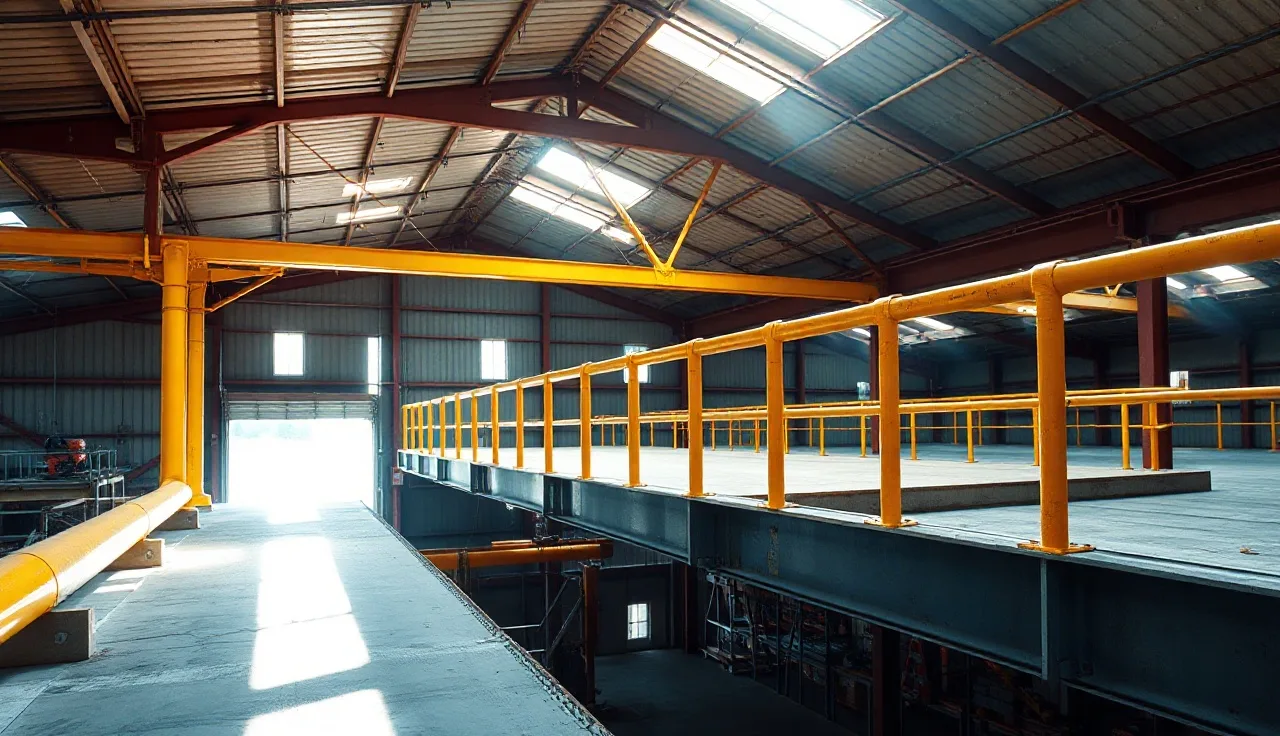
In general industry, covered spots include mezzanines, elevated platforms, open-sided floors, floor holes, stairways, ramps, and runways. A loading dock with an open edge above 4 feet needs fall protection. A mezzanine storage area with an open side gets the same answer.
Construction adds scaffold edges, leading edges of floors and roofs, excavations, and unprotected sides of ramps and runways. "Leading edge" is a specific OSHA term for construction where the edge moves as work goes forward, and it carries its own set of compliance options.
Floor holes are treated separately from open edges. A hole between 2 inches and 12 inches across needs a cover marked "HOLE" or "COVER." A hole big enough for a person to fall through needs a cover or a guardrail system around it.
Here's the one that catches people: loading dock edges when no vehicle is present. Workers near an open dock door above 4 feet with no truck backed in are standing at an unprotected edge. Chains or ropes across the opening can satisfy the standard if they meet the strength and height requirements. A single rope hung at knee height does not.
What are the most common guardrail citations OSHA issues?
Fall protection sits in OSHA's top five most-cited standards year after year. In fiscal year 2023, fall protection in construction (29 CFR 1926.501) was the single most-cited standard for the 13th straight year, with 7,762 violations [4]. The general industry walking-working surfaces standard (29 CFR 1910.28) shows up in the top 25 regularly.
The guardrail write-ups inspectors issue most often break down like this:
Height violations. The top rail sits below 39 inches. This happens constantly on older fixed systems where settling, welding, or a sloppy modification dropped the rail below spec. Inspectors carry tape measures for a reason.
Missing midrails. A top rail alone does not meet the standard. Midrails are not optional. The gap between a top rail at 42 inches and the floor at zero is wide enough to let a person through.
Inadequate strength. Harder to catch by eye, but an inspector can fail a guardrail that clearly can't hold 200 pounds, especially a single unsupported pipe span.
Openings too large. Mid-panel gaps that let a 19-inch sphere pass are a violation. Sagging or widely spaced cable guardrails are the usual culprit.
Missing toe boards. When falling objects could hit workers below, toe boards are required. Plenty of employers skip them entirely.
Serious violations, the category most guardrail citations fall into, run up to $16,550 per violation as of 2024 [5]. Willful or repeated violations reach $165,514 per violation.
What materials can you use for guardrail systems?
OSHA's guardrail rules are performance-based, not prescriptive about materials. The regulation says what the system has to do, not what it has to be made of. That hands employers real flexibility.
Common materials that work:
Pipe and fitting systems. Standard 1.5-inch or 2-inch steel pipe with flanged or clamp fittings is the classic warehouse and manufacturing answer. These are the modular systems from suppliers like Kee Safety and similar manufacturers. They reconfigure easily when your floor layout changes.
Cable guardrails. Wire rope at the right tension and diameter can meet the strength requirements. Cable systems are common at construction leading edges. The trick is keeping tension so the cable doesn't deflect too far under the 200-pound load test.
Concrete or masonry walls. A permanent wall at the right height around an elevated area can act as the guardrail. You see this in older warehouses with masonry mezzanines.
Pre-engineered modular systems. Many companies sell OSHA-compliant modular guardrails with engineering certifications included. For a small business, this is often the fastest path to compliance, because the strength testing is already documented by the manufacturer.
What you can't use: single chains or ropes that hang too low or too weak, plastic banding, and wooden rails nobody has verified against the strength requirement. A wooden 2x4 top rail nailed to posts might meet the standard if it's at the right height and the posts can handle 200 pounds. Many won't. If you're building with wood, check the post spacing and connection method against the load requirement before you trust it.
Self-closing gates are required anywhere a guardrail has an opening for access, like a ladder access point or a lift gate opening. The gate has to swing away from the hazard, never toward it.
How does a guardrail system differ from a personal fall arrest system?
The answer decides what your workers do, or don't have to do, every single day.
A guardrail system is a passive control. Install it right and it works with zero action from workers. No training on how to don equipment, no daily harness inspection, no anchor point math. That's a real operational win.
A personal fall arrest system (PFAS) is active. A worker has to wear a full-body harness, clip a properly sized lanyard to an adequate anchor point (rated 5,000 pounds per worker, or designed by a qualified person for twice the maximum arrest force), and the system has to stop a fall within set limits. OSHA requires a PFAS to "limit maximum arresting force on an employee to 1,800 pounds when used with a body harness" [2]. Getting the right combination of harness, lanyard, and anchor takes real osha training.
For a small business, the practical reality is simple: guardrails cost less to maintain once they're up. PFAS programs demand documented training, equipment inspection records, a rescue plan (OSHA requires prompt rescue before workers use PFAS), and constant oversight. If you can put up a guardrail, put up a guardrail.
The exception is leading-edge work in construction, where the edge moves daily and guardrails may not be practical. There, PFAS becomes the go-to. Residential construction also has alternative methods allowed under 29 CFR 1926.502(k) when conventional fall protection is infeasible.
Safety nets are the third option, mostly used in construction where neither guardrails nor PFAS will work. They have to sit close enough to the work level to catch a falling worker inside set distance limits, and they carry their own inspection and load-test requirements.
What does a compliant fall protection written program need to say about guardrails?
If you have fall hazards above the trigger heights, OSHA expects a written fall protection plan inside your safety program. In construction, a written plan is explicitly required when conventional fall protection is infeasible (29 CFR 1926.502(k)). In general industry, the walking-working surfaces standard under 29 CFR 1910.28 leans on documented hazard assessments and procedures as part of your general safety and health obligations.
A written program covering guardrails should hit six things:
1. Hazard identification. A map or list of every location where guardrails are required, with the specific fall height at each spot. 2. System specifications. The type and configuration of guardrail at each location, tied to manufacturer specs or engineering documentation. 3. Inspection schedule. How often guardrails get inspected, who does it, and what they check. At minimum: top-rail height, midrail presence, and visible damage to posts and connections. 4. Inspection records. A log of completed inspections with dates, inspector names, and findings. 5. Repair and replacement procedures. What happens when an inspection finds a problem, and who has the authority to pull a guardrail out of service. 6. Training requirements. Who trains workers on the fall hazards and the guardrails protecting them, and how that training gets documented.
Building this from scratch doesn't have to eat your weekend. SafetyFolio's safety program generator walks you through your specific hazards and produces a compliant written program in about 15 minutes, guardrail and fall protection sections included.
One thing your written program should never be: a generic downloaded template that ignores your actual locations and systems. Inspectors spot generic programs on sight. A site-specific program that names your mezzanine, your dock edges, and your exact guardrail configurations carries far more weight.
How do you inspect guardrail systems and how often?
OSHA doesn't set a mandatory inspection frequency for fixed guardrails the way it does for powered industrial trucks. What it does require is that guardrails meet the performance standards at all times. In plain terms, that means you need a regular inspection program even though no rule spells out the interval.
Most safety professionals run a formal inspection at least quarterly on fixed systems, plus a quick visual check during regular facility walkthroughs. Any time a guardrail takes a hit (forklift contact is the top cause in warehouses), it gets inspected before it goes back into service.
Here's your checklist:
Top-rail height. Measure it. Use a tape at several points along the span. If a post shifts, the rail height shifts with it.
Midrail presence and height. Confirm it's there and sitting near the midpoint.
Post integrity. Look for bends, cracks at welds, loose fasteners, and corrosion at the base. A post that looks solid but is rusted through at the floor flange can fail under far less than 200 pounds.
Surface condition. Rails have to be smooth enough not to snag clothing or cut a worker who grabs them. Burrs, sharp bends, and broken surfaces are violations.
Openings. Check that no gap is wide enough to pass a 19-inch sphere.
Gates. Confirm self-closing gates close completely and swing away from the hazard.
Toe boards. Check they're present where required and still seated tight against the floor.
Document every inspection. A short form with the date, inspector name, locations checked, and findings covers it. If OSHA asks for your inspection records and you have none, that's a separate recordkeeping problem stacked on top of any physical violation.
For an incident report template and guidance on documenting a near-miss or fall involving a guardrail, see our incident report guide.
What height triggers the guardrail requirement in different industries?
The trigger height is one of the most misunderstood parts of fall protection, because it shifts by standard and workplace type.
| Industry / Standard | Trigger Height | Key CFR Reference |
|---|---|---|
| General industry | 4 feet | 29 CFR 1910.28 |
| Construction | 6 feet | 29 CFR 1926.501 |
| Shipyards | 5 feet | 29 CFR 1915.73 |
| Marine terminals | 4 feet | 29 CFR 1918 |
| Agriculture | 4 feet | 29 CFR 1928.21 |
| Scaffolding (construction) | 10 feet | 29 CFR 1926.451 |
| Ladderway openings | Any height | 29 CFR 1910.29 |
Scaffold platforms in construction trigger at 10 feet, not 6. That's a specific exception buried inside the construction standard [12].
For stairways in construction, handrails are required on any stairway with four or more risers or one that rises more than 30 inches. That's a separate requirement from fall protection guardrails, but it lives in the same CFR part (1926.1052).
General industry stairways under 29 CFR 1910.29 require a stair rail on each unprotected side or edge of a stairway with four or more risers. Stair rails installed before January 17, 2017 that met the old standard have some grandfathering, but anything installed or replaced after that date has to meet the current spec.
One spot that generates confusion: retail stock rooms with elevated stock platforms. If workers access those platforms and the edge is unguarded above 4 feet, it's a general industry violation. Retail gets no exemption.
Can you use alternative fall protection methods instead of guardrails?
Yes, but with conditions attached to every alternative.
For walking-working surfaces in general industry, the main alternatives to guardrails are personal fall protection systems (harnesses and lanyards, or positioning systems) and travel restraint systems. A travel restraint keeps workers back from the edge entirely rather than arresting a fall after it starts. It's an underused option that works well on flat roofs and similar surfaces where you can define a safe working zone.
Warning line systems are allowed in construction roofing work under 29 CFR 1926.502(f), but only on low-slope roofs and only alongside another control or a safety monitor. A warning line on its own is not adequate fall protection for general roofing.
Safety monitor systems, where a designated person watches workers near an unprotected edge, are allowed in narrow construction situations under 29 CFR 1926.502(h). They're barred in general industry. They're also the lowest-reliability option, because they hang entirely on human attention.
Controlled access zones (CAZ) are another construction-specific alternative for certain precast concrete erection and leading-edge work. Workers inside the CAZ use PFAS; workers outside rely on the zone boundary.
The practical rule for most small businesses: if you can install a guardrail, install it. Every alternative demands more ongoing management, more training, and more paperwork. A guardrail sits there and works.
Want the full regulatory picture? OSHA's walking-working surfaces overview lays out the general industry context [11]. For a broader look at OSHA requirements that apply to your business, see our OSHA basics guide.
What do guardrail systems typically cost, and what are the ROI considerations?
Nobody has clean data on average guardrail installation costs across all industries. Prices swing hard by material type, manufacturer, install complexity, and region. Here's a realistic range by system type, built from common pricing:
Modular pipe-and-fitting systems: $30 to $80 per linear foot, installed. A 50-foot mezzanine edge runs roughly $1,500 to $4,000.
Cable guardrail systems: $15 to $40 per linear foot for materials, plus installation labor. Cheaper to buy, slower to install correctly.
Pre-engineered modular panel systems: $50 to $120 per linear foot installed, depending on manufacturer and configuration. Higher price, faster install, documented engineering specs.
Permanent steel welded systems: All over the map. Custom fabrication can run $80 to $200 per linear foot or more.
The cost-benefit math is not complicated. According to the National Safety Council, a lost-time work injury carries thousands of dollars in direct costs (workers' compensation, medical, overtime for a replacement worker), and indirect costs typically run several times higher [6]. A 50-foot guardrail at $4,000 pays for itself the first time it keeps someone from going off a mezzanine edge.
Citations pile onto the math. A serious violation for missing fall protection runs up to $16,550. A willful violation, where the employer knew about the hazard and didn't fix it, can hit $165,514 [5]. The guardrail is almost always cheaper than the citation, and beyond comparison against a fatality.
Some states offer OSHA's On-Site Consultation Program, free and walled off from enforcement, where a consultant visits your facility, finds fall hazards, and recommends fixes without issuing citations. Use it before you spend money, so you solve the right problems the first time.
How do state OSHA plans affect guardrail requirements?
Twenty-nine states and territories run their own OSHA-approved state plans. These plans have to be at least as effective as federal OSHA. They can be stricter. They can never be weaker [7].
Most state plans adopt the federal standards word for word. California (Cal/OSHA) is the notable holdout, with areas where its requirements differ from federal. Cal/OSHA's construction fall protection lines up largely with federal OSHA, but it handles residential construction and a few specific industries differently. Washington (L&I), Michigan (MIOSHA), and others sometimes carry higher penalties or extra requirements.
If your business operates in a state plan state, check with that state's occupational safety agency for any differences before you assume the federal numbers apply. The state plan map on OSHA.gov shows which states run their own programs [7].
One place state plans occasionally diverge: the trigger height for fall protection in specific sectors. Most match the federal thresholds, but confirm it for your state if you're in a sector sitting close to the line.
Frequently asked questions
What is the required height for a guardrail under OSHA standards?
The top rail of a guardrail must sit 42 inches above the walking-working surface, with an allowable range of 39 to 45 inches. That tolerance exists because OSHA knows surfaces aren't always level. Below 39 inches is a violation. Above 45 inches is also out of spec. Inspectors measure with a tape, so don't eyeball it.
Do guardrails need a midrail?
Yes. OSHA requires both a top rail and a midrail on all guardrail systems. The midrail goes approximately midway between the top rail and the walking-working surface, typically around 21 inches. It must withstand 150 pounds of force in any outward or downward direction. A top rail alone does not meet the standard, no matter how strong or tall it is.
How much force must an OSHA-compliant guardrail withstand?
The top rail must withstand at least 200 pounds of force applied in any outward or downward direction at any point along the top edge. The midrail must handle 150 pounds. For construction systems, the top rail also has to hold that 200-pound force without deflecting below 39 inches. A system that flexes too far under load fails even if it started at the right height.
At what height do you need fall protection guardrails in a warehouse?
Warehouses fall under OSHA's general industry standard (29 CFR 1910.28), which requires fall protection at 4 feet or higher above a lower level. That covers mezzanines, elevated platforms, open-sided floors, and loading dock edges when no vehicle is present. A dock sitting 48 inches above the lot needs a guardrail or another compliant method whenever workers are near the open edge.
Are toe boards required on guardrail systems?
Toe boards are required when tools, materials, or equipment on the elevated surface could fall and strike workers below. They must be at least 3.5 inches high, solid or with openings no larger than 1 inch, and seated within a quarter inch of the floor. If nobody ever works below your platform, you may not need them. If there's any chance a lower-level worker gets hit by a falling object, install them.
Can wire rope be used as a guardrail?
Yes, in construction, wire rope top rails are permitted under 29 CFR 1926.502(b)(9) if the rope is flagged with high-visibility material at maximum 6-foot intervals. Wire rope has to meet the same strength requirement as any top rail: 200 pounds of force without deflecting below 39 inches. Tensioning is the most common failure point. Slack cable that sags well below 39 inches under load does not meet the standard.
What is the difference between a guardrail and a handrail?
A guardrail is a barrier that keeps workers from falling off an elevated platform, roof, or open-sided floor. A handrail is a graspable rail on a stairway or ramp that helps workers keep their balance while walking. OSHA's stairway rules call for handrails; platform edge rules call for guardrails. Many stairways need both: a handrail for grip and a guardrail stair rail on the open side to stop a fall off the edge.
Do guardrails need to be inspected, and how often?
OSHA requires guardrails to meet performance standards at all times but sets no fixed inspection interval for permanent systems. Most safety professionals run formal inspections at least quarterly, plus a check after any impact or modification. Look at top-rail height, midrail presence, post integrity, surface condition, and gate function. Document every inspection with date, inspector name, locations, and findings. No records means no proof of compliance when OSHA shows up.
What happens if a forklift hits a guardrail and bends a post?
Pull the section out of service right away if there's any doubt about structural integrity. A bent post may no longer carry the 200-pound load to the floor anchor. Inspect the base connection for cracking or loosening. Replace bent components before the system goes back into use. Log the incident and the repair. A post that got hit hard, bent, and sprang back may have work-hardened and turned brittle at the bend point.
Can a safety monitor replace a guardrail system?
Only in narrow construction situations, and never in general industry. OSHA's construction standard (29 CFR 1926.502(h)) allows safety monitors on low-slope roofs and in controlled access zones for certain operations, as a last resort when conventional fall protection is infeasible. The monitor has to be a competent person with no other duties, positioned to see each worker. This is the least reliable method and should never be used when guardrails are practical.
What is the OSHA penalty for missing or inadequate guardrails?
Most guardrail violations land as serious, with penalties up to $16,550 per violation as of 2024. If OSHA finds the employer knew about the hazard and chose not to fix it, it becomes willful, reaching $165,514 per instance. Repeat violations, the same standard cited within three years of a prior citation, also hit the $165,514 ceiling. Several missing guardrails at one site can generate several separate violations.
Do temporary guardrails during construction need to meet the same specs as permanent ones?
Yes. Temporary guardrails in construction must meet the same 29 CFR 1926.502(b) specs as permanent ones: 42-inch top rail, midrail, 200-pound top-rail strength. The temporary nature of the install changes nothing. Construction workers face the same fall physics as anyone else, and OSHA's inspection authority carries no temporary-work exception for guardrail specs.
What should a self-closing gate at a guardrail opening look like?
A self-closing gate must swing away from the fall hazard, never toward it. If a ladder comes up through a hatch and the gate swings toward the opening, a worker stepping off could push the gate open and step into air. The gate has to close and latch on its own without the worker securing it. Gates must meet the same height and strength requirements as the guardrail sections they protect.
Sources
- OSHA, 29 CFR 1910.29 - Fall Protection Systems and Falling Object Protection Criteria and Practices: General industry guardrail top rail must be 42 inches (±3 in) and withstand 200 pounds of force; midrail required at midpoint and must withstand 150 pounds
- OSHA, 29 CFR 1926.502 - Fall Protection Systems Criteria and Practices: Construction guardrails: 42-inch top rail, 200-pound strength requirement with no deflection below 39 inches; PFAS must limit arresting force to 1,800 pounds
- Bureau of Labor Statistics, Census of Fatal Occupational Injuries 2022: 865 fatal occupational falls in 2022, making falls the second leading cause of workplace death
- OSHA, Top 10 Most Frequently Cited Standards FY2023: Fall protection in construction (29 CFR 1926.501) was the most-cited OSHA standard for the 13th consecutive year in FY2023 with 7,762 violations
- OSHA, Penalties page: Serious violations can reach $16,550 per violation; willful or repeated violations can reach $165,514 per violation as of 2024
- National Safety Council, Work Injury Costs: Direct and indirect costs of a lost-time occupational injury, including workers' compensation and medical costs
- OSHA, State Plans page: 29 states and territories operate OSHA-approved state plans that must be at least as effective as federal OSHA
- OSHA, 29 CFR 1910.28 - Duty to Have Fall Protection and Falling Object Protection: General industry fall protection required at 4 feet above a lower level for walking-working surfaces
- OSHA, 29 CFR 1926.501 - Duty to Have Fall Protection: Construction fall protection required at 6 feet above a lower level; leading edges, excavations, and roofing work covered
- OSHA, 29 CFR 1915.73 - Shipyard Fall Protection: Shipyard employment fall protection trigger height is 5 feet
- OSHA, Walking-Working Surfaces overview page: OSHA's walking-working surfaces standards cover general industry fall protection including guardrail specifications and alternative methods
- OSHA, 29 CFR 1926.451 - Scaffold General Requirements: Scaffold platforms in construction require fall protection at 10 feet, not the standard 6-foot construction threshold