Last updated 2026-07-11
TL;DR
When workers from general industry (29 CFR 1910) and construction (29 CFR 1926) share a site, OSHA applies each standard to the employer who controls that work. A construction contractor follows 1926. A facility maintenance crew on the same floor follows 1910. Employer identity and the nature of the work decide it, not physical location.
What is a mixed operation and why does OSHA treat it differently?
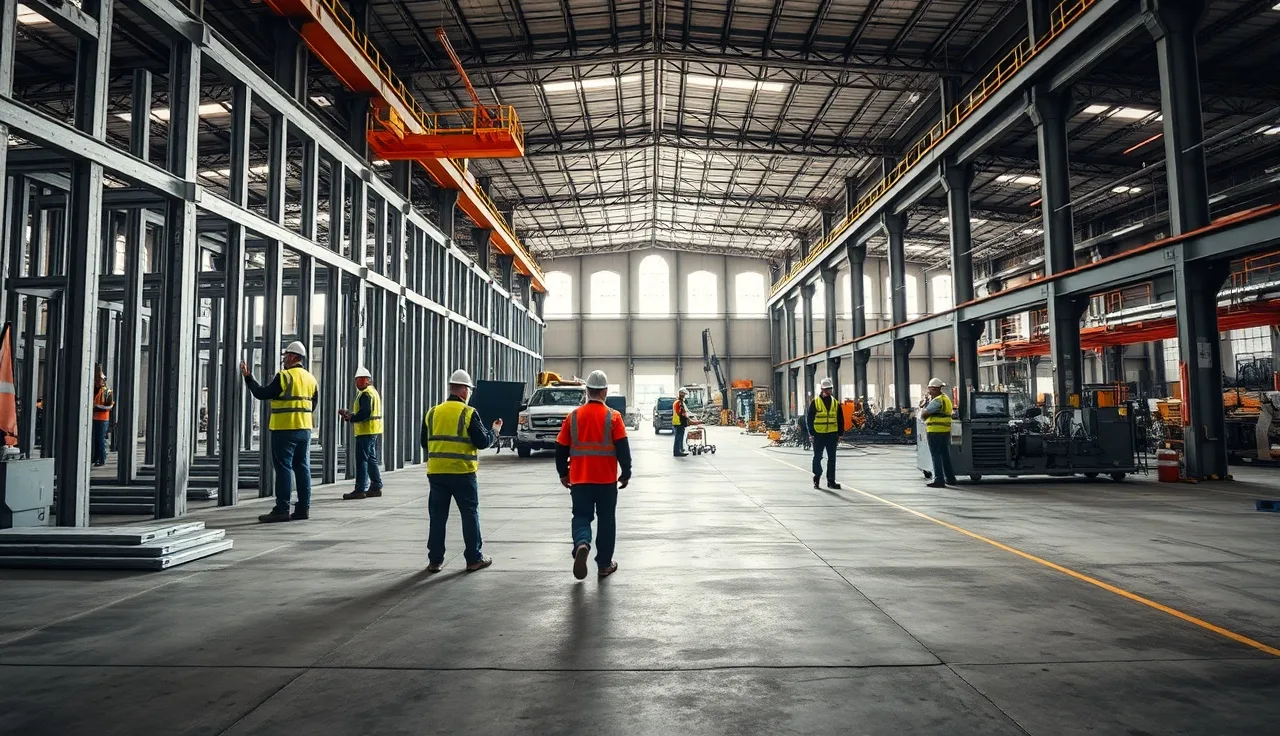
A mixed operation is any worksite where general industry activity and construction activity happen at the same time, often within a few feet of each other. Picture a food plant running production while a contractor builds a new conveyor line on the same floor. The plant's workers fall under 29 CFR 1910. The contractor's crew falls under 29 CFR 1926. Two employers, two regulatory frameworks, one floor.
OSHA drew this line on purpose. The agency defines construction work in 29 CFR 1926.32(g) as "construction, alteration, and/or repair, including painting and decorating." [1] General industry covers the rest: manufacturing, retail, warehousing, utilities. The reasoning is that construction hazards like falling materials, open excavations, and scaffold collapse differ enough from general industry hazards that they earned their own standard when Congress passed the OSH Act in 1970.
The line blurs in real operations. All the time. A facility maintenance employee who patches a roof one day and repairs a conveyor the next might be doing construction work under 1926 in the morning and general industry work under 1910 in the afternoon. Nobody has a clean answer for every edge case, but OSHA's letters of interpretation lay out the framework well enough to make defensible calls. [2]
Small business owners get tripped up because they assume the physical location picks the standard. It does not. The work being performed and the employer performing it are what matter.
Which OSHA standard applies when both 1910 and 1926 are in play?
Each employer is cited under the standard that governs their type of work. [2] That is the whole rule, even if the application gets messy. A general contractor doing structural steel work on a hospital expansion follows 1926 subpart R, even if the hospital's own maintenance staff is working 30 feet away under 1910.
Here is the test OSHA compliance officers actually run:
1. Who employs the worker in question? 2. What type of work are they doing at the moment of the alleged hazard? 3. Is that work construction, alteration, or repair as defined in 1926.32(g), or is it general industry operation?
If question 3 lands on construction, 1926 applies. If it lands on general industry operation, 1910 applies.
One wrinkle matters. When a 1910 standard and a 1926 standard cover the same hazard, and the 1926 standard is more protective, OSHA will sometimes apply the 1926 standard to the construction employer even on a mostly general industry site. The reverse rarely happens. OSHA has consistently declined to apply 1910 standards to construction employers just because the work happens inside a factory. [3]
A second wrinkle: OSHA can cite a host employer under the multi-employer worksite policy even when the host's own workers were never exposed. If a general contractor's unsafe scaffold puts the facility's maintenance crew at risk, OSHA can cite the contractor as the creating employer and the facility owner as the controlling employer. [4]
What is the multi-employer worksite policy and how does it work here?
OSHA's multi-employer citation policy lives in OSHA Instruction CPL 02-00-124, and it recognizes four employer roles: creating, exposing, correcting, and controlling. [4] One employer can hold several roles at once.
In a mixed operation, the facility owner (general industry) usually acts as the controlling employer, because they control site conditions, permit access, and set work schedules. That creates real liability even when the facility owner's workers never go near the hazard. If a construction subcontractor installs a temporary electrical panel with live exposed conductors, and the facility's janitorial staff walks past it every day, OSHA can cite the facility owner for failing to exercise reasonable diligence to discover and correct the condition.
The controlling employer standard is not strict liability. OSHA asks whether the controlling employer "exercised reasonable care" to prevent or detect violations. [4] Reasonable care in practice means requiring contractors to submit safety plans before work starts, running periodic site inspections during the project, and having a documented way to stop work when a hazard shows up.
Writing that process down matters enormously. An undocumented site safety meeting proves almost nothing next to a signed contractor safety agreement, dated inspection logs, and a corrective action record. If you are building a written program for a facility that regularly hosts contractors, the SafetyFolio program generator can help you produce the contractor management section in a fraction of the time it takes to draft from scratch.
What does OSHA's letter of interpretation say about overlapping standards?
OSHA has issued several letters of interpretation that hit the 1910/1926 boundary head-on. The core position is simple: the standard follows the nature of the work, not the location where it is performed. [2] Construction work gets 1926. General industry work gets 1910. Same address, different rules.
A 1999 letter addressed a hospital scenario almost identical to the factory example above. OSHA confirmed that hospital maintenance employees performing renovation work on an occupied floor were covered by 1926 for the renovation tasks, while the hospital's clinical staff on the same floor stayed under 1910. [3] Follow the work, not the address.
The genuinely hard part is maintenance versus repair versus construction. Routine maintenance is generally 1910. Repair of existing structures can tip into 1926. New construction plainly is 1926. A forklift technician replacing a drive motor is doing 1910 work, while a contractor installing a new electrical service to power a new conveyor is doing 1926 work, even if both happen in the same bay on the same day.
When you cannot find a letter of interpretation that fits your situation, apply the more protective standard. Compliance officers respect the good-faith effort, and the cost of over-complying is far lower than the cost of a citation.
How does fall protection work when 1910 and 1926 crews are on the same site?
Fall protection is the most common collision point between 1910 and 1926, because the trigger heights are different. Under 29 CFR 1926.501, construction workers generally need fall protection at 6 feet. Under 29 CFR 1910.28, the general industry walking-working surfaces rule updated in 2017, general industry workers need fall protection at 4 feet above a lower level for most operations. [5]
That two-foot gap causes real confusion. Say a construction contractor and a factory maintenance employee both work on a 5-foot elevated platform inside the same building. The maintenance employee needs fall protection under 1910 because they are above 4 feet. The contractor, sitting at 5 feet, does not trigger the 6-foot construction threshold. Same platform, two different legal requirements.
The practical answer for most facilities: require fall protection for everyone on elevated surfaces above 4 feet, no matter which standard technically applies to which worker. Put that requirement in your contractor safety agreement. It cuts hazard, simplifies enforcement, and spares you the awkward conversation during an inspection.
Falls stay the top killer in construction. BLS data for 2022 counted 395 fatal falls in construction out of 1,069 total construction fatalities, roughly 37 percent of the sector's deaths. [6] Across all industries, falls, slips, and trips accounted for 865 fatalities that year. [6] The hazard does not care which standard governs it.
What about [lockout tagout](/articles/osha-basics/lockout-tagout) when contractors work on facility equipment?
Lockout/tagout is one of the clearest spots where 1910 and 1926 genuinely conflict. The general industry LOTO standard at 29 CFR 1910.147 is detailed and mature. The construction standard at 29 CFR 1926.417 is much shorter and looser, basically requiring that equipment be de-energized or guarded before work begins, without 1910's full program requirements. [7]
So when a construction contractor works on a facility's existing energy-isolating equipment, which standard governs? OSHA's position is that 1926.417 applies to the contractor, because they are doing construction work. But the operational reality is that the contractor has to interact with the facility's LOTO program, since they are locking out the facility's equipment. The facility's procedures, its energy control program, its authorized employee list, all of it runs on 1910.147.
The right move in practice is to require contractors to follow the facility's 1910.147-based LOTO program as a contract condition, even though 1926.417 is what OSHA would cite them under if something went wrong. Many facilities go further and add the contractor to their authorized employee list for the length of the project. A contractor who follows a more rigorous procedure cannot be cited for doing so.
No written LOTO program at your facility? That is a separate problem to fix first. OSHA ranked lockout/tagout the fifth most cited standard in general industry for fiscal year 2023, with 2,554 violations. [8]
How do hazard communication rules apply across mixed worksites?
Both 1910 and 1926 carry hazard communication requirements, and both align to the Globally Harmonized System (GHS) after OSHA's 2012 update. 29 CFR 1910.1200 covers general industry and construction alike, one of the few places OSHA explicitly stretched a single standard across both sectors. [9]
The upshot: hazard communication obligations are essentially identical for both types of employers on a mixed site. Every employer keeps safety data sheets (SDSs) for hazardous chemicals its workers may contact, labels containers, and trains workers on chemical hazards before exposure.
Multi-employer SDS access is where it gets tricky. If a construction contractor brings epoxy, solvents, or welding materials onto a general industry worksite, both the contractor and the facility host share an obligation to make sure the facility's workers can reach the SDSs for those chemicals. The contractor provides them. The facility makes them available. Neither side gets to shrug it off.
A written contractor onboarding checklist that forces contractors to submit an SDS list for all materials before work begins clears up most of this cleanly. osha training for facility employees should cover how to reach the SDS system and what to do when a contractor introduces a new chemical to the work area.
Who is responsible for site-wide safety orientation when both standards apply?
No single OSHA rule says a facility host must give contractors a general safety orientation. But the multi-employer policy's controlling employer standard pushes hard toward doing exactly that. [4]
Most facilities that handle this well require contractors to sit through a site safety briefing before their first day. The briefing covers emergency exits, emergency response, the facility's LOTO program, restricted areas, facility PPE minimums (which may exceed the contractor's own program), and communication protocols.
The contractor still owns compliance with 1926 and training their own crew on construction-specific hazards. The facility briefing adds to that. It does not replace it.
OSHA's training courses recognize the split. An osha 30 course in construction teaches 1926 standards to construction supervisors, while an OSHA 30 in general industry teaches 1910. If you manage a major construction project inside your own facility, honestly, you want both. The OSHA 30-hour construction course helps you spot hazards your contractor's crew should be managing, even though you are a general industry employer.
For forklift certification, 29 CFR 1910.178 governs forklift operation in general industry. When a construction contractor runs a forklift on a general industry site, they technically fall under 29 CFR 1926.602, which covers construction equipment. Both require operator training and evaluation. Practically, most facilities make every forklift operator, contractor or employee, meet the facility's 1910.178-based requirements as a condition of site access.
What does a practical compliance checklist look like for mixed operations?
Here is a working framework. None of this is legally required as one package, but it reflects what facilities with mature contractor programs actually do, and it maps to the multi-employer policy's reasonable care standard.
| Step | What to do | Which standard it addresses |
|---|---|---|
| Before work starts | Require contractor to submit safety plan, SDS list, and proof of employee training | 1910.1200 HazCom, multi-employer policy |
| Before work starts | Define site-specific PPE minimums that apply to everyone | 1910.132 / 1926.95 |
| Before work starts | Add contractor to LOTO authorized employee list if they will work on facility equipment | 1910.147 |
| Day one | Run a site safety orientation: exits, emergency contacts, restricted zones | Multi-employer controlling employer standard |
| During work | Run periodic inspections, document findings and corrective actions | Multi-employer controlling employer standard |
| During work | Require 4-foot fall protection for all workers on elevated surfaces | 1910.28 (more protective than 1926.501 at 6 ft) |
| During work | Keep SDS access current for all chemicals on site | 1910.1200 |
| At completion | Run a close-out inspection, document hazard remediation | General best practice |
The documentation piece is not optional if you want to fight off a controlling employer citation. Signed attendance sheets from orientations, dated inspection logs, written corrective action notices to contractors. That is what you hand the compliance officer.
If building this program from scratch sounds like a multi-week slog, it does not have to be. The SafetyFolio safety program generator can produce a contractor safety management program plus the underlying written hazard communication, LOTO, and PPE programs in a single session.
Can a state plan state have different rules for mixed operations?
Yes. The 22 states (plus Puerto Rico, the Virgin Islands, and the District of Columbia) with OSHA-approved state plans must keep standards "at least as effective" as federal OSHA, but they can go further. [10] California's Cal/OSHA, for one, has its own Injury and Illness Prevention Program (IIPP) requirement under Title 8 CCR 3203 that applies to all employers, including contractors on general industry sites. Cal/OSHA also carries industry-specific requirements that do not map neatly onto the federal 1910/1926 split.
Washington State's program under the Washington Industrial Safety and Health Act similarly runs distinct standards for some industries and uses a different framework for deciding which standard governs in gray-area situations.
If you operate in a state plan state, the federal 1910/1926 model still gives you the right way to think about the problem, but you have to layer in your state's specific requirements. OSHA's website keeps a list of state plan states with links to each state agency. [10] Do not assume federal letters of interpretation automatically resolve ambiguities under state plan rules. They carry weight but do not bind state plan agencies.
What are OSHA's penalties if you get cited for a mixed operation violation?
OSHA adjusts penalty amounts every year for inflation. As of 2024, the maximum for a serious violation is $16,131 per violation. Willful or repeated violations top out at $161,323 per violation. [11] Those are per-violation figures. A single inspection can generate multiple citations across multiple standards.
In a mixed operation, both the construction contractor and the general industry host can be cited in the same inspection. Compliance officers routinely issue citations to several employers at once when the multi-employer policy applies. The facility owner gets no free pass just because a contractor created the hazard.
Penalty reductions exist for small businesses (fewer than 250 employees at the inspected site), good faith, and clean history. A small business with no prior citations, a written safety program, and documented training can see penalties cut by up to 70 percent from the proposed amount. [11] That reduction pays off most when you have the paperwork to earn it.
The incident report process matters here too. If a contractor's worker is hurt on your site, you may carry OSHA 300 log obligations depending on how much supervision and control you exercise over that worker. When in doubt, log it. An under-reported injury found during an inspection becomes a recordkeeping violation stacked on top of whatever hazard triggered the inspection.
How should you coordinate training when contractors and employees work together?
Training coordination is the part most facilities handle worst. The common mistake is assuming the contractor's training covers everything. It does not. A contractor's 1926-based training says nothing about your facility's evacuation routes, your chemical inventory, or your LOTO procedures for your specific equipment.
For your own employees, make sure anyone who works near construction activity has been trained on the construction-specific hazards they might meet: falling objects, struck-by hazards, equipment blind spots. This is not 1926 training. It is hazard awareness training tied to your general duty clause obligation under 1910.
For contractors, require documentation of their 1926 training before they start. An OSHA 10 or osha 30 training certificate is not the same as task-specific training for scaffold erection, confined space entry, or electrical work, so spell out exactly what you require.
A joint safety meeting at the start of a multi-week project, documented with sign-in sheets and an agenda, does a lot to demonstrate the reasonable care that protects you under the multi-employer policy. Weekly toolbox talks that pull in both contractor and facility workers do even more. The goal is plain: everyone on site, no matter who signs their check, knows the emergency response plan and the site-specific hazards.
Frequently asked questions
Does 1910 or 1926 apply to a maintenance worker who does some construction tasks?
It depends on what they are doing at the moment of the hazard. If the task meets the 1926.32(g) definition of construction, alteration, or repair, then 1926 applies to that task. If the task is routine maintenance or general industry operation, 1910 applies. The same worker can switch between standards from morning to afternoon. Document which work falls into each category if your employees regularly cross the line.
Can OSHA cite a building owner for a contractor's safety violation?
Yes. Under OSHA's multi-employer worksite policy (CPL 02-00-124), a controlling employer can be cited for failing to exercise reasonable care to detect and correct hazards created by contractors, even if none of the owner's own workers were exposed. The defense is documentation: contractor safety agreements, written inspection records, and corrective action notices showing you actively monitored site conditions.
What is the fall protection height threshold under 1910 versus 1926?
Under 29 CFR 1926.501, construction workers generally need fall protection at 6 feet. Under 29 CFR 1910.28, general industry workers need fall protection at 4 feet above a lower level for most operations. On mixed sites, requiring fall protection for everyone above 4 feet is the simplest path and satisfies both standards. It also cuts injury risk, which is the point.
Do contractors on a general industry site need to follow the facility's lockout/tagout program?
They are technically governed by 1926.417, not 1910.147. But if they are working on the facility's equipment, they have to interact with the facility's energy control procedures. Best practice, and what most facility LOTO programs require, is to add the contractor's authorized employees to the facility's LOTO program for the length of the project. A contractor cannot be cited for following a more rigorous procedure than 1926.417 requires.
Which OSHA standard covers a forklift operated by a contractor inside a factory?
Construction forklifts and industrial trucks fall under 29 CFR 1926.602 for the contractor. The facility's own forklifts stay under 29 CFR 1910.178. In practice, most facilities require all forklift operators on site, contractor or employee, to meet the facility's 1910.178-based certification program as a condition of site access. You enforce it through the contractor agreement, and it protects both parties.
Are hazard communication requirements different under 1910 versus 1926?
No. OSHA's hazard communication standard at 29 CFR 1910.1200 explicitly applies to both general industry and construction, so both types of employers on a mixed site carry the same HazCom obligations: maintain SDSs, label containers, and train workers. The practical complication is SDS access for chemicals introduced by contractors. Require contractors to submit a chemical list and SDSs before work begins.
What is OSHA's multi-employer worksite policy and where can I find it?
OSHA's multi-employer citation policy is in OSHA Instruction CPL 02-00-124, dated December 10, 1999. It defines four employer roles: creating, exposing, correcting, and controlling. On mixed operation sites, the facility owner usually acts as the controlling employer and can be cited for failing to exercise reasonable care to detect and correct contractor-created hazards, even if the owner's own workers were never exposed.
What penalties can result from a mixed operation safety violation?
As of 2024, OSHA serious violation penalties reach $16,131 per violation, and willful or repeated violations reach $161,323 per violation. Both the contractor and the facility owner can be cited in the same inspection. Small businesses with fewer than 250 employees, a written safety program, and documented training may qualify for penalty reductions of up to 70 percent from the proposed amount.
Does the standard that applies to a worker change if the work moves from inside to outside the facility?
No. Location does not pick the standard. The nature of the work and the employing entity do. A construction contractor doing structural work follows 1926 whether they are outside the building or inside it. A maintenance technician doing routine equipment upkeep follows 1910 whether they are in the factory or out in the parking lot equipment bay.
What should a contractor safety agreement include to manage mixed operation liability?
At minimum: which OSHA standards govern each scope of work, site-specific PPE minimums, a requirement to submit an SDS list for all chemicals brought on site, LOTO coordination procedures, fall protection for all elevated surfaces above 4 feet, mandatory site safety orientation attendance, emergency response protocols, stop-work authority, and a requirement to report all injuries and near-misses to the facility manager immediately.
Do state plan states follow the same 1910 versus 1926 framework?
Yes, in concept. State plan states must keep standards at least as effective as federal OSHA and generally follow the same 1910/1926 structure. But they can add requirements. California's Cal/OSHA, for example, requires an Injury and Illness Prevention Program from all employers, including contractors. Always check your state OSHA agency's rules directly, because federal letters of interpretation carry weight but do not bind state plan agencies.
How does the general duty clause interact with mixed operation standards?
Section 5(a)(1) of the OSH Act requires every employer to provide a workplace free from recognized hazards likely to cause death or serious physical harm, whether or not a specific standard covers the hazard. On mixed sites, if a hazard falls in a gap between 1910 and 1926, or is not squarely covered by either, OSHA can and does cite under the general duty clause. Recognized hazards your workers face are your responsibility even when no precise standard applies.
Does OSHA require a written site safety plan when contractors work in a general industry facility?
There is no universal OSHA requirement for a combined site safety plan on mixed operation sites the way there is on large construction projects. That said, specific standards trigger written program requirements regardless: 1910.147 requires a written LOTO program, 1910.1200 requires a written HazCom program, and 1910.134 requires a written respiratory protection program. The multi-employer controlling employer standard creates strong practical pressure to document contractor safety oversight even where no written plan is explicitly mandated.
Sources
- OSHA, 29 CFR 1926.32(g), Definitions: OSHA defines construction work as construction, alteration, and/or repair, including painting and decorating
- OSHA, Standard Interpretations, Application of 1910 versus 1926 standards: OSHA determines which standard applies based on the nature of the work being performed, not the location where it is performed
- OSHA, Letter of Interpretation, Construction vs. General Industry Standards for Hospital Renovation, 1999: Hospital maintenance employees performing renovation work were covered by 1926 for those tasks while clinical staff on the same floor remained under 1910
- OSHA, Instruction CPL 02-00-124, Multi-Employer Citation Policy, December 10, 1999: OSHA's multi-employer citation policy defines creating, exposing, correcting, and controlling employer roles and the reasonable care standard for controlling employers
- OSHA, 29 CFR 1910.28, Duty to have fall protection and falling object protection: General industry fall protection required at 4 feet above a lower level for most operations under the 2017 updated walking-working surfaces rule
- Bureau of Labor Statistics, Census of Fatal Occupational Injuries, 2022: BLS data for 2022 counted 395 fatal falls in construction out of 1,069 total construction fatalities; falls, slips, and trips accounted for 865 fatalities across all industries
- OSHA, 29 CFR 1926.417, Lockout and Tagging of Circuits (Construction): The construction LOTO standard at 1926.417 requires de-energization or guarding before work but lacks the full program requirements of 1910.147
- OSHA, Top 10 Most Cited Standards, Fiscal Year 2023: Lockout/tagout was the fifth most cited standard in general industry in FY2023 with 2,554 violations
- OSHA, 29 CFR 1910.1200, Hazard Communication: 29 CFR 1910.1200 explicitly applies to both general industry and construction, making HazCom requirements essentially identical for both types of employers
- OSHA, State Plans, State Occupational Safety and Health Plans: 22 states plus Puerto Rico, the Virgin Islands, and DC have OSHA-approved state plans that must maintain standards at least as effective as federal OSHA
- OSHA, Penalties, OSHA Civil Penalties 2024: As of 2024, OSHA maximum serious violation penalty is $16,131 per violation and willful or repeated violations reach $161,323 per violation; small businesses may qualify for up to 70 percent penalty reduction