Last updated 2026-07-09
TL;DR
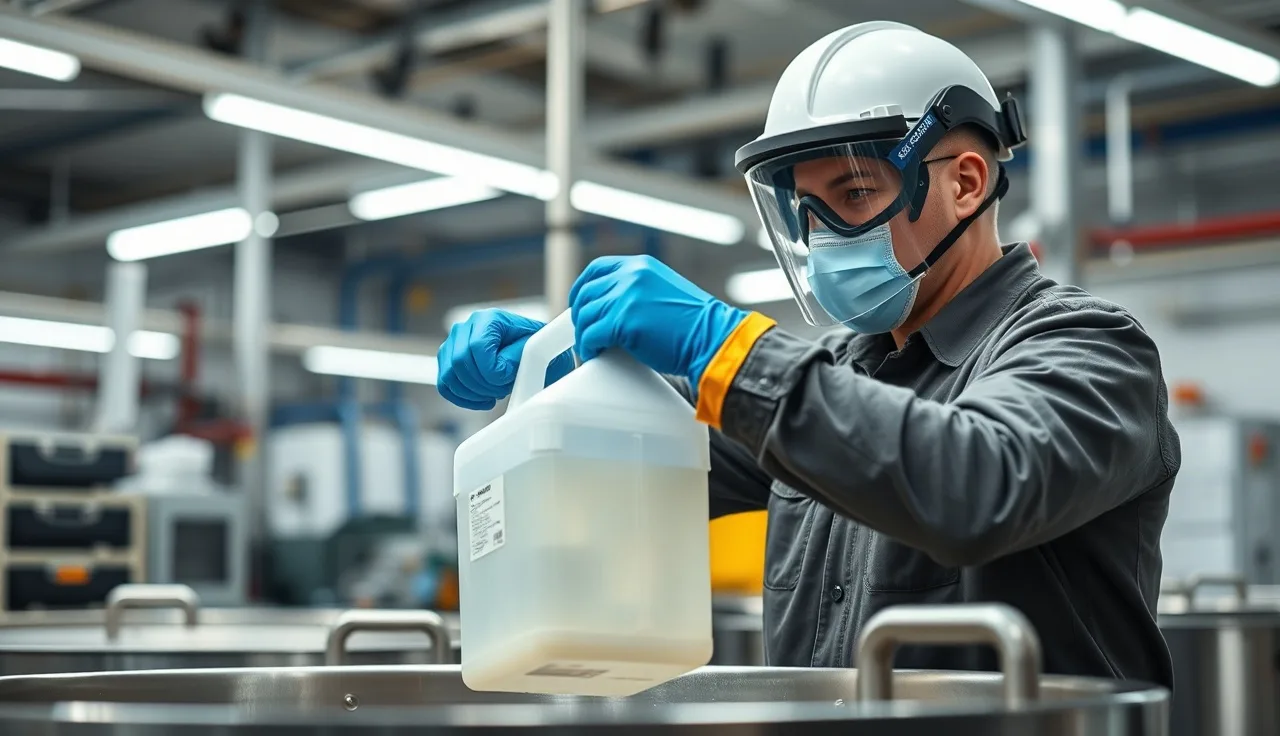
Sodium hydroxide (NaOH) is a strong corrosive alkali that can blind an eye or burn skin to the third degree in seconds. OSHA requires a 16-section GHS Safety Data Sheet under 29 CFR 1910.1200. The PEL is 2 mg/m³, and it's a ceiling, meaning never exceed it. Anyone handling NaOH needs splash goggles, a face shield, nitrile or neoprene gloves, and an eyewash within 10 seconds.
What is sodium hydroxide and why does its SDS matter?
Sodium hydroxide, formula NaOH, is one of the most heavily used industrial chemicals on earth. It's in drain cleaners, pretzel lye, pulp and paper mills, textile plants, water treatment, and soap making. It goes by a few names: lye, caustic soda, and sometimes it gets mixed up with soda ash. Soda ash is actually sodium carbonate, a different and much milder chemical, so read the label before you trust the nickname.
What makes the SDS matter so much here is the speed. NaOH starts saponifying (dissolving) skin tissue the instant it touches you. A splash of dilute NaOH in the eye can cost you vision in minutes if nobody flushes it. That timeline drives how you design the whole work area, more than what paperwork sits in a binder.
Under OSHA's Hazard Communication Standard, 29 CFR 1910.1200, any employer with NaOH on site must keep the current SDS accessible to workers during every shift [1]. That's a hard rule, not a suggestion.
What does the 16-section GHS safety data sheet for NaOH include?
OSHA adopted the Globally Harmonized System (GHS) in 2012 and locked every SDS into the same 16 sections in the same order. Before that, the MSDS format had no fixed structure, so the same chemical from two suppliers could read like two different documents. GHS ended that. When someone asks for the "OSHA material safety data sheet" or "OSHA safety data sheet" for NaOH, this 16-section document is what they mean [1].
Here is what each section holds for NaOH specifically:
| Section | Title | Key NaOH Information |
|---|---|---|
| 1 | Identification | Product name, supplier, emergency phone (e.g., CHEMTREC 1-800-424-9300) |
| 2 | Hazard Identification | GHS Signal Word: DANGER; Pictograms: Corrosion, Exclamation Mark |
| 3 | Composition / Information on Ingredients | CAS No. 1310-73-2; typically listed as 97-100% NaOH |
| 4 | First Aid Measures | Eyes: flush 15-20 min; Skin: remove clothing, flush 15-20 min |
| 5 | Fire-Fighting Measures | NaOH itself is non-flammable; reacts with metals to produce hydrogen gas |
| 6 | Accidental Release (Spill) | Neutralize with dilute acid or absorb with dry sand; no water flush into drains |
| 7 | Handling and Storage | Keep dry, away from metals and acids; store in closed containers |
| 8 | Exposure Controls / PPE | PEL 2 mg/m³ ceiling; splash goggles, face shield, nitrile gloves |
| 9 | Physical and Chemical Properties | White solid or clear solution; melting point 318°C; pH >13 in solution |
| 10 | Stability and Reactivity | Reacts violently with strong acids, water (exothermic), and aluminum |
| 11 | Toxicological Information | Corrosive to all tissues; no established carcinogenicity |
| 12 | Ecological Information | High pH toxic to aquatic life; neutralize before disposal |
| 13 | Disposal Considerations | Neutralize, then dispose per local regulations |
| 14 | Transport Information | UN 1823 (solid) or UN 1824 (solution); Packing Group II or III |
| 15 | Regulatory Information | OSHA HazCom, CERCLA, SARA Title III reportable quantities |
| 16 | Other Information | SDS revision date; disclaimer |
OSHA enforces sections 1 through 11 plus section 16. Sections 12 through 15 fall under other federal agencies, not OSHA, but suppliers fill them in anyway because DOT and EPA rules cover that ground [1].
What are the OSHA exposure limits for NaOH?
The OSHA Permissible Exposure Limit for sodium hydroxide is 2 mg/m³, and it's a ceiling, which means airborne concentration should never cross that line at any moment, not even for a few minutes averaged out over a shift [2]. The ceiling designation exists because NaOH does damage too fast for a time-weighted number to protect anyone.
NIOSH sets the same ceiling. Its Recommended Exposure Limit for NaOH is also 2 mg/m³ [3]. The ACGIH Threshold Limit Value (TLV-C) is 2 mg/m³ too. All three major U.S. occupational health bodies landed on the same number.
For context, workers start noticing upper respiratory irritation around 2 mg/m³. The NIOSH Immediately Dangerous to Life or Health value is 10 mg/m³ [3]. If monitoring shows air creeping toward IDLH, respiratory protection becomes mandatory and you clear the area.
Most places that use NaOH solutions (drain cleaners, cleaning crews, labs) throw off very little airborne NaOH as long as nobody creates mist or aerosol. The real aerosol risk shows up when you handle solid pellets or beads and when you pour concentrated solution. Local exhaust ventilation is your first defense. Reach for a respirator only after ventilation can't hold the line.
What PPE does OSHA require for handling sodium hydroxide?
Section 8 of the NaOH SDS lists the PPE your supplier recommends. OSHA doesn't spell out exact NaOH gear in its own standard. Instead, 29 CFR 1910.138 tells employers to assess the hazard and pick appropriate protection [4]. For NaOH, that assessment lands on the same kit almost every time.
Eye and face protection comes first. Chemical splash goggles, not safety glasses with side shields, are the floor for any liquid NaOH work. Add a full face shield over the goggles when you transfer bulk quantities or work above eye level. Here's the reasoning: NaOH splashes upward when you pour it, and a face shield on its own leaves gaps at the sides and bottom.
For hands and arms, nitrile gloves at 8 mil or thicker cover incidental contact. For long tasks or concentrated solutions above 30%, switch to neoprene or natural rubber. Thin nitrile gloves have a breakthrough time under 30 minutes against 50% NaOH, so don't cheap out on thickness when the work runs long.
Body protection scales with the job. A chemical-resistant apron (PVC or rubber) for concentrated solutions. A full chemical suit when a large spill is on the table. Rubber boots if the floor might splash.
If ventilation can't keep air below the ceiling PEL, a NIOSH-approved half-face respirator with cartridges rated for acid gases and particulates handles most NaOH work. (It's an alkali, but the cartridge chemistry is the same.) Any respirator use trips 29 CFR 1910.134: a written respiratory protection program, medical evaluations, fit testing, and training [4].
Emergency eyewash and shower: OSHA points to ANSI Z358.1 for placement. The working rule is that the eyewash sits within 10 seconds of the NaOH work, roughly 55 feet [5]. For a chemical that eats eye tissue this fast, 10 seconds is already too long. Plumb it with tepid water (60 to 100°F). Ice-cold water makes people quit flushing early, right when they need to keep going.
What are the first aid procedures listed on the NaOH SDS?
Section 4 of the NaOH SDS holds the first aid steps, and for this chemical those details carry more weight than almost anything else on the sheet.
Eye contact: flush right away with lots of water or saline for at least 15 to 20 minutes, holding the eyelids open. Take contacts out if they come easily and it won't slow the flush. Get the person to a doctor or ER afterward even if they feel fine. Alkali eye burns keep getting worse after the initial hit, because NaOH drives deeper into eye tissue than acids do.
Skin contact: strip off contaminated clothing at once, shoes and socks included if the chemical reached them. Flush the skin with water for at least 15 to 20 minutes. Do not try to neutralize a skin burn with acid, even though the high-school chemistry sounds right. Pouring vinegar on a NaOH burn can set off a heat-releasing reaction that makes the burn deeper.
Inhalation: move the person to fresh air. If breathing is hard, give oxygen if you're trained to. Call 911 for any real inhalation event.
Ingestion: do not induce vomiting. NaOH burns just as badly coming back up as it did going down. Give water or milk to dilute if the person is conscious and not convulsing. Call Poison Control (1-800-222-1222) right away.
Train workers on all of this before they ever crack open a container, not after. 29 CFR 1910.1200(h) requires training before initial assignment to work with hazardous chemicals [1].
How do you handle an NaOH spill safely?
Section 6 of the SDS covers accidental release. For a small spill of solid NaOH (pellets or flakes), put your PPE on first, then contain it with a dry sweep, not water. Water dissolves the pellets fast and makes a slick, high-pH liquid that spreads the hazard instead of stopping it. Sweep it up with a dry shovel into a labeled, chemical-resistant container.
For liquid NaOH, box in the flow with dry sand, dry earth, or vermiculite. Sodium hydroxide is water-reactive in the sense that dissolving it gives off serious heat, so don't dump water on a large dry NaOH spill all at once. Let a dry medium soak it up, then collect it.
Don't flush NaOH down a storm drain. Even dilute NaOH runs a high enough pH to break local wastewater limits, and plenty of municipalities require you to neutralize to a pH between 6 and 9 before drain disposal. Check your local pretreatment standards.
For large spills: evacuate, call your emergency response team, and pull your facility's hazard communication plan. If the spilled NaOH touches aluminum, zinc, or other reactive metals, it can release hydrogen gas, which is a fire and explosion hazard.
After cleanup, neutralize the residual alkalinity with a dilute acid (2 to 5% acetic acid or citric acid), then rinse with water. Test the pH of the rinse water before it goes down any drain.
What is the difference between an old MSDS and the current SDS for NaOH?
The old Material Safety Data Sheet (MSDS) was the U.S. standard before OSHA's 2012 revision to the Hazard Communication Standard [1]. The MSDS had no required section order, no required section count, and no standard hazard language. You could pull one NaOH MSDS with 8 sections, another with 16, and a third that named the same hazard three different ways.
The 2012 update lined U.S. rules up with the UN's Globally Harmonized System and replaced the MSDS with the 16-section SDS. Employers had until June 1, 2016 to update their programs [1]. If you still have an MSDS on file for NaOH instead of an SDS, you're out of compliance right now.
In plain talk, when a worker asks for the "OSHA material safety data sheet" for NaOH, they mean the SDS. People use the terms interchangeably out loud. On paper, the right term is Safety Data Sheet. Same goes for any old supplier file. If you spot a "urea material safety data sheet" from years back, check whether it's been rebuilt into the 16-section GHS format. Every chemical in your inventory follows the same rule.
Revision status matters too. Suppliers have to update the SDS within three months of learning significant new information about a chemical's hazards [1]. Ask your supplier for the current version, especially if it's been a few years since your last order.
Where must the NaOH SDS be kept, and who needs access to it?
OSHA is blunt about this in 29 CFR 1910.1200(g)(8): SDSs must be readily accessible to workers during every shift in their work area [1]. "Readily accessible" means a worker reaches the SDS with no barriers, no asking a supervisor for permission, and no delay. If someone's eyes are burning and they need the first aid section in 30 seconds, a binder locked in the manager's office fails that test.
How you store them is up to you. Paper binders at the workstation are fine. A central computer terminal works if every worker knows how to use it and the system doesn't hide behind a login a temp might not have. Plenty of employers run both: digital for speed, a paper binder as backup for power outages.
Every worker who might get exposed to NaOH needs to know where the SDS lives, not only the safety officer. That means training. Section 1910.1200(h) requires employees to be trained on where and how to reach SDSs [1].
Contractors count too. Bring in a contractor who'll work near your NaOH, and you have to tell them about the hazard and hand over the SDS. The multi-employer worksite provisions of HazCom mean you can't keep this information locked inside your own crew [1].
If your operation runs enough chemicals that tracking every SDS feels like a losing battle, that's exactly the problem a structured program solves. SafetyFolio's safety program generator builds the written HazCom program that ties your SDS management, training records, and chemical inventory into one compliant document in about 15 minutes.
What regulatory requirements apply to NaOH beyond the SDS?
The SDS is the information document. Several other rules control how you actually manage NaOH on site.
SARA Title III (Emergency Planning and Community Right-to-Know Act): sodium hydroxide is a CERCLA hazardous substance with a reportable quantity of 1,000 pounds [6]. Spill 1,000 lb or more and you must report to the National Response Center (1-800-424-8802). Store 10,000 lb or more on site and you owe annual SARA Section 312 Tier II reports to your state and local emergency planning committees [12].
DOT Hazmat: as SDS Section 14 notes, solid NaOH ships as UN 1823 (Hazard Class 8, corrosive solid) and solution ships as UN 1824 (corrosive liquid). If you ship or receive NaOH in quantities that trigger DOT hazmat rules, your people need hazmat employee training under 49 CFR 172.700 [7].
EPA effluent limits: sending NaOH to the drain means meeting local pretreatment standards. Discharging high-pH wastewater without treatment is a Clean Water Act violation.
Process Safety Management (29 CFR 1910.119): NaOH is not on OSHA's PSM list of highly hazardous chemicals, so PSM doesn't apply on its own. But if you run NaOH alongside listed chemicals, your PSM program should still cover corrosive hazards in its process hazard analyses [8].
For small businesses, the most common gap is the written Hazard Communication Program itself. 29 CFR 1910.1200(e) requires any employer with hazardous chemicals to keep one [1]. That document has to lay out your SDS management procedure, your labeling system, and your training approach.
How should you label NaOH containers in the workplace?
GHS labeling under 29 CFR 1910.1200(f) requires every NaOH container in your workplace to carry a compliant label [1]. For containers straight from a supplier, the supplier's label does the job as long as it carries the six required elements: product identifier, signal word, hazard statements, precautionary statements, pictograms, and supplier contact information.
For NaOH, the label must show the signal word DANGER (the stronger of the two GHS signal words), the corrosion pictogram (a hand and a surface being eaten by dripping liquid), and at minimum these hazard statements: "Causes severe skin burns and eye damage" and "May be corrosive to metals."
Move NaOH from the original container into a secondary one (a spray bottle, a smaller bucket) and you own the label on that secondary container. The only exemption is a portable container for immediate use by the same employee who filled it, used within one shift [1]. That exception is narrow. A spray bottle left out for the next shift doesn't qualify.
Workplace labels on secondary containers need at least the product name and the hazard warnings. You don't have to reproduce the full GHS label, but a bottle marked only "lye" with no hazard warning is not compliant.
For color-coded systems like the NFPA 704 diamond, NaOH rates Health 3, Flammability 0, Reactivity 1 (reacts with water). That health rating of 3 reflects serious corrosive potential.
What training do workers need before handling NaOH?
Training for NaOH falls under HazCom Section 1910.1200(h), which requires employee training before initial assignment and whenever a new chemical hazard shows up [1]. The training has to go past "this stuff is dangerous."
OSHA names the required content: the HazCom standard itself, the operations where hazardous chemicals are present, the location and availability of the written program and SDSs, how to detect the presence or release of a hazardous chemical (visual signs, odor), the physical and health hazards involved, and how workers protect themselves through PPE, work practices, and emergency procedures [1].
For NaOH, good training walks through the actual SDS, shows workers the eyewash station and has them operate it with their own hands, demonstrates donning and doffing PPE, and runs the spill response in Section 6. OSHA doesn't require a written test, but documenting the session (date, topics, worker signature) is what saves you in an inspection.
HazCom is one of the most-cited standards year after year. In fiscal year 2023 it was the second most frequently cited OSHA standard across all industries [9]. Inspectors go looking for it.
Supervisors who want a deeper grounding in chemical hazards get more from OSHA 30 training, which covers HazCom and hazardous materials in more depth than the 10-hour course. An OSHA training program built for your industry pays off if your crew handles more than one hazardous chemical.
What are the health hazards of NaOH exposure according to Section 11 of the SDS?
Section 11 (Toxicological Information) of a typical NaOH SDS runs through the exposure routes and health endpoints.
Acute skin contact: NaOH causes severe chemical burns by saponifying fatty tissue and denaturing protein. Burns from concentrated solutions can go full-thickness (third-degree) and may not hurt at first, because the alkali destroys nerve endings along with the tissue. That missing pain is the trap. Workers underestimate a burn that doesn't scream at them.
Acute eye contact: the worst hazard on the sheet. NaOH pushes into the anterior chamber of the eye faster than acids do, because it doesn't precipitate protective proteins the way an acid burn does. Even brief contact with concentrated solution can cause permanent vision loss and corneal clouding.
Acute inhalation: mist or dust above the ceiling PEL irritates and burns the upper respiratory tract, nose, throat, and larynx. Very high exposures can cause pulmonary edema.
Chronic exposure: long-term low-level exposure has been linked to dental enamel erosion and chronic rhinitis in some occupational studies. NaOH is not classified as a carcinogen by IARC, NTP, or ACGIH, and OSHA's Z-Table does not list it as one [2].
Ingestion: severe burns to the mouth, throat, esophagus, and stomach, with possible perforation of the gastrointestinal tract from concentrated solution. Always a medical emergency.
The SDS may also note that NaOH has no known reproductive or developmental toxicity at occupational exposure levels, though the data behind that is thin.
How do you write a hazard communication program that covers NaOH?
A written Hazard Communication Program is required by 29 CFR 1910.1200(e)(1) for any employer with hazardous chemicals, and NaOH qualifies [1]. The program doesn't have to be long. It does have to hit specific elements.
Start with a chemical inventory list. Every hazardous chemical in your workplace, NaOH included, with its common name, location, and SDS reference. This list is the backbone of the whole program.
Next, describe how you manage SDSs: where they live, who updates them when new versions arrive, and how workers reach them. When your supplier sends an updated NaOH SDS with new hazard information, your procedure should say exactly how it gets filed and how affected workers hear about it.
Third, describe your labeling system, secondary containers and all.
Fourth, describe your training program: what you teach, when you teach it (before initial assignment), and how you document it.
For multi-employer worksites, describe how you share hazard information with contractors.
If building this from scratch sounds like a mountain, it isn't. SafetyFolio's program generator walks you through each required element and hands you a document you can set in front of an OSHA inspector without flinching.
Hazard communication is one of the areas where small businesses get cited most, usually not because the NaOH is unsafe but because the written program is missing or the inventory list is stale. Keep yours current. OSHA inspectors check the inventory against what's actually on your shelves.
Frequently asked questions
What is the GHS classification of sodium hydroxide?
Under GHS (adopted by OSHA in 29 CFR 1910.1200), NaOH is Skin Corrosion Category 1A, Eye Damage Category 1, and Corrosive to Metals Category 1. Those classifications trigger the signal word DANGER and the corrosion pictogram. Category 1A skin corrosion means full-thickness skin destruction within one hour of exposure.
What is the OSHA PEL for sodium hydroxide?
OSHA's Permissible Exposure Limit for NaOH is 2 mg/m³ as a ceiling, found in 29 CFR 1910, Table Z-1. A ceiling means no exceedance at any moment, unlike a time-weighted average. NIOSH sets the same 2 mg/m³ ceiling REL, and the IDLH is 10 mg/m³.
Does sodium hydroxide have a flash point or fire risk?
NaOH itself is non-flammable and has no flash point. The fire risk comes from reactivity: NaOH reacts with aluminum, zinc, tin, and other metals to make hydrogen gas, which is flammable and explosive. Keep NaOH away from reactive metals and store it in tightly sealed containers to block moisture, which can start that reaction.
How long should you flush eyes after NaOH exposure?
Most NaOH SDSs call for at least 15 to 20 minutes of continuous flushing with water or saline, eyelids held open. ANSI Z358.1, which OSHA references for eyewash requirements, sets 15 minutes as the minimum for corrosives. After flushing, get the person to an ophthalmologist or ER immediately, even if symptoms seem to fade.
What gloves should you wear when handling NaOH?
For concentrated NaOH (above 30%), neoprene or thick natural rubber gloves are the better call. Nitrile at 8 mil or more works for dilute solutions and short tasks, but breakthrough time for 50% NaOH through thin nitrile can be under 30 minutes. Always check the glove maker's chemical resistance chart for your specific concentration and contact time.
Is sodium hydroxide regulated under SARA Title III?
Yes. NaOH is a CERCLA hazardous substance with a reportable quantity of 1,000 pounds. A spill of 1,000 lb or more requires immediate reporting to the National Response Center at 1-800-424-8802. Facilities storing 10,000 lb or more must file annual Tier II reports with state and local emergency planning committees under SARA Section 312.
What UN number applies to sodium hydroxide for shipping?
Solid NaOH ships as UN 1823 (Sodium hydroxide, solid), Hazard Class 8, Packing Group II. NaOH solutions ship as UN 1824 (Sodium hydroxide solution), Hazard Class 8, Packing Group II or III depending on concentration. Both require corrosive labels under DOT's 49 CFR 172. If you ship hazmat, employees need DOT hazmat training under 49 CFR 172.700.
Can I store NaOH with other chemicals?
No. NaOH has to stay segregated from strong acids (it reacts violently), reactive metals (aluminum, zinc, tin produce hydrogen gas), and moisture-sensitive materials. Store it in a cool, dry, well-ventilated area in tightly sealed, corrosion-resistant containers. Never store it with flammables. Keep it away from water sources that could wet it and set off exothermic dissolution.
What does 'ceiling' mean for an OSHA exposure limit?
A ceiling PEL is a concentration that must never be crossed at any moment during a shift, as opposed to a time-weighted average, which gets averaged over 8 hours. OSHA uses ceiling limits for chemicals that damage tissue too fast for averaging to protect anyone. NaOH's 2 mg/m³ ceiling means even a momentary spike above that level is a violation.
How often does the NaOH SDS need to be updated?
Under 29 CFR 1910.1200(g)(5), manufacturers must update the SDS within three months of learning significant new information about a chemical's hazards or protective measures. As an employer, request the current SDS from your supplier at least once a year and whenever a new shipment arrives. Replace outdated SDSs and record the update date.
What is the difference between NaOH and sodium carbonate (soda ash)?
NaOH (sodium hydroxide) is a strong base with pH above 13 that causes severe corrosive burns. Sodium carbonate (Na2CO3, soda ash) is a mild alkali with pH around 11.6 in solution and causes far milder irritation. They carry different SDSs, different OSHA PELs, and different PPE. Confusing the two is a real labeling hazard, especially in cleaning and food processing.
Do I need a written HazCom program just because I use NaOH?
Yes. 29 CFR 1910.1200(e) requires any employer with hazardous chemicals to keep a written Hazard Communication Program, and NaOH counts as hazardous. The program must include a chemical inventory, SDS management procedures, a labeling system description, and a training plan. HazCom was the second most cited OSHA standard in FY2023.
What should I do if a worker ingests NaOH?
Do not induce vomiting; NaOH burns the esophagus again on the way back up. If the person is conscious and not convulsing, give small amounts of water or milk to dilute. Call Poison Control immediately at 1-800-222-1222. Call 911 for any significant ingestion. Give nothing by mouth if the person is unconscious. Treat it as a medical emergency every time.
Does NaOH require a respirator for routine handling?
Not always. For most tasks with NaOH solutions, good local exhaust ventilation holds airborne levels below the 2 mg/m³ ceiling PEL without a respirator. Respirators come in when engineering controls can't keep levels below the PEL, or during emergency spill response. Any time a respirator is required, 29 CFR 1910.134 kicks in, triggering a written program, medical evaluation, and fit testing.
Sources
- OSHA, 29 CFR 1910.1200 Hazard Communication Standard: Requires 16-section GHS Safety Data Sheets, SDS accessibility during each work shift, employee training before initial assignment, and written HazCom programs for employers with hazardous chemicals
- OSHA, Table Z-1 Air Contaminants, 29 CFR 1910.1000: OSHA PEL for sodium hydroxide is 2 mg/m³ ceiling
- NIOSH, Pocket Guide to Chemical Hazards: Sodium Hydroxide: NIOSH REL for NaOH is 2 mg/m³ ceiling; IDLH is 10 mg/m³
- OSHA, 29 CFR 1910.138 Personal Protective Equipment for General Industry: Requires employers to assess hazards and select appropriate PPE including for corrosive chemical exposures
- OSHA, Medical and First Aid, 29 CFR 1910.151: Requires suitable facilities for quick drenching or flushing of eyes and body where workers may be exposed to corrosive materials; OSHA references ANSI Z358.1 for eyewash placement
- EPA, Comprehensive Environmental Response, Compensation, and Liability Act (CERCLA): Sodium hydroxide is a CERCLA hazardous substance with a reportable quantity of 1,000 pounds requiring National Response Center notification
- DOT Pipeline and Hazardous Materials Safety Administration, 49 CFR 172.700 Hazmat Employee Training: Employees who ship or handle DOT hazmat including UN 1823/1824 (NaOH) require hazmat training
- OSHA, 29 CFR 1910.119 Process Safety Management of Highly Hazardous Chemicals: NaOH is not on the PSM list of highly hazardous chemicals; PSM does not apply to NaOH alone
- OSHA, Top 10 Most Frequently Cited Standards FY2023: Hazard Communication (29 CFR 1910.1200) was the second most frequently cited OSHA standard in fiscal year 2023
- EPA, Emergency Planning and Community Right-to-Know Act (EPCRA) SARA Title III Section 312: Facilities with 10,000 lb or more of NaOH must file annual Tier II reports under SARA Section 312