Last updated 2026-07-09
TL;DR
OSHA's rule for flammable liquid storage is 29 CFR 1910.106. In a small shop you can keep up to 25 gallons of Class I flammable liquids in approved containers outside a cabinet. One approved safety cabinet holds up to 60 gallons. Break these limits and OSHA can cite you up to $16,550 per serious violation in 2024.
Which OSHA standard actually covers flammable storage in a shop?
The rule you need is 29 CFR 1910.106, titled "Flammable liquids." It covers the storage, handling, and use of flammable and combustible liquids in general industry, which takes in auto repair shops, woodworking shops, print shops, machine shops, and most other small business workplaces. [1]
A second standard shows up if your crew sprays. 29 CFR 1910.107 covers spray finishing using flammable and combustible materials. Spray paint or solvent-based coatings mean both standards apply. For most small shops, 1910.106 is the one that matters.
If your state runs an OSHA-approved State Plan, it may publish its own version of these rules. State plans have to be at least as strict as federal OSHA, and the storage limits are almost always identical.
Here's what trips shops up: OSHA's definition of "flammable liquid" is tighter than everyday language. A Class IA liquid has a flash point below 73°F and a boiling point below 100°F. Gasoline, acetone, and most lacquer thinners land here. Class IB runs a flash point below 73°F but a boiling point at or above 100°F. Class IC covers flash points from 73°F up to 100°F. Above that sit Class II and Class IIIA combustible liquids. The storage limits change by class, so knowing exactly what's on your shelf is the first job. [1]
How much flammable liquid can you store without a safety cabinet or storage room?
Outside any cabinet or storage room, 29 CFR 1910.106(d)(4) caps a single fire area at 25 gallons of Class I liquids and 60 gallons of Class II and Class IIIA liquids, all in approved containers. [1]
That 25-gallon number catches people off guard. A 5-gallon can of lacquer thinner, two 5-gallon cans of acetone, a gallon of contact cement, a few spray cans, and you're at the limit before you finish counting.
Containers have to meet 29 CFR 1910.106(d)(2). Safety cans with self-closing lids and flash-arrestor screens are required for quantities over one gallon of Class I or II liquid. A hardware-store plastic jug does not qualify. [1]
The standard also caps individual container size:
| Liquid Class | Metal Container Max | Safety Can Max | Glass Container Max |
|---|---|---|---|
| Class IA | 1 gallon | 2 gallons | 1 pint |
| Class IB | 5 gallons | 5 gallons | 1 quart |
| Class IC | 5 gallons | 5 gallons | 1 gallon |
| Class II | 5 gallons | 5 gallons | 1 gallon |
| Class IIIA | 5 gallons | 5 gallons | 1 gallon |
Source: 29 CFR 1910.106(d)(2), Table H-12 [1]
Glass is allowed for liquids that would react with metal, or when the liquid is being inspected and glass is the only workable option. Otherwise, stick to metal or a listed plastic safety can.
What does a flammable liquid storage cabinet actually need to meet OSHA rules?
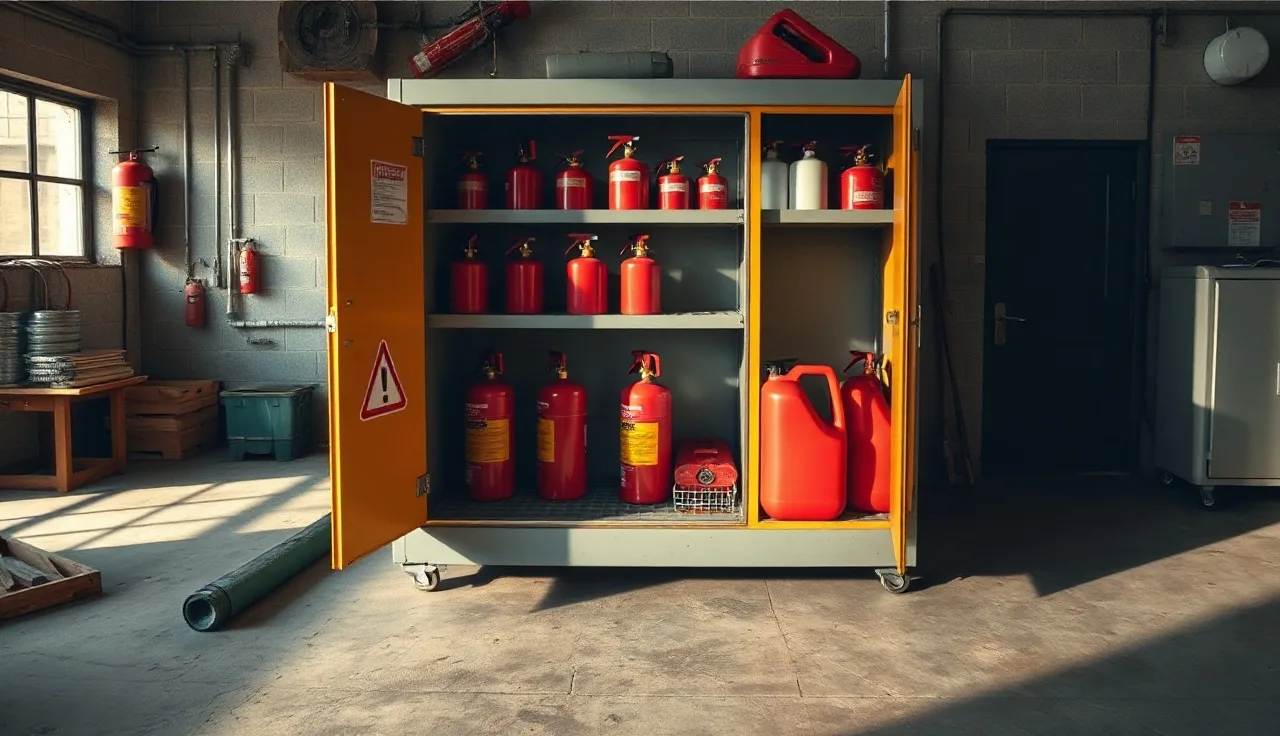
One approved cabinet holds up to 60 gallons of Class I and Class II liquids combined, or up to 120 gallons of Class IIIA combustible liquids. [1] You get no more than three such cabinets per fire area unless the building has an automatic fire suppression system.
29 CFR 1910.106(d)(3)(i) spells out the construction. A metal cabinet must be built of at least 18-gauge steel, double-walled with a 1.5-inch airspace, fitted with a three-point latch, and have a 2-inch raised sill at the bottom to hold a spill. [1] Wood cabinets are allowed if they meet specific thickness rules, but most shops buy a listed metal cabinet because it's simpler.
OSHA does NOT require you to vent a flammable cabinet. This one surprises people. An OSHA letter of interpretation from 1993 explained that venting a cabinet can reduce its fire protection by letting vapors escape and find an ignition source outside the cabinet. If you do vent, the vent has to meet specific requirements. You are not obligated to. [2]
The cabinet has to read "Flammable, Keep Fire Away" in red letters on a contrasting background, at least 1 inch high, under 29 CFR 1910.106(d)(3)(ii). [1]
A listed cabinet from a maker like Eagle, Justrite, or a Grainger-brand equivalent runs roughly $150 to $500 for a 12-to-30 gallon unit and $400 to $900 for a 45-to-60 gallon unit. Prices move with steel costs, so check current supplier pricing. Not cheap, but far cheaper than an OSHA penalty or a fire claim.
Do you need a separate flammable storage room or is a cabinet enough?
For most small shops, a safety cabinet is enough. A dedicated inside storage room only becomes necessary when your quantities pass what cabinets can legally hold in your fire area, or when you're storing drums and bulk containers that won't fit in a cabinet. [1]
Build or designate an inside storage room and 29 CFR 1910.106(d)(4) and (5) load on requirements: fire-resistive construction (typically a 2-hour rating for rooms over 150 gallons, 1-hour for smaller rooms), explosion-proof or nonsparking electrical equipment, mechanical ventilation at 1 cubic foot per minute per square foot of floor area with at least 6 air changes per hour, a raised sill or curb that holds a 10-minute supply of fire suppression water, and a self-closing fire door. [1]
An outside storage building is another route. Plenty of shops find a purpose-built flammable shed easier to run than an inside room. OSHA allows detached outside structures, and the key rule is that the building sits at least 10 feet from any other building, property line, or public way. [1]
For a shop storing under 60 gallons of combined Class I and II liquids, one or two quality cabinets cover it. Don't over-engineer this. Buy the right cabinets, label them, keep the contents organized, and get back to work.
What are the grounding and bonding requirements for flammable liquids?
Static electricity is the ignition source shops underrate. Pour flammable liquid from one metal container into another and friction from the flowing liquid builds a static charge. That charge can spark and ignite the vapor sitting around the container's opening.
29 CFR 1910.106(e)(6)(ii) requires containers and tanks to be bonded together (connected by a metal wire) before transfer, with one of them grounded to earth, whenever the liquid's flash point is below 100°F. [1] In plain terms: clip a grounding wire from the dispensing container to a grounded metal object before you pour.
Bonding wire kits with alligator clips cost $20 to $60 at safety suppliers. Not optional gear.
Shops that pump from drums or larger tanks need the pump, the drum, and the receiving container all in the same bonding circuit. A drum sitting on a plastic pallet is not grounded, even if it's parked next to a metal floor drain.
Filling a vehicle fuel tank or small engine, the NFPA 30 guidance OSHA references says to hold the nozzle against the opening of the receiving tank before flow starts. That contact makes the bond. A plastic fuel tank defeats it, so you need a separate bonding wire. [3]
What ventilation requirements apply to areas where flammable liquids are stored or used?
29 CFR 1910.106(e)(7) says areas where flammable liquids get dispensed need enough ventilation to keep vapor concentrations below 25% of the lower flammable limit (LFL). [1] That's a performance standard. OSHA doesn't hand you a CFM number for your space, but it does tell you the threshold you have to engineer or measure to.
For a small shop, "sufficient ventilation" usually means general dilution ventilation (exhaust fans pulling air out of the workspace at floor level, since most common solvent vapors are heavier than air) plus keeping containers closed when they're not in use. NFPA 30, which OSHA references in the preamble to 1910.106, recommends at least 1 CFM per square foot of floor area for enclosed spaces where flammable liquids are used. [3]
Natural ventilation can meet the standard if you can prove it's adequate. Most small shops can't prove it, so low-mounted mechanical exhaust fans (within 12 inches of the floor) are the practical answer. Spark-proof fan motors are required anywhere concentrations above 25% LFL are possible.
Hot work near stored flammable liquids (welding, grinding, cutting) means either clearing the liquids out or running fire watch procedures under 29 CFR 1910.252. This is one of the most common fire scenarios in small shops. Get the liquids out of the room before the grinder comes on.
What fire protection equipment does OSHA require near flammable storage?
29 CFR 1910.157 covers portable fire extinguishers, and where flammable liquids are present you need Class B units rated for the hazard. [4] For most small shops, a 10-pound dry chemical ABC extinguisher does the job. OSHA requires one within 50 feet of any location where flammable liquids are stored or used in quantities over 5 gallons. [4]
Extinguishers need a monthly visual check and annual maintenance by a qualified person, both with written records. This is a common citation because shops buy the extinguisher, hang it, and forget it for three years.
Sprinkler systems are required in inside storage rooms holding more than 150 gallons of Class I and II liquids combined. Below that, 1910.106 alone doesn't mandate them, though your local fire marshal or building code may set a lower trigger. Check both.
"No smoking" signs have to be posted where flammable liquids are stored or used, under 29 CFR 1910.106(e)(8). [1] Post them. It sounds obvious, and OSHA still cites shops for missing signage.
Spill kits with absorbent rated for flammable liquids (not the water-based stuff) belong near the storage area. OSHA doesn't name a "spill kit" requirement, but spill response ties into hazard communication and emergency action plan rules under 29 CFR 1910.38 and 1910.1200. [11]
How does hazard communication (HazCom) connect to flammable storage?
Every flammable liquid in your shop is a hazardous chemical under OSHA's Hazard Communication Standard, 29 CFR 1910.1200. [5] You need a Safety Data Sheet (SDS) for each product, those SDSs have to be reachable during a worker's shift, and every container has to carry the chemical's identity and the right hazard warnings.
Section 2 of each SDS gives you the GHS hazard classification, including the flash point, which sets whether the liquid is a Class I, II, or III flammable or combustible liquid for storage. That's where you start when a new product shows up.
You also need a written hazard communication program that lists every hazardous chemical in the workplace and describes how you handle labeling and training. That's not optional for any employer with one or more employees working around hazardous chemicals.
Workers have to be trained on the flammable liquids they use: flash points, storage, spill response, and emergency steps. The training has to be documented. A five-minute verbal walkthrough with no record won't hold up in an OSHA inspection. If you want to build that written program fast, a tool like SafetyFolio's safety program generator walks you through the required pieces without eating your week.
For OSHA training that goes deeper on chemical hazards, an OSHA 10 or OSHA 30 course covers HazCom in detail.
What are the most common OSHA citations for flammable storage in small shops?
OSHA inspection reports point to a steady set of repeat violations in small shops. The ones that show up again and again:
1. Blowing past the 25-gallon limit for Class I liquids outside a cabinet. Inventory creeps up and nobody tracks total volume. 2. Improper containers, usually non-listed plastic jugs or open-top cans instead of approved safety cans. 3. No grounding or bonding during transfer. 4. Missing or expired fire extinguisher inspection records. 5. Flammable liquids stored next to ignition sources (electrical panels, open-flame water heaters, welding areas). 6. No SDS on hand, or an SDS binder locked in an office nobody can reach during the shift. 7. Unlabeled containers, especially secondary containers.
Serious violations in 2024 run up to $16,550 each. Willful or repeated violations reach $165,514. [6] Those numbers are adjusted every year for inflation under the Federal Civil Penalties Inflation Adjustment Act. [13]
The expensive citations are rarely the cabinet alone. They're the stack: over-limit storage, bad containers, and no written HazCom program, all in one visit. Three findings at once adds up in a hurry.
OSHA publishes compliance help for small businesses, and many area offices run a free on-site consultation that's walled off from enforcement. The On-Site Consultation Program, run through state agencies, can catch problems before an inspector does. [7]
Does OSHA treat flammable aerosol cans the same as bulk flammable liquids?
Aerosol cans are a gray area, and they cause real confusion. Flammable aerosols count as flammable liquids under GHS and belong in your HazCom program. For storage quantity limits, though, 1910.106 focuses on "liquid" in containers, and aerosol cans in commerce usually get treated differently from bulk containers.
OSHA letters of interpretation say aerosol cans kept in their original retail packaging, in quantities reasonable for the work on hand, aren't subject to the same cabinet requirements as bulk Class I liquids. [2] But "reasonable for the work on hand" is a judgment call. A pallet of 200 spray cans in a small shop will draw attention.
The practical answer: store aerosols in a cool, dry spot away from heat and ignition, keep the quantity to what you'll actually use in a reasonable stretch, and list them in your chemical inventory for HazCom. A locked metal cabinet is still smart for larger quantities, even if 1910.106 doesn't force it.
NFPA 30B, "Code for the Manufacture and Storage of Aerosol Products," has the detailed quantity guidance. Local fire marshals sometimes adopt NFPA 30B limits, so check with your authority having jurisdiction (AHJ).
What records do you need to keep to prove flammable storage compliance?
OSHA doesn't demand a single "flammable storage log," but several connected rules build a paper trail you need:
Fire extinguisher records under 29 CFR 1910.157(e): monthly visual inspections logged (date, initials) and annual maintenance by a qualified person with a written record. Keep these at least one year, or the life of the extinguisher. [4]
HazCom records: your written program, your chemical inventory list, an SDS for each product, and training records showing what was covered, when, and who was there. OSHA can ask for all of it during any inspection.
Container condition: 1910.106(d)(2) implies containers get inspected for leaks and damage. There's no explicit log required, but documenting periodic checks is easy and worth producing if you're questioned.
Incident records: any spill, fire, or near-miss involving flammable liquids gets recorded. Depending on severity, it may need an incident report on your OSHA 300 log.
Keep written records somewhere employees can reach and somewhere that survives a fire (off-site backup or cloud storage). A box of paper in the same room as the storage cabinet isn't the move.
If your written safety program is thin or missing, SafetyFolio's generator builds a defensible one in about 15 minutes, covering flammable storage, HazCom, and emergency action plan requirements in one pass.
How do NFPA 30 and local fire codes relate to OSHA's requirements?
OSHA's 1910.106 was modeled largely on NFPA 30 ("Flammable and Combustible Liquids Code"), but the two aren't identical and don't always match. [3] OSHA is a federal worker-safety law enforced by federal or state-plan inspectors. NFPA 30 is a consensus standard that local jurisdictions adopt as part of their fire code.
Day to day, your local fire marshal enforces NFPA 30 (or the IFC, the International Fire Code, which references NFPA 30). OSHA enforces 29 CFR 1910.106. You can be cited by both, and the limits don't line up perfectly.
For most small shops, NFPA 30's limits are close to OSHA's or a bit stricter. The 25-gallon open-storage limit shows up in both. Cabinet capacities are comparable. But NFPA 30 can add sprinkler requirements or lower quantity thresholds depending on your occupancy classification.
The safe move: meet whichever standard is stricter on each point. Read 29 CFR 1910.106, then ask your fire marshal which edition of NFPA 30 or IFC your jurisdiction has adopted. Annual fire inspections are often where a shop first learns it has a storage problem.
Run a spray booth and 29 CFR 1910.94 plus NFPA 33 (spray application) stack on top of everything else, with their own rules for ventilation rates, electrical classification, and waste solvent disposal.
Frequently asked questions
Can I store gasoline in a regular gas can instead of an approved safety can?
For quantities over one gallon of Class I flammable liquid (gasoline is Class IB), OSHA's 29 CFR 1910.106(d)(2) requires an approved safety can with a self-closing lid and flash-arresting screen. A standard hardware-store gas can typically doesn't meet the spec. Type I and Type II safety cans from listed makers like Justrite or Eagle do. Under one gallon, a tightly closed approved container is acceptable.
How far does a flammable storage cabinet need to be from a heat source or ignition source?
OSHA's 29 CFR 1910.106 sets no numeric distance for cabinet placement, but it prohibits storing flammable liquids near heat or ignition sources. NFPA 30 recommends at least 5 feet from ignition sources. Common shop hazards include water heaters with open pilots, welding areas, electrical panels, and running engines. Distance, physical barriers, or removing the liquid before hot work are all acceptable controls.
How many flammable storage cabinets can I have in one room?
OSHA's 29 CFR 1910.106(d)(3)(i) limits you to three approved cabinets per fire area unless the building has an approved automatic fire suppression system. Each cabinet holds up to 60 gallons of Class I and II liquids combined. So the practical max in an unsprinklered space is 180 gallons across three cabinets, plus up to 25 more gallons in approved containers outside the cabinets.
Do OSHA flammable storage rules apply to a one-person shop?
Yes. The OSHA General Industry standards, including 29 CFR 1910.106, apply to any general industry employer regardless of size. If you have even one employee, you're covered. Self-employed workers with no employees are exempt from OSHA enforcement, but the moment you bring in a helper or a subcontractor treated as an employee, the rules apply.
What's the penalty for an OSHA violation involving flammable liquid storage?
For a serious violation (one that could cause death or serious physical harm), OSHA's maximum penalty in 2024 is $16,550. Willful or repeated violations reach $165,514 per violation. Penalties are adjusted annually for inflation under federal law. OSHA weighs good faith, history, and employer size, so small businesses often get reduced penalties, but the serious base still starts in the thousands.
Are flammable storage rules different for auto repair shops versus woodworking shops?
The same 29 CFR 1910.106 standard applies to both. What differs is the type and class of liquid. Auto shops deal with gasoline (Class IB) and brake cleaner (often Class IB or IC). Woodworking shops use lacquer thinner (Class IA or IB), finishes, and contact cement. Container limits, cabinet requirements, and ventilation rules are identical. What changes is which SDS you're reading and which flash points you're managing.
Does a flammable storage cabinet need to be vented?
No. OSHA doesn't require flammable cabinets to be vented, and a 1993 letter of interpretation states venting can reduce fire protection by letting vapors escape the cabinet and reach an ignition source outside. If you choose to vent, the vent has to meet specific requirements. An unvented, properly built and latched cabinet is fully compliant.
Can I store flammable liquids in a refrigerator in the shop?
Only in a refrigerator or freezer listed for flammable material storage. Ordinary household and commercial refrigerators have internal electrical parts (lights, thermostat contacts) that can spark and ignite vapor from even a small leak or open container. Units labeled "flammable material storage" have vapor-proof interiors with all spark-producing parts moved outside. A regular fridge full of solvents is one of the more dangerous common mistakes in small shops.
What training do employees need if they work with flammable liquids?
Under 29 CFR 1910.1200 (HazCom), employees must be trained on the hazardous properties of the flammable liquids they use, how to read an SDS, what the labels mean, and what to do in a spill or emergency. Training happens before initial exposure and again when new hazards appear. Document it with dates, topics, and signatures. OSHA sets no minimum hours; the test is competency, not time.
How does OSHA's flammable storage standard interact with EPA regulations on hazardous waste?
OSHA covers worker safety around flammable liquids in use and storage. EPA's Resource Conservation and Recovery Act (RCRA) governs disposal of flammable liquid waste, including used solvents and contaminated rags. Used flammable solvents are often hazardous waste under EPA rules and can't go in the trash or down the drain. Many shops use a licensed hauler. Check your state environmental agency; small quantity generator rules may simplify things for shops generating under 100 kg of hazardous waste a month.
What is a 'fire area' and why does it matter for storage limits?
A fire area is a space enclosed by fire-resistive construction (floors, walls, and ceilings with a rated fire resistance). OSHA's 29 CFR 1910.106 applies storage limits per fire area, not per building. If your shop is one open space with no fire-rated walls, the whole shop is a single fire area. Add a fire-rated wall with a self-closing fire door and you create a second fire area, each with its own limits. That matters when you need to store more than one area allows.
Do I need a lockout tagout program if I'm servicing equipment that uses flammable liquids?
Yes, if workers service or maintain equipment where unexpected startup or energy release could injure someone. Flammable liquid systems under pressure (fuel lines, hydraulic systems) are energy sources covered by OSHA's 29 CFR 1910.147. You need a written lockout tagout program and trained, authorized employees before anyone works on those systems. See the full requirements in our guide to lockout tagout.
Can flammable liquids be stored in the same cabinet as other chemicals?
It depends on the other chemicals. Flammable liquids should never sit with oxidizers (which feed fire) or with anything that reacts violently with them. Common shop incompatibilities include storing solvents near bleach, hydrogen peroxide, or pool chemicals. Your SDS Section 7 (handling and storage) and Section 10 (reactivity) tell you what a specific product can't be stored with. When in doubt, separate it.
Sources
- OSHA, 29 CFR 1910.106 Flammable Liquids: Storage limits, container requirements, cabinet construction specifications, ventilation performance standard, and ignition source control requirements for flammable liquids in general industry
- OSHA, Letters of Interpretation (Standard Interpretations index): OSHA 1993 letter of interpretation stating venting a flammable storage cabinet is not required and can reduce fire protection; aerosol cans in original retail packaging in reasonable quantities not subject to bulk cabinet storage limits
- NFPA, NFPA 30 Flammable and Combustible Liquids Code: NFPA 30 recommends at least 1 CFM per square foot of floor area ventilation and 5-foot ignition source separation; OSHA 1910.106 was modeled on NFPA 30
- OSHA, 29 CFR 1910.157 Portable Fire Extinguishers: Class B extinguisher requirement within 50 feet of flammable liquid storage or use areas exceeding 5 gallons; monthly inspection and annual maintenance documentation requirements
- OSHA, 29 CFR 1910.1200 Hazard Communication: All flammable liquids are hazardous chemicals requiring SDS, container labeling, written HazCom program, and employee training
- OSHA, Penalties: Maximum penalty for a serious OSHA violation is $16,550 per violation in 2024; willful or repeated violations up to $165,514
- OSHA, On-Site Consultation Program: OSHA On-Site Consultation Program provides free, confidential safety and health assistance to small and medium-sized businesses, kept separate from enforcement
- OSHA, 29 CFR 1910.107 Spray Finishing Using Flammable and Combustible Materials: Spray finishing operations using flammable materials require compliance with 1910.107 in addition to 1910.106
- OSHA, 29 CFR 1910.252 General Requirements (Welding, Cutting, and Brazing): Hot work near stored flammable liquids requires removal of the liquids or fire watch procedures
- OSHA, 29 CFR 1910.38 Emergency Action Plans: Emergency action plan requirements applicable to workplaces with flammable liquid hazards
- OSHA, 29 CFR 1910.147 Control of Hazardous Energy (Lockout/Tagout): Lockout/tagout required for service and maintenance of equipment with flammable liquid energy sources such as fuel lines and hydraulic systems
- Federal Register, Occupational Safety and Health Administration: OSHA penalty amounts are adjusted annually for inflation under the Federal Civil Penalties Inflation Adjustment Act Improvements Act of 2015