Last updated 2026-07-09
TL;DR
OSHA's permit-required confined space standard (29 CFR 1910.146) requires a written program the moment your workplace has any permit space and someone enters it. The program must cover hazard identification, entry procedures, atmospheric testing, rescue arrangements, and training. Confined space incidents kill roughly 100 U.S. workers a year. Get the written program right and everything else follows.
What exactly is a permit-required confined space, and do you need a written program?
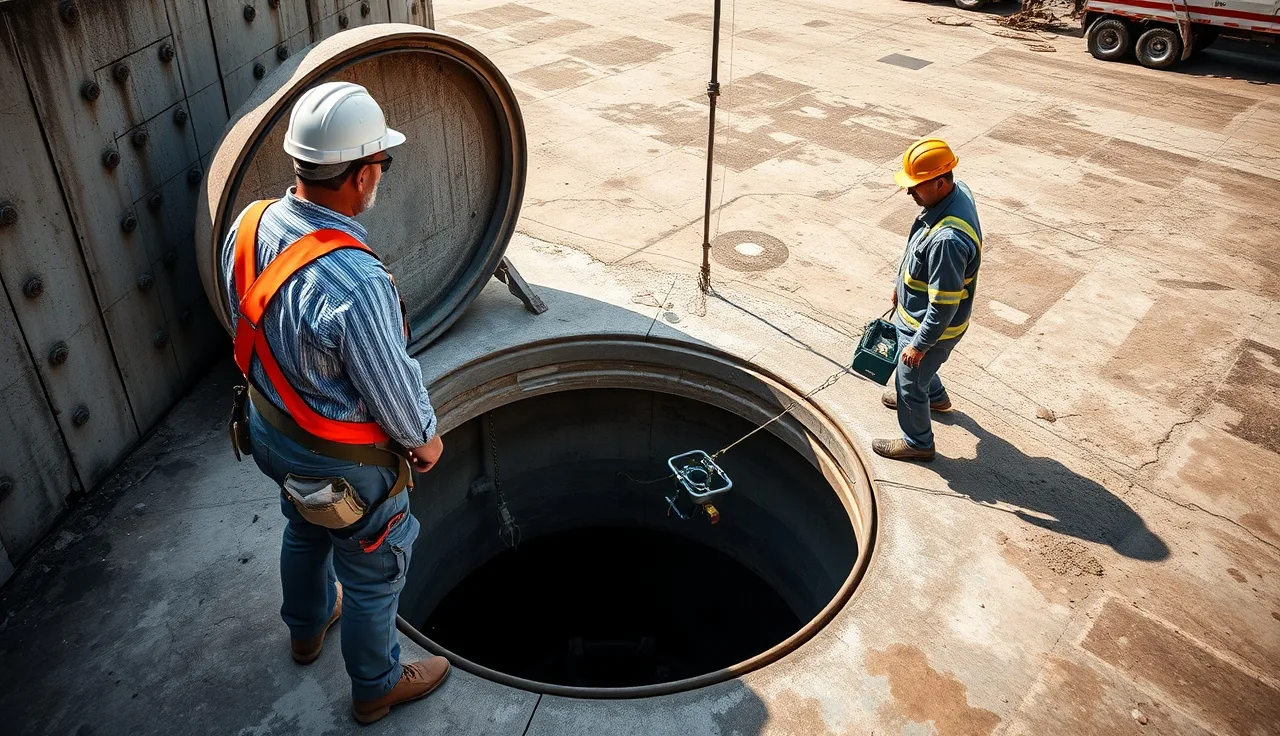
A confined space has three features: it's big enough for a worker to get inside and do work, it has limited or restricted ways in and out, and it wasn't built for people to occupy continuously. A manhole, storage tank, reactor vessel, or underground vault fits that description. So does a large pipe or a pit.
A confined space becomes permit-required (a "permit space") when it also has at least one of four conditions: it contains or could contain a serious atmospheric hazard (oxygen deficiency, flammable gas, toxic contaminant), it contains material that could engulf an entrant, it has an internal shape that could trap or asphyxiate a person, or it holds any other recognized serious safety or health hazard [1].
If you have permit spaces at your facility, 29 CFR 1910.146(c)(4) requires a written permit space program. No exemption for small employers. The standard says you must "develop and implement a written permit space program" before any employee enters [1]. A posted "Do Not Enter" sign only works if no employee ever needs to go in and you can document that fact.
The standard also gives you a way out. If you can eliminate every hazard in a space (often through forced-air ventilation when the only problem is atmospheric), you can reclassify it as a non-permit space. That reclassification has to be in writing and kept on file. Skip the paperwork and the space is still permit-required in OSHA's eyes.
What are the required elements of a permit-required confined space program?
29 CFR 1910.146(c)(4) spells out the elements your written program has to address. The regulation is specific enough that leaving out a section isn't a gray area. Here's what the standard actually demands:
Hazard identification and space inventory. You must identify all permit spaces at your workplace. Most programs use a site map or list showing each space, its location, the hazards present (atmospheric, engulfment, entrapment, other), and its classification.
Entry conditions and acceptable entry conditions. You need to define what makes it safe to enter, including atmospheric ranges: 19.5% to 23.5% oxygen, less than 10% of the lower explosive limit (LEL) for flammable gases, and contaminant levels below applicable permissible exposure limits (PELs) [1].
Atmospheric testing procedures. The standard requires testing the internal atmosphere before entry and monitoring continuously during entry wherever atmospheric hazards exist [1]. Your program spells out who tests, what equipment they use, the order of tests (oxygen first, then flammable gases, then toxic contaminants), and what to do when readings run out of range.
Permit system. You must use a written permit for each entry. The permit isn't busywork. It's the record that proves conditions were verified safe, the right people were assigned, and emergency procedures were ready.
Roles: authorized entrants, attendants, entry supervisors. You must name or define each role, its duties, and the number of people required. An attendant stays outside and keeps communication with entrants at all times during entry [1].
Equipment list. The program covers testing and monitoring gear, ventilation equipment, communication equipment, personal protective equipment (PPE), lighting, barriers, and rescue equipment.
Rescue and emergency services. This is the section that trips up the most programs. You either run an in-house rescue team with the equipment and training, or you arrange outside rescue (fire department, contracted service). The standard requires you to inform outside rescuers of the hazards they may face and to give them access to practice rescue from the actual or representative spaces [1].
Contractor coordination. Hire outside contractors to enter permit spaces and 29 CFR 1910.146(c)(8) requires you to tell them about the spaces, the hazards, and any precautions you've taken. You and the contractor coordinate the work and debrief afterward [1].
Annual program review. After each entry operation, or at least once a year, you review the program. A near-miss or a failed rescue attempt triggers an immediate review.
That's the skeleton. The rest of your program is just filling in how your specific workplace meets each requirement.
How do you write the confined space inventory section?
Start by walking your facility with someone who knows every corner of the building or site. Look for manholes, pits, vaults, tanks, silos, vessels, hoppers, tunnels, crawl spaces under raised flooring, boiler spaces, and ductwork big enough to climb into.
For each space you find, document:
- Location (building, room, address, GPS coordinates for large outdoor sites)
- Dimensions (enough to work out the entry and exit path)
- Normal contents or process function
- Known or potential atmospheric hazards and their source
- Engulfment potential (free-flowing grain, liquid, etc.)
- Configuration hazards (sloped floors, baffles, internal machinery)
- Other hazards (electrical, mechanical, thermal)
- Classification: non-permit confined space, permit-required, or reclassified non-permit
A simple table does the job. Give each space a number or code so your permits, training records, and incident reports all point to the same space.
Don't assume you already know every space. OSHA citations regularly hit employers who missed a space workers were entering. If a task requires someone to climb inside to finish it, walk over and look at it with fresh eyes.
What goes on the actual entry permit form?
The entry permit is a one- or two-page document created for each individual entry. 29 CFR 1910.146(f) lists exactly what the permit must contain [1]. A permit missing any of these elements is a violation:
| Permit element | Notes |
|---|---|
| Space identified | Use your space inventory ID |
| Purpose of entry | What work will be done |
| Date and authorized duration | Expired permits must be canceled |
| Authorized entrants | Names or means to track them |
| Attendants | Names |
| Entry supervisor | Name and signature |
| Hazards of the space | Listed specifically |
| Measures to isolate hazards | Lockout/tagout completed, blanked lines, etc. |
| Acceptable entry conditions | O2 %, LEL %, specific contaminant levels |
| Results of initial and periodic tests | With tester's initials and time |
| Rescue and emergency services | How to summon them |
| Communication procedures | How entrant and attendant will stay in contact |
| Equipment required and available | Testing gear, PPE, rescue equipment, lighting |
| Any other information needed | Relevant permits (hot work, lockout, etc.) |
| Any additional permits | Cross-referenced |
Once entry is done or the permit is canceled, keep it at least one year so OSHA can review the last twelve months of entries [1]. If something went wrong during an entry, hold that permit indefinitely, or at least until any investigation closes.
One practical tip. Don't build a permit form so complicated that supervisors race through it. A form with clean blanks, a checklist for atmospheric readings, and a signature block for the entry supervisor gets filled out accurately. If your form runs four pages, people start pencil-whipping it.
You can also tie this procedure to your lockout tagout program, since energy isolation is almost always a precondition for safe entry.
What atmospheric testing requirements does your program need to cover?
Atmospheric testing is the single step that prevents the most deaths. Most permit space fatalities involve oxygen deficiency or toxic gas, often in spaces that looked perfectly fine from the outside [2].
Your written program has to specify:
The order of tests. Oxygen first, then flammable gases or vapors, then toxic contaminants. The reason is instrument accuracy. Many gas detectors use electrochemical sensors that read wrong in low-oxygen air. Test for carbon monoxide before you confirm the oxygen level and you may get a number that lies to you.
Acceptable entry conditions. The standard sets the floor. Oxygen: 19.5% to 23.5%. Flammable gases: below 10% LEL before entry (setting your internal threshold lower is fine). Toxic contaminants: at or below the relevant PEL under 29 CFR 1910 Subpart Z, or the ACGIH TLV if it's more protective [1].
Testing before and during entry. Pre-entry testing happens from outside the space, or with forced-air ventilation already running, using a probe or sample hose. Continuous monitoring during entry is required wherever atmospheric hazards exist [1]. If a monitor alarms, the attendant orders everyone out immediately.
Calibration and maintenance of instruments. Your program needs a line about calibration. At a minimum, bump-test multi-gas monitors daily before use and follow the manufacturer's schedule for full calibrations. An uncalibrated or out-of-service monitor is a citation waiting to happen.
Ventilation strategy. Ventilation doesn't create an acceptable condition in every case. For some hazards, hydrogen sulfide in a sewer entry for example, the answer is continuous forced-air ventilation paired with continuous monitoring. Your program should say when ventilation is required and what flow rates or equipment each identified space needs.
How do you define the roles of authorized entrant, attendant, and entry supervisor?
These aren't interchangeable job titles. Each role carries specific duties under 29 CFR 1910.146(h), (i), and (j) [1]. Your written program defines what each person does, more than what they're called.
Authorized entrant. The person who goes inside. They have to know the space's hazards, the symptoms of exposure, how to use their equipment, how to communicate regularly with the attendant, and when to get out (on order, on an alarm, on a symptom, or on any changed condition).
Attendant. Stays outside the whole time. Watches conditions inside and outside. Keeps an accurate count of entrants. Maintains communication. Recognizes conditions that call for evacuation and orders it without hesitating. Does NOT enter the space to attempt rescue unless the attendant is also trained and equipped as a rescuer, and even then only after another attendant takes over the post.
That last point is where workers die. An attendant sees a coworker collapse and climbs in to help. No monitoring, no backup, no equipment. OSHA fatality investigations show this pattern over and over [2]. Your program must say it plainly: the attendant does not enter the space for any reason without trained replacement coverage.
Entry supervisor. Verifies every condition on the permit is met before authorizing entry. Ends entry when conditions turn. Can also be the authorized entrant when both roles are staffed at once (it's not prohibited), but in practice that's usually a bad idea.
Your program should also cover who can hold more than one role, how roles pass hands during long entries at shift change, and how the entry supervisor documents the entry.
What training is required, and how do you document it?
29 CFR 1910.146(g) requires training before employees work in permit spaces, and again before new duties call for new skills [1]. Training has to build proficiency, more than awareness. There's no OSHA-mandated minimum number of hours, but the standard does require that employees have the "understanding, knowledge, and skills necessary for the safe performance of the duties assigned."
For each role, your written program should name what the training covers:
Authorized entrants: Hazards of the specific spaces they'll enter, the mode of exposure, signs and symptoms of exposure, consequences of exposure, how to use monitoring equipment, PPE, communication gear, and when and how to get out.
Attendants: All of the above, plus the behavioral effects of hazard exposure, keeping an accurate count of entrants, how to summon rescue, non-entry rescue techniques, and when to call emergency services.
Entry supervisors: All of the above, plus permit procedures, equipment inspection, and program review.
Retrain whenever there's reason to think an employee's proficiency has slipped, after a program change, or after a near-miss.
Documentation should show the date of training, the content covered, the trainee's name and signature, and the trainer's credentials. Keep these records as long as the employee holds the role. OSHA inspectors will ask for them.
For the bigger picture on building out safety training, the OSHA training framework is a good place to start, and an OSHA 30 course covers confined space awareness at a supervisory level.
How do you set up a rescue plan that actually works?
The rescue section is where programs fall apart. "Call 911" is not a rescue plan. By the time emergency crews arrive and locate the space, an incapacitated worker in an oxygen-deficient atmosphere has minutes, and not many of them.
Your program must lay out one of two approaches:
Non-entry retrieval system. The standard prefers this for most situations. A retrieval line attaches to the entrant, and a mechanical advantage system (a tripod and winch) sits at the entry point so the attendant can pull a victim out without going in. If the internal shape of the space allows retrieval without added injury risk, you have to use it [1]. Wristlets instead of a chest harness are acceptable when a chest harness is impractical or would create a greater hazard.
Entry rescue. When non-entry retrieval won't work (because of the space's internal shape or the nature of the hazard), you need a trained entry rescue team, in-house or outside. Either way, you must:
- Verify the rescue service has the equipment for the space
- Confirm they're trained to use that equipment
- Give them the chance to practice rescue from the actual space or a representative mockup
- Inform them of the hazards they'll face
- Provide access to any permit space from which rescue may be needed [1]
If you're counting on the local fire department, call them. Ask straight out whether they have confined space rescue capability and whether they've drilled in your type of space. Some departments have it. Plenty of small municipal departments don't own the equipment or hold the training. If yours can't do it, you need a contracted service or an in-house team. Find that out before an emergency, not during one.
For any entry deeper than roughly five feet, or any space with confirmed atmospheric hazards, self-contained breathing apparatus (SCBA) for rescuers is almost certainly required. Your program should state the respiratory protection requirements for rescue operations.
How do you handle confined space entries by outside contractors?
Hire a contractor whose workers will enter permit spaces at your facility and 29 CFR 1910.146(c)(8) creates duties on both sides [1].
As the host employer, you must:
- Tell the contractor about the permit spaces and their locations
- Explain the hazards of each permit space the contractor may work in
- Share any precautions or procedures you've put in place (lockout, ventilation, etc.)
- Coordinate so their entry operations don't create hazards for your workers, and yours don't create hazards for theirs
- Debrief with the contractor after entry about any hazards faced or created
The contractor must:
- Get all the information above from you
- Confirm their workers are trained and equipped for the hazards
- Run a permit system at least as protective as yours
- Coordinate with you
- Report any hazard they find that wasn't in your assessment
In practice, that means a pre-entry meeting, documented in writing, before any contractor sets foot in a permit space. A one-page contractor coordination form works fine. It records what you told them, confirms they acknowledged the hazards, and lists who attended the briefing.
Don't assume the contractor has a compliant program of their own. Ask for a copy. If they can't produce one, that's a red flag before a single person enters a space.
How often do you have to review and update the program?
29 CFR 1910.146(d)(14) requires you to review the entry program at least once a year, using the canceled permits from the previous twelve months [1]. The point is to figure out whether the program is holding up or needs revision.
Annual review is the floor, not the ceiling. Review again after:
- Any incident, near-miss, or unplanned evacuation from a permit space
- Any fatality or serious injury in or around a confined space
- A failed rescue attempt
- A change in the nature of the work done in a space
- A physical change to a space (new equipment inside, changed process, new material)
- A staffing change that affects the availability of trained personnel
- Any OSHA inspection finding that touches confined space operations
Keep the canceled permits from the previous twelve months in a file. When the annual review comes around, pull them and look for patterns. Did any entries come close to the action levels? Did any permits get canceled mid-entry? Were there deviations from the procedures? Were all atmospheric readings recorded accurately?
Document the review itself with a date and a signature. Inspectors ask for the last annual review record, and "we do it every year" with nothing to show for it isn't a good enough answer.
If your operations change in a big way, ask whether any space you previously classified as non-permit now has new hazards that push it into permit space territory.
What does OSHA actually cite employers for under 1910.146?
29 CFR 1910.146 is one of OSHA's most frequently cited standards. On OSHA's top-10 citation lists, permit-required confined spaces shows up consistently among the top general industry violations [3].
The most common violations, based on OSHA's published enforcement data and letters of interpretation:
- No written program at all (the most basic gap)
- Failure to identify permit spaces (the inventory step got skipped)
- Permit forms missing required elements or left blank in critical fields
- No atmospheric testing, or testing done after entry instead of before
- Attendants who leave their post or who enter the space
- No rescue arrangements documented or in place
- Weak or missing training records
- Failure to coordinate with contractors
OSHA classifies violations as serious (penalty up to $16,550 per violation as of 2024) or willful/repeat (up to $165,514 per violation) [4]. A fatality in a permit space with no written program will almost certainly draw a willful citation.
The human cost is the real number. BLS Census of Fatal Occupational Injuries data puts confined space incidents at roughly 100 worker deaths a year in the U.S., and NIOSH investigations tie a large share of them to a missing basic: no attendant, no permit, or no working retrieval system [2][7]. NIOSH found that would-be rescuers made up a striking share of the dead, people who entered without equipment after watching a coworker go down [7].
For more on how OSHA citations work and how to answer them, the OSHA basics overview is a good starting point.
How long does it take to write a permit-required confined space program, and what are your options?
Writing from scratch, with a few confined spaces and straightforward hazards, takes most safety-competent operations managers four to eight hours if they know the standard. That covers the space inventory, the permit form, the roles, and the rescue plan.
Many permit spaces, complicated atmospheric hazards (solvents, hydrogen sulfide, low oxygen from biological processes), or reliance on contractors for entry pushes it closer to two full days before you have something defensible.
Your options:
Write it yourself using the standard as a template. 29 CFR 1910.146 is well-organized and readable. Go paragraph by paragraph, address each provision, and you'll cover the required elements. The 1910.146 appendices (A through F) are free guidance OSHA published alongside the standard, and they're genuinely useful [1].
Use a template or generator. A template gets you to a working draft faster. The trick is customizing it to your actual spaces, your actual hazard data, and your actual rescue arrangements. A template that still reads "[Company Name]" in five places hasn't been adapted. SafetyFolio's program generator walks you through the required elements for your operation in about 15 minutes and produces a program you can edit and own.
Hire a safety consultant. Worth it for complex facilities, multiple process chemicals, or confined spaces with unusual geometry. Expect $1,500 to $5,000 for a standalone confined space program, depending on scope. That's reasonable money when your spaces are complicated and your liability exposure is high.
Whatever route you pick, the program has to be specific to your facility. Generic boilerplate that doesn't name your actual spaces, your actual atmospheric hazards, or your actual rescue service isn't compliant and won't protect your workers.
Do construction employers need a different program than general industry?
Yes. Construction has its own standard: 29 CFR 1926.1200 through 1213, which OSHA finalized in 2015 [5]. The construction confined space rule is newer and in some ways more detailed than the general industry version, especially around multi-employer coordination on a job site.
The core ideas match: identify permit spaces, write a program, use permits, train workers, have rescue ready. The differences matter:
- Construction names a "controlling contractor" to coordinate all employers working in or near permit spaces on a site, with specific information-sharing duties.
- The construction standard has more detailed requirements for continuous atmospheric monitoring and the monitoring equipment involved.
- Initial entry assessment procedures differ slightly.
If your business does construction work, build your program under 1926 Subpart AA, not 1910.146. If you're a general contractor and subcontractors will enter permit spaces, your coordination and documentation duties as controlling contractor are heavy.
The general industry standard at 1910.146 covers workplaces like manufacturing plants, water treatment facilities, utilities, and warehouses. When you're not sure which standard applies to a given job, OSHA's letters of interpretation can sort it out based on the nature of the work [8].
Frequently asked questions
What's the difference between a confined space and a permit-required confined space?
A confined space is any space large enough to enter, with limited entry and exit, and not designed for continuous occupancy. A permit-required confined space adds at least one serious hazard: atmospheric danger, engulfment potential, internal entrapment geometry, or another recognized serious safety or health hazard. Under 29 CFR 1910.146, only permit-required spaces trigger the written program, permit system, and training requirements.
Does OSHA require a written permit-required confined space program for small businesses?
Yes. 29 CFR 1910.146 has no small-employer exemption. If your workplace has permit-required confined spaces and employees enter them, you need a written program, a permit system, trained personnel, and documented rescue arrangements, no matter your company size. OSHA inspects small employers and issues serious citations for missing programs.
Can you reclassify a permit-required confined space as a non-permit space?
Yes, under 29 CFR 1910.146(c)(7). If you can eliminate all atmospheric hazards through continuous forced-air ventilation and the space has no other permit-space hazards, you can reclassify it as a non-permit confined space. You must document the basis in writing and post a document at the space stating it has been reclassified. If conditions change, the permit-required classification comes back.
How many people are required for a confined space entry?
At a minimum, two: one authorized entrant inside and one attendant who stays outside the whole time. Entry supervisors can also be authorized entrants in some situations. For complex spaces or multiple entrants, you may need more people. Your written program must set the minimum staffing for each type of entry at your facility, based on the hazards present.
What atmospheric levels make it safe to enter a confined space?
Under 29 CFR 1910.146, acceptable entry conditions are oxygen between 19.5% and 23.5%, flammable gas or vapor below 10% of the lower explosive limit (LEL), and toxic contaminants at or below applicable PELs. Test in order: oxygen first, then flammable gases, then toxic contaminants. Your program should state these numbers and what to do when a reading falls outside the acceptable range.
What rescue equipment is required for confined space entries?
For any entry that could require rescue, 29 CFR 1910.146(k) requires retrieval systems unless the equipment would increase the overall risk. A retrieval line attached to the entrant, a chest or body harness, and a mechanical means of retrieval (a tripod and winch) meet this for most spaces. Rescue personnel also need appropriate respiratory protection and PPE for the specific hazards in that space.
Can the local fire department serve as your confined space rescue team?
Possibly, but verify it before you rely on them. Call your local fire department and ask specifically about confined space rescue capability. Many smaller municipal departments lack the training and equipment for permit-space rescue. If they're capable, document the arrangement, give them access to your spaces for practice, and inform them of the hazards. If they can't do it, you need a contracted service or an in-house team.
How long do you have to keep entry permits after the work is done?
At least one year. 29 CFR 1910.146(e)(6) requires canceled permits to be kept for at least twelve months so OSHA can review entry operations during that period. You also use these permits for your annual program review. If an incident happened during an entry, keep the permit until all associated investigations and legal proceedings close.
What happens if a contractor enters a permit space at your facility without coordination?
Both you and the contractor can be cited. 29 CFR 1910.146(c)(8) puts coordination duties on the host employer and the contractor. As host, you must inform the contractor of permit spaces, hazards, and your precautions. The contractor must share information about their program. If an incident occurs with no documented coordination, both parties face potential serious or willful OSHA violations.
Do the confined space rules apply to utilities like water and wastewater facilities?
Yes. Water treatment plants, wastewater facilities, and utilities with underground vaults, wet wells, digesters, and pump stations are among the most common general industry employers with permit-required confined spaces. They operate under 29 CFR 1910.146. These spaces often have oxygen deficiency from biological activity and toxic gas from decomposition, so program compliance carries real weight in that sector.
How is the confined space program different from the lockout tagout program?
They're separate required written programs, but they intersect constantly. Confined space entry almost always requires energy isolation (lockout/tagout) as a pre-entry condition before the permit is authorized. Your confined space permit should reference and cross-link to your lockout/tagout procedures. Workers assigned to permit space entries usually need training in both. Learn more about building a lockout tagout program at lockout tagout.
What's the most common reason workers die in confined spaces?
Atmospheric hazards, mainly oxygen deficiency and toxic gas (hydrogen sulfide, carbon monoxide), account for most confined space deaths. A large share of victims are would-be rescuers who entered without equipment after seeing a coworker collapse. That's why the attendant's role, staying outside and summoning equipped rescue instead of going in, is one of the most safety-critical elements of any program.
Sources
- OSHA, 29 CFR 1910.146 Permit-Required Confined Spaces (full regulatory text including appendices): Requirements for written program, permit elements, acceptable entry conditions, roles, atmospheric testing, rescue, and contractor coordination
- BLS, Census of Fatal Occupational Injuries: Approximately 100 confined space fatalities occur in the U.S. per year
- OSHA, Top 10 Most Frequently Cited Standards: 29 CFR 1910.146 permit-required confined spaces appears consistently among the top general industry citations
- OSHA, OSHA Penalties (civil penalty maximums for serious and willful violations, adjusted for inflation): Serious violations up to $16,550 per violation; willful/repeat violations up to $165,514 per violation as of 2024
- OSHA, 29 CFR 1926 Subpart AA Confined Spaces in Construction: Separate OSHA standard covering confined spaces in construction, finalized 2015
- OSHA, Confined Spaces (general industry compliance overview and guidance): OSHA guidance on permit space program requirements and employer obligations
- NIOSH, Confined Spaces (fatality prevention guidance and Fatality Assessment and Control Evaluation reports): Pattern of would-be rescuers dying after entering spaces without equipment cited in fatality investigations
- OSHA, Letters of Interpretation: 1910.146 Permit-Required Confined Spaces: OSHA interpretations on confined space classification, reclassification, and contractor coordination requirements
- ACGIH, Threshold Limit Values (TLVs) for Chemical Substances and Physical Agents: ACGIH TLVs referenced as more protective alternatives to OSHA PELs for atmospheric testing thresholds