Last updated 2026-07-09
TL;DR
Under 29 CFR 1926 Subpart AA, every construction employer whose crew enters permit-required confined spaces must have a written program, trained personnel, and a permit system before anyone goes in. There is no small-business exemption. The rule covers spaces large enough to enter, with limited egress, not designed for continuous occupancy.
What does OSHA actually require for confined spaces in construction?
A written program, a permit system, trained workers, a rescue plan, and atmospheric testing. All of it before anyone goes in.
OSHA's construction confined space standard, 29 CFR 1926 Subpart AA, took effect August 3, 2015. It is separate from the general industry standard at 29 CFR 1910.146 [10]. That separation matters. If your workers are on a construction site, Subpart AA governs, even if you're a three-person crew with one truck.
The standard defines a confined space as any space that (1) is large enough for an employee to enter and do work, (2) has limited or restricted means of entry or exit, and (3) is not designed for continuous employee occupancy [8]. Manholes, utility vaults, tanks, deep excavations, crawl spaces inside a structure under construction. All of these can qualify depending on how they're configured.
A permit-required confined space (PRCS) adds at least one more thing: it contains or could contain a serious atmospheric hazard, holds a material that could engulf an entrant, has an internal shape that could trap or asphyxiate a person, or contains any other recognized serious hazard [8]. Most spaces your crew enters on a construction site clear that bar.
Don't know whether a space is permit-required? OSHA's position is blunt. Treat it as one until you've assessed it and written down why it isn't. That write-up is part of your program.
Does the confined space rule apply to small construction companies?
Yes. OSHA does not size-exempt this standard. A company with two employees who enter a manhole has the same obligations as a company with two hundred.
The SBA calls a construction firm "small" at 500 employees or fewer, but OSHA's confined space rules aren't keyed to headcount. They're keyed to the hazard. If you have a PRCS on site, you comply or you're citable [3]. OSHA's own Small Entity Compliance Guide (Publication 3825) confirms there is no size-based exemption for construction employers with any PRCS entry obligation [7].
One narrow exception is worth knowing. If your company does not and will not enter confined spaces on a project, you don't need a program for that project. But if you're a general contractor with subs going into those spaces, you carry coordination duties under 1926.1203(h) [2]. You share hazard information with those subs and confirm their program is adequate. A GC can't hand off the paperwork and walk away.
Small contractors often figure they'll handle confined space entry the informal way, like a lot of other things on a busy site. That's where citations happen. The Bureau of Labor Statistics tracks confined space fatalities through its Census of Fatal Occupational Injuries, and roughly 100 to 150 workers die in these incidents each year across all industries, many after entering with no atmospheric testing and no attendant [4]. The informal approach kills people.
What must a written confined space program for construction include?
Not a form you download and sign. Your program has to spell out how your company will identify, classify, and control confined space entry. Here's what 29 CFR 1926.1203 and 1926.1204 require it to cover.
Space identification and classification. Before work starts at a site, you survey it for confined spaces [2]. The results go in writing. Every space gets classified as non-permit, permit-required, or not a confined space at all, and the reasoning gets documented.
Entry conditions. The program describes what makes entry acceptable: atmospheric hazards within safe limits, energy sources controlled, engulfment hazards eliminated or isolated, and any site-specific hazards addressed.
Permit system. For every PRCS entry, you issue an entry permit [2]. It lists the space, the date and authorized duration, the hazards, the control methods, the atmospheric test results, the names of all authorized entrants, the attendant, and the entry supervisor. The permit stays at the entry point during the operation and is kept for at least one year after cancellation [2].
Atmospheric testing sequence. Non-negotiable, and the order matters. Oxygen first, flammable gases and vapors second, toxic air contaminants third [2]. OSHA's acceptable conditions: oxygen between 19.5% and 23.5%, flammable gas below 10% of the lower explosive limit (LEL), toxic contaminants below their applicable PELs [2].
Roles and responsibilities. Define the entry supervisor (authorizes and cancels permits), the authorized entrant (goes in), and the attendant (stays outside and monitors). The attendant never enters to attempt a rescue unless a retrieval system is in use and rescue services are already on the way.
Rescue and emergency services. This is where small companies cut corners, and it's expensive when they do. You either designate an on-site rescue team trained in non-entry rescue or arrange off-site rescue services, and you evaluate that service before you rely on it [2]. "We'll call 911" is not a rescue plan.
Review and cancellation procedures. If a reading spikes, the attendant loses communication, or the weather turns the space dangerous, the permit is canceled and everyone exits. Your program says this out loud, and your crew knows it.
Your program also has to be available to all affected employees, in a language and at a literacy level they understand. That's a rule, not a suggestion, under 1926.1203(e) [2].
What training do construction workers need for confined space entry?
Training is role-specific under Subpart AA, and it happens before workers perform their assigned duties in or around a confined space [2].
Authorized entrants learn to recognize hazardous atmospheric conditions, use their assigned equipment, follow the attendant's instructions, and exit on their own without waiting for an order.
Attendants learn to track the number of entrants, spot the behavioral signs of hazard exposure, keep communication open with entrants, call for rescue, and never enter to attempt a rescue themselves.
Entry supervisors learn all of that plus how to verify permits, cancel entry when conditions change, and coordinate with rescue services.
How long is the training? OSHA doesn't set hours. The requirement is that training produces the knowledge and skills the role demands [2]. In practice, a half-day classroom session with hands-on equipment time works for most small crews, but you document the specific topics covered and each worker's demonstrated competency.
Retraining kicks in when there's reason to believe a worker doesn't understand their duties, or when the program, operations, or hazards change [2]. Someone on your crew runs a gas generator inside a vault? That's a retraining trigger, and a serious one.
If you want a structured path for supervisors, an OSHA 30 training course covers the regulatory framework at a level that helps supervisors see where confined space rules fit in the broader picture. It isn't a substitute for confined space-specific training.
Training records document the employee's name, the trainer's signature or initials, and the date [2]. Keep them for the length of the worker's employment.
What equipment is required for construction confined space entry?
Equipment calibrated, maintained, and matched to the actual hazards present. The standard names no brands, but it requires everything to be fit for the job [2].
Atmospheric testing: a four-gas monitor reading oxygen, LEL, carbon monoxide, and hydrogen sulfide covers the common hazards. Calibrate it on the manufacturer's schedule and keep the log. A monitor that wasn't bump-tested that morning is a liability on the job and in court.
Ventilation: mechanical forced-air ventilation is often required to hold acceptable atmospheric conditions. Natural ventilation is acceptable only where an engineering analysis confirms it's enough. On construction sites, it usually isn't.
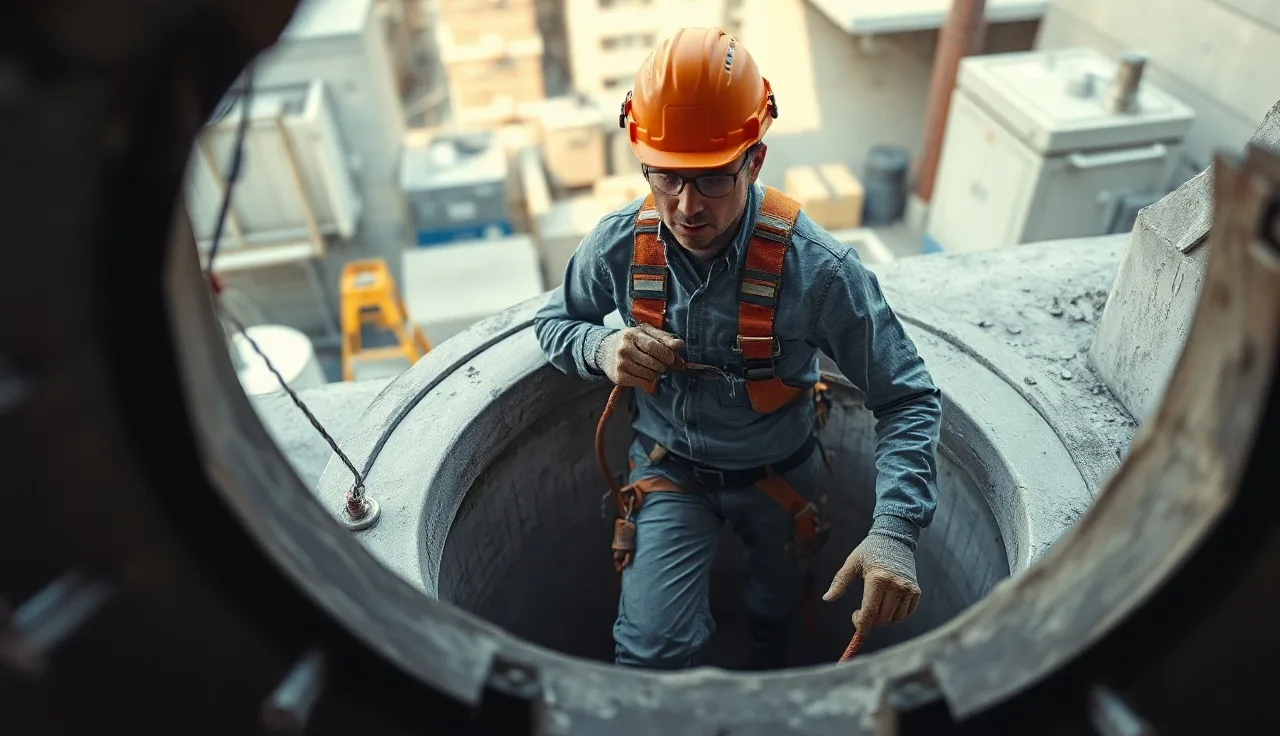
Retrieval systems: OSHA requires one unless it would increase the risk of entry or rescue [2]. A full-body harness clipped to a mechanical retrieval device (a tripod and winch, or a davit arm) at the entry point is the standard setup for vertical entries like manholes. Keep the retrieval line taut so an incapacitated entrant can be pulled out without a rescuer going in after them.
Communication: the attendant keeps constant two-way communication with entrants. For short entries in small spaces with visual contact, voice can do it. For deeper or longer entries, a radio or hardwired system is safer and easier to defend.
Respiratory protection: depending on the atmosphere, supplied-air respirators or self-contained breathing apparatus (SCBA) may be required. Entrants cannot rely on air-purifying respirators in IDLH (immediately dangerous to life or health) atmospheres [5]. Confined space prep also tends to involve lockout tagout on any energy source feeding the space; that's a separate program that runs right alongside entry.
| Equipment | Minimum Requirement | Notes |
|---|---|---|
| 4-gas monitor | Required before every entry | Calibrate per manufacturer; bump test daily |
| Retrieval system | Required unless it increases hazard | Tripod/winch for vertical entries |
| Forced-air ventilation | Often required | Document when natural ventilation is sufficient |
| Communication device | Required | Visual contact acceptable only in simple spaces |
| Respiratory protection | Depends on atmosphere | SCBA or supplied-air for IDLH conditions |
| Full-body harness | Required when retrieval system is used | Must meet ANSI Z359 standards |
How do permits work on a construction site, especially when the space changes?
This trips up small contractors more than anything else, because construction confined spaces don't hold still. A manhole you entered Monday with a clean atmosphere might read dangerous Wednesday after a neighboring crew ran welding operations nearby.
Each entry gets a new permit. No blanket permit covers the whole project. The permit is tied to one space, one date, one set of conditions, and specific workers [2].
The entry supervisor reviews conditions before signing. Different entrants, a new hazard, a new date, anything changes on that permit and you write a fresh one. If conditions change during entry, the permit is canceled on the spot and the crew comes out.
Permit duration runs to the shift or the length of the task, whichever ends first. A permit isn't a season pass.
When an entry operation wraps up, keep the canceled permit. OSHA requires one-year retention [2]. If there was an incident or near-miss during that entry, pair the canceled permit with your incident report to work out what went wrong. Those records feed your program review.
On multi-employer sites, the controlling contractor (the GC or prime) coordinates entry operations between employers [2]. If you're a sub working a space alongside another sub, you need their program, their personnel, and their hazard information, and that coordination gets written down.
Running several projects at once? The SafetyFolio program generator builds a base confined space program you customize per project, which beats starting from a blank page every time.
What are the rescue requirements, and can a small company realistically meet them?
Rescue is the hardest part of this standard for small companies to get right. Before entry begins, you need a rescue plan that actually works [2]. You have two real options.
On-site rescue means trained personnel are at the job site who can perform retrieval and, if needed, entry rescue. These rescuers are trained in rescue equipment, CPR, and first aid, and they practice retrieval operations using mannequins or actual people at least once every 12 months [12]. For most small crews, that's a stretch. Possible, but it takes real commitment and standing capacity.
Non-entry retrieval, pulling an incapacitated entrant out through the retrieval system without a rescuer going in, is the preferred method and is required wherever it's feasible [12]. This is why the harness and winch setup carries so much weight. It's your primary rescue method, not an accessory.
Off-site rescue is more realistic for most small companies. You find a local fire department or emergency rescue service with confined space rescue capability, confirm that capability in writing before work begins, and tell them what hazards they might face [2]. OSHA requires you to evaluate the service. Can they respond fast enough given the hazard? For an IDLH atmosphere, a 20-minute fire department response is not an adequate plan. For a non-IDLH space with a retrieval system in place, it might be.
Get the response time in writing. Call the department before the project starts, not when someone is down in a vault. And document that call.
What are the OSHA penalties for confined space violations in construction?
Serious money, and confined space citations tend to land in the serious and willful categories because the hazard is well-documented and the standard is explicit.
As of 2024, OSHA's maximum penalties are $16,550 per serious violation and $165,514 per willful or repeated violation [3]. Both numbers adjust for inflation every year. One site inspection that finds a missing permit system, no atmospheric testing records, and an untrained attendant can stack up several serious citations fast.
Inspectors know exactly what to ask for. After a confined space incident, they want your written program, your permits, your training records, and your atmospheric test logs. If those don't exist or come up short, you're looking at willful citations, which carry higher penalties and draw harder scrutiny from your insurer.
Complaints open inspections too. A worker who's been sent into an un-permitted space and feels unsafe can call OSHA's confidential complaint line, and that call triggers an inspection. For a small company, a single serious citation plus legal fees runs well into five figures.
Before an inspector shows up unannounced, the OSHA basics section walks through how inspections work and what your rights are during one.
How is the construction confined space standard different from the general industry standard?
This distinction matters more than most people realize. If you're a small contractor who also does maintenance work inside a facility, you might be under general industry rules (29 CFR 1910.146) for the facility work and construction rules (29 CFR 1926 Subpart AA) for the site work. Run both under one program without recognizing the differences and you leave gaps.
The key differences:
Scope. 1910.146 covers general industry workplaces. Subpart AA covers construction operations. OSHA has stated that a space used in connection with construction activities falls under Subpart AA even if the same space would otherwise sit under general industry rules [10].
Reclassification. Subpart AA lays out a more detailed process for reclassifying a permit-required space as non-permit, including documentation and the conditions that must hold before and during entry [2].
Multi-employer coordination. Subpart AA writes out explicit duties for controlling contractors to coordinate with subs. 1910.146 says much less on this.
Alternate procedures. Both standards allow simplified entry procedures for low-hazard spaces, but the construction standard's conditions differ.
Work across both construction and general industry settings and you need a program that addresses both, with clear language about which standard applies where.
| Feature | 1910.146 (General Industry) | 1926 Subpart AA (Construction) |
|---|---|---|
| Effective date | 1993 | August 3, 2015 |
| Applies to | Fixed workplaces | Construction sites |
| Multi-employer rules | Limited | Explicit controlling contractor duties |
| Reclassification process | Yes | Yes, more detailed |
| Alternate entry procedures | Yes | Yes, with different conditions |
What records does your confined space program need to keep?
Recordkeeping under Subpart AA is light if you build a system from day one. It turns into a nightmare when you're reconstructing it after an incident or an inspection.
You must retain:
Entry permits for at least one year [2]. Canceled permits, completed permits, and permits canceled for hazardous conditions all go in the file. The one-year rule is a floor, not a ceiling. If a permit ties to an incident, keep it with your incident records indefinitely.
Training records. Employee name, training date, and the trainer's signature or initials. Keep them for the length of employment.
Annual program review documentation. OSHA requires you to review the program annually and update it as needed [2]. Document the review and any resulting changes with a date and the name of the person who did it.
Atmospheric test results. These live on the permit itself, so permit retention covers them. If you run pre-entry surveys or test spaces before formal permits are issued, document those results separately.
Rescue service evaluations. Any written communication with fire departments or rescue services confirming their capability and response time.
Equipment calibration logs. Your gas monitor's manufacturer sets the calibration frequency. Keep the logs. An inspector will ask for them.
A physical binder at the job site works fine. So does a shared drive folder organized by project. A supervisor's memory does not. When you file incident reports after a near-miss or injury, route them through your standard incident report process and cross-reference the relevant permit.
Running several active projects? A centralized digital system beats paper binders. Just keep the records reachable at the job site during active work, not locked in a home office.
How do you write the confined space program if you've never done it before?
Start with an honest site survey, not a template.
Walk every project site before work begins and flag every space that could qualify. Use OSHA's three-part test as your checklist: big enough to enter, limited egress, not designed for continuous occupancy. All three? It's a confined space. Then work through the permit-required factors.
Write down what you find. A simple spreadsheet listing each space, its dimensions, the hazards present, and your classification is the backbone of your program. Update it as the project moves, because construction sites move.
Then write your program to match your operations. A residential contractor dealing with crawl spaces and utility trenches needs a different program than a commercial contractor working underground vaults and mechanical rooms. Generic templates miss site-specific hazards, and OSHA inspectors can tell a program that was lived in from one that was downloaded and never opened again.
The roles section (who's the entry supervisor, who are the authorized entrants, who are the attendants) has to name people, or at least name positions that map to your actual crew. With a four-person crew, you have to think hard about staffing three distinct roles without leaving the rest of the work uncovered.
If writing the program from scratch feels like a 15-hour slog, the SafetyFolio program generator walks you through the required elements and outputs a written program in about 15 minutes. You still customize it for your site and hazards, but it hands you a legally structured starting point that covers the regulatory elements.
Have a competent person (someone with relevant training and the authority to correct hazards) review the draft before you use it. Document that review and any changes.
Are there state-plan states with stricter confined space rules for construction?
Yes. Twenty-nine states and two territories run OSHA-approved state plans covering private sector workers [6]. State plans have to be at least as effective as federal OSHA, and they're allowed to be stricter.
California's Division of Occupational Safety and Health (Cal/OSHA) runs its own confined space standards under Title 8 of the California Code of Regulations. California's rules for excavation-related confined spaces, for one, differ from federal Subpart AA in specific ways. Michigan, Washington, and other state-plan states carry their own regulatory texts you should check against the federal rules.
Operate in a state-plan state and don't assume federal 29 CFR 1926 Subpart AA is your only obligation. Go to your state agency's website and confirm. For contractors who cross state lines, which happens all the time in regional markets, you need to know which rules apply on each side of the border.
OSHA keeps a map of state-plan states at osha.gov [6]. Check it before you assume federal rules are your ceiling.
For OSHA training purposes, workers who complete federally approved training satisfy state plan requirements in most cases, but verify with your specific state agency.
Frequently asked questions
Is there a confined space program template I can use for a construction company?
You can start from a template, but OSHA requires your program to reflect your specific site hazards, crew structure, and rescue arrangements. A form that doesn't name your actual entrants, attendants, and entry supervisor, or doesn't address the specific spaces on your project, won't satisfy an inspector. Customize any template before you use it.
What's the difference between a permit-required and a non-permit confined space?
A non-permit confined space meets the three-part definition (large enough to enter, limited egress, not designed for continuous occupancy) but has no atmospheric hazards, engulfment hazards, internal configuration hazards, or other recognized serious hazards. A permit-required confined space has at least one of those. Most construction confined spaces are permit-required. When in doubt, treat the space as permit-required until you've assessed and documented otherwise.
Can one person serve as both the attendant and the entry supervisor?
Under 29 CFR 1926 Subpart AA, these are distinct roles with distinct duties. The entry supervisor authorizes entry and can cancel permits; the attendant monitors conditions from outside and keeps communication with entrants. One person can hold both designations on a permit if they're physically present and able to perform both functions at once, but the attendant can never enter the space to perform rescue.
How often does the confined space program need to be reviewed and updated?
OSHA requires at least annual review under 29 CFR 1926 Subpart AA. You also review it after any entry where a hazard wasn't anticipated by the permit, and after any rescue operation. Document each review with a date and the reviewer's name. If you change the program, document what changed and why. Treat it as a living document, not a one-time filing.
What atmospheric levels make a confined space safe to enter?
OSHA's acceptable conditions for construction confined space entry: oxygen between 19.5% and 23.5%, flammable gas or vapor below 10% of the lower explosive limit (LEL), and airborne combustible dust below the LFL. Toxic contaminants must be below their permissible exposure limits (PELs). Test in sequence: oxygen first, flammable gases second, toxic contaminants third. These thresholds come from 29 CFR 1926.1203 and Subpart AA Appendix A.
Does my company need a confined space program if we only occasionally enter manholes?
Yes. Frequency of entry creates no exemption. If your workers enter a permit-required confined space even once on a project, you need a written program, a permit for that entry, a trained attendant, atmospheric testing, and a rescue plan. Occasional entry is exactly the scenario where workers skip steps and get hurt.
What are the most common OSHA citations for construction confined spaces?
Common citations: no written confined space program, no atmospheric testing before entry, no entry permit system, untrained personnel in confined space roles, and inadequate rescue provisions. These often cluster as grouped serious citations after an incident inspection. A single inspection can generate five or more citations when the basic program elements are missing.
Can the general contractor's confined space program cover subcontractors on the job site?
No. Under 29 CFR 1926.1203(h), the controlling contractor coordinates entry operations and shares hazard information with subs, but each employer is responsible for their own workers. The GC cannot substitute their program for a sub's program. The GC must confirm the sub's program is adequate before allowing entry, and must stop operations if it isn't.
What training does an attendant need for construction confined space work?
Attendants must be trained to know the hazards of the space, monitor atmospheric conditions and entrant behavior, keep communication with entrants, summon rescue services, and, critically, understand why they must not enter to perform rescue. Training must be documented with the employee's name, the trainer's identifier, and the date. Retraining is required when there's reason to believe the attendant doesn't understand their duties.
Does OSHA's confined space rule apply to excavations?
It depends on the excavation's configuration. Excavations are primarily covered by 29 CFR 1926 Subpart P. But if an excavation also meets the three-part confined space definition and has permit-required hazards (atmospheric hazards, engulfment risk), the confined space standard applies on top of the excavation standard. OSHA has stated both standards can apply at once to the same space.
How do I evaluate whether the local fire department can serve as our confined space rescue service?
Contact the department directly before work begins. Ask specifically whether they have confined space rescue capability, what their average response time is to your job site, and whether they can receive information about the hazards in your space. Get their confirmation in writing or document the conversation. OSHA requires the evaluation before you rely on them, not after an emergency starts.
What records do I need to keep and for how long?
Entry permits: at least one year after cancellation. Training records: the length of the employee's employment. Equipment calibration logs: at least as long as the equipment is in service. Annual program review records: indefinitely. Rescue service evaluation documentation: for the duration of the project. Store all of it where it's accessible at the job site during active work.
Is OSHA 30 training enough to qualify someone as an entry supervisor?
No. OSHA 30 construction covers confined space awareness inside a broader curriculum, but it doesn't substitute for the role-specific training required under 29 CFR 1926 Subpart AA. An entry supervisor needs training on permit review, hazard recognition in the spaces they'll supervise, and the authority to cancel permits. OSHA 30 is useful background, not a standalone qualification for confined space roles.
Sources
- OSHA, 29 CFR 1926.1203 and 1926.1204 (Permit-required confined spaces in construction): Requirements for written program, permit system, atmospheric testing sequence, entry roles, retrieval systems, permit retention of one year, and rescue evaluation before entry begins.
- OSHA, Penalties: OSHA maximum penalties as of 2024: $16,550 per serious violation; $165,514 per willful or repeated violation.
- Bureau of Labor Statistics, Census of Fatal Occupational Injuries (CFOI): Confined space incidents cause roughly 100 to 150 worker fatalities per year across all industries, with a disproportionate share involving workers who entered without atmospheric testing or an attendant.
- OSHA, 29 CFR 1910.134 (Respiratory Protection): Entrants cannot rely on air-purifying respirators in IDLH atmospheres; SCBA or supplied-air respirators are required.
- OSHA, State Plans: Twenty-nine states and two territories have OSHA-approved state plans covering private sector workers; state plans must be at least as effective as federal OSHA but may be stricter.
- OSHA, Confined Spaces in Construction: Small Entity Compliance Guide (Publication 3825): OSHA guidance confirming that construction employers with any PRCS entry obligation must have a written program, trained personnel, and a permit system, with no size-based exemption.
- OSHA, 29 CFR 1926.1201 (Scope and application, Confined Spaces in Construction): Subpart AA applies to all construction work; defines the three-part test for confined space classification and the permit-required hazard factors.
- OSHA, 29 CFR 1910.146 (Permit-required confined spaces, General Industry): General industry confined space standard, separate from construction Subpart AA; applicable to fixed workplaces rather than construction operations.
- NIOSH, Criteria for a Recommended Standard: Working in Confined Spaces: Historical NIOSH guidance supporting the hazard hierarchy and atmospheric testing requirements that underpin both the general industry and construction confined space standards.
- OSHA, 29 CFR 1926.1210 and 1926.1211 (Rescue and emergency services, Confined Spaces in Construction): Rescue services must be evaluated before entry begins; on-site rescue teams must practice retrieval operations at least annually; non-entry retrieval is required wherever feasible.