Last updated 2026-07-10
TL;DR
Any office where employees could contact blood must have a written blood spill cleanup procedure under OSHA's Bloodborne Pathogens standard, 29 CFR 1910.1030. The procedure has to cover PPE, disinfectants, disposal, and exposure documentation. You don't need a consultant. This guide gives you the required elements, the right disinfectant specs, and a section-by-section template you can adapt in an afternoon.
Does OSHA actually require a blood spill cleanup procedure for offices?
Yes. If your employees have any reasonable chance of contacting human blood or other potentially infectious materials (OPIM) at work, OSHA's Bloodborne Pathogens standard applies to you. The standard is 29 CFR 1910.1030, and it reaches far more workplaces than most small business owners assume.[1]
The common misconception is that 1910.1030 only covers healthcare. It doesn't. OSHA includes any employer whose workers could face "occupational exposure" to blood or OPIM. A receptionist who gives first aid. A manager who cleans up after a workplace injury. A janitor in a shared office building. An HR person who handles a medical emergency. Any of them can trigger coverage.
The part of the standard that requires a written procedure is the Exposure Control Plan requirement at 29 CFR 1910.1030(c)(1). That plan has to include your schedule and method of implementation for each requirement, including the decontamination procedures under 1910.1030(d)(4).[1] A blood spill cleanup procedure is exactly that: the written implementation of your decontamination duties.
If nobody at your company ever provides first aid, your risk profile might be low enough that OSHA would see no "reasonably anticipated" occupational exposure. The safer call is to have the procedure anyway. It costs almost nothing to write and protects your people when the unexpected happens.
What are the OSHA definitions you need to know before writing the procedure?
Four definitions from 29 CFR 1910.1030(b) set the scope of everything you write. Get them right first, because they decide what your procedure covers and who it applies to.[1]
"Blood" means human blood, human blood components, and products made from human blood. Animal blood is not covered by this standard, though it may carry other regulatory duties.
"Other potentially infectious materials" (OPIM) includes human body fluids such as saliva in dental procedures, semen, vaginal secretions, cerebrospinal fluid, synovial fluid, pleural fluid, pericardial fluid, peritoneal fluid, and amniotic fluid. It also covers any fluid visibly contaminated with blood, and all body fluids in situations where differentiating between them is difficult or impossible. The practical rule for a small office is short: treat any body fluid spill as infectious unless you have a specific reason not to.
"Occupational exposure" means reasonably anticipated skin, eye, mucous membrane, or parenteral contact with blood or OPIM from the performance of an employee's duties. Those two words, "reasonably anticipated," do one real job. They stop employers from claiming "we never expect injuries here" while still assigning staff to first-aid duty.
"Decontamination" means using physical or chemical means to remove, inactivate, or destroy bloodborne pathogens on a surface or item to the point where they can no longer transmit infectious particles. Your cleanup procedure is, in OSHA's language, a decontamination procedure. Knowing that framing helps you write it correctly.
What PPE do employees need for blood spill cleanup?
The PPE rules come from 29 CFR 1910.1030(d)(3). Your employer has to provide, at no cost to the employee, appropriate PPE such as gloves, gowns, lab coats, face shields or masks, and eye protection.[1] For a small office, you can build the whole thing around four items.
The realistic minimum kit for a blood spill:
- Disposable nitrile gloves (latex works, but nitrile avoids latex allergy problems; at least 4 mil thick)
- Eye protection if there's any splash risk (a face shield beats safety glasses for a liquid spill)
- A disposable apron or gown for a large spill
- A mask if splashing is possible
The standard at 1910.1030(d)(3)(iii) requires that gloves be replaced when contaminated, when they tear or puncture, or when their barrier ability is compromised.[1] Write that into your procedure explicitly.
Double-gloving isn't required, but it's smart for larger spills where gloves might contact sharp debris (broken glass, or a syringe if your office is in a medical setting). I'd list it as a recommended step.
Here's a mistake I see over and over: offices stock a few pairs of gloves in one size and call it done. Stock multiple sizes, keep them in the spill kit, and check the kit at least quarterly. Degraded nitrile is common when a kit sits in a hot storage room for a year.
PPE has to come off before leaving the work area and go into a designated container for storage, washing, decontamination, or disposal.[1] Write that step in. People skip it.
What disinfectant do you need and how strong does it have to be?
A fresh 1:10 dilution of household bleach or an EPA-registered tuberculocidal disinfectant. That's the short answer, and it's the part non-healthcare offices get wrong most often.
OSHA's standard at 29 CFR 1910.1030(d)(4)(ii)(A) requires that contaminated work surfaces be decontaminated with an appropriate disinfectant after completing procedures, immediately or as soon as feasible when a surface is overtly contaminated, and at the end of a work shift if the surface may have become contaminated.[1]
The standard doesn't name a product. It defines "appropriate disinfectant" by category. The two options that make sense for offices:
| Disinfectant | Typical dilution | Contact time | Notes |
|---|---|---|---|
| EPA-registered tuberculocidal disinfectant | Per label | Per label (often 1-10 min) | Recognized category under 1910.1030 |
| Fresh 1:10 household bleach solution | ~1/4 cup bleach per gallon of water | 10 minutes | Low cost, widely accepted |
| Fresh 1:100 bleach solution | ~1 tsp bleach per gallon of water | 10 minutes | For smaller, less concentrated spills per some guidance |
OSHA compliance guidance and CDC both back a fresh 1:10 dilution of sodium hypochlorite (household bleach) for visible blood spills.[2][3] The word that matters is "fresh." Bleach dilutions break down fast in sunlight and heat. Mix a new batch the day you use it. A premixed bleach solution that's been in your kit for six months won't work reliably.
The EPA-registered tuberculocidal route is a real alternative and honestly easier to stock in ready-made form. Quaternary ammonium compounds with tuberculocidal claims and accelerated hydrogen peroxide products both carry EPA registration numbers. Confirm the registration and the tuberculocidal claim on the label. EPA's List B (tuberculocidal disinfectants) is a good place to start.[4]
Contact time is the thing offices ignore. Spray and immediately wipe does nothing. Your procedure has to say the surface stays visibly wet for the full contact time on the label. Write that sentence word for word.
What are the step-by-step elements your written procedure must include?
A complete procedure runs eleven sections. This structure satisfies 29 CFR 1910.1030(d)(4) and gives employees enough detail to do the job safely under stress.[1]
Section 1: Scope State which employees this applies to and what types of spills it covers. Name the locations where spill kits live.
Section 2: PPE selection List PPE for minor spills (small volume, hard surface) and major spills (large volume, or involving sharps or carpet). Minor: gloves, eye protection. Major: gloves, gown or apron, eye protection, mask.
Section 3: Restrict the area Keeping others away until cleanup is done isn't required language, but it prevents secondary exposure. Tell employees to verbally alert coworkers and, for a large spill, drop a wet floor sign.
Section 4: Don PPE before approaching the spill Spell out the sequence: gloves first, gown if needed, then eye protection. Write it out.
Section 5: Remove bulk material Absorbent material (paper towels, disposable pads) goes on the spill first. Work from the outside inward so you don't spread it. Scoop or fold material inward. Never shake or fan it. Everything contaminated goes into a biohazard bag or a sealable plastic bag labeled with the biohazard symbol.
Section 6: Apply disinfectant and allow contact time Apply the approved disinfectant to the cleaned surface. State the product name (or both options), the dilution ratio, and the contact time. The surface stays wet for the full time.
Section 7: Wipe and re-apply if needed Wipe with clean disposable towels. For a visibly bloody spill, a second application is reasonable.
Section 8: Sharps If sharps (needles, broken glass) are involved, never pick them up by hand, even gloved. Use a dustpan and brush, tongs, or forceps. This rule lives at 29 CFR 1910.1030(d)(2)(vii).[1]
Section 9: PPE removal and hand hygiene Remove the gown before the gloves, then peel gloves from the wrist and turn them inside out. Wash hands with soap and water right away. The standard at 29 CFR 1910.1030(d)(2)(iv) requires handwashing facilities, or where that isn't feasible, antiseptic hand cleanser followed by soap and water as soon as possible.[1]
Section 10: Waste disposal Contaminated disposables go into a closeable, leak-proof biohazard bag. The standard at 29 CFR 1910.1030(d)(4)(iii)(A) requires regulated-waste containers to be closeable, prevent leakage, and carry the biohazard symbol or a red color code.[1] Regulated waste means liquid or semi-liquid blood or OPIM, items caked with dried blood capable of releasing it during handling, contaminated sharps, and pathological and microbiological wastes. If the absorbent material is saturated or drips, it's regulated waste and goes to a licensed medical waste hauler. Small amounts of blood on paper towels that don't drip when squeezed can go in regular trash in most states, but check your state rule.
Section 11: Post-cleanup documentation If the spill came from a workplace injury, complete an incident report. If an employee had a potential exposure, start the exposure incident documentation under 29 CFR 1910.1030(f).[1]
What goes in a blood spill kit and where should you keep it?
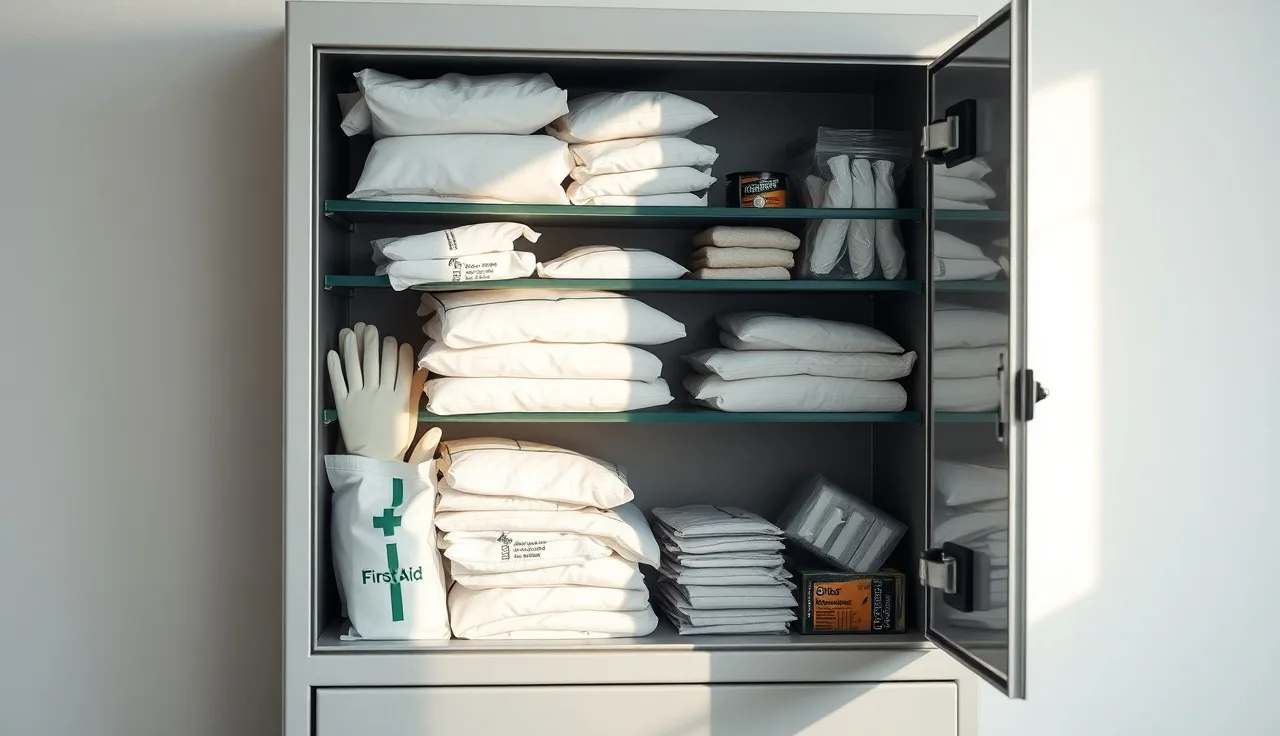
The standard doesn't dictate a kit format, but employees can't follow a procedure without the supplies in reach. Keep a kit wherever first aid gets provided. Most occupational health guidance and state OSHA plans land on that same advice.
A complete small-office blood spill kit holds:
- At least 2 pairs of nitrile gloves in each common size (S, M, L)
- 1 disposable apron or gown
- 1 face shield or safety glasses
- 1 disposable mask
- Absorbent pads or a bag of absorbent powder (sodium polyacrylate products work well)
- Disposable paper towels
- Premixed EPA-registered tuberculocidal disinfectant spray, OR a small bottle of bleach with a mixing instruction card
- 2 to 3 biohazard bags minimum (red or labeled with the biohazard symbol)
- 1 small sealable sharps container if any staff give medications or do finger-sticks
- Tongs or a small scoop for sharps
- Plastic bags for secondary containment
- A laminated copy of the written cleanup procedure
Commercial blood spill kits run roughly $15 to $40 each at safety supply distributors. Building your own from components costs about the same, sometimes a little less. Both work.
Storage matters more than people think. Don't keep bleach-based supplies in direct sunlight or above 75 degrees Fahrenheit if you can avoid it. Heat degrades bleach dilutions and nitrile gloves faster. Check the kit every quarter: inspect glove packaging for tears or degradation, check the mixing date if you premix bleach, confirm the biohazard bags haven't developed holes from being compressed.
A lot of offices keep one kit at the first aid station and a smaller backup near a break room or restroom, where first aid incidents tend to happen.
Do employees need training on the blood spill procedure, and how often?
Yes, and the schedule is fixed. 29 CFR 1910.1030(g)(2) requires training at initial assignment (before a worker starts a job with occupational exposure) and at least annually after that.[1] The training has to cover the standard itself, the Exposure Control Plan, how bloodborne pathogens are transmitted, how to recognize tasks that may involve exposure, the use and limits of PPE, the cleanup and decontamination procedure, and what to do after an exposure incident.
For a small office where cleanup falls to specific people (a facilities coordinator, an office manager), document that those employees got the training. The record has to include dates, the content or a summary, the trainer's qualifications, and the names and job titles of everyone who attended.[1]
Training doesn't have to cost anything. OSHA's free bloodborne pathogens materials are on OSHA.gov, and CDC publishes free reference materials.[2] A qualified internal person can run it. OSHA defines a trainer as someone knowledgeable in the subject matter, which in practice means someone who has read and understands the standard and your written procedure.
Knowing which standards require annual re-training versus initial-only is one of the most common gaps in small-business osha training. Bloodborne pathogens is squarely in the annual-refresher camp, so put it on the calendar.
One honest note: nobody has clean data on how often small offices get cited specifically for missing bloodborne pathogens training. What the record does show, year after year, is that training recordkeeping failures turn up across nearly every OSHA standard.
What if an employee is exposed to blood during or after a spill?
Get them to medical evaluation the same day, and pay for it. An exposure incident, defined at 29 CFR 1910.1030(b), is a specific eye, mouth, other mucous membrane, non-intact skin, or parenteral contact with blood or OPIM from an employee's duties.[1]
When exposure happens, the employer has to make a confidential medical evaluation and follow-up immediately available. At minimum that covers the route of exposure and the circumstances; identification and documentation of the source individual if feasible; collection and testing of the employee's blood; post-exposure prophylaxis when medically indicated; counseling; and evaluation of reported illnesses.[1]
The time-sensitive part is this: for needlestick injuries with potential HIV exposure, post-exposure prophylaxis (PEP) works best when started within 72 hours, with the strongest evidence supporting the first 2 hours.[3] Your exposure procedure needs to send employees to an emergency room or occupational health clinic that same day. Don't bury that fact three paragraphs down.
Document the incident. If a contaminated sharp was involved, OSHA requires a sharps injury log under 29 CFR 1910.1030(h)(5), separate from your OSHA 300 log.[1] The Needlestick Safety and Prevention Act of 2000 is what added that log requirement and the mandate to solicit employee input on safer devices.[10] For a non-sharp exposure, follow your standard incident report process and record what happened, the source if known, and the medical response.
The cost of the evaluation and prophylaxis is on the employer under 29 CFR 1910.1030(f)(3).[1] That's not optional.
How do you format and store the written procedure itself?
Employees have to be able to read it during their shift without asking permission, and OSHA has to be able to see it during an inspection. That's the accessibility rule at 29 CFR 1910.1030(c)(1)(iv).[1] A binder by the first aid kit, a shared drive folder anyone can open, or a laminated copy inside the spill kit all satisfy it.
The plan has to be reviewed and updated at least annually and whenever new tasks, procedures, or positions change occupational exposure.[1] Write the review date right into the document. "Last reviewed: [date], next review due: [date]" at the top makes audit-ready recordkeeping simple.
Plain language beats legal language. Write the procedure in the numbered-steps format an employee would actually follow in a stressful moment. If part of your workforce doesn't read English as a first language, the procedure should be available in their language. The standard doesn't require translation by name, but Section 5(a)(1) of the OSH Act, the General Duty Clause, requires a workplace free from recognized hazards, and a procedure nobody can read doesn't remove the hazard.
If you want the full written bloodborne pathogens program (more than the cleanup procedure, the entire Exposure Control Plan required by 1910.1030(c)), SafetyFolio's safety program generator walks you through the required elements in about 15 minutes and produces a document you can hand OSHA if they knock. A standalone cleanup procedure is one piece of that larger plan.
Keep signed training records with the plan. When OSHA inspects and asks for your bloodborne pathogens program, they'll want the written plan, the training records, and any sharps injury logs together in one review.
What are the OSHA penalties if you don't have a written procedure?
A missing written procedure can cost you up to $16,550 in a single serious citation. OSHA adjusts penalty amounts for inflation under the Federal Civil Penalties Inflation Adjustment Act. As of 2024, the maximum for a serious violation is $16,550 per violation, and the maximum for willful or repeated violations is $165,514 per violation.[5]
Bloodborne pathogens violations are often classified as serious, meaning OSHA found the employer knew or should have known about the hazard and that death or serious harm could result. A missing Exposure Control Plan, missing training records, and a missing documented cleanup procedure can each be cited separately.
Hazard communication is OSHA's perennial most-cited standard, but bloodborne pathogens shows up regularly in the top-cited list for healthcare and service industries.[12] For small general-industry offices, an inspection triggered by a reported exposure incident often turns up bloodborne pathogens deficiencies.
The good news: OSHA gives penalty reductions to small employers. Businesses with 25 or fewer employees can get a reduction of up to 60 percent, and those with 26 to 250 employees up to 40 percent.[5] A good-faith written procedure that isn't perfect beats having nothing at all. OSHA's process weighs whether you made a genuine effort.
Are there state-specific rules that go beyond the federal standard?
Twenty-nine states and two territories run their own OSHA-approved state plans, and those plans have to be at least as effective as federal OSHA but can be stricter.[6] If your office sits in California (Cal/OSHA), Washington (L&I), Michigan (MIOSHA), or any other state plans jurisdiction, check for extra bloodborne pathogen requirements before you finalize anything.
California is the clearest example. Its Bloodborne Pathogens Standard (8 CCR 5193) carries post-exposure procedure requirements more prescriptive than the federal language.[7] New York has its own medical waste rules that change how you handle saturated cleanup materials.
State medical waste rules drive disposal. Most states require regulated medical waste (saturated with blood or OPIM, or containing sharps) to go through a licensed hauler. The details swing hard from state to state: some allow small quantities of non-dripping blood-contaminated material in regular municipal trash, others don't. Check your state health or environmental agency for the exact rule. EPA's medical waste guidance is a starting point, not a substitute for state law.[8]
For biohazard bag disposal, your local hauler may offer small-quantity medical waste pickup, or you can use a mail-back service for low-volume offices. These run roughly $30 to $150 per pickup depending on volume, a fair cost for an office that rarely generates regulated waste.
What does a finished blood spill cleanup procedure actually look like?
Below is a condensed example of the language you'd use. Treat it as an illustration, not a substitute for reading 29 CFR 1910.1030 yourself and adapting it to your workplace.[1]
---
Blood and Body Fluid Spill Cleanup Procedure [Company Name] | Effective Date: [Date] | Review Date: [Date]
Purpose: To protect employees from exposure to bloodborne pathogens during cleanup of blood or other potentially infectious materials, consistent with 29 CFR 1910.1030.
Scope: Applies to all employees designated as responsible for first aid or spill cleanup at [location(s)].
Supplies location: Blood spill kit located at [specific location]. Backup kit located at [location].
Procedure (small spill, no sharps): 1. Alert nearby coworkers to stay clear of the area. 2. Put on nitrile gloves before touching anything. Add face shield and mask if any splash risk exists. 3. Place absorbent material over the spill. Work from outside the spill toward the center. 4. Pick up absorbent material and place directly into a biohazard bag. Seal the bag. 5. Apply EPA-registered tuberculocidal disinfectant (or fresh 1:10 bleach solution) to the cleaned surface. Keep it wet for the full contact time on the label (or 10 minutes for bleach). 6. Wipe dry with clean disposable towels. Place used towels in the biohazard bag. 7. Remove PPE: gown first, then peel gloves inside-out from the wrist. Place in the biohazard bag. 8. Wash hands with soap and water for at least 20 seconds. 9. Seal and label the biohazard bag. Store for pickup by a licensed medical waste hauler or dispose per company regulated waste procedure. 10. If any exposure occurred (contact with eyes, mouth, or a skin break), report immediately to [supervisor name/title] and seek medical evaluation the same day. 11. Complete an incident report for any injury or exposure.
If sharps are involved: Never use hands to pick up sharps, even with gloves. Use the tongs or scoop in the spill kit. Place sharps in the red sharps container. Then follow the steps above for the remaining blood spill.
---
That structure covers the required elements. Customize the disinfectant name, kit location, supervisor contact, and disposal method for your office. If you want to build the Exposure Control Plan this procedure lives inside, SafetyFolio's program generator produces the full document with every required 1910.1030 section included.
Frequently asked questions
Does a small office with no medical staff need a bloodborne pathogens program?
Yes, if any employee could reasonably contact blood or body fluids as part of their duties. That includes designated first-aid responders, custodial staff, and anyone whose job involves responding to injuries. OSHA's 29 CFR 1910.1030 uses the phrase "reasonably anticipated" exposure, which covers most offices that assign first-aid duties to any employee, even informally.
Can I use regular household bleach to clean up a blood spill at work?
Yes. A fresh 1:10 dilution of sodium hypochlorite (household bleach) is an OSHA and CDC-accepted disinfectant for blood spills. Mix it fresh the day you use it: roughly a quarter cup of bleach per gallon of water. The step most offices skip is contact time. The surface has to stay visibly wet for 10 minutes. Premixed solutions sitting in kits for weeks are not reliable.
What PPE is required for cleaning up blood at work?
At minimum, 29 CFR 1910.1030(d)(3) requires the employer to provide gloves, plus eye or face protection when splashing is possible. For a typical office spill, nitrile gloves and eye protection cover most situations. For larger spills, add a disposable gown or apron and a mask. The employer has to provide all of it at no cost to the employee.
How do you dispose of blood-contaminated paper towels after a spill?
If the towels are saturated or drip when compressed, they're regulated waste under 29 CFR 1910.1030 and go into a labeled biohazard bag for disposal through a licensed medical waste hauler. Small amounts on towels that are damp but not dripping may be regular trash in many states, but state rules vary. Check your state health department before assuming regular trash is fine.
What should an employee do if they get blood in their eye or on broken skin during cleanup?
This is an exposure incident under 29 CFR 1910.1030(b). The employee should flush the area with water immediately, then get a medical evaluation the same day. HIV post-exposure prophylaxis works best within 2 hours. The employer has to provide and pay for the evaluation and follow-up. Document the incident, and complete a sharps injury log if a sharp was involved.
How often do you need to retrain employees on blood spill cleanup?
29 CFR 1910.1030(g)(2) requires bloodborne pathogens training at initial assignment and at least annually after that. Records have to document the date, content covered, trainer qualifications, and the names and job titles of all attendees. If you hire a new employee with cleanup duties mid-year, train them before they start those duties, not at the next annual session.
Can one employee be responsible for all blood spill cleanup, or do multiple employees need to be trained?
You can name a primary responder, but OSHA requires training for all employees with occupational exposure. If your designated person is out sick when a spill happens and someone else steps in, that second employee is now occupationally exposed. Practical compliance means training two or three people. It also protects you from the scenario where one untrained person handles it badly.
Do you need a biohazard bag, or will a regular trash bag do for blood spill waste?
For regulated waste (saturated or dripping materials, sharps), 29 CFR 1910.1030(d)(4)(iii)(A) requires a closeable, leak-proof container labeled with the biohazard symbol or color-coded red. A plain black trash bag does not meet that. Biohazard bags are cheap and available at any safety supplier. Keep several in the spill kit so they're there when you need them.
What contact time is required for a disinfectant used on a blood spill?
It depends on the product. For a fresh 1:10 bleach solution, CDC guidance calls for 10 minutes of wet surface contact. For EPA-registered tuberculocidal disinfectants, follow the contact time on the label, which usually runs 1 to 10 minutes depending on the formulation. The surface has to stay visibly wet the whole time. Spray-and-wipe-immediately does not disinfect.
Does the blood spill cleanup procedure need to be a separate document or part of a larger safety program?
Technically it's a required component of your written Exposure Control Plan under 29 CFR 1910.1030(c)(1). Most employers include it as a section within that plan rather than a fully separate file. Either approach satisfies OSHA as long as the procedure is accessible to employees during their shift and available to OSHA during an inspection. Accessibility is the key compliance factor.
What if the blood spill is on carpet instead of a hard surface?
Carpet is harder to fully decontaminate. Your procedure should address it: blot up as much liquid as possible with absorbent material, apply a disinfectant rated for porous surfaces (confirm the EPA-registered product carries a porous surface claim), and hold the dwell time on the label. For large carpet spills, professional cleaning and possibly carpet replacement may be warranted. Document what you did and why in your incident records.
Can an employee refuse to clean up a blood spill?
Under OSHA's whistleblower provisions and Section 11(c) of the OSH Act, an employee can refuse work they reasonably believe poses imminent danger. If someone with no training, no PPE, and no procedure is told to clean a spill, that refusal carries legal weight. That's exactly why the written procedure, stocked PPE, and completed training matter: a trained employee with proper PPE has no legitimate basis to refuse, and you have documentation that you met your obligation.
How much does it cost to set up a blood spill compliance program for a small office?
A realistic budget is $50 to $200 to get fully set up. Commercial spill kits run $15 to $40 each. Biohazard bags in bulk cost $10 to $20. Nitrile gloves in multiple sizes cost $15 to $30 per box of 100. The written procedure and training can be done internally at no direct cost using OSHA's free resources. Annual medical waste disposal for a low-incident office runs $30 to $150 per pickup.
What OSHA standard number covers blood spill cleanup?
Blood spill cleanup in general industry falls under 29 CFR 1910.1030, the Bloodborne Pathogens standard. The decontamination requirements are at 29 CFR 1910.1030(d)(4). The requirement for a written Exposure Control Plan, which houses your cleanup procedure, is at 29 CFR 1910.1030(c)(1). Healthcare settings may also reference 1910.1030 alongside the Healthcare Standard at 29 CFR 1910.502, depending on the facility type.
Sources
- OSHA, Bloodborne Pathogens Standard, 29 CFR 1910.1030: Requires written Exposure Control Plans, decontamination procedures, PPE provision, training, and exposure incident follow-up for workers with occupational exposure to blood or OPIM.
- CDC/NIOSH, Bloodborne Infectious Diseases: HIV/AIDS, Hepatitis B, Hepatitis C: CDC recommends a fresh 1:10 dilution of sodium hypochlorite as an appropriate disinfectant for blood spills.
- CDC, Updated U.S. Public Health Service Guidelines for the Management of Occupational Exposures to HIV and Post-Exposure Prophylaxis: Post-exposure prophylaxis for HIV is most effective when initiated within hours of exposure, ideally within 2 hours and no later than 72 hours.
- EPA, Selected EPA-Registered Disinfectants (including List B tuberculocidal disinfectants): EPA registers tuberculocidal disinfectants; product labels carry the registration number and the disinfection contact time.
- OSHA, Penalties: As of 2024, the maximum penalty for a serious OSHA violation is $16,550 per violation; willful or repeated violations may reach $165,514 per violation. Small employers with 25 or fewer employees may receive up to 60% penalty reduction.
- OSHA, State Plans: 29 states and 2 territories operate OSHA-approved State Plans that may have standards more stringent than federal OSHA.
- California Department of Industrial Relations, Cal/OSHA Bloodborne Pathogens Standard, 8 CCR 5193: California's bloodborne pathogens standard includes specific post-exposure follow-up requirements that are more prescriptive than the federal standard.
- EPA, Medical Waste: The EPA provides guidance on medical waste definition and management; specific disposal requirements are governed by state regulations.
- OSHA, Bloodborne Pathogens and Needlestick Prevention: The Needlestick Safety and Prevention Act of 2000 required OSHA to revise the bloodborne pathogens standard to include sharps injury logs and employee input on safer device selection.
- CDC/NIOSH, Stop Sticks Campaign: Bloodborne Pathogens in Healthcare: NIOSH estimates healthcare workers sustain hundreds of thousands of needlestick and sharps-related injuries annually, a reason to specify safe sharps handling in cleanup procedures.
- OSHA, Commonly Used Statistics / Top 10 Most Frequently Cited Standards: OSHA's annually published list of most-cited standards shows bloodborne pathogens among the top violations in healthcare and service industries.