Last updated 2026-07-11
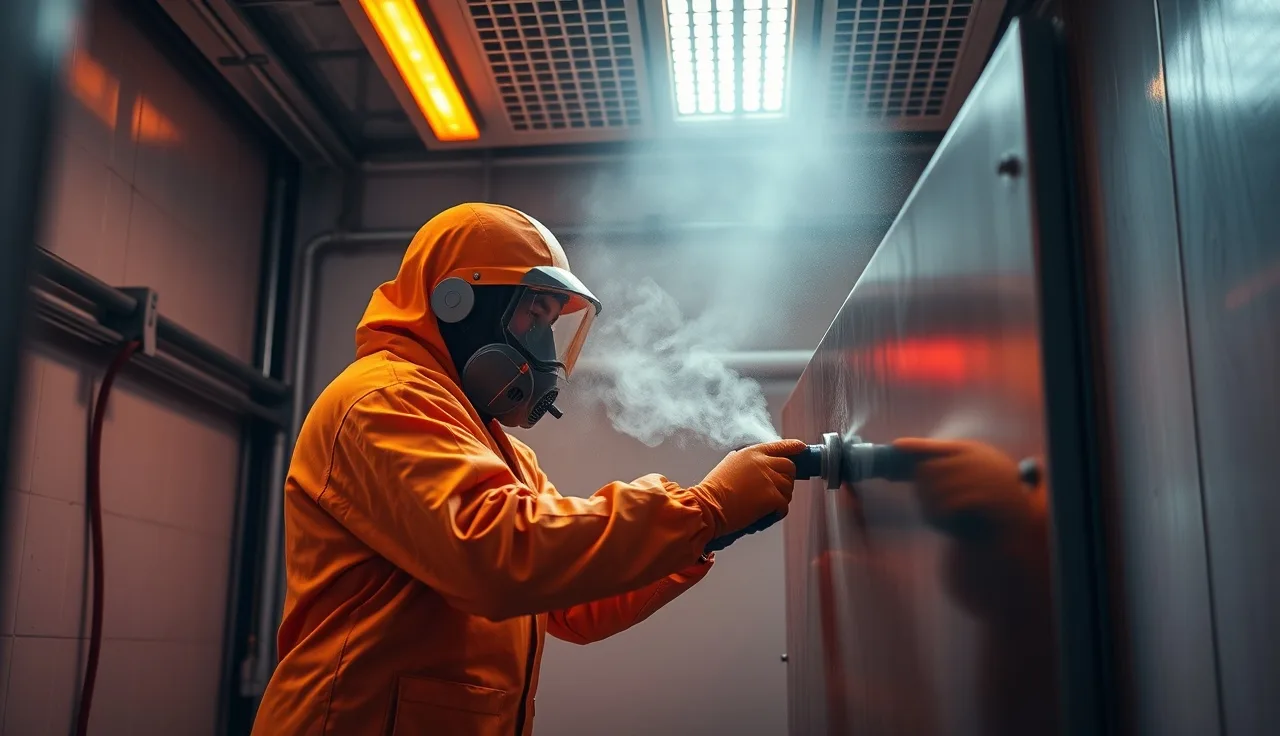
TL;DR
A small spray coating line needs a written safety program covering at least 29 CFR 1910.94 (spray finishing), 1910.1200 (HazCom), and 1910.132 (PPE). Name a responsible person, list your hazards, spell out your controls, document training, and review it every year. Most owners can draft a compliant program in a few hours. No consultant required.
What OSHA standards actually apply to a small spray coating line?
A spray coating line usually falls under at least five separate OSHA standards, not one. Get the list wrong and your program sails through your own review, then fails the inspection. Know which regulations you are writing to before you type a word.
The core standard is 29 CFR 1910.94, "Ventilation," in Subpart G, which governs spray-finishing operations that use flammable and combustible materials. [1] It sets requirements for spray booths, ventilation airflow, clearances, and housekeeping. Spray any flammable liquid or combustible powder and this standard almost certainly applies to you.
Several horizontal standards layer on top, and they apply no matter what your process looks like. 29 CFR 1910.1200, Hazard Communication, requires a written HazCom program, a Safety Data Sheet for every chemical you use, and employee training. [2] We break that piece down in our guide to hazard communication. 29 CFR 1910.132 requires a written PPE hazard assessment and a signed certification. [3] And 29 CFR 1910.134 kicks in the moment you require a worker to wear any respirator, even a filtering facepiece. [4]
Powder coating with electrical ignition risk brings in NFPA 33, the National Fire Protection Association's Standard for Spray Application Using Flammable or Combustible Materials. It is not an OSHA standard. Inspectors cite it anyway, as evidence of recognized industry practice under the General Duty Clause.
One more. If any part of your line gets locked out for maintenance or cleaning, 29 CFR 1910.147 (control of hazardous energy, also called lockout tagout) requires its own written program. [5] A spray booth with an exhaust fan you have to de-energize before cleaning is a textbook lockout scenario.
So a complete program for a spray line typically references five CFR sections. You are not writing one document. You are writing a set of short, job-specific programs that live in one binder.
What sections does a spray coating written program need to include?
OSHA has no single template for a spray coating program, but 1910.94 and the horizontal standards together tell you exactly what has to be in it. The structure below covers what an inspector looks for. Keep every section to one or two pages.
1. Purpose and scope. One paragraph. Names your facility, the specific coating line or lines covered, and the date you wrote it.
2. Responsible person. Name one individual (a job title is fine if you have turnover) who owns the program, runs the annual review, and takes the call during an inspection. OSHA expects a real person, not a department.
3. Applicable standards. List the CFR sections and any NFPA standards your process falls under. Inspectors notice when this is missing. It signals the employer does not know what applies to them.
4. Hazard identification. Describe the actual hazards: flammable vapor buildup, overspray and particulate inhalation, skin and eye contact with coatings, fire and explosion risk, plus any chemical-specific hazards from your SDS library. Write to your real materials, not a generic list.
5. Engineering controls. Spell out your booth: type (water wash, dry filter, or open face), rated airflow in feet per minute, filter replacement schedule, and clearances from combustibles. 1910.94(c)(6) requires airflow through any open face of a spray booth of at least 100 linear feet per minute. [1] Put that number in your program.
6. Administrative controls. Housekeeping schedules, solvent waste container procedures, no-smoking and no-ignition rules inside the hazard area, and limits on how much flammable material you store in the spray area at once.
7. Personal protective equipment. Reference your written PPE hazard assessment (required separately under 1910.132). Specify by task: respirator cartridge type for each coating, glove specification, eye and face protection. Never write "wear appropriate PPE."
8. Respiratory protection. If you require any respirator, attach or reference your full program under 1910.134. That covers medical evaluations, fit testing, and cartridge change-out schedules.
9. Training requirements. Who gets trained, on what, when (before or upon assignment), and how you document it. Keep the records. Most small shops use a simple sign-in sheet with date, topics, trainer name, and each employee's signature.
10. Emergency procedures. What to do in a fire or explosion: evacuation route from the spray area, location of extinguishers (dry chemical or CO2 rated for Class B fires), emergency contacts, and spill response for coating materials.
11. Program review. An annual review date and a signature line. Note any change to materials, equipment, or process since the last version.
That is the skeleton. Inspectors are not impressed by length. They are impressed by specificity.
What does the ventilation requirement actually mean for a small booth?
Ventilation is where small shops get cited most. 29 CFR 1910.94(c)(6) is blunt: airflow through any open face or open front of a spray booth must be at least 100 linear feet per minute during spraying. [1] Your program has to state that number, list your booth's rated capacity, and describe how you check it.
Checking it is cheap. A vane anemometer runs about $50 to $200 and lets a supervisor read the booth face before each shift, or weekly if you spray less often. Record the reading and the date. A log kept near the booth and referenced in your written program is exactly what an inspector wants.
Filters matter too. A loaded filter kills airflow even with the fan at full speed. Your program should set a filter inspection schedule (weekly is common in production shops) and a replacement trigger, such as a pressure-drop gauge reading or a visual standard you define and enforce.
Make-up air is the piece almost everybody overlooks. Exhaust 2,000 cubic feet per minute out of the building and that same volume has to come back in from somewhere. A booth in a tightly sealed shop pulls the building into negative pressure, drags combustion products off nearby gas equipment, and cuts the booth's real airflow. Your program should note how make-up air is provided, whether through a tempered make-up air unit in cold climates or open relief vents.
Don't know your booth's actual airflow? Get a reading before you finalize the program. Writing a number you cannot back up is worse than leaving it blank, because it creates a paper contradiction you will have to explain to an inspector standing at the booth with a meter.
How do you handle respiratory protection for spray coating workers?
Respiratory protection is one of the most cited areas in finishing work. 29 CFR 1910.134 has four written-program pieces that all trigger the moment you require any employee to wear a respirator: the written program, a medical evaluation, fit testing, and training. [4]
For solvent-based coatings, workers need an air-purifying respirator with organic vapor cartridges, usually paired with a P100 filter for the pigment mist. Isocyanate-containing coatings (common in two-part polyurethanes) are a different animal: supplied-air respirators are strongly recommended, because air-purifying cartridges do not give adequate protection against isocyanates, a leading cause of occupational asthma. OSHA's respirator selection logic sits in Appendix A and B of 1910.134. [4]
The medical evaluation trips up small employers over and over. Before an employee wears a tight-fitting respirator on the job, a licensed health care professional has to clear them to wear it. OSHA gives you a ready-made questionnaire (Appendix C to 1910.134) that the employee fills out and sends to a physician or other licensed provider for review. Cost runs roughly $30 to $75 per employee through occupational health clinics, and you only repeat it if their health status changes or they report a problem. [4]
Fit testing for tight-fitting respirators happens before first use and every year after. Qualitative tests (irritant smoke, saccharin) work for half-face air-purifying respirators and cost almost nothing with an in-house kit. Quantitative testing is required for supplied-air devices.
Your spray coating program does not have to contain the whole respiratory program. It does have to reference it by name and confirm it exists as a separate document. No respiratory program means your spray coating program is incomplete.
What chemical and HazCom requirements apply to coating materials?
Every coating, thinner, solvent, and cleaning agent on your line has a Safety Data Sheet. 29 CFR 1910.1200 requires those SDSs to be accessible to employees during every shift, a chemical inventory list to be maintained, and workers to be trained on the hazards before their first assignment. [2]
For your written program, the HazCom piece means three things: list every product on the line by name, confirm an SDS is on file for each, and say where the SDSs live. "In the yellow binder on the south wall of the finishing room" is exactly the level of detail required.
Read the flammability data on each SDS. The flash point sets your storage and handling controls. Liquids with a flash point below 100 degrees Fahrenheit are flammable; those at 100 up to 200 degrees are combustible. Calibrate your spray area controls (ignition source elimination, quantity limits, grounding and bonding) to the worst-case product in your inventory, not the average one.
Grounding and bonding for conductive spray equipment lives in 1910.94(c)(9): all metal parts of spray booths, exhaust ducts, and piping that carries flammable or combustible liquid must be electrically grounded. [1] Your program should say how you verify it, such as a pre-shift continuity check with a ground-continuity tester.
We cover the chemical inventory and SDS management side in detail in our hazard communication article. Our hcl safety data sheet example walks through the 16-section GHS format every one of your SDSs should follow.
What are the fire prevention and housekeeping requirements for a spray area?
1910.94(c)(7) requires spray booths to be kept free of paint residue and requires accumulated deposits to be removed before they become a fire hazard. [1] That one sentence forces you to define, in writing, how often you clean the booth interior and what "a fire hazard" means in your shop.
A reasonable standard most shops use: inspect booth walls and floors after every shift, remove gross buildup daily, and deep-clean interior surfaces weekly or once paint on the walls hits a set thickness (some shops use 1/8 inch; pick a number you will actually enforce).
Flammable waste (used rags, spent filters, scraped residue) goes in covered metal containers and leaves the building, or goes into approved flammable waste storage, at the end of every shift. This is not optional and it is not expensive. A lined steel can with a self-closing lid costs under $50.
Ignition source control is the other half of fire prevention. Your program should define a no-ignition-source zone with a radius around the booth, 20 feet is a common practical standard, where no open flames, no non-explosion-proof electrical equipment, and no grinding are allowed during spraying. Cut the zone off from any general-purpose outlets that are not rated for hazardous locations (see NFPA 70, Article 516 classifications).
Extinguishers: dry chemical (ABC-rated) or CO2 units are right for coating fires. Keep one within 25 feet of the spray area, which is what OSHA requires for Class B hazard areas under 29 CFR 1910.157. [6] State the location and type in your program.
How do you write the training section, and how long does training take?
The training section answers four questions: who must be trained, on what, when (before initial assignment and after any significant change), and how you document it. That is the whole job. It does not need to be elaborate.
For a spray line, the required topics are the hazards of your coating materials (pulled from the SDSs), safe use of the spray equipment, how the ventilation system works and where its limits are, the PPE for each task plus how to put it on and take it off correctly, emergency procedures including evacuation and fire response, and the written program itself (employees should know it exists and where to find it).
OSHA sets no minimum hours for spray finishing training, but 1910.134 does require respiratory training documented by topic. [4] A realistic first session for a new spray-line employee runs two to four hours: classroom review of the written program plus hands-on time in the booth.
Documentation is the step small shops skip and then regret. A one-page sign-in sheet with the date, topics covered, the trainer's name and signature, and each trainee's printed name and signature is enough. Keep those records for the length of employment plus three years. Store them where you can find them in ten minutes during an inspection.
Run refresher training every year, and again any time you change coatings, add equipment, or have a near-miss or injury. Write those triggers into the program.
Want your supervisors to know more than the minimum? osha training options run from informal toolbox talks to formal 10-hour and 30-hour courses. The osha 30 course covers general industry standards in enough depth that a finishing supervisor understands the regulatory framework around the line, more than the checklist.
What is a PPE hazard assessment and do you really need a written one?
Yes, you need a written one. 29 CFR 1910.132(d)(2) requires the employer to verify that a PPE hazard assessment has been done through a written certification naming the workplace evaluated, the person who certified it, and the date. [3] Not optional. And it is one of the most cited violations across all of general industry.
For a spray line, the assessment documents the tasks performed, the hazards present in each task (chemical splash, inhalation, fire, noise if it applies), and the PPE picked to control each hazard. One page is usually plenty.
Specify PPE by performance spec, not brand. "Chemical-resistant gloves, minimum 8-mil nitrile, for handling solvent-based coatings" beats "wear gloves." For eyes: "indirect-vent chemical splash goggles" during spraying, "safety glasses with side shields" for adjacent tasks.
Sign it, date it, and attach it to your written spray coating program. Review it every year and whenever tasks change. Done right, it takes about 30 minutes and protects you hard in an inspection or a lawsuit.
How do small spray coating operations get cited, and what are the typical penalties?
Small finishing shops get caught in a predictable set of places. The common citation groupings for spray finishing are: a missing or thin written program (1910.94), bad ventilation or no documentation of airflow checks, a missing or incomplete respiratory program (1910.134), HazCom problems like missing SDSs or untrained employees (1910.1200), and no PPE hazard assessment or no signed certification (1910.132). [7]
OSHA's maximum penalty for a serious violation is $16,550 per violation as of 2024. [8] A willful or repeated violation runs up to $165,514. A shop that has never had a written program and picks up five separate citations (no written program, no respirator program, no fit testing, missing SDSs, no PPE assessment) is looking at a penalty package around $60,000 to $80,000 before any negotiation. Informal settlement often cuts that 40 to 60 percent, but the remaining bill is still real money.
The bigger cost shows up when a worker develops occupational asthma from isocyanate exposure or gets burned in a poorly controlled booth. Bureau of Labor Statistics data show painting and coating workers carry occupational illness rates well above the all-industry average, with skin and respiratory conditions leading. [9]
A written program does not stop every incident. It does prove you took the hazard seriously, and that matters in workers' comp proceedings, in OSHA settlement talks, and in any civil suit that follows an injury.
Want a faster start? SafetyFolio's program generator produces a draft spray coating program in about 15 minutes, which you then customize to your booth, materials, and procedures. The draft does not replace reading the standards. It gives you a real structure to react to instead of a blank page.
How often do you need to review and update a spray coating written program?
Annual review is the floor. Some standards state it outright (1910.134 respiratory protection); others imply it through the general duty to keep a workplace free of recognized hazards. Put a section header in your program literally titled "Annual Review," with a signature line and a date.
Beyond the calendar, review and update the program whenever any of these happen: you add a coating with different hazards, you change your spray equipment or booth, you change the ventilation system, you have a work-related injury, illness, or near-miss in the spray area, or OSHA issues a new interpretation that touches your operation. Log injuries and near-misses in a real incident report so the trigger is documented, more than remembered.
Date every change in the document and keep the old versions. If an inspector asks whether you updated the program after a specific incident, you want to show a dated revision. Keeping prior versions is not required, but holding them at least five years is a defensible practice.
The review is not an all-day event. For most small shops it means sitting down with the program, checking every named person and phone number, walking the spray area and comparing what you see against what the program says, then fixing the gaps. One to two honest hours usually does it.
What does a compliant spray coating written program actually look like in practice?
Let's get concrete. A compliant program for a one-booth line using solvent-based automotive coatings runs about 12 to 18 pages total, attachments included. Here is the full document package.
| Document | Approx. Length | Referenced Standard |
|---|---|---|
| Main spray finishing program (purpose, scope, hazards, controls, emergency procedures, housekeeping, review) | 4-6 pages | 29 CFR 1910.94 |
| Hazard Communication program (inventory, SDS location, labeling, training) | 2-3 pages | 29 CFR 1910.1200 |
| PPE hazard assessment and certification | 1-2 pages | 29 CFR 1910.132 |
| Respiratory protection program (if respirators are required) | 3-4 pages | 29 CFR 1910.134 |
| Lockout/tagout program (if booth equipment requires de-energizing for maintenance) | 2-3 pages | 29 CFR 1910.147 |
| Training records (ongoing, added over time) | As needed | Multiple |
| Ventilation verification log (airflow readings, filter change dates) | Ongoing log | 29 CFR 1910.94 |
None of these need a legal or engineering degree to write. They need honest, specific descriptions of what you actually do and what you require your workers to do. The specificity is what makes them hold up.
Here is what I would actually do: write the ventilation section and the PPE section first, because that is where OSHA aims its enforcement energy in finishing work. HazCom is also heavily enforced and easy to build once your SDS library is complete. The respiratory program is the hard part. If you use supplied-air respirators or handle isocyanates, pay an occupational health professional to review that section specifically. It is money well spent.
Aim for a document a new supervisor could pick up, read in an hour, and know what to do and why. A program so vague it could describe any business anywhere will not protect you and will not help your workers.
Are there any OSHA exemptions or reduced requirements for very small shops?
Partly, and less than most owners hope. Low-hazard industries with fewer than 10 employees are partially exempt from OSHA's injury and illness recordkeeping under 29 CFR 1904.1. [10] That exemption does nothing to reduce your duty to have written programs, train employees, or comply with any standard in this article.
Spray finishing is not a low-hazard industry. Painting and coating operations sit under NAICS codes OSHA treats as high-hazard, given the fire, explosion, and inhalation risks. The recordkeeping exemption simply does not reach you.
What is true is that OSHA's penalty math accounts for size. Small employers (generally under 250 employees at the site and under 500 nationwide) get up to a 60 percent reduction off the gravity-based penalty under OSHA's Field Operations Manual. [8] Real money if you get cited. Not a reason to skip the program.
State plan states can be stricter than federal OSHA, not looser. California's Cal/OSHA, Michigan's MIOSHA, Washington's L&I, and roughly two dozen others sometimes carry standards tougher than the federal baseline. [11] Operate in a state plan state and you should check the agency's website for any state-specific spray finishing or coating rules before you finalize the program. The OSHA state plans page lists every state plan and its agency.
Frequently asked questions
Does a one-person shop need a written spray coating program?
Yes. The written program requirements under 29 CFR 1910.94, 1910.1200, and 1910.134 apply based on the hazard and the process, not the headcount. A sole proprietor with no employees sits in a gray zone for some OSHA enforcement, but the moment you hire even one employee, full compliance is required. The cost of the program is tiny next to one citation or one injury.
Can I use a template for my spray coating written program?
A template is a starting point, not a finished program. OSHA accepts template-based programs as long as they are customized to your real facility, equipment, materials, and procedures. A template with blanks you never filled in, or generic text that plainly does not describe your shop, will not satisfy an inspector. Fill every blank, delete what does not apply, and add the details specific to your booth and coatings.
What ventilation airflow does OSHA require for spray booths?
29 CFR 1910.94(c)(6) requires a minimum of 100 linear feet per minute of airflow through any open face or open front of a spray booth during spraying. Your program should document your booth's rated airflow, describe how you verify it (usually a vane anemometer), and set your filter inspection and replacement schedule. Loaded filters are the most common reason a booth drops below the threshold.
Do I need a respiratory protection program if workers only wear disposable N95s?
No, with a narrow exception. 1910.134 requires the full written program, including medical evaluation and fit testing, only when respirator use is required by the employer. If you voluntarily allow filtering facepieces like N95s and do not require them, you only owe employees the Appendix D information sheet from 1910.134. But if spraying conditions genuinely require respiratory protection, the full program is mandatory, and N95s alone are likely inadequate for solvent vapors.
What PPE is required for spray coating workers?
Your PPE hazard assessment under 29 CFR 1910.132 sets the specifics, but a typical spray operation needs an air-purifying respirator with organic vapor plus P100 combination cartridges (or supplied-air for isocyanates), chemical-resistant gloves (nitrile for most solvent-based coatings), indirect-vent splash goggles or a face shield, and a chemically resistant coverall or spray suit. The exact materials depend on your coatings, so check the SDS for each product.
How do I handle Safety Data Sheets for my spray coating chemicals?
Under 29 CFR 1910.1200 you must keep an SDS for every hazardous chemical on the line and make them accessible to employees during their shift. Most small shops keep a binder in or near the spray area. Your program should list every chemical by name, confirm an SDS is on file, and state exactly where the SDS library sits. Get SDSs from your coating suppliers; if a supplier cannot provide one, that is their compliance problem and your risk signal.
How long does it take to write a spray coating written program from scratch?
Four to eight hours if you truly start cold, gather your SDS library, confirm your booth airflow, and write specific content instead of filler. A well-structured template cuts that to one to two hours of customization. The respiratory protection section eats the most time the first time you write it. Budget more if you also need a lockout/tagout program for the booth equipment.
What records do I need to keep for my spray coating safety program?
At minimum: the written program itself (current and prior versions, dated), training records (sign-in sheets with topics and dates), respirator medical clearances (kept confidential), fit test records (retained two years), the signed PPE hazard assessment, and your ventilation verification log. Under 29 CFR 1910.1020, medical records tied to hazardous chemical exposure must be kept for the duration of employment plus 30 years.
What happens if OSHA inspects and I don't have a written spray coating program?
A missing required written program is a serious violation, carrying a maximum penalty of $16,550 per violation as of 2024. A shop with no program for spray finishing would likely draw several citations at once: one under 1910.94, one under 1910.1200, one under 1910.132, and one under 1910.134 if respirators are worn. Informal settlement usually reduces the total, but the process costs time and resources no matter the final number.
Do powder coating operations need the same written program as liquid spray operations?
Mostly yes. 29 CFR 1910.94(a) covers spray finishing with combustible powders, and electrostatically charged powder run through a heated oven creates both fire and explosion risk and an inhalation hazard. Your program still needs ventilation (the booth plus oven exhaust), PPE (including a particulate respirator for powder application), housekeeping (accumulated powder is a fire hazard), and grounding and bonding for the electrostatic gear. NFPA 33 and NFPA 654 are the reference standards for powder fire safety.
Can employees refuse to work in the spray area if they think it's unsafe?
OSHA gives employees the right to refuse work they reasonably believe poses imminent danger to their life or health, and to report hazards without retaliation, under Section 11(c) of the OSH Act. A clear program actually helps the employer here. By spelling out airflow standards, PPE requirements, and worker responsibilities, it defines what safe looks like and gives everyone a shared reference point for settling concerns before they escalate.
How often should I update the list of coating chemicals in my written program?
Every time you add or drop a product from the line. Do not wait for the annual review. A common failure is a program listing five chemicals while the shelf holds twelve, because new products came in without anyone updating the SDS library or the program. Give one person (your program owner) the job of approving new chemicals before they enter the building and filing the SDS at that moment.
Is grounding and bonding required for spray equipment, and does the written program need to address it?
Yes. 29 CFR 1910.94(c)(9) requires all metallic spray equipment and related conductors to be properly grounded. Electrostatic discharge from an ungrounded spray gun or container is a real ignition source for solvent vapors. Your program should describe the grounding and bonding procedure: how it is done, what equipment is involved, and how you verify it before use. A pre-shift continuity check with a ground-continuity tester is the standard method.
What is the difference between a spray booth and a spray room, and does it change what I need to write?
A spray booth is a defined enclosure built to contain overspray and direct exhaust airflow. A spray room is a larger dedicated room used for spraying. 29 CFR 1910.94 addresses both, with some differences in dimensional and ventilation requirements. Your program should identify which type you operate, cite the correct subsection of 1910.94, and describe the actual ventilation setup. The core elements (hazards, controls, PPE, training, emergency procedures) are the same either way.
Sources
- OSHA, 29 CFR 1910.94 Ventilation (Spray Finishing Operations): Spray booth airflow must be at least 100 linear feet per minute through any open face during spraying; metallic equipment must be electrically grounded.
- OSHA, 29 CFR 1910.1200 Hazard Communication: Requires a written HazCom program, SDS for every hazardous chemical, employee training before initial assignment.
- OSHA, 29 CFR 1910.132 Personal Protective Equipment General Requirements: Requires a written certification of PPE hazard assessment, identifying the workplace, assessor, and date.
- OSHA, 29 CFR 1910.134 Respiratory Protection: Requires written respiratory protection program, medical evaluation, fit testing, and training when respirators are required by the employer.
- OSHA, 29 CFR 1910.147 Control of Hazardous Energy (Lockout/Tagout): Requires a written energy control program for equipment that must be de-energized during maintenance or cleaning.
- OSHA, 29 CFR 1910.157 Portable Fire Extinguishers: Requires fire extinguishers within 25 feet of Class B hazard areas.
- OSHA, Top 10 Most Cited Standards: Hazard communication, respiratory protection, and PPE consistently appear among the most frequently cited OSHA standards.
- OSHA, Penalties page (OSHA.gov): Maximum penalty for a serious violation is $16,550 per violation as of 2024; willful or repeated violations up to $165,514; small employers receive a 60 percent penalty reduction.
- Bureau of Labor Statistics, Injuries, Illnesses, and Fatalities program: Painting and coating workers have occupational illness rates significantly above the all-industry average, with skin and respiratory conditions predominating.
- OSHA, 29 CFR 1904.1 Partial Exemption for Low-Hazard Industries: Employers with ten or fewer employees in low-hazard industries are partially exempt from OSHA injury and illness recordkeeping; this exemption does not eliminate written program or training requirements.
- OSHA, State Plans page: Approximately 26 states and territories operate OSHA-approved state plans that may have standards at least as stringent as federal OSHA.
- OSHA, 29 CFR 1910.1020 Access to Employee Exposure and Medical Records: Medical records related to employee exposure to hazardous chemicals must be retained for the duration of employment plus 30 years.