Last updated 2026-07-11
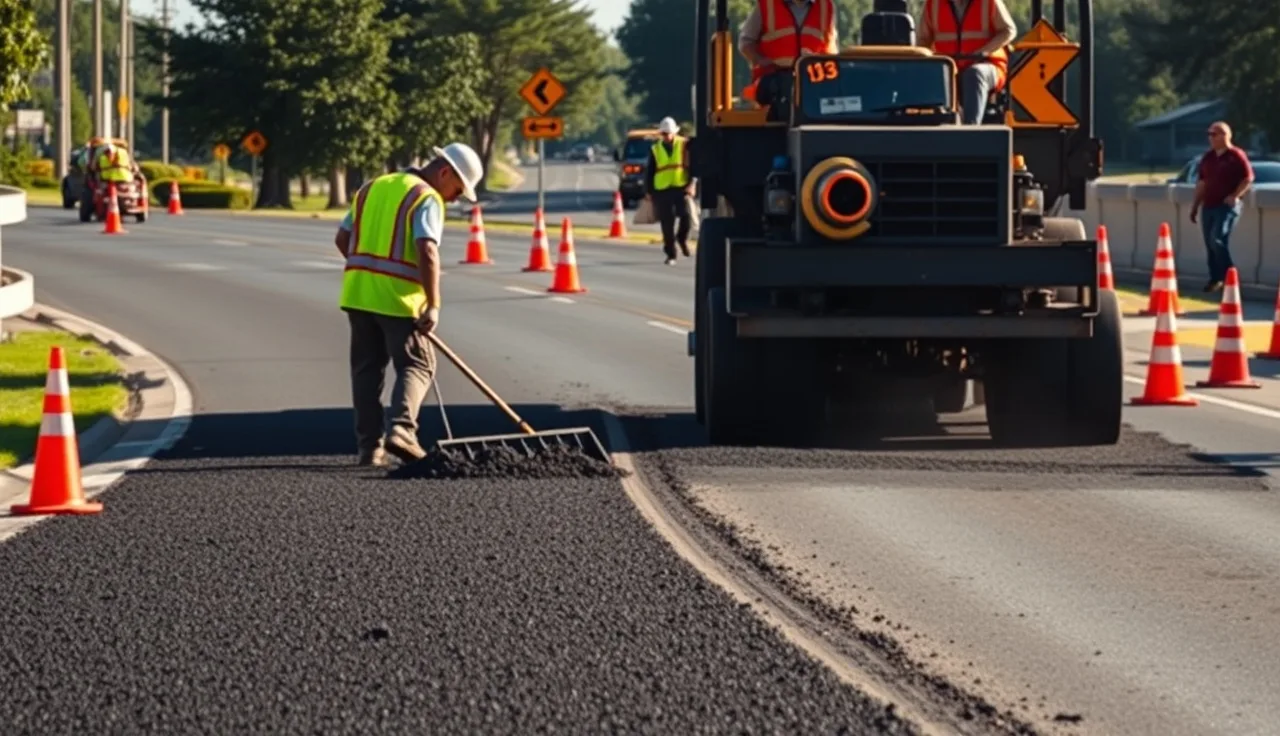
TL;DR
A small paving contractor needs at least seven written OSHA programs: hazard communication, PPE, fall protection, struck-by and work zone control, heat illness, emergency action, and incident reporting. Paving work falls under 29 CFR Part 1926, the construction standards. Work from a construction-specific template and you can build the whole set in a workday.
Why do paving contractors specifically need a written OSHA safety program?
Paving is one of the deadlier trades in construction, and the numbers make the case for a written program on their own. The Bureau of Labor Statistics reported a fatal injury rate of 18.2 per 100,000 full-time equivalent workers for highway, street, and bridge construction in 2022, nearly five times the all-industry average of 3.7. [1]
Here's the practical reason it matters for a small shop. OSHA compliance officers give no credit for safety rules that live only in a supervisor's head. Somebody gets hurt, OSHA shows up, and the first thing the officer asks for is your written program. Can't produce one? Every standard that applies to your site becomes a potential citation, and willful violations can reach $16,550 per instance as of January 2024. [2]
Small contractors who average 10 or fewer employees during the year are exempt from OSHA's injury and illness recordkeeping rule in 29 CFR 1904. They are not exempt from a single safety standard. [3] The written program requirement doesn't live in one blanket rule. It's buried inside individual standards, which is exactly why a lot of small paving companies never realize they're already required to have several documents on file.
Which OSHA standards actually apply to paving work?
Paving falls under 29 CFR Part 1926, OSHA's construction standards. A handful of subparts cover most of what happens on a job.
Subpart C (29 CFR 1926.20 through 1926.35) sets the general safety and health provisions for all construction, including the requirement that a competent person on site can identify hazards. [4] Subpart D covers personal protective equipment. Subpart E covers fire protection and emergency response. Subpart G covers signs and barricades, the backbone of any roadway work zone. Subpart K covers electrical, which matters when you're milling near buried utilities. Subpart P covers excavations if you cut into the road base.
Four standards apply to almost every paving job regardless of crew size:
| Standard | What it covers | Written program required? |
|---|---|---|
| 29 CFR 1926.59 (Hazard Communication) | SDS for asphalt fumes, solvents, diesel | Yes |
| 29 CFR 1926.95-100 (PPE) | Hard hats, gloves, eye protection, hi-vis | Written hazard assessment |
| 29 CFR 1926.502 (Fall Protection) | Work near drop-offs, bridge decks | Yes, if 6-ft threshold met |
| 29 CFR 1926.62 (Lead) | Milling painted bridge decks | Medical surveillance + written compliance plan if exposure above action level |
There's also 29 CFR 1926.601 for motor vehicle safety, which covers your rollers, pavers, and haul trucks on site. And the moment a crew member steps into the right-of-way of live traffic, the Manual on Uniform Traffic Control Devices (MUTCD) becomes part of your OSHA picture, because OSHA references it in 29 CFR 1926.200. [8]
Hazard communication deserves its own attention. Paving operations carry real chemical exposures: asphalt (coal tar or petroleum-based), tack coat solvents, diesel exhaust, and milling dust. Each one needs a safety data sheet on file and reachable by workers. That's not optional. See our guide to the hazard communication program for the full build.
What written programs does a paving contractor actually have to produce?
Seven programs cover the vast majority of paving contractors. Each one is tied to the standard that requires it to exist in writing.
1. Hazard Communication Program (29 CFR 1926.59). Lists every chemical on your jobs, explains how you handle SDS, and describes how you label containers. This is the single most commonly cited missing document for small contractors.
2. PPE Hazard Assessment and Program (29 CFR 1926.95). A written assessment of each task and the PPE it requires. It sounds bureaucratic. In practice it's a two-page table: task on the left, required PPE on the right, supervisor signature at the bottom.
3. Emergency Action Plan (29 CFR 1926.35). Required when 10 or more employees are on a job site. Even if you usually run under 10, you probably hit that number on a bigger pour or when subs show up. Write it once, keep it current.
4. Fall Protection Plan (29 CFR 1926.502). Required if any work surface sits 6 feet or more above a lower level. Bridge work, elevated screeds, and loading platforms all trigger it. OSHA requires the plan be written and job-site-specific. [4]
5. Heat Illness Prevention Program. OSHA's general duty clause, Section 5(a)(1) of the OSH Act, covers heat even without a dedicated standard. [11] OSHA's proposed Heat Injury and Illness Prevention rule, published August 2024, would codify a written program requirement outright. [5] Either way, a crew standing over 300-degree asphalt in July faces genuine heat risk. Write the program now.
6. Struck-By and Work Zone Traffic Control Plan (29 CFR 1926.200-203). This is the one that costs lives in paving. Spell out how you set up temporary traffic control, who the designated flagger is, and what your worker positioning rules are.
7. Injury and Illness Recordkeeping and Reporting Procedures. Even if you're exempt from OSHA 300 logs, you are never exempt from reporting a fatality within 8 hours, or a hospitalization, amputation, or loss of an eye within 24 hours. [3] A one-page procedure that tells supervisors what number to call and when is all you need.
Run larger jobs or bridge work and you may also need a Respiratory Protection Program (29 CFR 1910.134, applied to construction) for asphalt fume exposures. That standard is heavier, because it requires medical evaluations and fit testing.
Want a faster path? SafetyFolio's safety program generator builds all seven in about 15 minutes from questions about your specific operation, instead of forcing you to fill in a generic template that never had paving in mind.
How do you actually write each section of the program?
The structure of any single OSHA written program is nearly identical every time, and you don't need a consultant to work it out.
Every program needs six pieces: a purpose statement (one sentence on why the program exists), a scope (who it applies to, subcontractors included), roles and responsibilities (who does what, by job title not name), the procedures themselves, a training section, and a review date. That's the whole skeleton. OSHA doesn't ask for elaborate prose.
For the Hazard Communication Program, open 29 CFR 1926.59 and read the short list of what the written program must include. [4] The standard names them: how you maintain an SDS library, how containers get labeled, and how you train workers. Write one plain-English paragraph per item. Print it. Date it. Sign it.
For the PPE Hazard Assessment, walk every task your crew does: shoveling hot mix, raking edges, running the roller, flagging traffic, cutting existing pavement. For each one, write the hazard and the required PPE. The written certification must name the workplace evaluated, the person who did the evaluation, the date, and a statement that the assessment happened. That's exactly what 29 CFR 1926.95(d) requires. [4]
For the Work Zone Traffic Control Plan, point to your state DOT's standard work zone drawings or MUTCD Part 6 for your road type and speed limit. Name the Traffic Control Supervisor, list the devices (cones, signs, advance warning, arrow boards), and describe how you handle an unexpected lane closure. This one takes the most time because it should be project-specific.
One honest note. The first time you write these, budget a full day. After that, updating for a new project takes about 30 minutes.
What training do paving workers need and how do you document it?
Training documentation is where small contractors fail inspections most often. The bar isn't that training happened. It's that you can prove it happened, for named employees, on named topics, on a specific date.
For construction work, OSHA requires documented osha training that includes hazard communication (before chemical exposure, 29 CFR 1926.59(h)), PPE use and limitations (before you require PPE, 29 CFR 1926.95), fall protection systems (29 CFR 1926.503), work zone traffic control (29 CFR 1926.201), and powered industrial truck operation if you keep forklifts in the yard (forklift certification is separately required under 29 CFR 1910.178).
A training record doesn't need to be fancy. A sign-in sheet with the topic, date, trainer name, and employee signatures does the job. Keep it for the duration of employment plus three years. OSHA can and does ask for records going back years.
For supervisors and safety leads, the OSHA 30 for construction earns its cost. It's 30 hours across the major construction standards, and an OSHA 30-trained super signals to an inspector that leadership takes safety seriously. Some state DOT contracts and general contractors now require it for site supers. If your project manager runs jobs with more than a handful of workers, the OSHA 30 training is worth the time.
New employee orientation is where a lot of small shops cut corners and pay for it later. Before anyone sets foot on a live paving job, they need hazcom training, PPE training, and a site-specific orientation covering the work zone layout and emergency procedures. That orientation runs 30 to 45 minutes and ends with a signed acknowledgment form filed in the employee's folder.
How do you handle asphalt fume and chemical hazards specifically?
Asphalt fume is the chemical hazard most paving contractors underestimate. Hot mix releases a complex mixture of polycyclic aromatic hydrocarbons (PAHs), and emissions peak when mix temperatures top 300 degrees Fahrenheit. OSHA has no specific PEL for asphalt fume, but NIOSH recommends keeping exposure below 0.4 mg/m3 as a 10-hour time-weighted average. [6]
Your Hazard Communication Program has to name asphalt directly. The SDS for your hot mix comes from your supplier. Using tack coat (emulsified asphalt)? Get that SDS too. Diesel exhaust off the paver and haul trucks is another real exposure, and OSHA has cited general contractors under the general duty clause for diesel particulate on enclosed sites.
For most outdoor paving, engineering controls (keeping workers upwind of the paver hopper) and administrative controls (rotation, limited time at the screed) handle fume exposure without respirators. But send a worker into a tunnel, parking garage, or enclosed space to do asphalt repair, and a full Respiratory Protection Program under 29 CFR 1910.134 kicks in. That means medical evaluations, fit testing, a written program, and trained users.
Keep SDS reachable at the job site. "Accessible" under OSHA's HazCom standard means workers can get to them immediately during the shift, not "ask the office tomorrow." [12] A laminated binder in the supervisor's truck works. An app-based SDS library works. A locked cabinet the crew has no key to does not.
What does OSHA require for work zone and struck-by hazards in paving?
Struck-by incidents are the leading killer in roadway construction. OSHA's Focus Four names struck-by as one of the four hazard types behind roughly 60% of all construction fatalities. [9]
For paving crews, the danger comes from three directions. Vehicles passing through or beside the work zone hit workers. On-site equipment (pavers, rollers, water trucks, haul trucks) backs over or into workers. And material (milled chunks, debris off the paver hopper) strikes workers during operations.
Your traffic control plan has to specify four things: the advance warning distance for your speed limit and road type (MUTCD Table 6C-1 gives these by road type and speed), the flagger positioning and communication method, the minimum buffer zone between traffic and workers, and the procedure when a driver blows through your control devices. [8]
Hi-visibility vests are not optional. ANSI/ISEA 107-2015 Class 2 or Class 3 garments are required for anyone in the right-of-way. Many state DOTs require Class 3 for all paving workers regardless of traffic speed, so check your state's traffic control manual. It's often stricter than the federal MUTCD.
For backing equipment, the simplest control is a spotter. Your program should state that no haul truck backs without a designated spotter in visual contact with the driver, and that the spotter can stop the truck instantly by radio, horn, or hand signal. One procedure, documented and trained, prevents a large share of on-site struck-by deaths.
How do you write the recordkeeping and incident reporting section?
This section tells your supervisors exactly what to do in the minutes and hours after something goes wrong. It's short, and it's the section you hope they never open.
OSHA's reporting deadlines are firm. A work-related fatality goes to OSHA within 8 hours. An in-patient hospitalization, amputation, or loss of an eye goes within 24 hours. [3] You report by calling 1-800-321-OSHA, calling the nearest OSHA area office, or using OSHA's online reporting tool. Print that phone number right in the program.
Small employers averaging 10 or fewer employees are exempt from maintaining OSHA 300, 300A, and 301 forms for routine injury recordkeeping. [3] That exemption is narrower than it sounds. It covers only routine logs, and it evaporates if your industry moves off the partial-exemption list, which OSHA updates periodically.
Here's my honest advice: keep an incident report for every injury and near-miss regardless of your exemption. It costs 15 minutes. It hands you data to catch patterns before someone gets seriously hurt. And if you grow past 10 employees, you'll already have records to fill out the required forms without guessing.
Your reporting section should name the person who completes the report (usually the job site supervisor), set the timeline (report to the owner within 24 hours of any incident), and list what to gather: who got hurt, what they were doing, the immediate cause, the conditions present, and what you did to stop it from happening again.
How do you keep the program current and actually use it on jobs?
A safety program that sits in an office binder and never reaches the field isn't worth the paper. The point is that workers know what it says and supervisors enforce it.
Annual review is the floor. Every program carries a review date on the cover page. Set a calendar reminder. When you review, ask three things. Did our work change (new equipment, new chemicals, new job types)? Did any incident or near-miss expose a gap? Did any OSHA standard change? OSHA publishes standard-setting updates in the Federal Register and summarizes them on OSHA.gov. [5]
Before each project, the job super pulls the site-specific pages (work zone plan, emergency action plan with local 911 and hospital address) and briefs the crew. That pre-job briefing runs 10 to 15 minutes and gets documented on a sign-in sheet. It doesn't have to be a formal safety meeting. Standing in the job site parking lot while the crew gears up works fine.
Some contractors drop a laminated one-page summary in every truck: emergency numbers, hi-vis requirements, the backing spotter rule, and the SDS location. That's genuinely useful. The full written program stays in the main job file or a shared digital folder supervisors can open from their phones.
Change the program after an incident? Document why and when. That paper trail is your proof of a responsive safety culture if OSHA ever reviews your program after a citation.
What does an OSHA inspection of a paving contractor actually look like?
OSHA reaches roadway contractors a few ways: a programmed inspection (OSHA targets high-hazard industries on a schedule), a referral (another agency or a DOT prime contractor flags a concern), or an accident-triggered inspection after a serious injury or fatality.
Paving draws more attention than average. OSHA's Site-Specific Targeting program and National Emphasis Programs on heat illness and struck-by hazards all point at your industry.
When the compliance officer arrives, they ask for your written programs first. Hand over an organized, dated set and you set a professional tone for the whole visit. Then they walk the job and look at worker PPE, work zone setup against your traffic control plan, chemical container labeling, SDS accessibility, and equipment condition.
The standards OSHA cites most against construction contractors, based on its annual top-10 lists, are fall protection (29 CFR 1926.501, the most cited construction standard every year), scaffolding, ladders, hazard communication, and eye and face protection. [9] For paving specifically, work zone and struck-by citations show up often.
Get a citation and you have 15 working days to contest it. Plenty of small contractors just pay and fix the hazard. But if a citation is factually wrong or the penalty is out of proportion, contesting is worth a serious look. The Occupational Safety and Health Review Commission handles contests and often reduces penalties for small employers who show good-faith correction.
How long does it take to build this program and what does it cost?
Let's be straight about time and money, because the spread is wide and the expensive options often aren't better.
Hiring a safety consultant to build a custom program for a small paving contractor typically runs $1,500 to $5,000, depending on your location and the consultant's credentials. That's reasonable if you have a complex operation with tunnels, bridge work, or multiple crews, or if you just took a serious citation. For a straightforward crew doing commercial lots and road patching, it's more than the job needs.
Grabbing a template online and filling it in yourself costs nothing in dollars and plenty in risk if the template is outdated, not construction-specific, or missing sections that apply to you. I've seen contractors run HazCom templates written for general industry that never referenced 29 CFR 1926.59 at all. That's a live problem during an inspection.
The middle path is a tool built for construction safety programs that asks about your operation and generates a document tied to the right CFR sections. SafetyFolio's program generator does that, and for most small paving contractors it runs a few hundred dollars against a few thousand for a consultant, with the same CFR coverage.
Time-wise, one person who knows the operation can produce all seven programs in a workday from a good template or generator. Writing from a blank page while looking up CFR sections? Budget two to three days. After the initial build, annual updates take an hour or two.
The cost of getting cited for a missing program dwarfs all of that. A serious citation for a missing fall protection plan or HazCom program starts at $1,083 per violation as of 2024 and scales with severity and employer size. [2]
Frequently asked questions
Does a paving contractor with only 3 employees need a written safety program?
Yes, for every standard that requires one. The written program requirement inside standards like HazCom (29 CFR 1926.59) and PPE (29 CFR 1926.95) applies regardless of company size. The only small-employer break in OSHA construction is from routine injury recordkeeping logs if you average 10 or fewer employees. Safety programs and training requirements still bind even a 2-person crew.
What is the most commonly missed OSHA requirement for small paving contractors?
The written PPE hazard assessment. Most small paving contractors hand out hi-vis vests, hard hats, and safety glasses but never produce the signed, dated written certification that 29 CFR 1926.95(d) requires. It takes about 20 minutes to write and sign. Without it, distributing PPE still leaves you citable for failing to document the assessment.
Do I need a separate safety program for every job site?
Not entirely. Your core written programs (HazCom, PPE, Emergency Action Plan) can be company-wide documents. What changes per project is the site-specific traffic control plan and the emergency action plan's local contact information. Make those pages easy to swap so you're not rewriting the whole program for each job.
Are asphalt fumes an OSHA regulated substance?
OSHA has no specific permissible exposure limit (PEL) for asphalt fume. NIOSH recommends a limit of 0.4 mg/m3 as a 10-hour TWA, and OSHA can cite asphalt fume exposures under the general duty clause when they're recognized as hazardous. Your HazCom program still has to address asphalt as a chemical hazard with an SDS on file.
How do I document safety training for workers who rotate between job sites?
Keep training records centralized in an employee file, not at the job site. Each record lists the topic, date, trainer, and employee signature. Site-specific orientation (emergency contacts, traffic control layout for that job) gets documented separately at the project level. General training like HazCom and PPE only has to happen once, then again when job hazards change.
Does my subcontractor's safety program count, or do I need my own?
If you're the general contractor, you need your own program and you carry responsibility for subs on your site under OSHA's multi-employer citation policy. [10] If you're a sub under a GC, you still need your own written programs for the standards covering your scope. The GC's program doesn't cover your crew. Both parties can be cited for the same hazard.
What is a competent person in paving and do I need one?
A competent person is someone who can identify existing and predictable hazards that are unsanitary, hazardous, or dangerous to employees, and who has authorization to take corrective measures. That definition is from 29 CFR 1926.32(f). For paving, the job site superintendent usually fills the role. No certification is required, but the person needs documented knowledge of the specific hazards on the job.
How often does OSHA update the standards that apply to paving?
Major standard changes land a few times per decade, but penalty amounts adjust annually for inflation. OSHA also issues letters of interpretation and enforcement guidance that shift how existing standards apply without amending the rule. Review your program annually and check OSHA.gov for new rules, especially the proposed heat illness standard published in 2024 that will affect outdoor paving significantly.
Do I need a fall protection plan if my crews only pave flat parking lots?
Probably not for the paving itself, but check every task on the job. If workers climb on equipment to clean hoppers or do maintenance, if there are loading docks or slope edges nearby, or if any work surface sits 6 feet or more above a lower level, fall protection under 29 CFR 1926.502 kicks in. Flat lots are low-risk, not zero-risk, for fall hazards.
What is the penalty for not having a written HazCom program during an OSHA inspection?
A missing or inadequate HazCom program is typically cited as a serious violation. As of January 2024, serious violations carry a maximum penalty of $16,550 per violation. OSHA adjusts penalties for employer size, good faith, and history, so a first-time small-employer citation usually lands much lower, but it still starts at $1,083 per violation under OSHA's penalty structure.
Can I use a free OSHA template from the internet for my paving company?
You can, but verify it carefully first. Check that every standard cited uses Part 1926 (construction), not Part 1910 (general industry). Confirm the penalty figures and review dates are current. Many free templates are generic, outdated, or written for another industry. A template referencing the wrong CFR section can create compliance problems because it implies you reviewed a standard that doesn't fit your operation.
Does a paving company need an OSHA 300 log?
Only if you averaged more than 10 employees during the previous calendar year. Paving contractors under that threshold are partially exempt from routine recordkeeping under 29 CFR 1904.1. All employers, regardless of size, must still report fatalities within 8 hours and hospitalizations, amputations, or eye loss within 24 hours. The reporting requirement never goes away, even for the smallest crew.
What should a pre-job safety briefing for a paving crew cover?
Cover the site-specific traffic control plan, emergency contact numbers and nearest hospital, chemical hazards expected that day and the SDS location, PPE requirements, equipment backing and spotter procedures, and the process for workers to report hazards. It runs 10 to 15 minutes. Document attendance with a sign-in sheet and keep it in the project file.
Is there an OSHA standard specifically for heat illness in paving?
Not yet, but a proposed rule published in August 2024 would create a dedicated heat illness prevention standard. Until it's finalized, OSHA cites heat illness under the general duty clause of the OSH Act. Outdoor crews working over hot asphalt in summer are clearly in scope. A written heat illness prevention program with water, rest, and shade provisions is the safest approach right now.
Sources
- Bureau of Labor Statistics, Census of Fatal Occupational Injuries 2022: Highway, street, and bridge construction workers had a fatal injury rate of 18.2 per 100,000 FTE workers in 2022, versus an all-industry average of 3.7.
- OSHA, Penalties page (OSHA.gov): Willful or repeated OSHA violations carry a maximum penalty of $16,550 per violation as of January 2024; serious violations start at $1,083.
- OSHA, Injury and Illness Recordkeeping and Reporting Requirements (29 CFR 1904): Employers with 10 or fewer employees on average are exempt from routine 300-log recordkeeping, but all employers must report fatalities within 8 hours and hospitalizations, amputations, or eye loss within 24 hours.
- OSHA, 29 CFR Part 1926 Construction Standards: Subpart C (1926.20-1926.35) requires a competent person on site; 1926.95(d) requires a written, signed PPE hazard assessment certification; 1926.59 requires a written HazCom program; 1926.502 requires a written fall protection plan for work at 6 feet or more.
- OSHA, Heat Injury and Illness Prevention in Outdoor and Indoor Work Settings (Proposed Rule, 2024): OSHA published a proposed heat illness prevention standard in August 2024 that would require written heat illness prevention programs for outdoor workers including paving crews.
- NIOSH, Asphalt Fumes (CDC.gov/niosh): NIOSH recommends asphalt fume exposure be kept below 0.4 mg/m3 as a 10-hour TWA; OSHA has no specific PEL for asphalt fume.
- FHWA, Manual on Uniform Traffic Control Devices (MUTCD) Part 6: MUTCD Table 6C-1 specifies advance warning distances for temporary traffic control by road type and speed limit; OSHA references MUTCD in 29 CFR 1926.200.
- OSHA, Commonly Used Statistics and Top 10 Most Cited Standards: Fall protection (29 CFR 1926.501) is the most cited construction standard year after year; HazCom and eye/face protection also appear in OSHA's top-10 construction citations. Struck-by is one of the Focus Four hazard types behind roughly 60% of construction fatalities.
- OSHA, Multi-Employer Citation Policy (Compliance Directive CPL 02-00-124): OSHA's multi-employer citation policy allows both general contractors and subcontractors to be cited for the same hazard on a shared work site.
- OSHA, OSH Act of 1970, Section 5(a)(1) General Duty Clause: The general duty clause requires employers to provide a workplace free from recognized hazards, the basis for heat illness and asphalt fume citations where no specific PEL exists.
- OSHA, Hazard Communication Standard (incorporated into 29 CFR 1926.59): HazCom requires written programs listing chemicals, SDS access, container labeling, and employee training before exposure; the standard applies to construction via 29 CFR 1926.59.