Last updated 2026-07-10
TL;DR
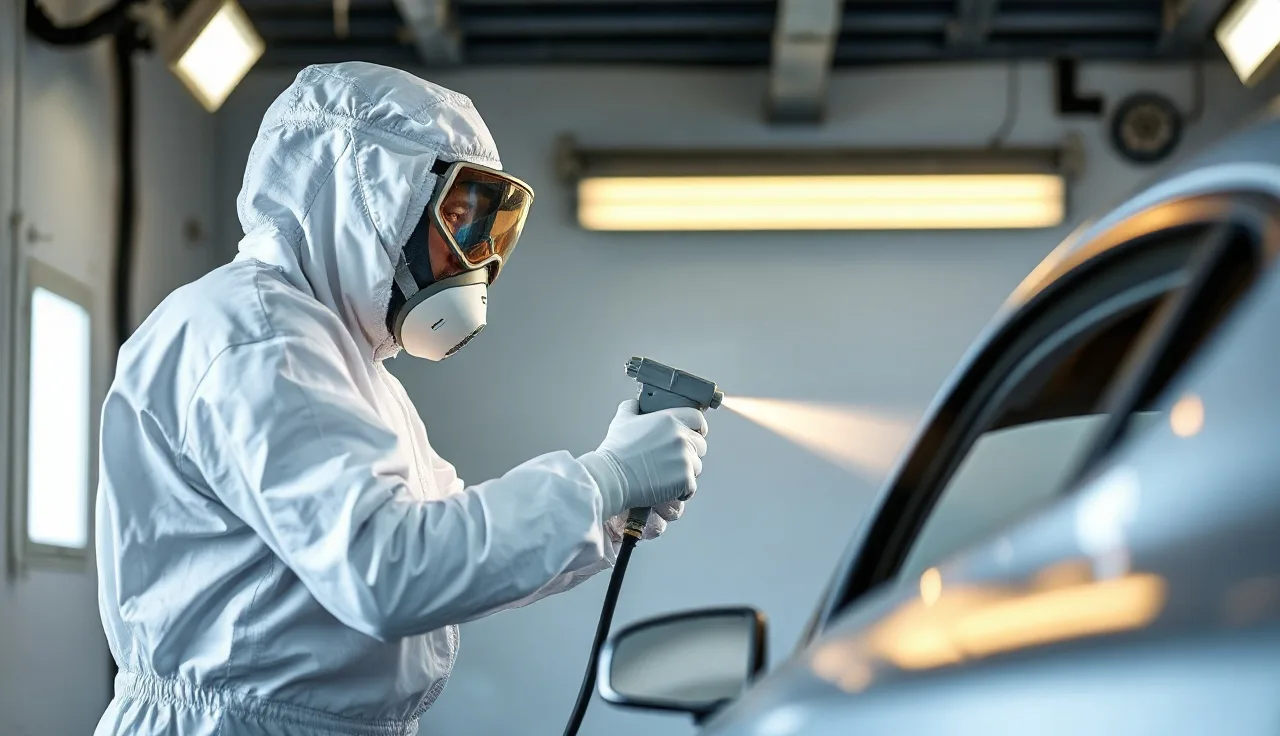
Auto body shops that spray isocyanate-based paints must keep a written exposure control program. It pulls from OSHA's Hazard Communication rule (29 CFR 1910.1200), Respiratory Protection (29 CFR 1910.134), PPE (29 CFR 1910.132), and the General Duty Clause. There is no single OSHA isocyanate standard. The program must cover engineering controls, supplied-air respirators for spraying, medical surveillance, and training.
What are isocyanates and why are they a specific hazard in auto body shops?
Isocyanates are the hardener half of two-part polyurethane paint. They are among the most reactive chemicals in your shop, and they are in nearly every modern automotive clearcoat and basecoat. The common ones in body work are methylene diphenyl diisocyanate (MDI), hexamethylene diisocyanate (HDI), and their prepolymers. When you spray, when you sand cured paint, or when you bake fresh panels, you release isocyanate vapor and aerosol fine enough to reach the deep lung.
Isocyanates are the leading occupational cause of work-related asthma in the United States. NIOSH estimates they account for 15 to 25 percent of all new-onset occupational asthma cases [1]. Here is the part that scares people who understand it: once a worker is sensitized, any later exposure, even far below the permissible limit, can set off a severe asthma attack. There is no cure. That worker may never safely work around isocyanates again.
Body shops are high-risk for three plain reasons. Spraying happens in an enclosed booth, and overspray circulates even with good ventilation. Workers sand cured panels and treat the dust as harmless. Small shops rarely have the industrial hygiene staff a big manufacturer keeps on payroll. Respirator and written-program problems show up on nearly every isocyanate citation OSHA writes against body shops [2].
Does OSHA have a specific isocyanate standard auto body shops must follow?
No. That gap is where most of the confusion starts. OSHA has never finalized a dedicated isocyanate standard for general industry. Compliance gets assembled from several existing rules, and the agency fills the holes with the General Duty Clause (Section 5(a)(1) of the OSH Act) for recognized hazards no specific standard covers.
The rules that apply to auto body isocyanate work:
| Standard | CFR Citation | What it requires |
|---|---|---|
| Hazard Communication | 29 CFR 1910.1200 | SDS access, labeling, training on isocyanate hazards |
| Respiratory Protection | 29 CFR 1910.134 | Written program, medical eval, fit test, respirator selection |
| PPE General | 29 CFR 1910.132 | Hazard assessment, provision of gloves, suits, eye protection |
| Air Contaminants (General Industry) | 29 CFR 1910.1000, Table Z-1 | PEL for methylene bisphenyl isocyanate (MDI): ceiling of 0.02 ppm |
| General Duty Clause | OSH Act Sec. 5(a)(1) | Catch-all for recognized hazards without a specific standard |
HDI is the isocyanate in most automotive clearcoats, and OSHA has no PEL for it in Table Z-1 [9]. The agency defaults to the General Duty Clause and treats ACGIH's TLV of 0.005 ppm (8-hour TWA) as a recognized benchmark in enforcement [3]. NIOSH sets a matching REL of 0.005 ppm [10].
OSHA also published a hazard alert built specifically for auto body workers in 2013. It names supplied-air respirators as the required control during spraying and lists the written program as a compliance expectation [4]. The alert is not a regulation. Inspectors still cite it.
What are the required elements of an isocyanate written program for auto body shops?
No single CFR section lists every element, so your program has to stitch together respiratory protection (29 CFR 1910.134), hazard communication (29 CFR 1910.1200), and the general duty to protect workers from recognized hazards. Here is what the document has to address to survive an inspection.
Scope and applicability. Name the tasks that involve exposure: spraying two-part urethane paints, mixing hardener and basecoat, sanding cured coatings, and being in the booth while painting happens. List the specific products you use and their isocyanate components. Pull the SDS for each one.
Exposure assessment. Describe how you evaluated exposure. For most shops that means either air monitoring data or a written engineering judgment explaining why your controls should hold exposures below the ACGIH TLV of 0.005 ppm for HDI. Inspectors will ask for this. If you have no monitoring data, the program has to acknowledge worst-case exposures in writing and justify your controls anyway.
Engineering and administrative controls. Spray booths have to hold the cross-draft or downdraft airflow the manufacturer specifies. Document booth face velocity (typically 100 feet per minute), filter change schedules, and certification records. Administrative controls include keeping non-essential workers out during spray work and blocking re-entry until the air has cleared.
Respirator program (referenced or included in full). This is the longest element. 29 CFR 1910.134 requires a written program covering selection, medical evaluation, fit testing, maintenance, and training [5]. For spray work, OSHA's position across multiple letters of interpretation is that air-purifying respirators alone are not acceptable during active spraying, because no cartridge reliably protects against isocyanate aerosols at spray concentrations. A supplied-air respirator at positive pressure is the minimum for spraying. An APR with organic-vapor plus P100 cartridges may work for low-exposure tasks like mixing, but only if air monitoring backs it up.
Medical surveillance. Exposed workers need a pre-placement exam (to screen for asthma, bronchitis, or other lung conditions that raise sensitization risk), periodic exams, and an exit exam when they leave the job. 29 CFR 1910.134 requires a medical evaluation before fit testing, which covers part of this. Good practice for isocyanate work adds spirometry at baseline and every year after. NIOSH recommends that annual interval for ongoing exposure [1].
Housekeeping and waste disposal. Hardened isocyanate waste and cleanup solvents holding unreacted isocyanate get handled as hazardous waste. Spell out how painters decontaminate spray guns and mixing gear, and how the waste is labeled and disposed.
Incident response. What do you do if a worker starts wheezing during or after a spray job? Write the protocol: pull them from exposure, get them fresh air, call emergency services if symptoms are severe, and log the event as a possible sensitization incident. Enter it on the OSHA 300 log if it needs treatment beyond first aid. See incident report for the recordkeeping detail.
Training. Workers have to understand what isocyanates are, how they hurt you, what controls are in place, how to use the respirator, and which symptoms to report. Train before initial assignment and every year after [6].
What respirator is actually required for spray painting with isocyanates?
A supplied-air respirator in pressure-demand mode is the minimum for isocyanate spraying. This is the question shop owners get wrong most. The instinct is to grab a cheap half-face respirator with organic vapor cartridges because everyone already owns one. OSHA and NIOSH both say that is not enough for spraying.
OSHA's 2013 auto body hazard alert states that during isocyanate spray painting, supplied-air respirators (Type C, pressure-demand) must be used [4]. A supplied-air unit feeds filtered compressed air from a remote source and takes the cartridge-saturation problem off the table entirely.
Why not air-purifying? Two reasons. At spray concentrations, the aerosol and vapor loading saturates combination cartridges fast, and workers have no reliable way to sense breakthrough because isocyanates have terrible warning properties (the odor threshold sits near or above the TLV for many compounds). Second, a half-face APR carries an assigned protection factor of 10 times the limit, while spray work can throw exposures hundreds of times above the TLV.
For non-spray tasks (mixing, cleaning guns, sanding fully cured paint), a half-face respirator with combination OV/P100 cartridges can be adequate, but only if air monitoring shows concentrations stay inside the cartridge's protection factor. Your program has to justify that task by task.
Every respirator user passes a medical evaluation (29 CFR 1910.134(e)) before fit testing, and tight-fitting facepieces get fit-tested annually [5]. Supplied-air hoods and helmets with no tight seal skip fit testing but still require medical evaluation and training [7].
For how hazard communication feeds PPE selection, including reading the SDS to confirm isocyanate content, that is where your program starts.
What does medical surveillance for isocyanate workers actually require?
Medical surveillance is required, but no single OSHA standard spells out the content for isocyanates. It comes from 29 CFR 1910.134 (medical evaluation before respirator use), NIOSH guidance, and OSHA enforcement history.
At minimum, build in:
- Pre-placement spirometry and an occupational health questionnaire before the worker starts spray painting
- Annual spirometry for anyone with ongoing exposure
- An exit exam when a worker leaves spray duties
- Same-day physician evaluation if a worker reports respiratory symptoms, chest tightness, wheezing, or skin reactions that could signal sensitization
A NIOSH Alert on isocyanates puts it plainly: "Workers who become sensitized to isocyanates must be removed from further isocyanate exposure to prevent serious, potentially fatal, asthma attacks." [1] That is the operative sentence. Sensitization is permanent. Your surveillance program exists to catch it before it becomes a catastrophe.
Baseline and annual spirometry runs roughly $150 to $350 per worker per year through occupational medicine clinics, based on general occupational health pricing. Real money for a small shop. A single workers' comp claim for occupational asthma runs well past $50,000 once you add indemnity and medical costs.
Document every evaluation in the worker's confidential medical file. OSHA requires you to keep health records tied to toxic-substance exposure for the duration of employment plus 30 years (29 CFR 1910.1020) [8].
How do you write the engineering controls section of your isocyanate program?
Engineering controls come before respirators, and OSHA inspectors read this section closely. Your job here is to document the controls, more than mention them. That means specifics.
Spray booth design. Cross-draft or downdraft? What is the design airflow velocity? Most booths target 100 feet per minute (fpm) face velocity. You need records showing the booth holds at or above spec. NFPA 33 (Standard for Spray Application Using Flammable or Combustible Materials) sets minimum ventilation figures that many state fire codes adopt, and inspectors reference it even though NFPA 33 is not an OSHA standard.
Filter maintenance. Intake and exhaust filters get changed on a documented schedule. Clogged exhaust filters cut airflow and drive up exposure. Name the interval (often every 40 to 80 spray hours, or when a manometer says so) and require written proof of each change.
Mixing location. Where do painters mix the two-part paint? Inside the booth with ventilation running, or in a designated ventilated area. Never in the open shop.
Local exhaust at the mixing station. If mixing happens at a bench, put a local exhaust hood rated for flammable vapors over it.
Booth interlocks. Modern booths stop the spray gun from firing unless ventilation is confirmed running. Note whether yours has this.
If your booth falls short, document the gap and your corrective plan with a date. An inspector reads a written improvement plan very differently from an empty file.
What training does OSHA require for workers exposed to isocyanates?
Training comes from two standards: Hazard Communication (29 CFR 1910.1200) and Respiratory Protection (29 CFR 1910.134). Both require initial training before exposure and annual refreshers.
HazCom training covers the health hazards of isocyanates (sensitization and occupational asthma), how to read the SDS for each isocyanate product in the shop, what the label system means, and how to use the controls in place. 29 CFR 1910.1200(h) requires this be delivered in a language and manner the employee understands [6].
Respirator training covers why the respirator is needed, its limitations, how to don, doff, adjust, and seal-check it, how to maintain and store it, and how to spot when it is failing. For supplied-air units, add the air supply system and hose management.
Beyond the bare requirements, your training should also cover:
- Early sensitization signs (wheezing after work, chest tightness that clears on weekends, runny nose or eye irritation during spraying)
- Why to report symptoms right away instead of waiting them out
- What happens if a worker is found sensitized (reassignment away from exposure, not termination)
Document every session with sign-in sheets, the date, who delivered it, and the content. If a Spanish-speaking employee got training in Spanish, note that.
For OSHA training duties across the whole shop, osha training covers what the agency actually audits.
How should you handle an isocyanate exposure incident or suspected sensitization?
Write this down before it happens. The moment a worker starts wheezing in the booth is the wrong time to invent a plan.
Your program's response protocol:
1. Pull the worker from the exposure area immediately. Fresh air, away from the booth. 2. Assess symptoms. Mild eye or nose irritation is one thing. Wheezing, chest tightness, or trouble breathing is another, and it means emergency services. 3. Call 911 for any respiratory distress. Isocyanate-induced bronchospasm can move fast. 4. Notify the physician or occupational medicine clinic the same day for any symptomatic exposure. 5. Investigate. What were the ventilation conditions? Was the respirator worn? Was the cartridge changed? Write it all down. 6. Determine recordability. Any case needing prescription medication, hospitalization, or restricted work goes on the OSHA 300 log. 7. Do not return the worker to isocyanate work until a physician clears them and assesses sensitization status.
Sensitization testing (specific inhalation challenge or immunological testing) is beyond most occupational medicine clinics and may need referral to an academic pulmonologist. Name that referral clinic in advance.
If a worker is confirmed sensitized, they cannot safely return to any isocyanate exposure, supplied-air respirator or not. Sensitization bypasses the dose-response relationship. This is a career-limiting injury, and your workers' comp carrier needs to hear about it right away.
What does OSHA actually look for when it inspects an auto body shop for isocyanate compliance?
OSHA's programmed inspection list includes auto body shops under its National Emphasis Programs, and isocyanates rank as a priority hazard. Inspectors follow a predictable order.
First, the written program. If you cannot produce it during the inspection, that is a citation for 29 CFR 1910.134 (if there are respirators anywhere in the shop) and likely a General Duty Clause violation for the isocyanate hazard.
Second, the respirators. Supplied-air for spray work? Cartridges inside their change-out schedule? Medical evaluation records for every user? Fit test records?
Third, the spray booth. Inspectors may run a portable airflow meter across the face. They check filter condition and change logs.
Fourth, training records. Can you show sign-in sheets and content documentation for HazCom and respiratory protection within the past 12 months?
Fifth, the SDS binder or its electronic equivalent. Is there an SDS for every isocyanate product in use? Can workers reach it?
Here is the number that gets attention. Serious violations run $1,083 to $16,131 each as of 2024, and willful or repeated violations reach $161,323 [2]. One inspection that finds a missing written program, wrong respirators, no medical evaluations, and no fit tests can hand a small shop a five-figure total penalty.
If you need to build a compliant program fast, SafetyFolio's generator walks through the isocyanate-specific elements in about 15 minutes and produces a document formatted for inspections.
How do you build the hazard communication piece of your isocyanate program?
Isocyanate hazard communication sits inside your broader HazCom program (29 CFR 1910.1200), but these products earn special attention because they are among the most hazardous substances in the shop.
Start with your chemical inventory. List every two-part paint, hardener, primer, and clearcoat that contains isocyanate. HDI prepolymer products often carry names that never say "isocyanate" on the can. Check SDS Section 3 (Composition) for any compound with the word "isocyanate" or the NCO functional group.
For each product, confirm you have a current SDS from the manufacturer and that workers can reach it during every shift. Electronic access (tablet, computer) is fine, but the system has to work without power, or you keep paper backups.
Labeling: every container carries either the original manufacturer's label or a workplace label with the product name, hazard pictograms, and signal word. Secondary containers like spray cups used and emptied inside one shift are exempt. Larger secondary containers are not.
Your HazCom written program has to name isocyanates as a covered hazard category and explain how training addresses sensitization risk, not only acute toxicity. Generic HazCom training that skips the permanent-sensitization hazard is not enough for a body shop.
For the full HazCom framework across your shop, hazard communication explains the standard. Reading an hcl safety data sheet for a reactive chemical is good practice for spotting what matters in Section 8 (Exposure Controls) of an isocyanate SDS.
What does a written isocyanate program cost to put together, and is there a template?
Writing the program yourself, no consultant, takes most shop owners four to eight hours of reading regulations, pulling SDS sheets, and drafting. Hire an industrial hygienist to write it and expect $500 to $2,000 depending on your market and scope. Add air monitoring (genuinely useful) and figure another $800 to $1,500 for sampling and lab analysis.
OSHA does not sell templates. It did publish a guidance document, "Isocyanates in Auto Body Repair Shops," that lists the required elements and lives on OSHA.gov [4]. Good starting checklist, even though it is not fill-in-the-blank.
A few state plans, California's Cal/OSHA among them, carry stricter isocyanate rules than federal OSHA. If you are in a state plan state, check your state's requirements before you finalize anything.
The cheapest defensible path for most small shops: OSHA's published guidance plus a tool like SafetyFolio to structure the document, then a single industrial hygiene consult for air monitoring if you want real exposure data.
One thing worth saying straight. A free template pulled off the internet, never checked against your actual products, booth type, and tasks, is often worse than nothing. It hands you false confidence in a program that does not match your shop. The written program has to describe what actually happens on your floor.
Frequently asked questions
Is there a specific OSHA isocyanate standard for auto body shops?
No single OSHA standard covers isocyanates in auto body shops. Compliance comes from 29 CFR 1910.1200 (hazard communication), 29 CFR 1910.134 (respiratory protection), 29 CFR 1910.132 (PPE), and OSHA's General Duty Clause for hazards without a dedicated PEL, like HDI. OSHA published a 2013 hazard alert for auto body workers that describes its enforcement expectations.
Can auto body painters use a half-face respirator with organic vapor cartridges for spray work?
No. OSHA's position, stated in its auto body hazard alert and multiple letters of interpretation, is that supplied-air respirators in pressure-demand mode are required during isocyanate spray painting. Air-purifying cartridges saturate quickly at spray concentrations, and isocyanate vapors have poor odor warning properties, so workers cannot reliably detect breakthrough before harmful exposure occurs.
What is the OSHA PEL for isocyanates?
OSHA's Table Z-1 (29 CFR 1910.1000) sets a ceiling limit of 0.02 ppm for methylene bisphenyl isocyanate (MDI). For HDI, the most common isocyanate in automotive clearcoats, OSHA has no PEL. Inspectors use ACGIH's TLV of 0.005 ppm as a recognized benchmark in General Duty Clause enforcement. NIOSH recommends a REL of 0.005 ppm as a TWA for all isocyanates.
Do I need to do air monitoring in my spray booth for isocyanates?
OSHA does not explicitly require periodic air monitoring for isocyanates absent a specific standard. But if you cannot show through monitoring or documented engineering judgment that controls hold exposures below recognized limits, an inspector can cite you under the General Duty Clause. For most shops, baseline air monitoring (once, unless tasks change) is the most defensible approach and costs $800 to $1,500 through an industrial hygienist.
What medical surveillance is required for auto body painters working with isocyanates?
At minimum, 29 CFR 1910.134 requires a medical evaluation before any worker is fit-tested for a respirator. Beyond that, NIOSH recommends baseline spirometry before exposure begins and annual spirometry for ongoing exposure. Any worker with symptoms suggesting sensitization should be referred for immediate evaluation and removed from isocyanate exposure until cleared by a physician. Records must be kept for the duration of employment plus 30 years.
What happens if a worker is sensitized to isocyanates?
Isocyanate sensitization is permanent. A sensitized worker cannot safely return to isocyanate exposure at any level, even with a supplied-air respirator. Later exposures can trigger severe asthma attacks that are potentially fatal. The worker must be reassigned to tasks with no isocyanate exposure. This typically triggers a workers' compensation claim, and the employer should notify their carrier immediately. No medical treatment reverses sensitization.
Does my written isocyanate program need to cover sanding as well as spray work?
Yes. Sanding cured isocyanate coatings generates dust that holds residual unreacted isocyanate and degradation products. OSHA's auto body hazard alert explicitly includes sanding as a covered task. Your program should address engineering controls (local exhaust at the sanding station or HEPA vacuum collection) and respiratory protection for sanding, which at minimum requires a P100 half-face respirator.
How often does my isocyanate written program need to be updated?
Review it any time your products change (new paint system, new hardener), your booth or ventilation changes, a worker has a sensitization event, or OSHA issues new guidance. A calendar review at least annually is good practice. When you add new products, update your chemical inventory and SDS file and confirm the new products' isocyanate components are addressed in training and PPE selection.
What PPE besides a respirator is required for isocyanate spray work?
29 CFR 1910.132 requires a hazard assessment to determine PPE needs. For isocyanate spray work, that assessment should produce chemical-resistant gloves (nitrile at minimum, butyl rubber preferred), a full-body paint suit or chemical-resistant coveralls, and splash-proof eye protection or a face shield. Isocyanates absorb through skin and can cause sensitization by that route as well as inhalation.
Can OSHA cite my shop for isocyanate hazards even if I am below the PEL?
Yes. Because OSHA has no PEL for HDI (the most common automotive isocyanate), the agency can cite under the General Duty Clause if it finds a recognized hazard and feasible controls exist to reduce it. ACGIH's TLV of 0.005 ppm and NIOSH's REL of 0.005 ppm serve as the benchmarks inspectors reference. Being below MDI's 0.02 ppm ceiling does not protect you from citation for HDI exposures.
Are there state OSHA plan requirements for isocyanates that are stricter than federal OSHA?
Yes. California's Cal/OSHA, for example, has more specific requirements for isocyanate work in auto body shops, including defined training content and medical surveillance components. If your shop is in a state plan state (California, Washington, Michigan, and about 20 others), check that state's regulations before finalizing your program. Federal OSHA rules set the floor; state plans can and often do exceed them.
What should my isocyanate emergency response plan include?
Your written program should specify immediate removal of any symptomatic worker from the exposure area, fresh air and rest, emergency services contact for any respiratory distress, same-day occupational medicine evaluation for any symptomatic exposure, exposure investigation documentation, OSHA 300 log entry if recordable, and a process for deciding whether the worker can return to isocyanate work. Name the clinic or physician your shop uses for occupational health before an emergency occurs.
How do I know which of my paint products contain isocyanates?
Check Section 3 (Composition/Information on Ingredients) of the Safety Data Sheet for each paint, primer, clearcoat, and hardener you use. Look for compounds with "isocyanate" in the name, or the notation "NCO" (the isocyanate functional group). HDI, MDI, HMDI, IPDI, and TDI are all isocyanate compounds found in automotive coatings. If the SDS is unclear, call the manufacturer's technical line directly and document the response.
Sources
- NIOSH, Isocyanates Topic Page: Isocyanates are the leading occupational cause of work-related asthma, estimated to cause 15 to 25 percent of occupational asthma cases; NIOSH recommends annual spirometry for ongoing isocyanate exposure.
- OSHA, OSHA Penalties Page: Serious violation penalty range is $1,083 to $16,131 per violation as of 2024; willful or repeated violations up to $161,323.
- OSHA, Isocyanates Safety and Health Topics Page: OSHA references ACGIH's TLV of 0.005 ppm (8-hour TWA) for HDI as a recognized benchmark in General Duty Clause enforcement where no PEL exists.
- OSHA, Hazard Alert: Isocyanates in Auto Body Repair Shops (2013): OSHA's 2013 auto body hazard alert names supplied-air respirators (Type C, pressure-demand) as the required control during isocyanate spray painting and lists the written program as a compliance expectation; sanding is a covered task.
- OSHA, Respiratory Protection Standard 29 CFR 1910.134: 29 CFR 1910.134 requires a written respiratory protection program, medical evaluation before fit testing, annual fit testing for tight-fitting facepieces, and training.
- OSHA, Hazard Communication Standard 29 CFR 1910.1200: 29 CFR 1910.1200(h) requires HazCom training be provided in a language and manner the employee understands, before initial assignment, with annual refreshers.
- OSHA, Assigned Protection Factors for the Revised Respiratory Protection Standard: Supplied-air hoods and helmets that do not require a tight seal are exempt from fit testing but still require medical evaluation and training under 29 CFR 1910.134.
- OSHA, Access to Employee Exposure and Medical Records Standard 29 CFR 1910.1020: 29 CFR 1910.1020 requires medical records related to exposure to toxic substances be maintained for the duration of employment plus 30 years.
- OSHA, Air Contaminants Standard 29 CFR 1910.1000 Table Z-1: OSHA Table Z-1 sets a ceiling limit of 0.02 ppm for methylene bisphenyl isocyanate (MDI); no PEL exists for HDI in this table.
- NIOSH, Pocket Guide to Chemical Hazards: NIOSH recommends a REL of 0.005 ppm (TWA) for isocyanates including HDI.
- OSHA, PPE General Standard 29 CFR 1910.132: 29 CFR 1910.132 requires the employer to conduct a hazard assessment and provide appropriate PPE including gloves, coveralls, and eye protection for chemical hazards.
- OSHA, General Duty Clause Section 5(a)(1) of the OSH Act: Section 5(a)(1) of the OSH Act requires employers to furnish employment free from recognized hazards likely to cause death or serious physical harm, applied to HDI exposures without a specific PEL.