Last updated 2026-07-09
TL;DR
A lockout tagout station is a wall-mounted cabinet or board that stores the locks, tags, hasps, lockout devices, and written procedures a facility needs to safely de-energize equipment before maintenance. OSHA's 29 CFR 1910.147 doesn't mandate a physical station, but having one is the practical way to stay compliant. Stations cost roughly $80 to $600 depending on size and material.
What is a lockout tagout station?
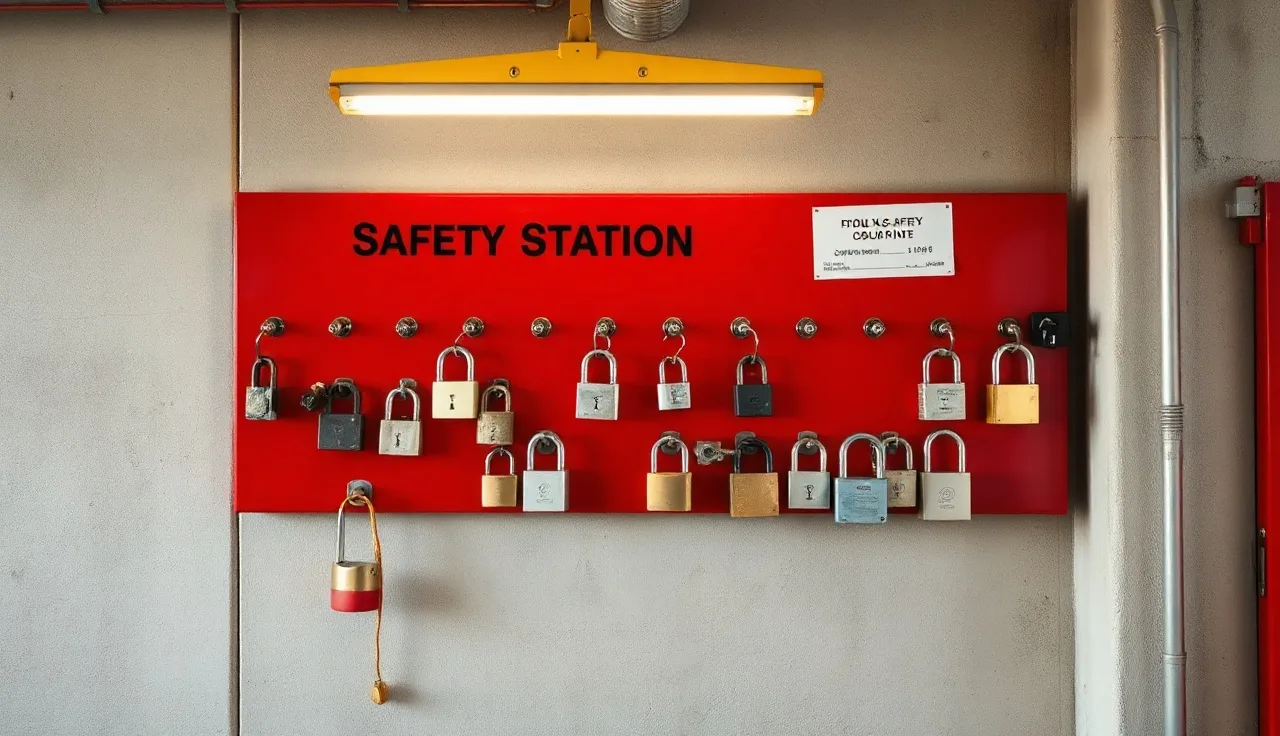
A lockout tagout station is a dedicated storage point, usually a wall-mounted shadow board, pegboard panel, or enclosed cabinet, that holds every piece of hardware and every document a worker needs to isolate hazardous energy before servicing equipment. Think of it as a first-aid kit for energy control. Everything is in one place, always stocked, always visible.
The contents usually include padlocks (each worker gets their own), lockout tags, hasps that let several workers lock out the same isolating device, valve lockouts, circuit breaker lockouts, plug lockouts, and a copy of the facility's written energy control program or the machine-level procedures. Some stations also carry safety scissors, cable lockouts for awkward valves, and a sign-out log.
The word "station" is generic. Some facilities call it a lockout tagout cabinet, some call it a lockout station board, and suppliers sell both open shadow boards and fully enclosed cabinets. The enclosed version keeps dust off the devices and limits access to authorized employees, which matters in high-traffic areas.
OSHA's energy control standard at 29 CFR 1910.147 never uses the word "station." What it requires is that authorized employees apply locks and tags, that the employer provides the hardware, and that written procedures reach the employees who need them [1]. The station is the delivery system for all of that, which is why nearly every compliance auditor, third-party consultant, and large manufacturer treats a physical station as the working minimum.
Does OSHA actually require a lockout tagout station?
No. OSHA never uses the phrase "lockout tagout station" in 29 CFR 1910.147, and no line in the standard says you must own a dedicated cabinet or board [1]. What the standard does require sits at 1910.147(c)(1): "The employer shall establish a program consisting of energy control procedures, employee training and periodic inspections to ensure that before any employee performs any servicing or maintenance on a machine or equipment where the unexpected energizing, startup or release of stored energy could occur and cause injury, the machine or equipment shall be isolated from the energy source and rendered inoperative."
Without a station, sustaining that program gets much harder. Padlocks vanish into toolboxes. Tags run out at the worst moment. A mechanic in a hurry skips a step because the hasp is nowhere to be found. OSHA's compliance officers judge whether the program actually works, and a missing hasp or a borrowed lock is the kind of gap that turns a paperwork review into a citation under 1910.147(c)(4), which requires the employer to provide the hardware [1].
So the station is not legally mandatory, but it's the most reliable way to meet the requirements that are. The distinction matters for a shop on a tight budget. You don't need a $500 branded cabinet on day one. You do need the locks, tags, and hardware to be available and findable every hour of every shift.
What goes inside a lockout tagout station?
The contents depend on your equipment, your headcount, and the energy types in your building. Most stations still share a common core.
Hardware every station needs:
- Padlocks, one per authorized employee plus at least two spares. Many suppliers sell keyed-differently lock sets in red so LOTO locks never get mixed into general lockup use.
- Lockout tags rated for the environment (heat, moisture, chemicals). OSHA requires tags to be "capable of withstanding the environment to which they are exposed for the maximum period of time that exposure is expected" [1].
- Hasps, which let several workers each apply a personal lock to one isolating device. A four-hole hasp is a fine start. Go to six holes for larger crews.
- Circuit breaker lockouts that fit the brands in your panels. This is where people get caught. A Siemens lockout won't fit a Square D breaker, so audit your panels before you order.
- Ball valve lockouts and gate valve lockouts sized for your plumbing.
- Plug lockouts for cord-and-plug equipment where unplugging is the only isolation method.
- Cable lockouts for irregular valves or complex points that have no dedicated device.
Documentation that should live at or near the station:
- A copy of the facility's written energy control program.
- Machine-specific procedures. OSHA's 1910.147(c)(4)(i) requires "a documented procedure" for each machine unless the conditions for the exception are met [1]. Keeping these at the station means a worker grabs the right procedure and the right hardware in one trip.
- A sign-out log, if your program requires employees to check out locks.
Let me be direct about the log. It helps with audits and shift transfers, but it adds friction. For a five-person shop, informal accountability (your lock is your responsibility) often works just as well.
How many lockout tagout stations does a facility need?
There's no OSHA number. The practical rule is one station per work area where energy isolation happens regularly, within about 30 seconds of walking distance from the machines it serves.
A sprawling floor with CNC machines in one bay, compressed air in another, and electrical work in a third probably needs three stations. A small auto body shop with one paint booth and a handful of air tools might be fine with one station near the main panel.
The real test is whether a worker in a rush would actually walk to the station and back, or rationalize skipping a step because it's inconvenient. If the honest answer is "skip the step," move the station closer or add a second one. Convenience is not a luxury here. BLS data ties failure to control hazardous energy to roughly 10 percent of serious accidents in manufacturing [2].
For multi-shift operations, also settle who restocks the station and how often. A night crew that runs low on tags and can't find a hasp is a liability waiting to happen.
What's the difference between a lockout tagout cabinet and an open shadow board?
This is mostly a practical and environmental choice, not a compliance one.
| Feature | Open shadow board / pegboard | Enclosed lockout tagout station cabinet |
|---|---|---|
| Visibility | Instant: you see what's missing at a glance | Requires opening the cabinet door |
| Dust and debris protection | Low | High |
| Security (limits access) | Low | Moderate (can be locked) |
| Cost | $80 to $200 typical | $150 to $600 typical |
| Best environment | Clean indoor, low-traffic | Outdoor, dusty plant floor, high-traffic area |
| Customization | Easy to add shadow labels | Requires interior layout planning |
Shadow boards outline each device with a silhouette on the panel behind it. When a device is missing, the empty silhouette does the talking. That's genuinely useful on a busy floor where a supervisor does a quick scan.
Enclosed cabinets earn their keep when the station sits near grinding, welding, or other airborne-contamination work, when it's partly outdoors, or when you need to limit who touches the hardware. Some facilities with theft concerns or strict access control lock the cabinet and issue a key to each authorized employee.
For most small businesses, an open board in a clean indoor space is the better starting point. It's cheaper, easier to audit by eye, and needs no key management.
How do you set up a lockout tagout station step by step?
Setup takes less time than people expect. Here's how to get it right the first time.
Step 1: Audit your equipment and energy types. Walk the building and list every machine that needs lockout. For each one, name the energy type (electrical, hydraulic, pneumatic, thermal, mechanical, gravitational, chemical) and the isolating device (breaker, valve, plug). This list drives everything you buy [3].
Step 2: Identify your authorized employees. These are the people who perform the actual lockout. Each one needs a personal padlock, ideally color-coded and theirs alone. Count them and add a 20 percent buffer for turnover and growth.
Step 3: Choose your station format. Open board or enclosed cabinet, based on the environment above. Buy one slightly larger than you think you need. They fill up fast once you add machine-specific hardware.
Step 4: Stock the station. Use the equipment audit to match devices to machines. Hang each device with a label. In a cabinet, organize by device type or by machine zone, whichever matches how your workers think.
Step 5: Attach or co-locate the written procedures. Laminate the machine-specific procedures and attach them inside the cabinet door or hang them in a sleeve on the board. No written procedures yet? You'll need them before the station is compliant [1].
Step 6: Train authorized and affected employees. The station is a physical object. The safety comes from training. OSHA 1910.147(c)(7) requires training before employees perform lockout duties [1]. Cover both the lockout tagout procedures and the station location in that training.
Step 7: Build in periodic inspection. Someone checks the station weekly for depleted tags, missing locks, and damaged devices. A formal annual inspection of the whole program is required by 1910.147(c)(6)(i) [1].
If your written energy control program doesn't exist yet or needs updating, SafetyFolio's safety program generator can produce a compliant written LOTO program in about 15 minutes, which you then attach to the station.
How much does a lockout tagout station cost?
Costs swing with format, size, and whether you buy prebuilt or build your own.
An empty open shadow board runs $80 to $200 from safety supply companies. An enclosed cabinet ranges from about $150 for a small single-door unit to $600 or more for a large industrial cabinet with pre-installed hardware kits. Prebuilt kits that pair the board with a starter set of locks, tags, hasps, and assorted devices usually run $250 to $500 for a small-to-medium facility.
The cost most people forget is consumables. Tags are single-use and run roughly $0.25 to $1.00 each depending on material and quantity. A facility doing 200 lockouts a year burns through at least 200 tags. Budget $75 to $200 a year for tags alone.
For a five-to-ten person shop, a realistic first-year all-in budget looks like this:
- Station board or cabinet: $150 to $350
- Padlocks (10 to 15): $100 to $250
- Assorted lockout devices: $150 to $400
- Tags (starter pack): $30 to $80
- Total: $430 to $1,080
That's a rounding error next to an OSHA citation for a serious 1910.147 violation, which carries a maximum penalty of $16,550 per violation as of 2024 [4]. Willful or repeat violations reach $165,514 each [4].
What OSHA standard covers lockout tagout stations?
The governing standard for general industry is 29 CFR 1910.147, titled "The control of hazardous energy (lockout/tagout)" [1]. Construction work falls under 29 CFR 1926.417 for lockout and tagging of circuits [5]. Maritime work has its own parallel rules.
OSHA issued 1910.147 in 1989 and hasn't substantially revised it since. The agency estimates the standard prevents about 120 fatalities and 50,000 injuries a year [3]. The standard covers:
- 1910.147(c)(1): Program requirements
- 1910.147(c)(4): Hardware requirements (the employer must provide isolating devices)
- 1910.147(c)(4)(ii): Tags must warn against hazardous conditions and state the prohibition against removal
- 1910.147(c)(6): Periodic inspections, at least annually for each energy control procedure
- 1910.147(c)(7): Training for authorized and affected employees
- 1910.147(d): The six-step lockout sequence
- 1910.147(e): Release from lockout procedures
- 1910.147(f): Contractor coordination requirements
1910.147 sits among OSHA's ten most-cited standards year after year. In fiscal year 2023 it was the fifth most cited standard in federal OSHA inspections [6]. Read the full lockout tagout standard before you build a station. That's the right order of operations.
How should lockout tagout stations be organized for multi-shift facilities?
Shift changes are where LOTO programs break down. A worker leaving at the end of shift may still have equipment locked out, and the incoming worker has to continue or finish the task. 1910.147(f)(4) addresses this head-on: the employer's procedure must cover shift or personnel changes to keep lockout protection continuous [1].
A few station-level habits help.
First, keep a shift-transfer log at the station. When a worker leaves with equipment still locked out, they note the machine, their lock number, and the job status. The incoming shift lead reviews it at the start of each shift. Five minutes of discipline prevents hours of confusion.
Second, color-code locks by shift. Red for day, blue for night. It's not required, but it makes clear whose lock is on a machine and whether the lockout is legitimate or forgotten.
Third, name one station custodian per shift. They check stock at the start and end of each shift, reorder tags when they run low, and flag damaged devices. This role works best when it's formalized (named in your written program) rather than assumed.
When contractors work alongside your crew, 1910.147(f)(2) requires the host employer and contractor to inform each other about their LOTO programs and confirm the procedures each follows offer equivalent protection [1]. If your contractor uses different lock colors or a different hasp system, sort it out before work starts.
What are the most common lockout tagout station mistakes?
A handful of failure modes show up again and again in OSHA citations and industry audits.
Stocking generic locks instead of personal locks. The whole logic of LOTO is that each worker controls a padlock and keeps the key in a pocket. Shared locks with shared keys break the system. If two people hold the same key, one can remove the other's lock while someone is still in the danger zone.
Missing machine-specific procedures. The station is stocked, but the written procedures aren't there, or they're a generic template that never names the actual energy sources on that specific machine. OSHA 1910.147(c)(4)(ii) says the written procedure must include the steps for shutting down, isolating, blocking, and securing the machine [1]. Generic doesn't cut it.
Device mismatch. The station holds lockout devices that don't fit the real breakers, valves, or plugs on site. This happens when someone orders a standard kit without auditing the equipment first. Workers improvise, and an improvised lockout isn't reliable.
No training on the station itself. Employees know the LOTO procedure in the abstract but can't say which device fits which machine, where the station is when they're in a rush, or how to check out a lock. Training should walk the station physically.
Neglecting affected employees. OSHA 1910.147(c)(7)(ii) requires training for affected employees (those who operate machines others lock out) as well as authorized employees [1]. The station briefing often skips this group entirely.
How does a lockout tagout station fit into a written safety program?
The station is the physical asset. The written program is the legal backbone. They need to reference each other explicitly to mean anything.
Your written energy control program, required by 1910.147(c)(1), should spell out where stations sit in the facility, what hardware each one stocks, the procedure for checking hardware out and back in, how the station gets restocked and inspected, and who owns station management [1].
The machine-specific procedures (usually one-page laminated sheets per machine) should live at or near the station so a worker grabs the hardware and the instructions in one motion.
No written program yet, or an old downloaded template that doesn't match your building? A SafetyFolio safety program can generate a facility-specific document fast. That document then anchors everything your station does.
For how LOTO fits the wider compliance picture, see our osha training overview and osha basics guide. If your crew also runs powered industrial trucks, the forklift certification requirements stack on top of LOTO training. And when something does go wrong, our incident report guide covers what to document.
Can a tagout-only station ever replace a full lockout station?
It's a real question, and the answer matters. 1910.147(c)(3) says that if an isolating device can't be locked out, the employer must use a tagout system [1]. The standard is also blunt that tagout alone gives less protection than lockout, and OSHA states a clear preference for lockout wherever it's feasible.
Tagout-only is acceptable only when the equipment genuinely can't be locked out, meaning the isolating device has no physical mechanism to accept a lock. Even then, 1910.147(c)(3)(ii) requires the employer to demonstrate the tagout program gives "full employee protection" through extra measures: removing and isolating a circuit element, blocking a controlling switch, opening an extra disconnecting device, or removing a valve handle.
A station holding only tags and no locks is a compliance red flag unless your equipment audit truly shows no lockable isolating devices, which is increasingly rare. Most modern equipment ships with lockout capability. In an older facility with legacy equipment, document specifically why each tagout-only procedure is necessary. That documentation belongs at the station, right next to the procedure.
Frequently asked questions
Does OSHA require a specific location for a lockout tagout station?
No. OSHA 29 CFR 1910.147 doesn't specify where a station must sit. The practical standard is within about 30 seconds of walking distance from the equipment it serves. If workers have to cross the whole facility to grab a lockout device, the station is too far away and people will skip steps. Your written energy control program should document each station's location.
How many locks does each worker need at a lockout tagout station?
Each authorized employee should have at least one personal padlock, keyed differently from everyone else's. A worker who regularly locks out several energy sources at once on different machines may need two or three. OSHA sets no number, but the rule holds: one worker, one lock, one key kept on that worker's person the entire time. Shared locks violate the standard's intent.
What's the difference between a lockout device and a lockout tag?
A lockout device is a physical mechanism (a hasp, cable, breaker lockout, or valve lockout) that physically stops a machine from being energized. A lockout tag is a warning label attached to the device or isolating point that names who applied the lockout and prohibits operation. Tags alone aren't equivalent to locks unless locking is physically impossible. Most stations stock both because most procedures require both.
Are lockout tagout stations required in construction?
Construction work falls under 29 CFR 1926.417 for lockout and tagging of circuits rather than 1910.147. The construction standard is similar but less detailed. Many larger construction firms apply 1910.147 practices voluntarily because the logic holds across industries. A portable lockout kit carried in a gang box is common on large job sites where workers meet varied mechanical and electrical equipment.
How often should a lockout tagout station be inspected?
Check the station hardware weekly for missing or damaged items and restock as needed. OSHA 1910.147(c)(6) requires a formal inspection of each energy control procedure at least once a year, done by an authorized employee other than the one using the procedure. That annual inspection should also review the station's contents to confirm every required device is present and working.
Can a contractor use a facility's lockout tagout station?
Yes, with coordination. OSHA 1910.147(f)(2) requires the host employer and contractor to inform each other of their LOTO programs before work begins and to confirm the procedures are compatible and offer equivalent protection. If a contractor uses your station hardware, your written program needs to address it, and each contractor employee still needs a personal padlock. They should never use locks that belong to your employees.
What should a lockout tagout station look like visually to pass an OSHA inspection?
Inspectors look for whether the hardware your written program requires is present and accessible. A station that passes is clearly labeled, visually complete (no obvious missing devices), stocked with appropriately rated tags, and co-located with or near the written procedures. A shadow board with outlined silhouettes makes missing items obvious at a glance. An enclosed cabinet should be organized so any authorized employee finds what they need fast.
What is the OSHA penalty for not having proper lockout tagout equipment available?
Failing to provide required LOTO hardware falls under 1910.147(c)(4) and is a serious violation. OSHA's maximum penalty for a serious violation is $16,550 per violation as of 2024. Willful or repeat violations reach $165,514 per violation. A single inspection of a facility without adequate lockout hardware can generate multiple citations, one for each machine that lacks proper isolation capability.
Do I need a separate lockout tagout station for each piece of equipment?
No. A single station serving several machines in a work area is standard practice. What matters is that machine-specific procedures are accessible (often as laminated sheets at or near the station) and that the stocked hardware matches the real isolation devices on every machine the station serves. One well-stocked central station beats several underfilled ones in a small shop.
What color should lockout padlocks be?
OSHA mandates no specific color. Red is the industry convention for LOTO padlocks because it signals danger and separates them from everyday security locks. The bigger rule is that LOTO padlocks should never serve any other purpose and should be clearly distinct from non-LOTO locks. Some facilities assign colors by department or shift for an extra layer of visual management.
Can a small business build its own lockout tagout station instead of buying one?
Yes. A pegboard sheet, some hooks, and shadow outlines drawn in marker make a fully functional LOTO station if it's stocked correctly. The hardware (locks, hasps, tags, lockout devices) is what costs money. The board is just the delivery mechanism. Many small shops build their own boards for under $50 in materials, then spend the real budget on lockout devices matched to their specific equipment.
What training is required before employees can use a lockout tagout station?
OSHA 1910.147(c)(7) requires authorized employees (those who lock out equipment) to train on recognizing hazardous energy, methods for isolating it, and the specific procedures for the equipment they service. Affected employees (those who operate the machinery) must train on the purpose of the LOTO program and the ban on restarting locked-out equipment. Training must happen before employees perform any LOTO duties.
Sources
- OSHA, 29 CFR 1910.147 - The control of hazardous energy (lockout/tagout): OSHA's energy control standard requirements for program, hardware, training, and procedures
- Bureau of Labor Statistics, Injuries, Illnesses, and Fatalities program: Failure to control hazardous energy accounts for roughly 10 percent of serious accidents in manufacturing
- OSHA, Control of Hazardous Energy (Lockout/Tagout) topic page: OSHA estimates the standard prevents approximately 120 fatalities and 50,000 injuries per year
- OSHA, Penalties page: Maximum penalty for a serious OSHA violation is $16,550 per violation as of 2024; willful or repeat violations reach $165,514
- OSHA, 29 CFR 1926.417 - Lockout and tagging of circuits (construction): Construction lockout tagout requirements fall under 29 CFR 1926.417 rather than 1910.147
- OSHA, Top 10 Most Frequently Cited Standards: 1910.147 was the fifth most cited standard in federal OSHA inspections in fiscal year 2023
- OSHA, Publications page (Lockout/Tagout fact sheet, OSHA 3120): Details on authorized vs affected employee definitions and LOTO program components
- National Institute for Occupational Safety and Health (NIOSH), Hierarchy of Controls: Lockout as an engineering control in the hierarchy of hazard control methods