Last updated 2026-07-09
TL;DR
OSHA 29 CFR 1910.147 requires lockout/tagout tags to carry a warning legend, be standardized by color, shape, or size, withstand the environment, and attach with at least 50 pounds of holding force (no slip-knots). A tag alone replaces a lock only when locking is proven infeasible. One missing element can trigger a serious citation with penalties up to $16,550 per violation.
What are lockout tagout tags and why does OSHA care so much about them?
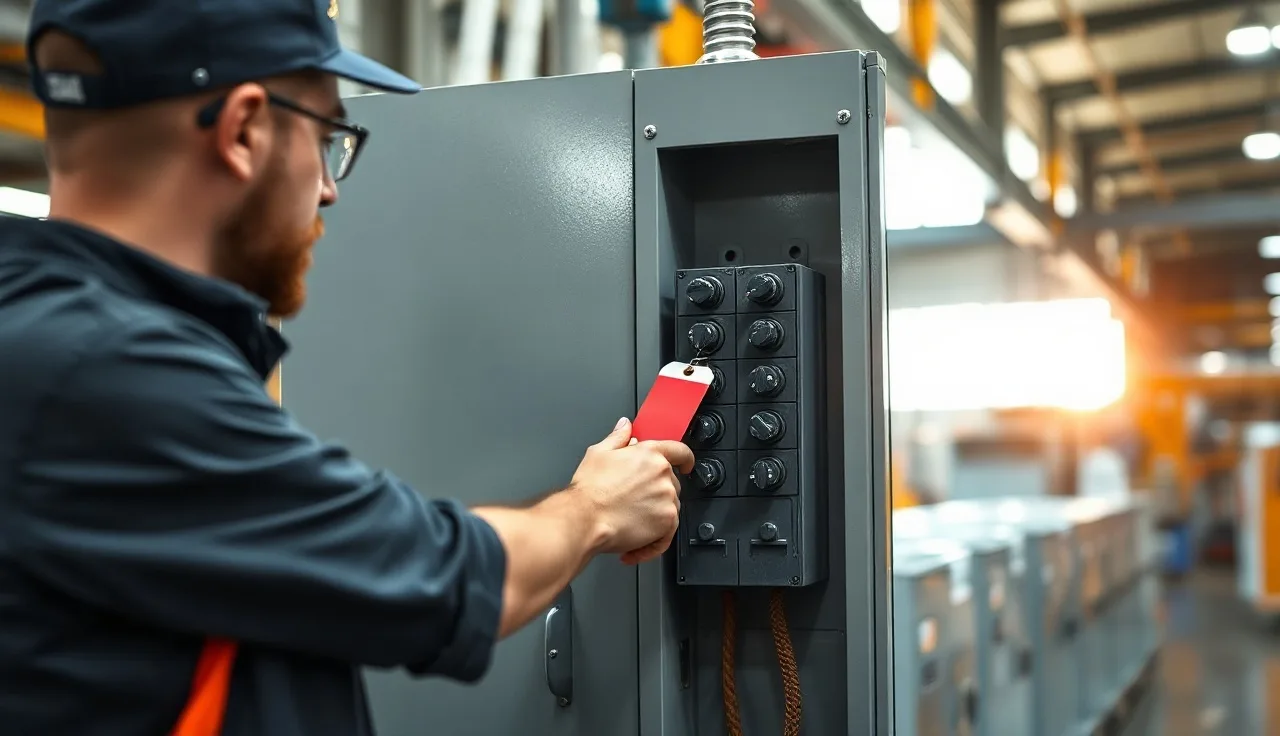
A lockout tagout tag is a physical warning device you attach to an energy-isolating device, like a circuit breaker, valve, or machine disconnect, to tell anyone who walks up: do not operate this equipment. That's the whole job. Simple idea, high stakes.
OSHA's control of hazardous energy standard, 29 CFR 1910.147, spells out what workers must do before servicing or maintaining machinery where an unexpected startup or a release of stored energy could hurt someone [1]. OSHA estimates the standard protects roughly 3 million workers who service and maintain hazardous machinery each year [2]. The agency's own fact sheet ties failure to control hazardous energy to about 50,000 injuries and 120 deaths a year during maintenance and servicing [9].
Tags sit at the center of the program because they are the visible, human-readable signal that an energy control procedure is in progress. A lock without a tag gives no information. A tag with the wrong content gives false confidence. Get either one wrong and a worker can die.
OSHA does not treat tagout mistakes as paperwork problems. They land on the serious citation list, and 1910.147 shows up on OSHA's top-ten most frequently cited standards year after year [8].
If you want the full picture of how the tagout program fits inside a complete written program, read our lockout tagout overview first, then come back here for the tag-specific rules.
What must lockout tagout tags include? The 7 required elements
29 CFR 1910.147(c)(5) lays out what tags must look like and what they must say. The regulation requires that tags be "legible and understandable by all authorized employees" and meet the tagout device criteria in (c)(5)(ii) [1]. Break it down and here are the seven elements every compliant tag needs.
1. A warning legend. The tag has to state "Do Not Start," "Do Not Open," "Do Not Close," "Do Not Energize," "Do Not Operate," or an equivalent message [1]. That legend needs to be prominent, printed or stenciled on the tag body. A general warning scrawled by hand, with no preprinted legend, doesn't cut it.
2. Standardization within the facility. Tags must be standardized by color, shape, or size, and the print and format must be standardized too [1]. Every tag in your building should look the same so a worker reads the hazard signal in a half-second. One crew can't use red paper cards while another uses yellow plastic ones.
3. Durability for the environment. Tags must withstand the environment they're exposed to for the maximum period that exposure is expected [1]. A paper tag soaked by water, steam, or chemicals until it's unreadable is a violation. Outdoor, wet, and chemical jobs call for tags rated for those conditions. Many makers list a temperature range and chemical exposure ratings right on the spec sheet.
4. Legibility. The standard requires tags to be "legible and understandable by all authorized employees whose use or exposure to the equipment may place them at risk" [1]. Font size matters. Ink contrast matters. Language matters if your workforce is multilingual.
5. Built against accidental removal. Tag attachments must be attachable by hand, self-locking, and non-releasable, with a minimum unlocking strength of no less than 50 pounds [1]. They have to attach in a way that stops inadvertent or accidental removal. A string loop or a slip-knot fails this test.
6. Attached to the energy-isolating device itself. The tag goes on the actual device being controlled, not taped to a nearby wall or looped over a pipe two feet away. It attaches directly to the device.
7. Identifying information. The regulation's minimum focuses on the warning legend, but OSHA's compliance directive and nearly every working program add the authorized employee's name, the date, and the reason for the lockout. OSHA enforcement guidance treats identifying the authorized employee as part of an effective program [3].
Three things people get wrong. A warning written in permanent marker on blank card stock is not standardized. A cable tie you can snap with a fingernail does not meet the 50-pound rule. And a tag that reads only "Out of Service," with no "Do Not Energize" or equivalent legend, is not compliant.
When can you use a tag alone instead of a lock?
Rarely, and only under narrow conditions. OSHA's default is a lock. 29 CFR 1910.147(c)(2)(i) makes lockout the required method whenever an energy-isolating device is capable of being locked out [1]. A tag by itself on a lockable breaker is a violation.
Tagout alone is allowed only when the employer can show that the tagout program gives protection equal to what a lockout program would provide [1]. The burden of proof sits on you. In a 1993 letter of interpretation, OSHA said equivalent protection means full compliance with every tagout procedure requirement plus extra safety measures, such as removing an isolating circuit element, blocking a controlling switch, opening an extra disconnect, or removing a valve handle [10].
The honest short list of when tagout alone is legal: the isolating device physically can't accept a lock (no hasp, no locking mechanism, and adding one would require taking the device apart), or you can prove through documented analysis that equivalent protection exists.
Older facilities sometimes run blade-type disconnects that were never designed for a padlock hasp. That's where tagout-only programs get justified most often. Even then, OSHA expects the compensating measures on top of the tag.
How do tagout tags compare to lockout devices? A side-by-side look
Workers and supervisors treat tags and locks as interchangeable. They're not. A lock stops the machine. A tag only warns you about it. Here's the direct comparison.
| Feature | Lockout device (padlock + hasp) | Tagout tag alone |
|---|---|---|
| Physical barrier to re-energization | Yes | No |
| OSHA-preferred method | Yes | No (only when locking is infeasible) |
| Required warning legend | N/A (tag accompanies it) | Yes, mandatory |
| 50-lb removal strength | N/A for lock itself | Yes, required for tag attachment |
| Provides equivalent protection alone | Yes | Only with compensating measures |
| Typical cost per device | $5-$30 for padlock plus hasp | $0.25-$2.00 per tag |
| Durability concern | Minimal | Significant in harsh environments |
The cost gap is real but it's a bad reason to skip locks. A box of 100 compliant nylon-strap tags runs $20 to $60 depending on material. A single padlock and hasp setup costs $8 to $25. A serious OSHA citation makes both numbers look like rounding errors. In 2024, the maximum penalty for a serious violation was $16,550 per violation, and willful or repeat violations reached $165,514 [2].
Tags and locks also work together in group lockout. When several workers service the same machine, each one puts a personal padlock on a hasp, and each lock carries a tag with that worker's name. The machine can't be re-energized until every worker's lock comes off. The tag is the information layer. The lock is the physical barrier.
What materials and durability standards do compliant tags need to meet?
OSHA doesn't publish a list of approved manufacturers or materials. The rule says tags must withstand the environment for the maximum expected exposure period [1]. You match the tag to your actual conditions, and the responsibility for getting that right is yours.
In a clean, dry office or light manufacturing space, a card-stock tag with a plastic laminate usually holds up. In a food plant with high-pressure steam cleaning, you want a nylon or polypropylene tag rated for moisture. In a chemical plant where tags meet solvents or acids, you need material compatibility data from the maker. Some tags carry ratings from -40 F to 250 F or higher.
The attachment gets the same scrutiny as the tag. The 50-pound minimum unlocking strength means the attachment has to resist a real pull. Heavy-duty nylon cable ties, reinforced plastic clips, and metal grommets with cable-locking attachments are common compliant choices. String, twist-ties, and rubber bands are not.
A few material categories and where they fit:
- Card stock with polyester coating: General indoor use, dry environments. Low cost. Not for wet or chemical exposure.
- Polypropylene (poly) tags: Water and many chemical exposures. Good for food and beverage and light manufacturing.
- Vinyl or PVC tags: Better chemical resistance and a wider temperature range. Common in chemical processing.
- Tyvek tags: Tear-resistant, some moisture resistance, lightweight. Often used in utilities and outdoor electrical work.
- Aluminum or stainless steel tags: High-temperature or highly corrosive environments. More expensive, essentially permanent.
When you buy in bulk, ask the supplier for the tag's rated chemical and temperature resistance before you commit. A good-looking tag is worthless if it dissolves, fades, or tears off in a week.
What information should be written on a lockout tagout tag?
A completed tag should answer three questions for anyone who finds it: who put this here, why, and when. The preprinted legend handles the warning. The fill-in fields handle the accountability.
Most compliant tag designs include fields for:
- Authorized employee name (printed, more than a signature nobody can read)
- Date applied
- Reason for lockout (equipment being serviced, fault being repaired, and so on)
- Contact info or department (so anyone with a question knows who to ask)
- Estimated return date or shift (not always required, but useful across shifts)
OSHA's compliance directive for 1910.147, CPL 02-00-147, backs up that tags must identify the authorized employee [3]. If someone goes home sick with their lock and tag still on a machine, the next crew needs to know who to call before touching anything.
Don't rush the fill-in. An illegible date or a first name only breeds the kind of guessing that gets people hurt. "J.S. Maintenance" is not adequate. "James Strickland, Electrical Maintenance, Ext. 4412, 6/15/2025" is.
Some facilities use two-part tags with a tear-off stub that goes into a logbook. The employee keeps or files the stub as proof they applied the tag. That's a good habit, especially in bigger operations, but OSHA doesn't require a specific logbook format.
How should lockout tagout tags be attached and removed?
Attachment is not a detail. It's one of the few spots where the rule hands you a hard number: 50 pounds of removal force [1]. Nobody should be able to bump the tag off or pull it free with a casual tug.
Heavy-duty nylon cable ties (zip ties) rated at 50-pound tensile strength or higher, and made for lockout use, are the most common attachment. Many tag sets ship with the attachment included, and the maker usually prints the rated pull strength on the package. Check it. Not all cable ties are rated the same.
Some tags come with a built-in plastic locking eye that takes a cable, wire, or through-hasp attachment. These get used when you're attaching directly to a padlock hasp alongside a physical lock.
Removal is as controlled as application. Only the authorized employee who applied the tag should remove it, and only after the work is done, the components are back together and safe, employees are clear of the machine, and the isolating device is ready to operate [1]. In group lockout, each person pulls their own tag when their piece of the job is finished.
Say the employee who applied the tag is gone, the worker went home sick, and the equipment is needed. OSHA's rule lets the employer remove the tag under a specific documented procedure. That procedure usually requires verifying the authorized employee is not in the facility, making a reasonable effort to reach them, and confirming it's safe to remove. This should be rare, documented every single time, and written into your energy control program.
What OSHA citations look like for lockout tagout tag violations
OSHA usually cites 1910.147 tag problems as serious violations, meaning there's a substantial probability that death or serious harm could result [2]. Tag-specific citations tend to look like this:
- Tags not attached directly to the energy-isolating device
- Tags missing a required warning legend
- Tags not standardized across the facility
- Tags made of materials that degrade in the environment
- Attachments that fail the 50-pound removal strength requirement
- Tags used alone on lockable devices with no infeasibility determination
Penalties turn on the classification and the employer's history. In fiscal year 2024, the maximum serious penalty was $16,550, and willful or repeat violations topped out at $165,514 [2]. Employers with 25 or fewer employees may get penalty reductions, but the violation still goes on record and stays subject to follow-up inspections.
Here's the pattern worth burning into memory: OSHA inspectors often show up after an accident, not on a routine sweep. If a worker gets hurt on a machine that was supposed to be locked and tagged out, the investigation looks hard at the physical tags that were, or weren't, in place. A non-compliant tag at the scene of an injury can turn a serious citation into a willful one, and the penalty math changes completely.
Keep a supply of compliant, preprinted tags on hand. Train workers to fill them out right. Audit tag condition during periodic inspections. A compliance officer looks for all three. If you're building or updating your written energy control program, the SafetyFolio program generator walks through each required element of 29 CFR 1910.147 and produces a policy you can adapt to your equipment.
How does lockout tagout tag training work under OSHA?
29 CFR 1910.147(c)(7) requires authorized employees (the people who apply locks and tags) to be trained on recognizing hazardous energy sources, the type and magnitude of energy in the workplace, and the methods to isolate and control it [1][11]. Affected employees (people who work around lockout/tagout but don't apply the devices themselves) have to know one thing above all: never restart or re-energize a machine that's locked or tagged out.
Tag-specific training should cover:
- How to read and interpret the warning legend
- How to fill out the identification fields correctly
- How to attach the tag using an approved method
- How to confirm the attachment meets the removal-strength requirement
- What to do when you find a tag on equipment with no matching lock and no idea who applied it
- Your facility's standardized tag: what it looks like and where to find them
Training has to happen before an employee does any lockout/tagout work for the first time. Retraining is required whenever there's reason to believe someone lost the knowledge or skill, or whenever a job assignment, a machine, or an energy control procedure changes [1][11].
For general OSHA training rules and how to keep documented training records, see our osha training guide. For a supervisor-level credential, osha 30 training covers lockout/tagout inside the general industry curriculum.
Do construction sites have different lockout tagout tag rules?
Yes, and it trips up a lot of contractors. 29 CFR 1910.147 covers general industry. Construction work falls under 29 CFR 1926, and for most electrical hazards there, OSHA points to 29 CFR 1926.417, lockout and tagging of circuits [4].
1926.417 is shorter and thinner than 1910.147. It requires that controls used to de-energize circuits and equipment be locked out or tagged, that tags plainly identify the equipment or circuits being worked on, and that tags stay on and equipment stay off until the work is done and it's safe to restore service [4]. The detailed tag construction rules (50-pound removal strength, standardization by color, shape, or size) live in 1910.147, not 1926.417.
In practice, plenty of construction employers apply the more detailed 1910.147 tag requirements anyway, because the principle is identical and inspectors judge whether energy control was actually adequate. On a multi-employer site, the host employer's energy control program often governs, and that program may be written to 1910.147 standards.
Maritime and shipyard work fall under 29 CFR 1915.89, which has its own detailed lockout/tagout requirements and specifies tag construction standards similar to 1910.147 [5].
Know which standard applies to your industry classification before you buy tags or write your program. The tag requirements in 1910.147 are the most specific, and for general industry employers, those are your rules.
Where can you buy compliant lockout tagout tags and what should you look for?
You don't need a safety consultant to source compliant tags. Brady, Panduit, Master Lock, and Accuform are the major makers, and their lockout lines are built to meet 29 CFR 1910.147. Before you buy any tag, check the spec sheet for these:
- Preprinted warning legend ("Do Not Operate," "Do Not Energize," or equivalent)
- Material rated for your environment (temperature range, chemical exposure)
- Attachment rated at 50 pounds or higher
- Standardized format matching your other tags (same color, size, shape)
- Fields for employee name, date, and reason
Prices in 2024 ran roughly $0.25 to $2.00 per tag for standard poly or Tyvek, and $5 to $15 for metal or high-spec industrial tags. Bulk buying drops the per-unit cost a lot. For a small shop with 10 employees, a starter kit of 50 to 100 tags plus a compatible hasp and padlock set is a sensible opening inventory.
Some facilities print their own tags with template software and a durable printer. That's allowed, but you have to verify the output meets the durability standard for your environment and that the design is truly standardized. A tag printed on regular office paper fails the durability test in almost every industrial setting.
One practical move: buy a few sample tags from two or three suppliers and run a pull-test with a luggage scale before you commit to a big order. If the attachment fails below 50 pounds on your bench, that product doesn't meet the standard no matter what the package claims.
How do lockout tagout tags fit into your written energy control program?
29 CFR 1910.147(c)(4) requires employers to establish a written energy control program that documents the procedures for controlling hazardous energy [1]. Tags don't exist on their own. They're one part of a system that also includes equipment-specific procedures, authorized employee lists, training records, and periodic inspections.
Your written program needs to spell out:
- The type of tag your facility uses (with a description or image)
- Where tags are stored
- How workers fill out the identification fields
- The approved attachment method and its rated strength
- How you verify tag durability during periodic inspections
- The procedure for removing a tag when the authorized employee is unavailable
29 CFR 1910.147(c)(6) requires that each energy control procedure be inspected at least annually by an authorized employee other than the one using it [1]. That inspection includes checking that tags are filled out correctly, attached properly, and still in good shape. An inspection that turns up faded, torn, or badly attached tags is a documented compliance problem, and pretending it isn't only makes the next inspection worse.
The periodic inspection has to be certified. You need a written record with the date, the equipment covered, the employees involved, and the name of the person who inspected [1]. Keep those records. Inspectors ask for them.
If building that program feels like a slog, SafetyFolio's safety program generator gets you a working 29 CFR 1910.147 energy control program in about 15 minutes. You still add your equipment-specific procedures, but the framework and required policy language are done.
For how energy control connects to other hazard programs, our hazard communication guide covers the GHS labeling system, which runs on similar hazard-warning logic. And when a lockout failure does cause an injury, our incident report guide covers what to document.
Frequently asked questions
What must lockout tagout tags say?
At minimum, a lockout/tagout tag must display a warning legend such as "Do Not Operate," "Do Not Energize," "Do Not Start," or an equivalent phrase, per 29 CFR 1910.147(c)(5)(ii). Most compliant tags also carry fields for the authorized employee's name, the date applied, and the reason for the lockout, which OSHA enforcement guidance expects to be completed.
Can I use a regular label or handwritten sign instead of a lockout tagout tag?
No. OSHA requires tags to be standardized by color, shape, or size across your facility, durable enough for the environment, and attached with a mechanism rated for at least 50 pounds of removal force. A handwritten sign or stick-on label almost never meets the standardization or durability rules and can't be attached compliantly. Use purpose-made lockout tags from a recognized safety supplier.
How long does a lockout tagout tag need to last?
OSHA says tags must withstand the environment for the maximum period that exposure is expected. There's no fixed calendar life in the regulation. A tag used for a two-hour repair in a dry shop needs different durability than one left on equipment during a week-long shutdown in a wet or chemical environment. Match the material to the actual conditions and expected duration.
What is the minimum pull strength required for a lockout tagout tag attachment?
29 CFR 1910.147(c)(5)(ii)(C) requires tag attachments to be non-releasable with a minimum unlocking strength of no less than 50 pounds. The attachment must also be self-locking and attachable by hand. Nylon cable ties sold for lockout use usually meet this if rated at 50-lb tensile strength, but check the product rating. A slip-knot or ordinary string does not comply.
Can a tagout tag alone replace a physical lock?
Only when the employer can show that a tagout-only program gives protection equal to lockout, usually because the isolating device physically can't be locked. When a device can accept a lock, a lock must be used. Tags alone on lockable devices are an OSHA violation. Even in tagout-only cases, extra compensating measures are required to establish equivalent protection.
Who can remove a lockout tagout tag?
Under normal circumstances, only the authorized employee who applied the tag removes it, and only after confirming the work is done, employees are clear, and the equipment is safe to re-energize. If that employee is unavailable, the employer must follow a documented procedure that verifies the person is off-site, attempts to contact them, and confirms safety before removal. Document this process every time it happens.
Do lockout tagout tags need to be standardized by color?
OSHA requires standardization by color, shape, or size. You don't have to standardize all three; meeting one can be enough, but the chosen standard has to be consistent across the facility. Most programs settle on a specific color (red is common), a consistent size, and a consistent format. Using different tag designs for different departments or equipment types usually violates the standardization requirement.
What is the OSHA penalty for a lockout tagout tag violation?
Tag-related violations under 29 CFR 1910.147 are usually classified as serious, carrying penalties up to $16,550 per violation as of 2024. Willful or repeat violations can reach $165,514 per violation. If a tag violation contributes to a worker injury, OSHA may reclassify it as willful, which sharply increases the penalty exposure and the odds of follow-up inspections.
Do construction workers have to follow the same lockout tagout tag rules?
Construction falls under 29 CFR 1926.417, not 1910.147. The construction standard requires controls to be locked out or tagged, tags to identify the circuits being worked on, and equipment to stay off until the work is done. The construction requirements for tag durability and pull strength are less detailed than 1910.147, but many construction employers apply the 1910.147 tag specs anyway for consistency and better protection.
How often do lockout tagout tags and procedures need to be inspected?
29 CFR 1910.147(c)(6) requires at least annual inspection of each energy control procedure by an authorized employee other than the one using it. The inspection must be certified with a written record showing the date, equipment covered, employees involved, and the inspector's name. Inspectors reviewing tag compliance look at whether tags are filled out correctly, attached properly, and still legible and intact.
What happens to lockout tagout tags during a group lockout?
In group lockout, each authorized employee applies a personal padlock to a hasp, and each lock carries a tag with that person's name and information. No one re-energizes the equipment until every employee's lock and tag is off. Each employee removes their own devices only when their portion of the work is complete and they are clear of the hazard zone.
Are bilingual lockout tagout tags required?
OSHA requires tags to be understandable by all authorized employees whose exposure to the equipment puts them at risk. If any authorized employee can't read English, tags must be provided in a language they can read, or in a format (symbols, pictographs) they understand. Inspectors sometimes find gaps here in facilities with multilingual workforces. Pairing internationally recognized symbols with text is a practical fix.
Can I reuse lockout tagout tags?
The regulation doesn't ban reusable tags, but reuse only works for certain types. Metal or rigid plastic tags with erasable fields can be reused if the attachment is replaced and the tag is clean and legible. Card stock and most poly tags are single-use because the attachment (usually a cable tie) has to be cut to remove it, and filled-in fields don't erase cleanly. Most programs treat standard lockout tags as single-use consumables.
Sources
- OSHA, 29 CFR 1910.147, The Control of Hazardous Energy (Lockout/Tagout): Requirements for tagout device construction, warning legend, standardization, durability, attachment strength (50 lb minimum), removal procedures, annual inspection, and written program.
- OSHA, Control of Hazardous Energy (Lockout/Tagout) topic page: OSHA estimates the standard protects roughly 3 million workers; 2024 maximum penalty for serious violations was $16,550, willful/repeat up to $165,514.
- OSHA, CPL 02-00-147, Inspection Procedures for the Control of Hazardous Energy Standard: Enforcement guidance confirming tagout alone is permitted only when locking is infeasible and that tags must identify the authorized employee; requires compensating measures for tagout-only programs.
- OSHA, 29 CFR 1926.417, Lockout and Tagging of Circuits (Construction): Construction lockout/tagging requirements; controls must be locked out or tagged and tags must plainly identify the equipment or circuits being worked on.
- OSHA, 29 CFR 1915.89, Control of Hazardous Energy (Shipyard Employment): Maritime and shipyard lockout/tagout requirements with tag construction standards comparable to 1910.147.
- OSHA, Occupational Safety and Health Act of 1970: Statutory basis for OSHA's authority to set and enforce standards, including penalty authority.
- Bureau of Labor Statistics, Injuries, Illnesses, and Fatalities program: BLS data on workplace injuries and fatalities in manufacturing, utilities, and construction.
- OSHA, Commonly Used Statistics / Top 10 Most Frequently Cited Standards: Lockout/tagout (1910.147) appears on OSHA's annual top-ten most frequently cited general industry standards.
- OSHA, Lockout/Tagout Fact Sheet (OSHA 3120): OSHA fact sheet attributing an estimated 50,000 injuries and 120 fatalities per year to failure to control hazardous energy during maintenance and servicing.
- OSHA, Standard Interpretation, tagout-only programs and equivalent protection (June 11, 1993): OSHA confirmed tagout-only programs require demonstration of equivalent protection, full compliance with tagout procedure requirements, and additional compensating measures; employers must document infeasibility of lockout.
- OSHA, 29 CFR 1910.147(c)(7), Training and communication: Training requirements for authorized and affected employees under the lockout/tagout standard, including retraining triggers.