Last updated 2026-07-09
TL;DR
OSHA requires specific employee training in more than 100 individual standards across 29 CFR 1910 (general industry) and 29 CFR 1926 (construction). Training has to be hazard-specific, delivered in a language workers understand, and documented. Willful violations run up to $165,514 each as of 2024. No universal curriculum exists. Your obligations depend on the hazards present in your workplace, nothing else.
What does OSHA actually require for employee training?
OSHA has no master training rule. Training requirements live inside individual standards, and there are a lot of them. The General Industry standards alone (29 CFR Part 1910) carry training mandates on everything from hazard communication to powered industrial trucks to bloodborne pathogens. Construction standards (29 CFR Part 1926) run a parallel set of their own.
The framework comes from two places. The OSH Act's General Duty Clause (Section 5(a)(1)) requires employers to keep the workplace free of recognized hazards, and inspectors routinely read inadequate training as a General Duty Clause violation even when no specific standard applies [1]. Then the individual standards spell out exactly what training has to cover, when it happens, and what records you keep.
Every standard with a training requirement tends to specify four things: who gets trained, what topics the training covers, how often retraining kicks in, and whether you need a written record. OSHA's Outreach Training Program (the system behind OSHA 10 and 30-hour courses) is voluntary. A 10- or 30-hour card does not, on its own, satisfy any specific standard's training requirement.
Here's the part people miss. Your training obligations come from the hazards and operations in your building, not from a checklist someone hands you at a seminar.
Which OSHA standards require specific training?
The list is long. Below are the standards that trip up most small businesses, with the CFR citation for each.
| Hazard / Topic | Standard | Who Must Be Trained |
|---|---|---|
| Hazard Communication (GHS) | 29 CFR 1910.1200 | Any worker exposed to hazardous chemicals |
| Lockout/Tagout | 29 CFR 1910.147 | Authorized and affected employees |
| Powered Industrial Trucks (Forklifts) | 29 CFR 1910.178(l) | Operators before independent operation |
| Bloodborne Pathogens | 29 CFR 1910.1030 | Workers with occupational exposure |
| Respiratory Protection | 29 CFR 1910.134 | Workers required to wear respirators |
| Personal Protective Equipment | 29 CFR 1910.132 | Workers required to use PPE |
| Fire Extinguishers | 29 CFR 1910.157(g) | Workers expected to use them |
| Emergency Action Plans | 29 CFR 1910.38 | All employees covered by the plan |
| Electrical (NFPA 70E-aligned) | 29 CFR 1910.332 | Workers exposed to electrical hazards |
| Fall Protection (Construction) | 29 CFR 1926.503 | Workers exposed to fall hazards |
| Scaffolding (Construction) | 29 CFR 1926.454 | Workers who erect, use, or dismantle scaffolds |
For hazard communication, 29 CFR 1910.1200(h) requires training at initial assignment and whenever a new physical or health hazard shows up in the area [2]. That "new hazard" trigger is the one employers forget.
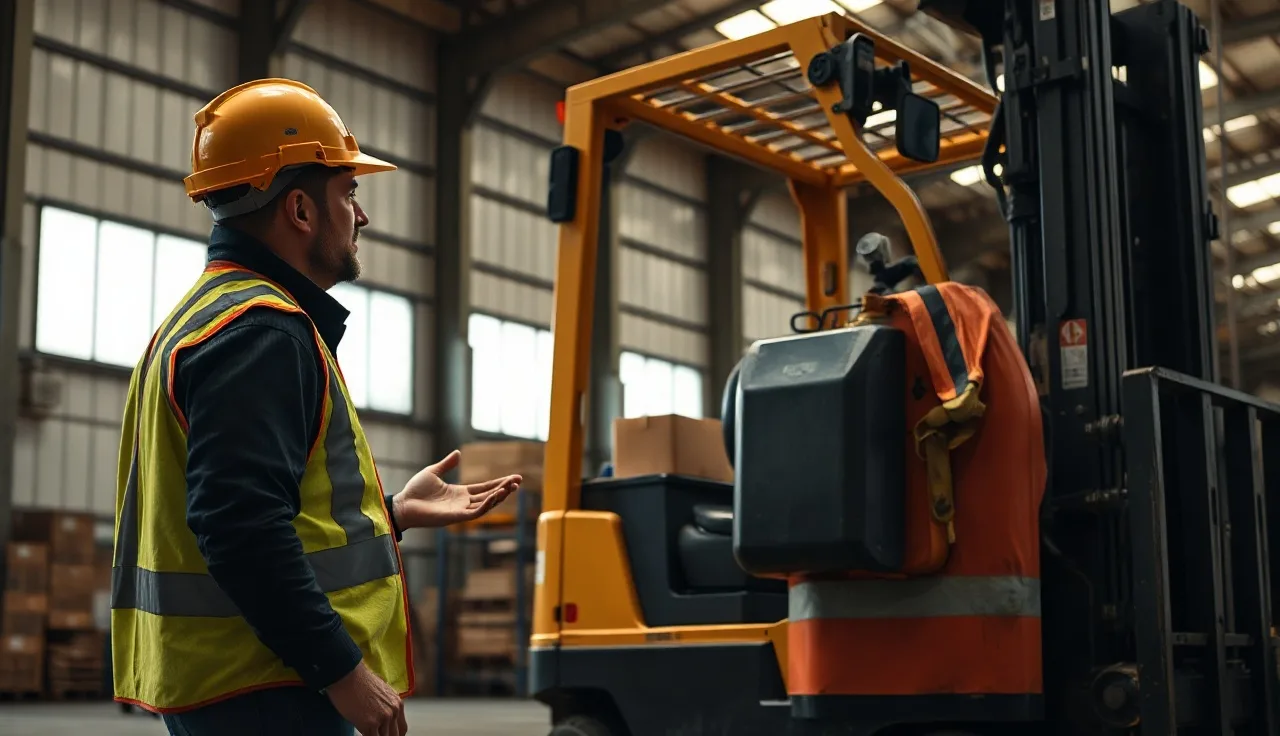
If you run forklifts, the forklift certification standard under 1910.178(l) lands in OSHA's top-cited list year after year. The rules are specific: operators must be evaluated, certified, and recertified at least every three years, plus after any accident or near-miss [3].
Lockout/tagout training under 1910.147 splits workers into two groups. Authorized employees perform the actual lockout. Affected employees work in the area. Each group has different training. Most small employers train everyone the same way and blow past the distinction [12].
What are OSHA's most frequently cited training violations?
OSHA publishes its top 10 most-cited standards every year, and training-related violations run through several of them. If you want to know where the risk is, this list is the map.
For fiscal year 2023, the top 10 included hazard communication (29 CFR 1910.1200), respiratory protection (29 CFR 1910.134), powered industrial trucks (29 CFR 1910.178), and lockout/tagout (29 CFR 1910.147), each carrying embedded training requirements [4]. Those four standards alone generate thousands of citations a year.
The inspector's move is simple. They ask to see training records. If the records are missing, you get cited even if the training actually happened. No documentation equals no training in OSHA's eyes. That is not a loophole. That is the standard you will be held to.
A "no training" citation reads roughly like this on the report: "Employer failed to ensure that each employee who was exposed to [hazard] was trained as required by [standard]." OSHA does not have to prove nobody was trained. They only have to show you cannot prove they were.
Does OSHA training have to be in a specific language?
Yes, in the way that matters for enforcement. OSHA's training standards generally require training in a manner the employee understands [5]. If your crew speaks Spanish, Haitian Creole, or anything other than English, training delivered only in English does not meet the standard. Full stop.
OSHA spelled this out in a 2002 letter of interpretation, which states that employers must present training "in a manner and language that their employees can understand." Handing a worker a translated handout while you lecture in English does not cut it [5].
Practically, that means bilingual trainers, qualified interpreters, or materials that are genuinely translated and delivered in the worker's language. A translated video paired with a bilingual supervisor to field questions is a widely accepted setup, though OSHA has never locked in a single method.
The stakes here are real. Bureau of Labor Statistics data shows Hispanic and Latino workers face fatal occupational injury rates above the all-worker average, a gap researchers tie in part to language barriers in safety training [6]. Getting training into a worker's actual language is not box-checking. The data says it changes who goes home.
How often does OSHA training need to be repeated?
Retraining frequency depends on the standard, and there is no single answer. Here is what the big ones actually say.
Forklift operators get evaluated at least every three years, and retrained after any accident, near-miss, or observed unsafe operation [3]. Bloodborne pathogen training is annual [7]. Lockout/tagout retraining is required when an inspection turns up gaps in an employee's knowledge or when machines or procedures change [12]. Respiratory protection training happens before the worker uses a respirator and again "as necessary" when requirements change, the workplace changes, or the employee shows they didn't retain it.
Some standards, hazard communication included, set no periodic interval at all. They require training at initial assignment and when new hazards appear, and that's it. Plenty of employers run an annual refresher across every standard regardless. That's defensible, but it isn't required.
My rule of thumb: check the specific standard for your hazard. Annual training is rarely wrong, but don't assume it clears every retraining trigger. A near-miss, a procedure change, or a new machine can independently force retraining no matter when the last session ran.
What records does OSHA require you to keep?
Record-keeping requirements vary by standard, and this is another spot where employers get cited without seeing it coming. The training happened; the paper didn't survive.
For lockout/tagout, 29 CFR 1910.147 requires a certification record with the employee's name, the training dates, and the subject. For powered industrial trucks, 1910.178(l)(6) requires a certification listing the operator's name, the training date, the evaluation date, and the trainer or evaluator [3]. For bloodborne pathogens, 1910.1030(h)(1) requires records of every training session, including dates, a content summary, the trainer's name and qualifications, and the names of everyone trained. Those records stay on file for three years [7].
For most other standards, OSHA doesn't dictate a format, but inspectors expect proof training happened. A sign-in sheet with dates, topics, and trainer name, plus the materials you used, is the standard approach. An employee acknowledgment form is a reasonable add-on. It's not universally required.
One practical note. Store these where you can find them fast. OSHA inspectors usually ask for training records inside the first hour of an opening conference. Digging through filing cabinets or old email while an inspector waits is a bad look, and it sometimes turns records that technically exist into citations because they were inaccessible.
What are the penalties for OSHA training violations?
OSHA raises its penalty ceilings every year for inflation under the Federal Civil Penalties Inflation Adjustment Act. For 2024, the maximums are:
- Serious violations: up to $16,550 per violation [8]
- Willful or repeated violations: up to $165,514 per violation [8]
- Other-than-serious violations: up to $16,550 per violation
- Failure to abate: up to $16,550 per day past the abatement deadline
Training violations almost always land as "serious" because failing to train exposes employees to a hazard that could cause death or serious physical harm, which is the legal test for a serious violation under the OSH Act.
In practice, OSHA runs a penalty reduction formula built on good faith, employer size, and violation history. A small employer with fewer than 25 workers can pull reductions of up to 60% for size, with more for good faith and a clean history. The sticker maximum rarely shows up in a real citation. Willful violations are the exception. When the employer knew the requirement and ignored it, there is no good-faith credit and the full multiplier applies.
Getting cited almost always costs more than building the program would have. A single serious training citation plus abatement runs a small employer several thousand dollars at the low end, and that's before legal fees if you contest.
Can OSHA training be done online?
Yes, with conditions. OSHA has never banned online or computer-based training, and its letters of interpretation accept electronic formats. A 2002 letter states that computer-based training can meet OSHA requirements as long as it covers the required content, lets the employee ask questions and get answers, and fits the employee's level and vocabulary [9].
The "ask questions and get answers" piece is the catch. Purely self-paced video with no way to interact does not clearly satisfy that for every standard. Pair the online content with a live or asynchronous Q&A: a supervisor review session after the module, a chat function, or at minimum a named person employees are told to contact.
Hands-on skills are where online alone falls apart. You cannot evaluate a forklift operator through a screen. A worker learning to don a respirator needs a fit test and a real demonstration. The test is whether the training covers what the employee actually has to do, and a lot of tasks demand observed, hands-on practice.
The OSHA 30-hour course delivered online is common now for supervisors and managers. It helps demonstrate a safety culture, but it does not by itself satisfy any standard-specific training requirement. Treat it as a baseline, not a substitute.
How do you build an OSHA training program for a small business?
Start with a hazard inventory, not a training calendar. Walk the workplace. List every task that could hurt someone. Map each hazard to the OSHA standard that governs it. That map tells you which training requirements apply, and everything else follows from there.
A workable small-business program has four parts: a schedule (who gets trained on what, and when), content (matched to the standard's required topics), delivery (in-person, online, or both, in the right language), and documentation (records that survive an inspection).
You don't have to write content from scratch. OSHA publishes free training materials, fact sheets, and QuickCards at osha.gov for most major hazards. OSHA also funds Susan Harwood Training Grants, which produce free training materials aimed at small employers and hard-to-reach workers [10]. These are genuinely useful, and most small employers have never opened them.
If you need a written safety program to anchor the training, SafetyFolio's safety program generator builds one in about 15 minutes, giving you the written foundation your training records attach to. That's a real time-saver when you're starting from zero.
One thing I'd spend money on: bilingual materials if you have a mixed-language crew. One thing I wouldn't buy without checking first: pricey third-party annual retraining subscriptions for standards that don't require annual retraining. Know which standards actually demand it before the invoice shows up.
What is the difference between required OSHA training and OSHA 10/30-hour courses?
This one causes real confusion, so here's the clean version. The OSHA 10- and 30-hour Outreach courses are voluntary programs run through OSHA-authorized trainers. They give a broad overview of OSHA standards, worker rights, and general safety principles. Finishing one does not satisfy the training requirements of any specific standard.
Put plainly: a worker who completes an OSHA 30-hour course has not been trained on lockout/tagout, bloodborne pathogens, or respiratory protection to the level those standards demand. The 30-hour card is a credential that shows general safety awareness. It's worth having, especially for supervisors. It is not a stand-in for standard-specific training.
Some states and cities require OSHA 10 or 30 cards for certain construction or public-works contracts. That's a contract or licensing requirement, separate from OSHA's own mandates. New York City, for example, requires OSHA-authorized safety training for workers on job sites covered by Local Law 196. Always check what your contracts and local laws demand on top of federal OSHA.
The takeaway: OSHA 10/30 is worth doing for supervisors and safety leads. It does not replace the specific training your hazards require. You need both.
How should new employee safety training be handled on day one?
Several OSHA standards require training before the employee starts the work or at the time of initial assignment. Hazard communication training comes before exposure to hazardous chemicals. Lockout/tagout training comes before an employee works on or near machinery subject to the procedure. So your orientation process and your OSHA training program have to be wired together.
New-hire orientation is the natural delivery vehicle. Build a new-hire training checklist that maps each required topic to the role. A warehouse worker needs forklift training (if they'll operate), hazard communication, the emergency action plan, and at minimum a lockout/tagout review as an affected employee. An office worker usually needs emergency action plan training, plus hazard communication if they're near any chemicals.
Document all of it at orientation. Have the employee sign and date an acknowledgment for each module. Confirm they got a chance to ask questions. If training runs in a second language, note the language in the record.
One thing that actually works: pair the formal training with a short supervised walk-through of the real workplace, covering the specific machines, chemicals, and exits the new hire will actually meet. A generic video followed by no real-world context is the pattern that produces workers who remember almost nothing.
How do OSHA training requirements differ between general industry and construction?
General industry (29 CFR Part 1910) and construction (29 CFR Part 1926) are separate regulatory frameworks, each with its own standards. Many hazards show up in both, like fall protection, electrical safety, and PPE, but the training requirements can differ.
Construction's fall protection training standard (29 CFR 1926.503) requires a competent person to run the training, and workers have to demonstrate they understand the fall hazards in the work area and the procedures to reduce them [11]. General industry's fall protection sits under walking-working surfaces (1910.28 and 1910.29, updated in 2017) and carries its own training provisions.
In construction, the competent person concept is everywhere. Scaffolding, excavation, steel erection, and more all require a competent person, defined as someone who can identify hazards and is authorized to take corrective action, to oversee or conduct the training. Small contractors often skip this and never formally designate anyone as competent person for each hazard.
If your business does both, say a maintenance company that does in-plant work plus occasional on-site construction, you have to track which standard applies to each type of work. OSHA generally applies the standard that most specifically addresses the hazard and the work context.
Frequently asked questions
Is OSHA training mandatory for all employees?
Not universally. OSHA training is required only for employees exposed to specific hazards covered by individual standards. Office workers with no chemical exposure and no machinery work may have almost nothing beyond emergency action plan orientation. The more physically hazardous the job, the more standards apply. Start with a hazard assessment of each role, then map the standards that attach to it.
How long does OSHA-required training typically take?
Most standards set no minimum hours. OSHA requires that training cover the required topics effectively, not that it run a fixed length. Hazard communication for a small office might take 30 minutes. Forklift operator training usually takes 6 to 8 hours including the hands-on evaluation. Respiratory protection for a simple dust mask user may take an hour. Match the duration to the complexity of the hazard and the tasks.
Who is allowed to conduct OSHA-required training?
Most standards don't require a certified trainer. They require someone knowledgeable about the hazard and the standard's requirements. Some standards need a competent or qualified person, notably fall protection in construction (1926.503) and lockout/tagout (1910.147). You can train your own people if you or a designated supervisor knows the topic well enough to answer questions accurately and demonstrate the required skills.
What happens if an employee refuses to attend OSHA training?
OSHA puts the compliance obligation on the employer, not the employee. If a worker refuses training and is then exposed to a hazard, the employer still owns the citation. Your move: make training a condition of employment or of continued assignment to hazardous tasks, document the refusal, and pull the employee off the hazardous task until training is done. It's also a legitimate HR discipline matter under most policies.
Do temporary or contract workers need OSHA training?
Yes. OSHA's multi-employer citation policy and a series of letters of interpretation make clear that both the host employer and the staffing agency share responsibility for temp worker safety. Generally the host handles site-specific and task-specific hazard training, while the agency handles general safety orientation. A host employer cannot assume a temp arrived trained on your specific hazards. Document who trained them and when.
Does OSHA require a written training plan or program?
Not for training alone, but many standards that include training also require a written program. Hazard communication requires a written plan under 29 CFR 1910.1200(e). Lockout/tagout requires written energy control procedures under 1910.147(c)(4). Respiratory protection requires a written program under 1910.134(c). In practice, written documentation of what your training covers, who delivers it, and how often it recurs is your strongest defense during an inspection.
What training records does OSHA require, and how long must they be kept?
Requirements vary by standard. Bloodborne pathogen training records must be kept three years (29 CFR 1910.1030(h)(1)(iv)). Forklift certification records have no set retention period but must be current. For most other standards, OSHA doesn't specify a length; three to five years is common practice. At minimum, keep who was trained, the date, topics covered, and the trainer's name, and store them where you can reach them during an inspection.
Can OSHA fine me for training violations if nobody got hurt?
Yes. OSHA cites the violation of the standard, not the injury. A training citation requires only that you failed to train as required and that employees were exposed to the hazard. No injury, illness, or incident is needed. Many training citations come from routine planned inspections, not accident investigations. The absence of injuries is a good-faith factor in the penalty math, not a shield against the citation.
How do I know which OSHA standards apply to my business?
Start at osha.gov with the standards section, organized by industry sector. OSHA also offers free small-business compliance resources and sector-specific e-Tools. The most reliable method is a workplace hazard assessment: walk the facility, flag every task involving chemicals, machinery, heights, electrical work, or emergencies, then look up the standard that governs each one. The standards pages list each regulation with its full text.
Is there a difference between OSHA training and safety orientation?
In practice, yes. Safety orientation is the general day-one introduction: where the exits are, who to call in an emergency, your company's safety policies. OSHA-required training is standard-specific: it covers defined topics, addresses identified hazards, and often requires documentation. A good new-hire program does both. Orientation sets the culture; standard-specific training satisfies your legal obligations. Confusing the two is why employers think they're covered when they aren't.
What is the General Duty Clause, and how does it affect training requirements?
Section 5(a)(1) of the Occupational Safety and Health Act, the General Duty Clause, requires employers to provide a workplace free from recognized hazards likely to cause death or serious harm. OSHA uses it to cite hazards not covered by a specific standard, or when an employer knew about a hazard and did nothing. Inadequate training on a recognized hazard can support a General Duty Clause citation even when no specific training standard exists for that hazard.
What free resources does OSHA provide to help with training?
OSHA offers a lot for free. Its website has QuickCards (summary reference cards), safety and health topics pages for hundreds of hazards, and Susan Harwood Training Grant materials made for small employers and high-hazard workers. OSHA's On-Site Consultation Program gives free, confidential safety advice to small businesses, kept separate from enforcement. The OSHA Training Institute Education Centers also offer some free online courses.
How does OSHA training work for multi-site businesses?
Each site must meet the training requirements for that site's specific hazards. A program built for your main warehouse may miss hazards at a satellite location. For multi-site operations, build a training matrix by job role and location, then keep records maintained and accessible at each site. Remote sites get cited just as readily as headquarters during inspections, and "our main office handles training" is not a defense.
Sources
- OSHA, OSH Act Section 5(a)(1) General Duty Clause: Employers must keep workplaces free from recognized hazards; OSHA cites inadequate training as a General Duty Clause violation
- OSHA, 29 CFR 1910.1200 Hazard Communication Standard: Hazard communication training required at initial assignment and whenever a new physical or health hazard is introduced
- OSHA, 29 CFR 1910.178(l) Powered Industrial Trucks: Forklift operators must be evaluated and certified, with recertification at least every three years or after accidents or observed unsafe operation
- OSHA, Top 10 Most Frequently Cited Standards: Hazard communication, respiratory protection, powered industrial trucks, and lockout/tagout are among OSHA's most-cited standards annually
- OSHA, Standard Interpretations (training must be understandable to employees): OSHA requires training presented in a manner and language employees can understand
- Bureau of Labor Statistics, Census of Fatal Occupational Injuries: BLS data shows Hispanic and Latino workers face fatal occupational injury rates above the all-worker average, a gap linked in part to language barriers in safety training
- OSHA, 29 CFR 1910.1030 Bloodborne Pathogens Standard: Bloodborne pathogen training required annually; records must include dates, content summary, trainer qualifications, and names of trained employees, retained three years
- OSHA, Penalties (2024 penalty adjustments): 2024 maximum OSHA penalties: serious violations up to $16,550 per violation; willful or repeated violations up to $165,514 per violation
- OSHA, Standard Interpretations (computer-based training acceptable with conditions): Computer-based training can meet OSHA requirements if it covers required content, allows questions and answers, and fits the employee's level and vocabulary
- OSHA, Susan Harwood Training Grant Program: OSHA funds free training materials for small employers and hard-to-reach workers through the Susan Harwood Training Grant Program
- OSHA, 29 CFR 1926.503 Fall Protection Training Requirements (Construction): Construction fall protection training must be conducted by a competent person; workers must demonstrate understanding of fall hazards and protective measures
- OSHA, 29 CFR 1910.147 Control of Hazardous Energy (Lockout/Tagout): Lockout/tagout standard distinguishes training requirements for authorized employees versus affected employees; retraining required when deficiencies are observed or procedures change