Last updated 2026-07-09
TL;DR
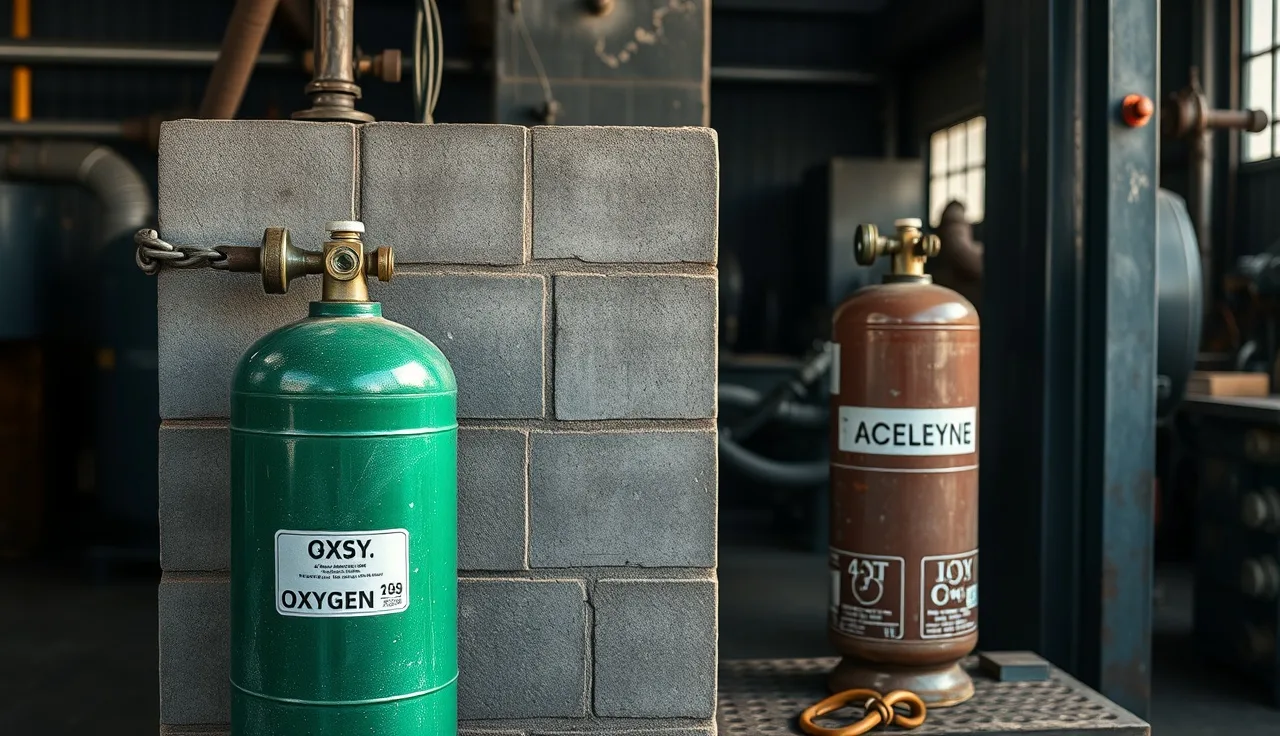
OSHA 29 CFR 1910.253(b)(4)(ii) requires oxygen cylinders in storage to be kept away from fuel gas cylinders (acetylene included) and combustible materials by at least 20 feet, or by a noncombustible barrier at least 5 feet high with a fire-resistance rating of at least 30 minutes. Two cylinders leaning together at the end of a shift is enough to trigger it. This is one of OSHA's most cited compressed gas rules.
What is the OSHA rule for separating oxygen and acetylene in storage?
The rule lives in 29 CFR 1910.253(b)(4)(ii), the standard covering oxygen-fuel gas welding and cutting. Oxygen cylinders in storage must be kept away from acetylene and other fuel gas cylinders, and away from highly combustible materials, unless they are separated by at least 20 feet or by a noncombustible partition at least 5 feet high and able to resist fire for at least 30 minutes. [1]
That's the entire rule. Twenty feet of clear floor, or a 5-foot barrier rated for 30 minutes. Pick one.
Why it exists: oxygen doesn't burn on its own, but it makes everything around it burn faster and hotter. Acetylene is flammable in air at concentrations as low as 2.5 percent. [2] Put a leaking acetylene cylinder next to an oxygen-enriched pocket of air and you get a fire that outruns a shop extinguisher in seconds.
The 30-minute rating isn't a random number. OSHA pulled it from National Fire Protection Association standards on compressed gas storage, to buy workers time to get out and give suppression a chance before a cylinder fails. An 8-inch concrete block wall clears the 30-minute bar without trying. A plywood divider does not. [3]
Does the 20-foot rule apply during use or only during storage?
Only during storage. The separation rule in 29 CFR 1910.253(b)(4)(ii) applies to cylinders being stored, meaning cylinders that aren't connected to a torch and in active use. [1]
When cylinders are in use, or being wheeled between the storage area and a work station, other parts of 1910.253 take over. The standard requires cylinders to be kept away from heat sources and valve protection caps kept on whenever a regulator isn't attached. There is no required separation distance between an oxygen cylinder and an acetylene cylinder while both are hooked up and working at a welding station, though keeping them on the same cart with proper chaining is normal practice.
Here's the line most inspectors draw. The moment you end the shift and pull the regulators, those cylinders are in storage. The 20-foot rule applies right then. A disconnected acetylene cylinder leaning against a disconnected oxygen cylinder overnight is the exact violation OSHA writes up in small welding shops.
Build the habit of moving cylinders to their storage spot at the end of every shift, even if you plan to grab them again at 7 a.m. The few minutes it takes beats a citation. A serious violation runs up to $16,131, and a willful or repeated one up to $161,323, under OSHA's 2024 penalty schedule. [4]
What counts as a compliant noncombustible barrier or partition?
OSHA publishes no list of approved barrier materials. The 30-minute fire-resistance requirement is the test, and it points straight at ordinary building materials that already carry known ratings.
Concrete masonry unit (CMU) block, poured concrete, and standard drywall assemblies using two layers of 5/8-inch Type X gypsum on steel studs all reach 30 minutes without argument. [3] A single layer of 1/2-inch drywall on wood studs generally does not. Neither does corrugated metal sheeting or any wood-framed partition.
The barrier has to be at least 5 feet tall. OSHA set that height so a low leak on the floor of the fuel gas side can't drift over to the oxygen side at breathing height or ignition height. It doesn't have to reach the ceiling, though running it to the ceiling is fine and kills any argument an inspector might start.
What the barrier does not need: a door, a specific width, or a stack of certification paperwork. If an inspector questions your wall, you want to point at it and say "that's CMU block" or "that's a rated gypsum assembly." That ends it. If you cobbled something together from mixed materials and can't name its rating, your local fire marshal or building official can put an opinion in writing, usually at no cost.
How many cylinders trigger the storage separation rule?
Two. The regulation sets no minimum count. One oxygen cylinder and one acetylene cylinder in storage together trigger the requirement. [1]
This catches a lot of small shop owners off guard. They assume the rule targets bulk storage or big cylinder farms. It doesn't. A single set of cylinders stored at the end of a shift, leaning together or sharing one cage, violates 29 CFR 1910.253(b)(4)(ii) unless they're 20 feet apart or split by the required barrier.
The cylinder count does change how you design storage, though. If you keep two or three of each type around, a dedicated cage or room with a rated partition between the oxygen side and the fuel gas side is the cleanest fix. If you only keep one of each, dedicating two corners of the building 20 feet apart is usually simpler and cheaper than building a wall.
What other OSHA cylinder storage rules apply alongside the separation requirement?
Separation gets cited the most, but 29 CFR 1910.253 carries several companion rules that hit the same storage areas.
Cylinders must be stored upright and secured so they can't tip. [1] A falling 200-pound acetylene cylinder can shear its own valve, and a sheared valve turns a compressed gas cylinder into an unguided rocket. Chains or straps run to a wall bracket are the standard fix.
Valve protection caps go on whenever a regulator isn't attached. [1] The cap protects the valve from impact damage.
Keep cylinders away from heat: radiators, direct sun in hot climates, open flames. One number to remember: acetylene stored above 125 degrees Fahrenheit (51.7 C) can start decomposing internally, a fire risk that needs no outside spark at all. [2]
Acetylene also has a pressure ceiling. 29 CFR 1910.253(e)(6)(ii) bans using acetylene above 15 psig (pounds per square inch gauge). That's a use rule, not a storage rule, but it trips up workers who think cranking the regulator gets them more flow. Above 15 psig acetylene turns shock-sensitive and can decompose explosively. [1]
If your shop also carries hazard communication duties, cylinder storage belongs in your chemical inventory and your SDS library. Compressed gases count as hazardous chemicals under OSHA's Hazard Communication standard, 29 CFR 1910.1200. [10]
| Requirement | Standard | What it says |
|---|---|---|
| Separation distance (storage) | 29 CFR 1910.253(b)(4)(ii) | 20 ft or 5 ft noncombustible barrier (30-min rated) |
| Cylinder upright and secured | 29 CFR 1910.253(b)(2)(i) | Must be chained or restrained |
| Valve protection caps | 29 CFR 1910.253(b)(2)(ii) | Required when regulator not attached |
| Acetylene pressure limit | 29 CFR 1910.253(e)(6)(ii) | 15 psig maximum |
| Storage away from heat | 29 CFR 1910.253(b)(2)(i) | Keep from heat sources and open flame |
Does the National Fire Protection Association (NFPA) standard add anything beyond OSHA?
Yes, and it matters most if you're in a state that enforces its own fire code.
NFPA 55, the Compressed Gases and Cryogenic Fluids Code, and NFPA 51, the Standard for the Design and Installation of Oxygen-Fuel Gas Systems for Welding, Cutting, and Allied Processes, both set cylinder storage requirements that often run past OSHA's floor. [5] Many state fire codes adopt NFPA 55 by reference, which means your local fire marshal can cite you under state law for things OSHA might never come inspect.
For most small shops, the real-world gap is signage and ventilation. NFPA 55 wants storage areas posted with the names of the gases stored there and wants indoor areas ventilated so leaking gas can't build up. OSHA 1910.253 assumes adequate ventilation but doesn't spell it out the way NFPA 55 does.
If you operate in an OSHA State Plan state (22 states plus two territories run approved plans as of 2024 [6]), your state plan may fold NFPA requirements directly into its enforcement code, making them as binding as any federal standard. Check your state plan's adopted standards before you assume federal OSHA is the only agency you answer to.
What are the most common OSHA violations related to oxygen and acetylene storage?
Compressed gas storage citations cluster around a short list of repeat offenders in small shops and on job sites.
Number one is the obvious one: cylinders stored together with no 20-foot gap and no rated barrier. Inspectors find it in welding supply corners, maintenance shops, and fab shops on nearly every inspection that touches the storage area. [4]
Second is unsecured cylinders. A chain zip-tied to a wire shelf doesn't count. The cylinder has to be tied to a structural element: a wall, a dedicated rack, or a cart built for the job.
Third is missing valve caps on stored cylinders. Fast to fix. Faster to spot.
A sneakier one: cylinders stored where they can catch grinding sparks, sit next to an electrical panel, or bake near HVAC equipment. OSHA has cited shops for storing cylinders in boiler rooms and mechanical spaces where the heat and ignition risk make the location itself the violation.
Before a surprise visit, it helps to understand what OSHA looks at. Our guide to incident report requirements and inspection triggers walks through what puts your shop on OSHA's radar and what an inspector checks in compressed gas storage.
How do I set up a compliant oxygen and acetylene storage area from scratch?
Start with location. Pick a spot naturally separated from work areas and away from heat. An outside wall with good ventilation beats an interior closet. Ideally cylinder deliveries reach it without rolling cylinders across the shop floor.
Pick your separation method. If your layout gives you 20 feet between oxygen storage and fuel gas storage with no construction, use distance. Mark the two zones with painted floor lines and basic signs. That costs almost nothing.
No 20 feet? Build the barrier. A CMU block wall or a properly built Type X gypsum-on-steel-stud partition between the two zones clears the 30-minute rating. Get it to at least 5 feet, ideally to the ceiling. Budget roughly $800 to $2,500 for materials and labor depending on your building and local trades, though regional prices swing hard.
Install restraints on both sides. Wall-mounted chain brackets or cylinder racks run $30 to $150 per bracket from welding supply companies. Every cylinder position needs one.
Post signs. At minimum, "Oxygen Storage" on one side and "Flammable Gas Storage" on the other. NFPA-style signs with the exact gas names are better.
Write the storage area into your safety program. If you don't have a written program yet, SafetyFolio can generate a compliant one covering compressed gas storage in about 15 minutes. The written program is the first thing an OSHA inspector asks to see.
Then train everyone who touches cylinders on separation, securing, and the valve cap rule. Keep the training records on file. For a place to start, our OSHA training resources cover compressed gas handling inside general industry safety.
Does the separation rule apply on construction sites too?
Yes, under a different regulatory number.
For construction, the standard is 29 CFR 1926.350, covering gas welding and cutting on construction work. 29 CFR 1926.350(a)(10) requires oxygen cylinders in storage to be separated from fuel gas cylinders by the same 20-foot minimum, or a 5-foot noncombustible barrier with a 30-minute fire rating. [7] The wording nearly matches the general industry rule.
Compliance gets harder on a job site because storage is temporary and usually improvised. Cylinders end up staged together at a gate or crammed into a tool trailer. Both spots carry the same fire risk as a permanent shop.
The fix for contractors is simple discipline. Designate a physical spot at each new site as the cylinder storage area before cylinders show up, mark it, and brief the crew. A toolbox talk at project startup that covers cylinder separation takes under five minutes and leaves a documented training record.
Crews also need lockout tagout awareness when welding gear ties into larger systems. Lockout/tagout doesn't govern cylinder storage directly, but the idea of controlling hazardous energy applies whenever cylinders connect to manifold systems or fixed piping.
What are OSHA's penalties for a cylinder storage violation?
OSHA treats most compressed gas storage violations as "serious," meaning the hazard could cause death or serious physical harm and the employer knew or should have known.
For 2024, the maximum penalty for a serious violation is $16,131 per violation. [4] "Per violation" usually means per citation item, not per cylinder, but OSHA can write separate items for separate distinct problems. Unsecured cylinders, missing caps, and bad separation could each land as its own line item.
Willful and repeated violations run up to $161,323 each. A "repeat" means the same standard was cited at your establishment within the previous five years. A "willful" means you knew about the hazard and blew it off anyway.
OSHA raises these civil penalty maximums every year under the Federal Civil Penalties Inflation Adjustment Act. The numbers above reflect the January 2024 adjustment. [11] Check the current penalty schedule on OSHA.gov before any inspection.
The fine isn't the whole cost. A serious citation joins your OSHA inspection history, which anyone can search. For contractors bidding work that requires safety prequalification, a compressed gas citation on record can cost more in lost bids than the fine ever did.
What should a written safety program say about compressed gas cylinder storage?
A written compressed gas storage policy can be short. It just has to be specific enough that a new hire could read it and know exactly what to do.
At minimum, cover these: the storage location for oxygen cylinders, the location for acetylene and other fuel gas cylinders, confirmation those locations meet the 20-foot or barrier rule, the securing method your facility uses, the valve cap rule, the ban on using acetylene above 15 psig, and who inspects the storage area and how often.
The program should also say what happens when a cylinder is damaged, a valve leaks, or a cylinder heads back to the supplier. Gas suppliers like Airgas and Linde publish cylinder return procedures, and pointing to the supplier's procedure in your written program is fine.
If you're building the program from a blank page, SafetyFolio's generated programs cover compressed gas storage, so you're not drafting policy language cold.
OSHA doesn't require a standalone compressed gas program. These requirements can live inside a broader shop safety manual or your hazard communication program, as long as they're covered clearly and employees can get to them.
Frequently asked questions
What is the exact OSHA standard number for oxygen and acetylene storage separation?
The rule is 29 CFR 1910.253(b)(4)(ii) for general industry and 29 CFR 1926.350(a)(10) for construction. Both require at least 20 feet of separation between oxygen cylinders and fuel gas cylinders in storage, or a noncombustible partition at least 5 feet tall with a 30-minute fire resistance rating.
Can I store oxygen and acetylene in the same cage or locker if there's a divider inside?
Only if the divider meets OSHA's specs: noncombustible, at least 5 feet tall, and rated for 30 minutes of fire resistance. A wire mesh divider or plywood partition does not qualify. A CMU block or rated gypsum wall built inside a shared cage would meet the standard.
What happens if my shop doesn't have 20 feet of space between storage zones?
Build the barrier. A 5-foot wall of concrete block or a rated drywall assembly between the oxygen side and the acetylene side is the alternative OSHA spells out under 29 CFR 1910.253(b)(4)(ii). Plenty of small shops with tight floor space use the barrier option routinely.
Does the separation rule apply to partially used or empty cylinders?
Yes. The rule applies to cylinders in storage regardless of fill level. A nearly empty acetylene cylinder still holds flammable gas and still poses a fire risk. Treat any cylinder that still has a valve as if it's full for storage, securing, and separation.
How far from combustible materials do oxygen cylinders need to be stored?
29 CFR 1910.253(b)(4)(ii) applies the same 20-foot (or 5-foot barrier) rule to separation from highly combustible materials as it does to fuel gas cylinders. That covers cardboard stacks, solvent containers, oily rags, and similar materials. Oxygen speeds up combustion dramatically in any of them.
Is there a maximum number of acetylene cylinders I can store indoors?
OSHA's 29 CFR 1910.253 sets no cylinder count limit for indoor storage on its own. But NFPA 55 and local fire codes often cap how much flammable compressed gas you can store in a given occupancy without a separate hazardous materials storage room. Check your local fire code for the specific limit.
What ventilation is required for cylinder storage areas?
OSHA 1910.253 requires storage locations to be well ventilated, dry, and away from heat and ignition sources. NFPA 55, adopted by many state fire codes, is more specific: ventilation openings near the floor for gases heavier than air and near the top for gases lighter than air. Acetylene is slightly lighter than air.
Can acetylene cylinders be stored on their sides?
No. Acetylene cylinders must be stored and used upright. They contain a porous filler soaked in acetone that dissolves the acetylene for safe storage. Laying one on its side lets liquid acetone migrate toward the valve, which fouls the regulator and can push acetone into your work. Standard practice and most supplier agreements prohibit it.
How often should I inspect my cylinder storage area?
OSHA 1910.253 sets no inspection frequency. A practical routine is a quick visual check at the start and end of each shift: cylinders secured, caps on disconnected cylinders, nothing combustible within 20 feet or on the wrong side of the barrier, and no obvious valve damage or leaks. Keep a simple log.
Does OSHA require training on cylinder storage and separation, and how do I document it?
29 CFR 1910.253 doesn't mandate a specific training program for cylinder storage the way the Hazard Communication standard does. But OSHA's general duty clause requires a workplace free of recognized hazards. Training employees on the storage rules, with a sign-in sheet or training record, is the standard way to show compliance if an injury or fatality happens.
What is the maximum pressure for acetylene, and why does it matter for storage?
29 CFR 1910.253(e)(6)(ii) bans using acetylene above 15 psig. Above that, acetylene can decompose explosively even with no oxygen present. It's a use rule, but the practical result is that cylinders should never be pressurized above this level for testing or anything else, and regulators must be set accordingly.
Are there OSHA requirements for labeling or posting signs in cylinder storage areas?
OSHA 1910.253 requires the gas supplier to label the cylinders, but it doesn't mandate specific signs on the storage area walls. NFPA 55 does require posting the names of stored gases. Practically, posting "OXYGEN" and "FLAMMABLE GAS" signs at each zone costs almost nothing and removes all doubt for workers, suppliers, and inspectors.
How do I handle an acetylene cylinder that's been lying on its side when I find it?
Stand it upright and wait at least one hour before using it or attaching a regulator. That gives the acetone time to settle back to the bottom. If it was on its side for many hours, or you see liquid at the valve when you crack it open, call your gas supplier before using it. Do not try to purge the cylinder yourself.
Sources
- OSHA, 29 CFR 1910.253 - Oxygen-Fuel Gas Welding and Cutting: Oxygen cylinders in storage shall be separated from fuel gas cylinders and combustible materials by a minimum distance of 20 feet or by a noncombustible barrier at least 5 feet high having a fire-resistance rating of at least one-half hour.
- Occupational Safety and Health Administration, Safety and Health Topics: Welding, Cutting and Brazing: Acetylene is flammable at concentrations between 2.5 and 82 percent in air, and cylinders stored above 125°F can decompose internally.
- National Fire Protection Association, NFPA 55 Compressed Gases and Cryogenic Fluids Code: NFPA 55 establishes storage, use, and handling requirements for compressed gases including fire-resistance rating criteria for storage barriers.
- OSHA, Penalties, OSHA.gov: OSHA's maximum penalty for a serious violation in 2024 is $16,131 per violation; willful or repeated violations carry penalties up to $161,323 per violation.
- National Fire Protection Association, NFPA 51 Standard for Design and Installation of Oxygen-Fuel Gas Systems for Welding, Cutting, and Allied Processes: NFPA 51 sets design and storage requirements for oxygen-fuel gas systems that often exceed OSHA minimums and are adopted by state fire codes.
- OSHA, State Plans, OSHA.gov: As of 2024, there are 22 states and two territories with OSHA-approved state plans that may adopt additional requirements beyond federal OSHA standards.
- OSHA, 29 CFR 1926.350 - Gas Welding and Cutting (Construction): 29 CFR 1926.350(a)(10) requires the same 20-foot separation or 5-foot noncombustible barrier for oxygen and fuel gas cylinder storage on construction sites.
- Bureau of Labor Statistics, Injuries, Illnesses, and Fatalities: BLS injury and fatality data for welding and gas operations, used as context for compressed gas hazard severity.
- OSHA, 29 CFR 1910.1200 - Hazard Communication Standard: Compressed gases are classified as hazardous chemicals under OSHA's Hazard Communication standard and require SDS documentation and employee training.
- OSHA, Penalties, OSHA.gov: OSHA adjusts civil penalty maximums annually under the Federal Civil Penalties Inflation Adjustment Act; figures cited reflect January 2024 adjustment.