Last updated 2026-07-09
TL;DR
Under 29 CFR 1910.147, three groups must be involved in lockout tagout: authorized employees (who apply the locks), affected employees (who operate the equipment), and supervisors (who enforce the program). Contractors, outside service personnel, and safety coordinators have defined roles too. Each group needs different training, and OSHA requires your written program to name them.
What does OSHA actually require for lockout tagout roles?
The governing rule is 29 CFR 1910.147, OSHA's Control of Hazardous Energy standard. It took effect in 1989 and has not changed much since. The standard defines specific roles, then requires your written energy control program to address each one. [1]
The language is precise about who does what. Section 1910.147(b) gives you the definitions your program has to be built around:
- An "authorized employee" is the person who locks or tags out machines before servicing or maintenance.
- An "affected employee" is someone whose job requires them to operate equipment that is being serviced, or who works in an area where lockout tagout is being performed.
- "Other employees" are anyone else who works in an area where energy control procedures are used.
Those three categories are the floor, not the ceiling. Most workplaces also need to account for supervisors, contractors, and in some operations, a dedicated safety person. Skip any of these and you leave the gap where injuries happen.
OSHA cited lockout tagout violations 2,554 times in fiscal year 2023, making it one of the ten most-cited standards year after year. [2] That frequency traces back to a single habit: employers write programs that list procedures but never say who carries them out.
Who is an authorized employee in lockout tagout?
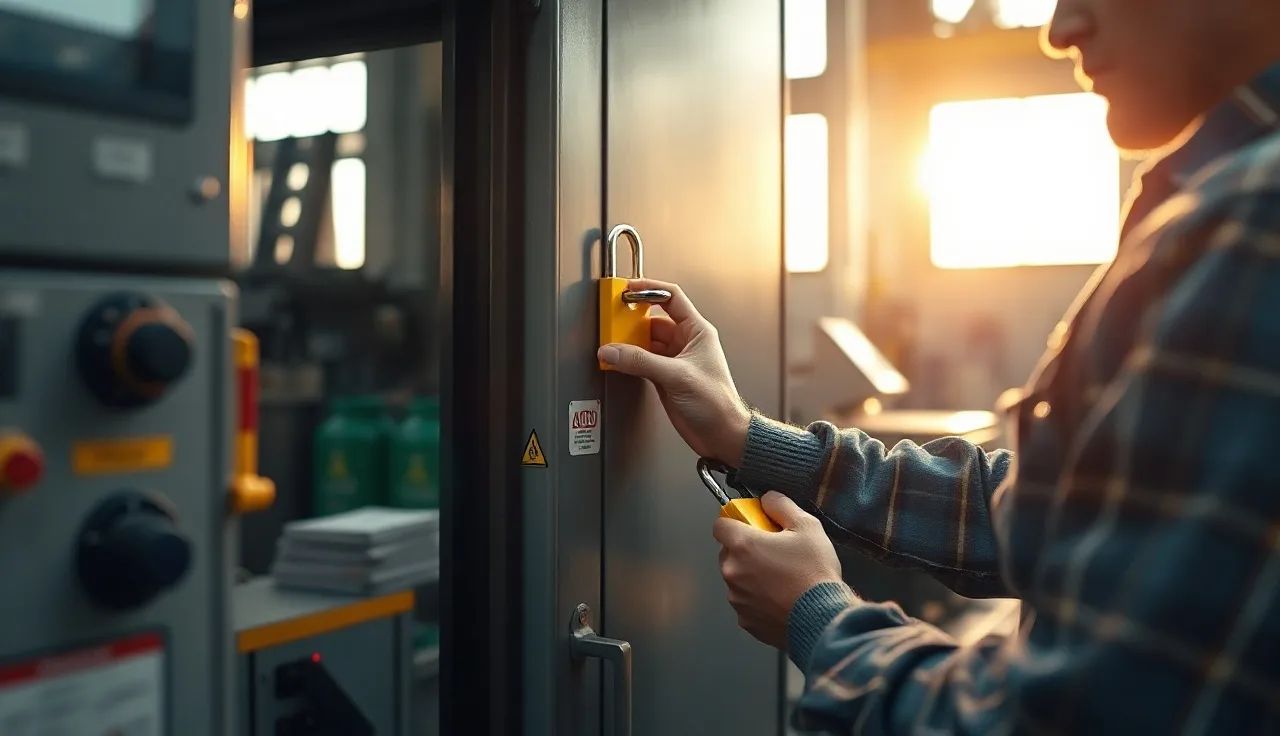
The authorized employee is the person who actually applies the lock or tag. That is the line that matters: only authorized employees apply and remove lockout devices. Nobody else.
Authorized employees need training specific to the hazardous energy sources on the equipment they service. Under 1910.147(c)(7)(i)(A), that training has to cover recognition of applicable hazardous energy sources, the type and magnitude of the energy in the workplace, and the methods for energy isolation and control. [1]
In a small machine shop, an authorized employee might be any maintenance technician. In a food processing plant, it might be the maintenance team plus the line leads who change over equipment. The designation follows the task, not the title. A warehouse supervisor who never services equipment does not need authorized employee status. A production worker who regularly clears jams from a conveyor probably does.
Here is what trips up small businesses. You can end up with a lot of authorized employees by accident. Let anyone restart a machine after clearing a jam without locking out first, and you have created an untrained authorized employee waiting to produce both an injury and a citation. Be deliberate about who gets the designation, and write it into your program.
See our full overview of the lockout tagout standard for the complete procedure sequence authorized employees have to follow.
Who is an affected employee and what do they need to know?
Affected employees are the machine operators or the people working in the area where lockout tagout is happening. They do not apply locks. Their job is to recognize when a lockout is in place, stay clear, and never try to restart equipment that is locked out.
That sounds simple. It is also where fatalities happen. A worker who does not understand why a machine has a lock on it, or who treats the lock as an inconvenience to work around, is a danger to themselves and to the authorized employee whose hands may still be inside the machine.
Training for affected employees under 1910.147(c)(7)(i)(B) has to cover the purpose of the energy control program and the prohibition against restarting or re-energizing machines that are locked or tagged out. [1] Shorter list than authorized employee training. Still has to be documented.
In practice, affected employee training gets folded into general onboarding and then never touched again. That is a mistake. Affected employees should watch a demonstration of how a lockout looks on the specific machines near their workstation. Knowing in the abstract that locks exist is not the same as recognizing one on the machine you run every day.
What role do supervisors and managers play in lockout tagout?
OSHA's standard does not name a separate "supervisor" category, but supervisors carry at least two defined responsibilities that run through 1910.147.
First, supervisors enforce the written energy control program. If an authorized employee skips a step, or an affected employee tries to pull a lock, and a supervisor sees it and does nothing, that supervisor has contributed to a violation. OSHA's multi-employer policy means supervisors at general contractors can be cited for a subcontractor's conduct when they have the ability to correct it.
Second, a supervisor who personally services or maintains equipment is an authorized employee and needs the full authorized employee training. The title buys no exemption from the procedural requirements.
Many small businesses hand supervisors the periodic inspections of energy control procedures. Under 1910.147(c)(6), an authorized employee other than the one using the procedure has to certify an annual inspection of each energy control procedure. [1] Supervisors are a logical pick, but only if they hold authorized employee credentials themselves.
For a wider view of how supervisors fit into OSHA's training framework, the OSHA training overview covers the general duty requirements that apply across every role.
How do contractors and outside service personnel fit into lockout tagout?
This is where small businesses get hurt most often in citations. The contractor relationship feels informal, the paperwork feels like overkill, and neither impression is correct.
Under 1910.147(f)(2), whenever outside personnel are going to do work covered by the energy control standard, the host employer and the outside employer have to inform each other of their respective lockout/tagout procedures. [1] The host employer also has to make sure their own employees understand and follow the restrictions of the outside employer's program.
Plain version: hire a contractor to service a piece of equipment, and you tell them your lockout procedures while they tell you theirs. You agree on which set governs the work. Usually the more stringent of the two wins.
Contractors bring their own locks. That is more than a best practice. It follows from the personal lock requirement at 1910.147(c)(5)(ii), which requires each lock to be individually keyed and controlled. If a contractor uses your lock, you hold a key to their lockout, and the protection collapses.
OSHA issued a 2006 letter of interpretation confirming that host employers share responsibility for contractor compliance when they control the worksite. [3] If a contractor gets hurt because you never communicated your procedures, expect a citation.
Do safety coordinators or safety officers have a formal lockout tagout role?
OSHA does not create a mandatory "safety officer" role in 1910.147. But in any workplace where lockout tagout is a live risk, someone has to own program administration, and a safety coordinator is usually the right answer.
The administrative work includes writing and updating the energy control program, keeping training records, scheduling and documenting the annual procedure inspections, and tracking the corrective actions those inspections turn up. None of it requires the coordinator to physically apply a lock. All of it requires them to understand the procedures well enough to audit them.
In a small business with no formal safety title, this lands on the operations manager or a lead supervisor. Fine, as long as someone actually owns it. Programs written once and filed in a drawer fail inspections because nobody updated the procedure list when new equipment arrived or old equipment left.
If you need to build or update your written program without hiring a consultant, SafetyFolio's safety program generator produces a compliant lockout tagout program in about 15 minutes by walking you through your specific equipment and employee roles. No safety degree required.
What training does each role require, and how is it different?
Training requirements under 1910.147(c)(7) split by role. The standard requires retraining when there is reason to believe a worker lacks the required knowledge or skills, or when job assignments, machinery, or energy control procedures change. [1]
| Role | Training Content Required | Frequency |
|---|---|---|
| Authorized employee | Energy source types, magnitudes, isolation methods, full procedure | Initially + when deficiency found or procedures change |
| Affected employee | Program purpose, prohibition on restarting locked-out equipment | Initially + when deficiency found |
| Other employees | Awareness that equipment is locked out, prohibition on interference | Initially + when deficiency found |
| Supervisor (as authorized) | Same as authorized employee | Same as authorized employee |
| Contractor employees | Must meet the stricter of host or contractor program requirements | Contractor's responsibility, verified by host |
OSHA requires certification of training, which means a written record with the employee's name, the date, and the subject covered. The record does not have to sit on a specific form. It just has to exist and be producible during an inspection.
One honest note. The standard says "retraining" but sets no mandatory annual retraining interval for any role. Some employers confuse the annual procedure inspection with an annual training requirement. Those are two different things. The inspection reviews the procedure itself. It is not refresher training, though you can run both in the same session.
What happens during a group lockout or complex servicing situation?
When several authorized employees work on the same equipment at the same time, a single-lock procedure falls apart. OSHA handles this at 1910.147(f)(3) with the group lockout requirement. [1]
In a group lockout, a primary authorized employee coordinates the job and attaches a group lockout device (usually a hasp). Every authorized employee working on the equipment then adds their own personal lock to that hasp. Nobody can re-energize the machine until every person has removed their individual lock. This is not optional when multiple workers service the same equipment.
Group lockouts require someone to be designated as the primary authorized employee responsible for the group's energy control. That person verifies affected employees are notified, confirms energy isolation before others begin work, and coordinates lock removal at the end.
Complex servicing situations like shift changes are addressed at 1910.147(f)(4). The standard requires a procedure to transfer protection from one shift to the next so the lockout or tagout holds. [1] In practice, the incoming employee applies their lock before the outgoing employee removes theirs. Skip that hand-off, even for five minutes, and you open an unprotected window.
Can one person perform both authorized and affected employee roles?
Yes, and it happens all the time in small businesses. A machine operator who also does routine maintenance on their own equipment can be both an authorized employee and an affected employee for different tasks on the same machine.
The catch is training. That person needs both the authorized employee training and the affected employee awareness training. They usually get it in one session, but the training record has to reflect both designations.
What you cannot do is let an affected employee act like an authorized employee without the training and the designation. This is the production worker who clears a jam by reaching into a machine without locking out, waving it off with "I do this all the time." Familiarity is not a procedure. The standard grants no frequency exception.
Review every job that involves clearing jams, cleaning inside guarded areas, or adjusting machine parts under power, and decide whether the task requires a lockout. If it does, the people doing it are authorized employees by function, and they need the training regardless of their job title.
What does OSHA look for during an inspection of lockout tagout roles?
An OSHA compliance officer inspecting your lockout tagout program works from a specific list. Knowing that list lets you see your own program from the outside.
First, they ask for your written energy control program. If it does not exist, or does not address all the required elements, that is a serious citation before they look at anything else. [1]
Second, they ask for training records for employees with authorized employee status. They often interview those employees to confirm they understand the procedures, more than that they signed a form. Interviewers ask things like "What do you do first when you need to service this machine?" and "Who has a key to your lock?"
Third, they walk the floor and look for lockout devices on equipment during any active servicing. They check whether the locks present match the authorized employees assigned to the task.
Fourth, they look for documentation of the annual procedure inspections. This one trips up experienced employers, because the inspections happen once a year and the records are easy to let slide.
Fifth, they ask about contractors. What is your policy? Who coordinates with outside service personnel? Can you show them the communication?
Run the self-audit even if you never expect an inspection. It surfaces gaps, and closing a gap before an injury beats closing it after one. Our guide on how to file an incident report covers what happens when things do go wrong.
How should a small business assign and document lockout tagout roles?
Start with your equipment list. Every machine that stores or transmits hazardous energy needs a written energy control procedure. Each procedure names the energy sources, the isolation steps, and the type of lockout device required.
Then build a role matrix. List every job position at your facility and mark which ones require authorized employee status, affected employee awareness, or no lockout involvement at all. That matrix becomes an appendix to your written program and tells you exactly who needs which training.
Document training as you go. A sign-in sheet with employee name, date, trainer name, and topic covered satisfies OSHA's certification requirement. Keep those records for the duration of employment plus a few years after. OSHA can request records going back to when the standard last applied.
Schedule your annual procedure inspections as a recurring calendar event. The inspection has to be done by an authorized employee who is not the one normally using the procedure under review. Designate that person in advance. Set a reminder 30 days out so you have time to reschedule if they are on leave.
For operations that involve equipment covered under a different OSHA standard, like electrical work under 29 CFR 1910.333, check whether that standard's requirements exceed 1910.147. When they do, the more protective standard applies. [4]
If your written program needs to be built from scratch, the OSHA overview explains the legal framework that makes a written program mandatory, and SafetyFolio's generator walks you through the role-assignment questions systematically so you do not miss anyone.
Frequently asked questions
Does every employee at a facility need lockout tagout training?
Every employee who works in an area where lockout tagout procedures are used needs at minimum the "other employee" level of awareness training under 29 CFR 1910.147(c)(7)(i)(C). That covers the prohibition against interfering with lockout devices and recognizing when a lockout is in place. Authorized and affected employees need additional role-specific training on top of that baseline.
Can a contractor use the host employer's locks?
No. Each lock has to be individually keyed and controlled by the person who applies it, under 29 CFR 1910.147(c)(5)(ii). A contractor using your lock means you hold the key to their isolation, which defeats personal protection. Contractors supply and control their own lockout devices. Verify this before work starts.
Who is responsible for the annual lockout tagout procedure inspection?
Under 29 CFR 1910.147(c)(6), the annual inspection has to be performed by an authorized employee other than the one using the procedure under review. Most employers assign it to a lead authorized employee, a safety coordinator, or a supervisor who holds authorized employee status. The inspection has to be certified in writing with the date, equipment reviewed, and names of employees involved.
What happens if a contractor does not have its own lockout tagout program?
The host employer is not legally required to make a contractor adopt their exact program, but they must ensure the contractor's employees understand and follow the relevant restrictions. If a contractor has no program, OSHA would likely cite the contractor. The host employer could also be cited if they controlled the worksite and had reason to know the contractor lacked a compliant program.
Does a part-time employee need to be trained as an authorized employee?
If a part-time employee performs servicing or maintenance on machinery with hazardous energy, yes. The authorized employee designation is based on job tasks, not hours worked or employment status. An employer cannot skip training for part-timers, seasonal workers, or temporary employees assigned to covered tasks.
Can one person be both the authorized employee and the one doing the annual procedure inspection?
No. 29 CFR 1910.147(c)(6) requires the annual inspection to be performed by an authorized employee other than the one using the procedure being inspected. The point is independent verification. So you need at least two authorized employees if you have one energy control procedure, or an authorized supervisor who can inspect it.
What training do supervisors need for lockout tagout if they do not personally service equipment?
A supervisor who never personally performs servicing covered by 1910.147 needs at minimum the affected employee training, since they work in areas where lockouts occur and they enforce the program. If they ever apply a lock or supervise the lockout procedure directly, they need full authorized employee training.
How does lockout tagout apply in a group setting, like a maintenance crew?
Group lockouts are addressed at 29 CFR 1910.147(f)(3). A primary authorized employee coordinates the job and attaches a group lockout hasp. Every authorized employee working on the equipment adds their own personal lock to the hasp. The machine cannot be re-energized until every person removes their individual lock. Someone has to be designated as the primary authorized employee responsible for coordination.
Who needs to know about a lockout tagout during a shift change?
All incoming authorized employees who will continue the servicing work must be informed and must apply their own locks before the outgoing employees remove theirs. This hand-off is required under 29 CFR 1910.147(f)(4). Affected employees on the incoming shift also need to know a lockout is in place. A gap here is one of the most common root causes of re-energization incidents.
Is a tagout-only program ever acceptable instead of lockout?
Only when the energy isolating device cannot be locked out. If a tag alone is used, the employer has to demonstrate the tagout system provides protection equivalent to lockout through additional safety measures. OSHA's standard strongly prefers lockout. Tagout-only programs require extra documentation and protective measures and draw higher scrutiny during inspections.
What records does OSHA require for lockout tagout role assignments?
OSHA requires certification that training was conducted, including each employee's name, date of training, and subject covered. For annual inspections, you need the date, equipment inspected, employees involved, and the name of the authorized employee who performed it. There is no mandatory form, but the records have to be producible on demand during an inspection.
Does lockout tagout apply to office or administrative workers?
Only if they work in or regularly pass through areas where energy control procedures are in use. A purely office-based employee with no exposure to machinery or energy isolation areas does not need lockout tagout training. But an office manager who sometimes walks the production floor to talk to supervisors probably qualifies as an "other employee" who needs the basic awareness level of training.
Sources
- OSHA, 29 CFR 1910.147 Control of Hazardous Energy (Lockout/Tagout): Defines authorized employee, affected employee, and other employee roles; sets training, inspection, group lockout, and contractor coordination requirements
- OSHA, Top 10 Most Cited Standards FY2023: Lockout tagout (1910.147) was among OSHA's ten most-cited standards in fiscal year 2023
- OSHA Letter of Interpretation, Multi-employer Responsibility for Contractor Lockout/Tagout, 2006: Host employers share responsibility for ensuring contractor compliance with energy control requirements when they control the worksite
- OSHA, 29 CFR 1910.333 Electrical Safety-Related Work Practices: Electrical servicing may require more protective requirements than 1910.147 alone; when requirements conflict, the more protective standard applies
- OSHA, Control of Hazardous Energy (Lockout/Tagout) Safety and Health Topics Page: OSHA estimates compliance with the lockout tagout standard prevents roughly 120 fatalities and 50,000 injuries annually
- Bureau of Labor Statistics, Census of Fatal Occupational Injuries Summary: Contact with objects and equipment, including caught-in and struck-by events preventable by lockout tagout, is a leading category of fatal occupational injuries
- OSHA, Lockout/Tagout Fact Sheet (OSHA 3120): Workers injured by unexpected energization or start-up of machines, or contact with a residual energy source, account for a significant share of serious industrial accidents
- OSHA, Compliance Directive CPL 02-00-147 for 1910.147: OSHA's compliance directive for 1910.147 outlines inspection procedures for energy control programs, including role verification and record review
- OSHA, Training Requirements in OSHA Standards (OSHA 2254): Summarizes required training content and certification requirements for authorized and affected employees under 29 CFR 1910.147(c)(7)
- NIOSH, Preventing Worker Deaths from Uncontrolled Release of Hazardous Energy: NIOSH identified failure to implement or follow energy control procedures, and inadequate training, as primary contributing factors in energy-release fatalities reviewed