Last updated 2026-07-09
TL;DR
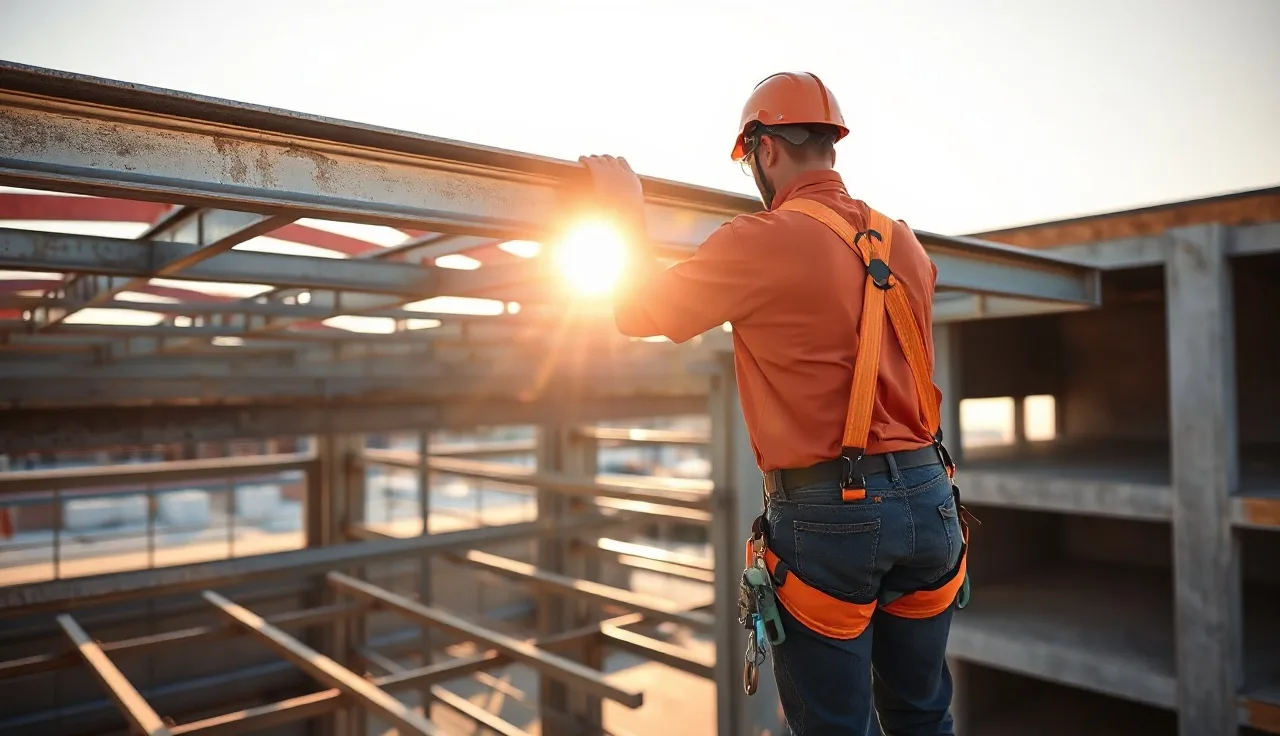
A full-body harness is OSHA's required fall arrest system for most work above 6 feet in construction (29 CFR 1926.502) and 4 feet in general industry (29 CFR 1910.28). Inspect it before every use, wear it correctly, and anchor it to a point rated for at least 5,000 pounds per attached worker. Body belts alone are banned for fall arrest.
What does OSHA actually require for fall protection harnesses?
OSHA splits its fall protection rules by industry. Construction runs under 29 CFR 1926.502(d). General industry runs under 29 CFR 1910.140, which took effect in January 2017 and replaced the old body-belt rules. Both standards agree on one thing: if you use a personal fall arrest system, it has to include a full-body harness. Body belts are flatly prohibited for fall arrest under both, because they load all the arrest force onto the abdomen and can rupture internal organs.
The trigger heights differ. Construction workers get fall protection at 6 feet above a lower level [1]. General industry workers get it at 4 feet [2]. Those heights apply no matter how you protect people, and a harness is only one option. Guardrails and safety nets also satisfy the rule. A harness becomes mandatory only when you pick personal fall arrest as your method. For roofing, steel erection, and most elevated platform work, that's usually where you land anyway.
The standard also sets hard performance numbers. Under 29 CFR 1926.502(d)(15), a personal fall arrest system must hold maximum arresting force to 1,800 pounds, bring a falling worker to a complete stop, and limit free fall to 6 feet or less. Those three numbers drive every later decision about harness rating, lanyard type, and anchor choice.
What are the different types of fall protection harnesses?
Harnesses are not interchangeable, and the differences show up fast in the field.
A standard full-body harness has a back D-ring, leg loops, and a chest strap. It spreads arrest forces across the thighs, pelvis, and chest. This is the baseline for most construction and general industry fall arrest. A basic one runs $75 to $200 at most safety suppliers.
A positioning harness adds side D-rings so a worker can lean into a structure hands-free, common in window washing and ironwork. Those run $150 to $350. A climbing harness has front and back D-rings rated for climbing loads. A suspension or rescue harness is built for long hang times with heavy padding in the leg loops, which matters for rope access and confined space rescue.
Most small employers need one thing: a Class A full-body harness with a back D-ring, built to ANSI/ISEA Z359.11 (the current standard for full-body harnesses), paired with the right lanyard for the job [3]. Skip the positioning features you'll never use. But here's the exception worth paying for. If a worker might have to self-rescue, or could hang in the harness for more than a few minutes waiting on help, leg-loop padding stops being a comfort item and becomes a safety one. Suspension trauma can set in within minutes of hanging motionless in a bare-bones harness.
How does a fall protection lanyard work with a harness?
The harness is only half the system. The harness spreads arrest forces across the body. The lanyard, or self-retracting lifeline, connects the harness D-ring to an anchor point. Neither works without the other.
Shock-absorbing lanyards are standard on most construction sites. They have a tear-away pack that deploys during a fall, stretching the lanyard by up to 3.5 feet while it soaks up energy and keeps arrest forces under 1,800 pounds. A standard shock-absorbing lanyard is 6 feet long. That means your fall clearance has to cover four things: the 6-foot lanyard, up to 3.5 feet of pack deployment, the worker's height (roughly 6 feet with the attachment at mid-back), and a safety buffer of at least 2 feet. Add it up and you need close to 18 feet of clearance below the anchor. Don't have it? A standard 6-foot lanyard lets the worker hit the ground before arrest finishes [4].
Self-retracting lifelines (SRLs) fix the clearance problem in most situations. They lock almost instantly, holding free fall to inches instead of feet. A standard SRL needs only 2 to 4 feet of clearance, depending on the model. They cost more ($200 to $800 and up), but on flat roofs, elevated platforms, or anywhere the anchor can't sit directly overhead, an SRL usually beats a plain lanyard on both safety and practicality.
Double-leg lanyards (Y-lanyards) are required anywhere workers must stay tied off continuously while moving point to point, like communication towers or steel erection. One leg clips in before the other unclips. Both legs never hang free at once.
For the anchor itself, 29 CFR 1926.502(d)(15) requires that anchor points hold at least 5,000 pounds per attached employee, or be designed by a qualified person to a 2:1 safety factor [1]. A structural steel beam usually passes. A purlin or a corrugated roof panel usually doesn't.
How do you inspect a fall protection harness?
OSHA requires inspection before each use under 29 CFR 1926.502(d)(21) and 29 CFR 1910.140(c)(20). That's not a suggestion. It's a pre-shift task, every shift.
Here's what a real pre-use inspection covers.
Webbing: hold a 6-inch section between your thumbs and index fingers and bend it into an inverted U. Watch for cuts, fraying, discoloration, chemical staining, heat damage, or any spot where the fibers pull apart. Run every inch of every strap through your hands.
Hardware: check D-rings for distortion, cracks, or corrosion. Tongue buckles should move freely and lock without slipping. Snap hooks and carabiners need locking gates that close smoothly and positively. A snap hook that won't lock is done.
Labeling: OSHA and the ANSI standard both require permanent labels with the manufacturer, model, serial number, and manufacturing date. Missing or unreadable labels mean the harness comes out of service.
Impact indicators: many modern harnesses have a pull-through indicator, usually a red sleeve or tab, that shows itself once the harness has arrested a fall. If it's deployed, the harness is finished. Period. Even if the webbing looks perfect.
Beyond the pre-use check, a competent person should run formal documented inspections on the manufacturer's schedule, usually every six months to a year for gear in regular service. Log each one with the harness serial number, the date, and the inspector's name. Manufacturers publish retirement guidance too. Most say retire harnesses after 5 to 10 years from the manufacturing date no matter how they look, and plenty of safety pros treat 5 years as the practical ceiling for harnesses living in harsh conditions.
After any arrested fall, pull the harness immediately. A qualified person inspects it before anyone decides whether it goes back. The default answer is retirement, not reuse.
How do you put on a fall protection harness correctly?
Donning a harness wrong is nearly as dangerous as skipping it. A loose or badly adjusted harness can let a worker slip out mid-fall, or dump arrest forces into the wrong part of the body and cause injury.
Here's the correct sequence for a standard back-D-ring full-body harness.
1. Hold the harness by the back D-ring and shake it out to clear any twists. 2. Slip both shoulder straps on like a backpack. 3. Connect the chest strap and set it at mid-sternum. Not the throat, not the belly. 4. Connect the leg loops. They should be snug enough that two fingers slide under, no more. Too loose and the worker slips through. Too tight and it cuts off circulation. 5. Confirm every buckle is latched. Tongue-and-frame buckles need the tongue all the way through the frame and seated. 6. Tighten all straps so the back D-ring sits between the shoulder blades, not down at the small of the back. 7. Have a coworker run a buddy check: look at the D-ring position, confirm no strap is twisted, and check that no excess webbing dangles.
The buddy check is the step most small employers skip. It takes 90 seconds and it catches real problems. Make it a written requirement in your program. If you need a fall protection written program fast, the SafetyFolio safety program generator builds an OSHA-aligned one in about 15 minutes instead of hunting down templates.
One more thing. Harnesses aren't one-size-fits-all. Most makers offer small through XL in both weight and height configurations. A harness dialed in for a 200-pound worker may fit a 130-pound worker badly even if both can buckle it. Check the manufacturer's sizing chart against each worker's weight and chest measurement.
What does fall protection training need to cover under OSHA?
Training is required, no exceptions. 29 CFR 1926.503 says every employee who could be exposed to fall hazards has to be trained by a competent person before exposure [8]. General industry workers fall under 29 CFR 1910.30, which reads essentially the same.
Training has to cover the nature of the fall hazards in the work area, the correct way to erect and dismantle fall protection systems, how personal fall arrest systems (harnesses and lanyards included) actually work, each worker's role in the fall protection plan, and the limits of the equipment.
OSHA sets no minimum number of hours. What it does require is that training be enough for the worker to prove they understand it. Retraining kicks in when a worker shows they don't get it, when conditions change, or when new equipment shows up.
Documentation matters. Keep records with each worker's name, the training date, and the trainer's signature. OSHA inspectors ask for these during inspections and after incidents, so treat them as evidence you'll need to produce.
For broader context on structuring safety education for your crew, see our guides on osha training and osha 30 training.
How common are fall fatalities, and what does the data actually show?
Falls kill more construction workers than anything else. The Bureau of Labor Statistics counted 395 fatal falls in construction in 2022, out of 1,069 construction deaths total [5]. That's roughly 37 percent of all construction fatalities from one hazard category. Falls also top OSHA's citation list year after year. The general fall protection standard, 29 CFR 1926.501, has held the number-one spot on OSHA's most-cited list for over a decade [6].
General industry looks different but still ugly. BLS data for 2022 shows falls, slips, and trips caused 805 fatalities across all industries combined [5]. A lot of those were unprotected elevated work where a properly fitted, properly anchored harness would have changed the outcome.
The money side is real too. As of 2023, OSHA's maximum penalty for a serious violation is $15,625, and willful or repeated violations run up to $156,259 [7]. Those figures adjust every year for cost of living. A single fatality dwarfs any citation. OSHA's own analysis puts the average cost of a construction fatality, counting penalties, litigation, and lost productivity, at $1 million or more, though the exact number swings hard by case.
What are the most common fall protection harness mistakes employers make?
Looking at OSHA citation data and inspection patterns, the same handful of mistakes keep showing up.
Botched clearance math is the most dangerous. Employers buy 6-foot shock-absorbing lanyards, anchor them at or below shoulder height, and never run the numbers. The worker falls 6 feet of lanyard, plus 3.5 feet of pack deployment, plus their own height before stopping. If the drop is 10 feet and the anchor sits at 8 feet, the math simply doesn't close. Use an SRL or a shorter lanyard in those spots.
Bad maintenance is a close second. Harnesses tossed in truck beds or toolboxes next to chemicals and tools get chewed up without anyone noticing. UV, petroleum products, and abrasion all degrade webbing. The pre-use inspection habit is the only real defense, and it only works when workers actually know what to look for.
A missing written program draws citations too. OSHA expects a written fall protection plan when conventional fall protection is infeasible or creates a greater hazard, which is common in residential construction under 1926.502(k). Even when no written plan is technically required, inspectors want proof that a competent person assessed the site's fall hazards.
Anchor mistakes happen when workers clip to whatever's handy instead of an engineered or clearly rated point. Guardrail top rails, roof hatches, pipe penetrations, and HVAC units are not anchors.
Sharing gear without a sizing check rounds out the list. A harness adjusted for one worker and handed to another without readjustment can fit dangerously wrong. Assign harnesses individually, or build a readjustment step into every handoff.
For documentation after a fall incident, our guide on incident reports walks through exactly what OSHA expects.
How do you choose the best fall protection harness for your specific application?
No single harness wins every job. The right pick depends on what the worker is actually doing.
General construction, elevated platform work, or roofing: a standard full-body harness with a back D-ring, paired with an appropriate SRL or shock-absorbing lanyard, handles most of it. MSA, 3M/DBI-SALA, Miller (Honeywell), and Protecta all have solid track records and easy access to replacement parts. A quality harness alone runs $100 to $250.
Steel erection and tower climbing: OSHA's steel erection standard (29 CFR 1926 Subpart R) sets specific rules, including 100% tie-off during leading edge work [11]. A double-leg Y-lanyard, or an SRL combined with a positioning strap, is usually the practical answer.
Confined space entry: fall arrest often pairs with retrieval. Workers need a harness with a back D-ring for arrest and a sternal or front D-ring rated specifically for retrieval. Confirm the sternal D-ring is rated for retrieval, more than attachment.
Work over water: OSHA requires added protection, including lifejackets, under certain conditions (29 CFR 1926.106) [12]. A harness by itself doesn't meet that.
| Application | Recommended Harness Type | Lanyard/Lifeline | Typical Harness Cost |
|---|---|---|---|
| General construction / roofing | Full-body, back D-ring | SRL or 6-ft shock absorber | $100-$250 |
| Steel erection (100% tie-off) | Full-body, back D-ring | Double-leg Y-lanyard | $150-$350 |
| Tower climbing | Full-body, front + back D-rings | SRL-C (leading edge rated) | $200-$500 |
| Confined space rescue | Full-body, back + sternal D-ring | Tripod/winch retrieval system | $200-$450 |
| Window washing / positioning | Full-body, back + side D-rings | Positioning lanyard + backup | $200-$400 |
Fit matters as much as features. Have workers try harnesses on before you buy in bulk. An uncomfortable harness gets worn loose or not at all.
When must a harness be taken out of service?
The manufacturer's documentation controls this, not gut feel. OSHA points to manufacturer instructions throughout 1910.140 and 1926.502. If you don't have the manufacturer's inspection and retirement criteria, go get them. Most live on the manufacturer's website.
Mandatory retirement triggers:
Any fall arrest event. The harness did its job. Retire it. Some manufacturers allow a return to service after a qualified person inspects it, but the industry standard practice is retirement after any arrest.
Visible damage: cuts to webbing, distorted or cracked hardware, chemical contamination, heat damage, missing or illegible labels.
Deployed impact indicator. Most modern harnesses carry a visual indicator that shows when arrest forces hit the system.
Age past the manufacturer's service life. Most makers cap service life at 5 to 10 years from the date of manufacture (stamped on the label), regardless of condition. Many safety managers use 5 years as a hard cutoff for gear that lives outdoors.
When you're not sure, retire it. A new harness costs $150. A fall fatality costs everything. There's no gray area worth arguing over.
For how PPE fits your wider osha compliance picture, the hierarchy of controls puts personal fall arrest in context: engineering controls (guardrails, covers) come before PPE in OSHA's framework.
Does your written safety program need to address fall protection specifically?
Yes, for most employers with elevated work. OSHA doesn't demand a written fall protection program from every employer the way it demands a written HazCom program, but some situations make one mandatory.
Under 29 CFR 1926.502(k), residential construction employers who can't use conventional fall protection must have a written fall protection plan. Site-specific. Signed by a competent person. Kept at the job site [1].
Broader than that, OSHA's general duty clause, Section 5(a)(1) of the OSH Act, means any employer with recognized fall hazards needs documented controls. In practice, inspectors look for a written program, or at least documented hazard assessments, when they investigate a fall incident or a citation.
A good written program covers the scope of fall hazards at your specific sites, the control methods you picked (guardrails, personal fall arrest, safety nets), equipment selection and inspection rules, training requirements and records, rescue procedures for a suspended worker who's arrested a fall, and the name of the competent person who owns the program.
The rescue plan is the piece most small employers forget entirely. OSHA's preamble to 1910.140 states plainly that prompt rescue is required because suspension trauma can turn life-threatening within minutes. If your plan for a suspended worker is "call 911," you need a better plan. Fire departments can be 15 to 30 minutes out and may not carry gear for an elevated rescue.
If building a full fall protection program from scratch sounds like a slog, the SafetyFolio safety program generator produces a ready-to-edit written program in about 15 minutes, including the sections OSHA looks for during an inspection.
What are OSHA's rules on harness use for general industry versus construction?
The two standards share a philosophy and split on the specifics. Here's the direct comparison.
29 CFR 1926.502(d) (construction) was the original. It sets the 6-foot trigger, bans body belts for fall arrest, requires anchors rated at 5,000 pounds per employee, and caps free fall at 6 feet and arrest forces at 1,800 pounds [1].
29 CFR 1910.140 (general industry) took effect January 17, 2017 [2]. It sets the 4-foot trigger (3 feet for fixed ladders in some configurations), bans body belts for fall arrest, and uses essentially the same performance specs. It also addresses self-retracting lifelines, vertical lifelines, horizontal lifelines, and anchorages in a more organized way than the older construction standard.
One meaningful difference: 1910.140 explicitly requires a written certification record of anchorage testing when anchorages are designed to a 2:1 safety factor rather than the 5,000-pound default. Construction's 1926.502 has a similar provision, but the standard text spells it out less clearly.
If your business does both construction and general industry work, say a facilities team that both builds and maintains equipment, you may fall under both standards depending on the task. When there's ambiguity, the more protective standard generally wins.
Frequently asked questions
At what height does OSHA require a fall protection harness?
OSHA requires fall protection at 6 feet above a lower level in construction (29 CFR 1926.501) and 4 feet in general industry (29 CFR 1910.28). A full-body harness is required specifically when you choose personal fall arrest as your control method. Guardrails and safety nets are alternatives that satisfy the rule without a harness.
Can I still use a body belt for fall protection?
No. Body belts are banned for fall arrest under both 29 CFR 1926.502(d) and 29 CFR 1910.140. They concentrate arrest forces on the abdomen and can cause serious internal injuries. Body belts can still be used for positioning, meaning keeping a worker in place rather than arresting a fall, but a full-body harness must handle the arrest function.
How often should a fall protection harness be inspected?
Before every single use, as required by 29 CFR 1926.502(d)(21) and 29 CFR 1910.140(c)(20). A competent person should also run formal documented inspections on the manufacturer's schedule, usually every six months to a year. Inspection records should include the harness serial number, the date, and the inspector's name.
What anchor point strength is required for a fall protection harness?
At least 5,000 pounds per attached employee, per 29 CFR 1926.502(d)(15). A qualified person can instead design an anchorage to a 2:1 safety factor, but that requires documentation. Structural steel beams typically qualify. Roof panels, HVAC equipment, and guardrail posts typically do not.
How long can you use a fall protection harness before it must be retired?
Most manufacturers cap service life at 5 to 10 years from the manufacturing date stamped on the label, regardless of apparent condition. Any harness that has arrested a fall must come out of service immediately. Visible damage, chemical contamination, or a triggered impact indicator are also automatic retirement triggers.
What is the difference between a fall protection lanyard and an SRL?
A standard shock-absorbing lanyard is 6 feet long and deploys a tear-away pack during a fall, needing roughly 18 feet of clearance below the anchor. A self-retracting lifeline (SRL) locks within inches of fall initiation and needs only 2 to 4 feet of clearance. SRLs cost more but are often the safer and more practical choice when anchor points can't sit directly overhead.
Does OSHA require a written fall protection program?
A written plan is mandatory for residential construction when conventional fall protection is infeasible, under 29 CFR 1926.502(k). For other employers, no single regulation always requires it, but OSHA's general duty clause means documented hazard assessments and controls are expected. A written program is strong evidence of compliance and is almost always worth having.
What should a fall rescue plan include?
OSHA requires prompt rescue for any suspended worker because suspension trauma can turn life-threatening within minutes. A rescue plan should name the rescue method (self-rescue, assisted rescue, or emergency services), identify who's responsible, list the rescue equipment on site, and define the maximum acceptable wait before rescue starts. Calling 911 alone is not a compliant rescue plan.
What fall protection is required on a roof?
For construction roofing at or above 6 feet, 29 CFR 1926.502 requires guardrails, safety nets, or personal fall arrest systems. On low-slope roofs, personal fall arrest with a full-body harness and an SRL or shock-absorbing lanyard is the most common method. Steep-slope roofing carries the same trigger height. Residential roofing under 1926.502(k) allows a written alternative plan when conventional protection is infeasible.
How do you properly store a fall protection harness?
Store harnesses away from direct sunlight (UV degrades nylon and polyester webbing), heat sources, chemicals, and sharp objects. Hang them on a peg or lay them flat in a breathable bag. Never leave a harness in a truck bed where it gets crushed under tools and exposed to vehicle fluids. Inspect after any unusual storage condition before returning it to use.
Is fall protection training required by OSHA?
Yes. 29 CFR 1926.503 requires that all employees exposed to fall hazards be trained by a competent person before exposure. General industry workers fall under 29 CFR 1910.30 with the same requirement. Training must cover fall hazards in the work area, the use of personal fall arrest systems, and equipment limitations. Records must document each employee's training.
What is the maximum free fall distance allowed with a harness?
29 CFR 1926.502(d)(16)(iii) limits free fall distance to 6 feet when using a personal fall arrest system, and total arrest force must not exceed 1,800 pounds. Standard 6-foot shock-absorbing lanyards meet this when anchored above the worker's back D-ring, but you must calculate clearance to the lower level first to confirm the system stops the worker before impact.
Can the same harness be shared between workers?
Sharing is allowed but requires full readjustment for each wearer and a fresh pre-use inspection. In practice, shared harnesses often get worn with leftover adjustments from the previous user, which creates fit and safety problems. Assigning harnesses individually is the safer practice. At minimum, build an adjustment and inspection step into any handoff.
Sources
- OSHA, 29 CFR 1926.502 - Fall protection systems criteria and practices: Personal fall arrest systems must limit free fall to 6 feet, limit arrest forces to 1,800 pounds, and use anchors rated at 5,000 pounds per attached employee. Body belts are prohibited for fall arrest.
- OSHA, 29 CFR 1910.140 - Personal fall protection systems: General industry fall protection trigger is 4 feet; body belts banned for fall arrest; standard effective January 17, 2017.
- International Safety Equipment Association (ISEA), full-body harness standard overview: ANSI/ISEA Z359.11 is the current product standard governing full-body harness design and performance requirements.
- OSHA, Fall Protection in Construction (OSHA 3146 publication): Total fall clearance with a 6-foot shock-absorbing lanyard must account for lanyard length, pack deployment up to 3.5 feet, worker height, and a safety buffer.
- Bureau of Labor Statistics, Census of Fatal Occupational Injuries Summary, 2022: 395 fatal falls in construction in 2022 (37% of 1,069 total construction fatalities); 805 fatal falls, slips, and trips across all industries in 2022.
- OSHA, Top 10 Most Frequently Cited Standards: 29 CFR 1926.501 (fall protection) has ranked as the most cited OSHA standard for over a decade.
- OSHA, OSHA Penalties: Federal maximum OSHA penalty for a serious violation is $15,625; willful or repeated violations up to $156,259 as of 2023.
- OSHA, 29 CFR 1926.503 - Training requirements for fall protection: All employees exposed to fall hazards must be trained by a competent person before exposure; retraining required when conditions change.
- OSHA, 29 CFR 1926.501 - Duty to have fall protection: Construction workers must be protected from fall hazards at 6 feet or more above a lower level.
- OSHA, 29 CFR 1910.28 - Duty to have fall protection (general industry): General industry workers must be protected from fall hazards at 4 feet or more above a lower level.
- OSHA, 29 CFR 1926 Subpart R - Steel Erection: Steel erection standard requires 100% tie-off during leading edge work and governs fall protection for ironworkers.
- OSHA, 29 CFR 1926.106 - Working over or near water: Workers over or near water require lifejackets in addition to fall arrest equipment under certain conditions.