Last updated 2026-07-09
TL;DR
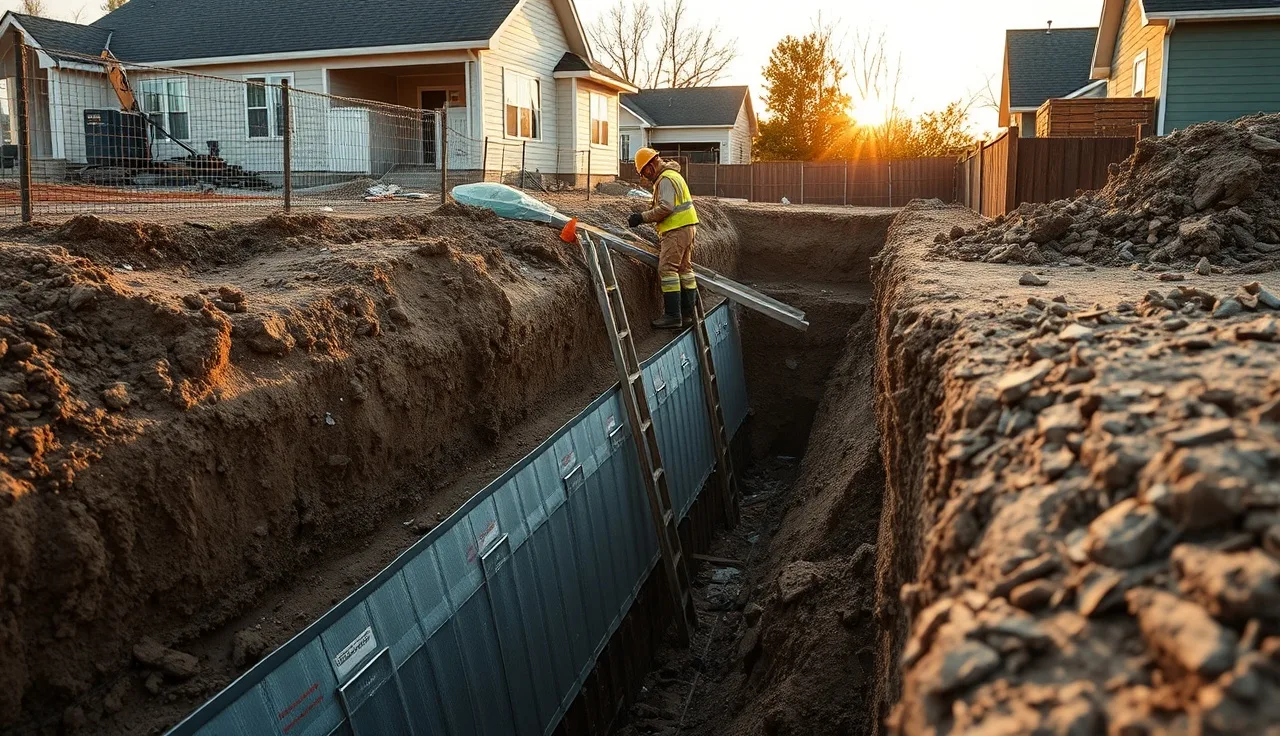
A trenching and excavation safety plan has to satisfy 29 CFR 1926 Subpart P. It names a competent person, documents soil classification, and specifies a protective system (sloping, shoring, or shielding) for any trench 5 feet or deeper. It also sets entry and egress rules and rescue procedures. Skip any element and you expose workers to one of the deadliest hazards OSHA tracks.
Why does a trenching and excavation safety plan matter so much?
Trench collapses kill fast. The Bureau of Labor Statistics counted 22 fatal work injuries from excavation cave-ins in 2022, and the annual average over the prior decade runs between 20 and 30 deaths [1]. One cubic yard of soil weighs roughly 2,700 to 3,000 pounds. A collapse gives a worker almost no time to react, and the force is like being hit by a mid-size car.
OSHA's trenching and excavation standard, 29 CFR 1926 Subpart P, has governed this work since 1989 [2]. It sits near the top of the most-cited construction standards every year. In fiscal year 2023, 29 CFR 1926.652 (requirements for protective systems) was among OSHA's top 10 most cited construction violations [12]. Penalties reach $15,625 per serious violation and $156,259 for willful or repeat violations under the current schedule [3].
A written safety plan does two things. It forces you to think through every excavation before anyone picks up a shovel. And it gives your competent person a documented baseline to inspect against.
Without it, each excavation is improvised. Improvised is how people die.
What does OSHA actually require for a trenching safety plan?
OSHA never uses the phrase "written safety plan" in 29 CFR 1926 Subpart P the way it does for a Hazard Communication program or a Lockout/Tagout program (see our guide to lockout tagout for how those differ). What the standard requires, spread across 29 CFR 1926.650 through 29 CFR 1926.652, is a set of decisions you have to make and document before work begins [2].
Those required elements are:
- A designated competent person (defined by the standard, not a title you hand out)
- A soil classification for each excavation, done by the competent person before entry
- A protective system matched to the soil type and trench depth when the excavation is 5 feet or deeper
- Safe access and egress, including a ladder within 25 feet of any worker in a trench 4 feet or deeper
- A surface encumbrance inspection to locate underground utilities before digging
- Water removal or control procedures when water can accumulate
- Atmospheric testing when hazardous atmospheres are reasonably expected
- A rescue and emergency plan
OSHA's general duty clause (Section 5(a)(1) of the OSH Act) covers any gap the standard doesn't spell out [4]. Putting all of this into one written plan is not legally mandated, but it's the approach any compliance officer will recommend, because it keeps your competent person from having to reconstruct decisions after an incident.
One warning. A plan does not replace the real-time inspection requirement. The competent person has to inspect the excavation before each shift, after any rain or other hazard-increasing event, and as needed through the day [2]. The plan sets the framework. The inspection applies it.
Who counts as a "competent person" under the trenching standard?
OSHA defines a competent person in 29 CFR 1926.650(b) as "one who is capable of identifying existing and predictable hazards in the surroundings or working conditions which are unsanitary, hazardous, or dangerous to employees, and who has authorization to take prompt corrective measures to eliminate them" [2].
That definition has two parts, and people miss the second one. The person has to be able to spot the hazards, and they have to hold the actual authority to stop work. A title without that authority does not satisfy the standard.
For trenching specifically, OSHA guidance (including letters of interpretation) makes clear the competent person must classify soil using the methods in Appendix B to Subpart P, and must be present at the excavation whenever a worker is inside it. Showing up only at the start of the day fails the test if conditions change mid-shift.
Competent person training for excavations usually runs 4 to 8 hours from a reputable provider. It covers soil classification methods, protective system selection, and inspection procedures. There's no OSHA-approved certification card for this role (unlike the OSHA 30 credential for general construction supervision), so keep training records that show the content and hours in your plan file. Those records are your proof.
How do you classify soil and why does it change everything about your protective system?
Soil classification under Appendix B to 29 CFR 1926 Subpart P uses three categories: Type A (most stable), Type B (intermediate), and Type C (least stable) [10]. That single classification decides how steep a slope you can cut, how much shoring you need, or which trench shield works. Guess optimistically and you get a cave-in.
Here is how the three types compare:
| Soil Type | Description | Maximum Allowable Slope | Typical Examples |
|---|---|---|---|
| Type A | Cohesive, unconfined compressive strength ≥1.5 tsf, undisturbed | 3/4:1 (53°) | Hard clay, cemented soils (if no fissures, no vibration) |
| Type B | Cohesive, UCS 0.5 to 1.5 tsf, or previously disturbed | 1:1 (45°) | Angular gravel, silt, silty clay, previously disturbed soils |
| Type C | Cohesive with UCS <0.5 tsf, granular, submerged, or layered | 1½:1 (34°) | Gravel, sand, loamy sand, submerged rock, any previously failed soil |
The competent person classifies soil with visual and manual tests: the ribbon test, the thumb penetration test, and observation for fissures, seeping water, or previous disturbance. Wet or fissured soil cannot be Type A, no matter what a lab report says under ideal conditions.
Your written plan has to document which method was used and what the result was. If the classification changes during work (weather, vibration from nearby equipment), the plan needs to capture that reassessment. Many contractors attach a one-page soil classification form to the plan for each job. It takes a minute and settles the question in writing.
What are the three protective systems and how do you choose between them?
For any trench 5 feet deep or greater, OSHA requires one of three protective systems [9]. Between 5 and 20 feet, you can use a tabulated data approach (pre-engineered sloping, shoring, or shield tables from the manufacturer or Appendix C/D to Subpart P). Deeper than 20 feet, a registered professional engineer has to design the system.
Sloping and benching means cutting the trench walls back to a stable angle. It's the simplest system and needs the most horizontal space. On a tight worksite, sloping rarely works. Benching (stepped horizontal levels in the walls) is allowed only in cohesive soil and never in Type C.
Shoring uses aluminum or steel hydraulic shores, screw jacks, or timber to brace the trench walls against movement. It installs faster than sloping and works in confined spaces. Pneumatic and hydraulic shoring systems from major suppliers ship with tabulated data you can use directly, no engineer required, as long as you follow the manufacturer's specifications exactly.
Trench shields (also called trench boxes) are pre-fabricated steel or aluminum boxes lowered into the excavation. They protect workers inside the box but do not support the surrounding soil. Workers stay inside the shield, never in front of or behind it. The shield's tabulated data has to match the depth, width, and soil type. Having a shield on-site means nothing if it's the wrong size for the conditions.
Your written plan should state which system is pre-approved for your typical conditions and what triggers a switch or a call to an engineer. Leaving that to a field gut call is the exact gap that produces incidents and citations.
What goes into the access, egress, and emergency section of the plan?
This section covers how workers get in and out under normal and emergency conditions. OSHA is specific: ladders, steps, ramps, or other safe means of egress must be placed so no worker in a trench 4 feet or deeper travels more than 25 lateral feet to reach one [8]. That's not a suggestion. It's a frequently cited violation.
Ladders have to extend at least 3 feet above the landing surface. Structural ramps used for egress must meet OSHA's ramp requirements in 29 CFR 1926.651(c)(1)(iv), and if a ramp carries equipment rather than just workers, a registered engineer or the competent person using tabulated data has to design it.
The emergency section should name the nearest trauma center, list the worksite street address (more than GPS coordinates), and say who calls 911 and who manages bystanders. Rescue from a trench collapse is a technical rescue. Never send workers into a collapsed trench to pull out a victim before technical rescue services are called. This is a hard rule. Attempted bystander rescues account for a meaningful share of total trench fatalities in a given year, per NIOSH case studies [5].
Atmospheric hazards are a related emergency concern. When work is near fuel lines, near landfills, in organic soils, or anywhere oxygen-deficient or toxic atmospheres are plausible, the plan has to require testing with a direct-reading instrument before anyone enters. The same confined space principles from 29 CFR 1926.1200 apply when an excavation meets the definition of a permit-required confined space [11].
What surface hazard and utility checks does the plan need to cover?
Before any dig starts, the competent person has to locate underground utilities: gas, electric, water, sewer, telephone, and fiber. In most states, calling 811 (the national Call Before You Dig number operated by the Common Ground Alliance) is required by law, more than good practice [6]. Your written plan should state the requirement to call 811 at least 2 to 3 business days before digging (some state laws require more lead time) and describe how markings get protected once they're down.
The plan also handles surface encumbrances. Spoil piles (the dirt you excavate) have to stay at least 2 feet from the edge of the trench so material can't roll back in [8]. Sounds obvious. It's cited constantly. Equipment, tools, and materials get positioned so their vibration and weight don't compromise the trench walls.
Water accumulation is a separate trigger. If water enters the trench faster than you can control it, or accumulates to a level that could affect stability, work stops until the water is removed and the competent person reassesses. The plan should name the water control method (sump pump, dewatering system) and the threshold at which work pauses.
On larger jobs, a short pre-excavation checklist works well as an appendix: 811 call confirmation, utility markings, soil classification, protective system choice, egress placement. It takes about 5 minutes to fill out and creates a defensible record.
How long and detailed does the written plan need to be?
Honest answer: it depends on your operation. A small utility contractor doing residential water and sewer connections in predictable soil needs a shorter, simpler plan than a general contractor digging deep foundations near active roadways.
A minimum adequate plan for a small contractor covers these elements in roughly 4 to 8 pages:
1. Purpose and scope (which excavations this plan covers) 2. Competent person designation with name and training records attached 3. Soil classification procedures and which methods will be used 4. Protective system decision tree by depth and soil type 5. Access and egress requirements with the 25-foot rule stated explicitly 6. Surface hazard and utility procedures including the 811 call requirement 7. Water control procedures 8. Atmospheric hazard procedures if applicable to your work 9. Inspection frequency and form 10. Emergency procedures including local rescue contact
Don't write it so long the competent person won't read it. A plan that lives in a binder in the truck isn't functioning as a plan. If you want a faster starting point, the SafetyFolio program generator produces a structured OSHA-aligned excavation safety plan in about 15 minutes by walking you through each required element.
Review and update the plan at least once a year, or whenever your work type, soil conditions, or equipment changes. Date-stamp every revision. OSHA inspectors do look at revision history, and a plan that hasn't moved in five years tells its own story.
What records does OSHA expect you to keep?
The standard sets no retention period for excavation-specific records the way 29 CFR 1904 does for injury logs, but the practical standard is 5 years for any safety program documentation, matching the OSHA recordkeeping rule for 300 logs [7]. Keep at minimum:
- The written plan itself, with revision dates
- Competent person training records
- Pre-excavation checklists for each job (if you use them)
- 811 call confirmation numbers and dates
- Any incident reports from excavation work
For incident reports, the OSHA 300 log and 301 form are required if you have 11 or more employees or fall into a covered industry regardless of size. Any fatality or in-patient hospitalization from an excavation incident triggers mandatory OSHA reporting: fatalities within 8 hours, inpatient hospitalizations within 24 hours [4]. We cover the mechanics in our incident report guide.
Engineering drawings or tabulated data used to design your protective system stay on-site during the work and get archived afterward. If an engineer designed the system, keep the stamped drawings. If you used manufacturer tabulated data, keep a copy of the relevant table and note which page and revision you used. Inspectors ask for these documents during site visits, and "we followed the manufacturer's data" carries no weight if you can't produce the page.
What OSHA violations are most commonly cited in trenching and excavation inspections?
OSHA publishes its top violation lists every year, and construction excavation citations cluster around a predictable set of failures:
1. No protective system in a trench 5 feet or deeper (29 CFR 1926.652(a)(1)), the most common and most serious 2. No competent person on-site, or a designated person who lacks the required knowledge and authority 3. Spoil piles within 2 feet of the trench edge (29 CFR 1926.651(j)(2)) 4. No adequate means of egress, or egress more than 25 feet away (29 CFR 1926.651(c)(2)) 5. Failure to inspect before each shift or after a hazard-increasing event
Serious violations were $15,625 per violation as of January 2024 [3]. Willful or repeat violations go up to $156,259. Those numbers are per citation item, not per trench. One site visit with 3 serious violations is a $46,875 exposure before you've hired a lawyer.
Here's the pattern worth knowing. OSHA often opens a trenching inspection after a fatality or near-miss report, and once inspectors are on-site they look at everything, more than the trench that caused the incident. A documented, well-maintained safety plan is your best protection in an after-incident inspection. An absent or generic plan tells an inspector the company never took the standard seriously.
How do you train workers to use the trenching and excavation safety plan?
Training is where a written plan either becomes real or stays decorative. OSHA's excavation standard doesn't specify training hours or content the way some standards do (the OSHA training framework for construction is good background), but the general duty clause requires that workers can recognize the hazards they face.
At minimum, workers assigned to excavation work should be trained on:
- The hazards of trench collapse and why they can't outrun it
- The protective system in use on their specific job and the boundaries of safe movement
- Where the egress points are before they enter
- Who the competent person is and how to report a concern
- What to do (and not do) if a collapse happens nearby
The competent person needs separate, deeper training on soil classification, protective system selection, inspection procedures, and emergency response. Document all training with name, date, content covered, and the trainer's name. A sign-in sheet is the bare minimum. A short quiz creates better documentation and actually tests whether the information stuck.
For supervisors managing excavation work across crews, an OSHA 30 construction course is a reasonable baseline. It covers Subpart P inside a broader construction safety curriculum. The OSHA 30 training credential is not a legal substitute for competent person training, but it shows familiarity with the standard framework.
Can a small contractor use a template, or does every plan need to be custom?
Templates are fine as a starting structure. What matters is that the final document reflects your actual operations. A plan that says "the competent person will classify soil using Type A, B, or C criteria" satisfies the framework. A plan that names the classification methods your competent person is trained to use, and cross-references your specific soil conditions, is what an inspector wants to see.
The risky move is downloading a generic template, changing the company name, and filing it. Inspectors have read thousands of plans and spot a mismatch instantly. A plan that describes shoring systems you don't own, or soil types not found in your region, raises more questions, not fewer.
The practical approach for a small contractor: start with a solid template, then spend an hour with your competent person filling in the specifics. What equipment you have. What your typical trench depths run. What soil you actually hit. Who your local emergency responders are. That customization is what turns a template into a real plan.
If you want a generator that walks you through each required decision instead of handing you a blank document, SafetyFolio builds the plan around your answers to job-specific questions. It's faster than starting from scratch and less risky than a generic template.
Frequently asked questions
Does OSHA require a written trenching and excavation safety plan?
OSHA's 29 CFR 1926 Subpart P doesn't use the phrase "written safety plan" as an explicit requirement the way some standards do. But it requires a competent person, documented soil classification, a specified protective system, and defined emergency procedures. Putting those in a written plan is the only practical way to demonstrate compliance and protect yourself in an inspection or after an incident.
At what depth does OSHA require a protective system for a trench?
OSHA requires a protective system (sloping, shoring, or shielding) for any trench 5 feet or deeper, per 29 CFR 1926.652(a)(1). For trenches under 5 feet, the competent person must still assess the site and can require protection if unstable soil conditions exist. All trenches 20 feet or deeper require a protective system designed by a registered professional engineer.
What is a competent person for excavation and how do I designate one?
Under 29 CFR 1926.650(b), a competent person must be able to identify excavation hazards and have the authority to stop work. For trenching, that means training in soil classification and protective system selection. Designate one in your written plan by name. Keep their training records on file. The designation is only as good as their actual knowledge and authority.
What are the soil classification types and how do they affect my plan?
OSHA Appendix B to Subpart P defines three types: Type A (hard cohesive soil, maximum slope 3/4:1), Type B (intermediate, 1:1 slope), and Type C (least stable, 1.5:1 slope). Your plan must specify how the competent person will classify soil at each excavation. Wet or fissured soil automatically drops to a lower, less stable classification regardless of lab data.
How close to the trench edge can spoil piles be placed?
29 CFR 1926.651(j)(2) requires spoil, equipment, and materials to be kept at least 2 feet from the edge of the excavation. This is one of the most commonly cited trenching violations. Spoil piles that are too close can fall back into the trench, and their weight can destabilize the trench wall. Your plan should state the 2-foot rule explicitly and include it in your competent person's inspection checklist.
Do I need to call 811 before every excavation?
Yes. In most states, calling 811 (the national Call Before You Dig number) is required by state law before any excavation, typically 2 to 3 business days before digging. Your safety plan should document this as a mandatory pre-excavation step, require keeping the confirmation number on file, and address how utility markings will be protected during work. Some states impose additional requirements.
What should the emergency section of a trenching plan include?
Name the local technical rescue team and their number, the address of your worksite, who calls 911, and who manages bystanders. State clearly that untrained workers must not enter a collapsed trench to attempt rescue. Include atmospheric testing requirements if hazardous atmospheres are possible. NIOSH data shows bystander rescue attempts account for a meaningful share of trench fatalities each year.
How often does the competent person need to inspect the excavation?
29 CFR 1926.651(k) requires inspection before each shift, after any event that could increase hazards (rain, freeze-thaw, nearby blasting or vibration), and as conditions change throughout the day. The competent person must remove workers if conditions become unsafe. Your plan should state this inspection frequency and include a simple form to document each inspection with date, time, and findings.
Can workers be in a trench while equipment is excavating nearby?
Workers should not be in a trench while excavating equipment is operating in that trench unless specific conditions are met. Vibration from nearby equipment can degrade soil stability rapidly, potentially changing the soil classification from Type A or B to Type C. Your plan should address when equipment operation requires workers to exit and how the competent person reassesses conditions after vibration stops.
What are the OSHA fines for trenching violations?
As of January 2024, serious violations are up to $15,625 per violation. Willful or repeat violations reach $156,259 per violation. A single inspection with multiple items (no protective system, no egress, spoil piles too close) can produce fines exceeding $45,000. Fatality-related violations frequently carry willful classifications, which dramatically increase penalties and can trigger criminal referrals.
Does my trenching safety plan need to be reviewed by a professional engineer?
Not always. Protective systems for trenches up to 20 feet deep can use manufacturer tabulated data or the sloping and shoring tables in OSHA's Appendix C and D to Subpart P without an engineer. Any protective system for a trench deeper than 20 feet, or a system that deviates from tabulated data, requires design by a registered professional engineer under 29 CFR 1926.652(b) or (c).
How do I handle an excavation that might be a confined space?
An excavation can qualify as a permit-required confined space if it has limited entry/egress, is not designed for continuous occupancy, and contains or could contain a serious hazard (atmospheric, engulfment, or other). This is common near landfills, sewers, or areas with organic soils. When an excavation meets that definition, permit-required confined space procedures under 29 CFR 1926.1200 apply in addition to Subpart P requirements.
How long should I keep trenching and excavation safety plan records?
OSHA's excavation standard does not state a specific retention period. The standard practice, matching OSHA's 300 log retention rule, is 5 years. Keep the written plan, competent person training records, pre-excavation checklists, 811 call confirmations, and any engineering drawings used for protective system design. Records that document your compliance are your primary defense in an inspection or litigation.
Sources
- Bureau of Labor Statistics, National Census of Fatal Occupational Injuries 2022: 22 fatal work injuries from excavation cave-ins in 2022
- OSHA, 29 CFR 1926 Subpart P - Excavations: Full requirements for competent person, soil classification, protective systems, access/egress, and inspections for trenching and excavation
- OSHA, Penalties page: Maximum penalty of $15,625 per serious violation and $156,259 for willful or repeat violations as of January 2024
- OSHA, OSH Act of 1970 - General Duty Clause and Reporting Requirements: Section 5(a)(1) general duty clause; fatalities must be reported within 8 hours, inpatient hospitalizations within 24 hours
- NIOSH, Preventing Deaths and Injuries from Trench Collapses: Attempted bystander rescues account for a significant share of total trench fatalities; technical rescue required for collapse response
- Common Ground Alliance, 811 Call Before You Dig: 811 is the national Call Before You Dig number; most states require calls 2 to 3 business days before excavation
- OSHA, 29 CFR 1904 - Recording and Reporting Occupational Injuries and Illnesses: OSHA 300 log and related records must be retained for 5 years
- OSHA, 29 CFR 1926.651 - Specific Excavation Requirements: Spoil piles must be at least 2 feet from trench edge; ladders required within 25 feet lateral travel for trenches 4 feet or deeper
- OSHA, 29 CFR 1926.652 - Requirements for Protective Systems: Protective system required for trenches 5 feet or deeper; trenches over 20 feet require a professional engineer's design
- OSHA, Appendix B to Subpart P - Soil Classification: Defines Type A, B, and C soil classifications and required maximum allowable slopes for each type
- OSHA, 29 CFR 1926.1200 - Confined Spaces in Construction: Permit-required confined space requirements apply to excavations meeting the definition under this standard
- OSHA, Top 10 Most Cited Standards FY2023: 29 CFR 1926.652 was among the most cited construction violations in fiscal year 2023