Last updated 2026-07-09
TL;DR
An asbestos toolbox talk is a short pre-work safety meeting that prepares workers to recognize asbestos-containing materials (ACM), understand OSHA's permissible exposure limit (0.1 f/cc over 8 hours), follow the right PPE and decontamination steps, and avoid releasing airborne fibers. Federal law requires asbestos awareness training before any worker disturbs or works near ACM. This guide gives you a ready-to-run agenda and everything behind it.
What is an asbestos toolbox talk and who legally needs one?
A toolbox talk is a short, focused safety meeting held at the job site, usually right before a shift starts. An asbestos toolbox talk covers the hazards of asbestos-containing materials (ACM), how exposure happens, what the legal limits are, and exactly what workers must do to protect themselves.
The requirement is not optional. Under 29 CFR 1926.1101 (construction) and 29 CFR 1910.1001 (general industry), employers must provide asbestos awareness training to any employee who may be exposed above the action level (0.1 fibers per cubic centimeter as an eight-hour time-weighted average) or who performs Class III or Class IV asbestos work. [1] Class III work means maintenance and repair operations that disturb ACM. Class IV means custodial work near ACM. If your crew does renovation, demolition, roofing, flooring removal, pipe insulation work, or HVAC work in buildings put up before the mid-1980s, this talk applies to you.
The OSHA construction standard at 29 CFR 1926.1101(k)(9) spells out what awareness training must include: the health effects of asbestos, the locations of ACM and PACM (presumed ACM) in the work area, the proper methods to recognize ACM, how to prevent exposure, and the purpose and proper use of protective controls. [1] A toolbox talk is one legitimate format for delivering that content. For Class I and II work (actual removal or abatement), OSHA requires more formal training measured in hours, not a single short meeting.
Small contractors and facility managers often skip the talk because they assume asbestos is a specialized abatement issue only. That assumption writes citations. OSHA's asbestos standards apply any time there is a reasonable expectation of contact with ACM, and a violation of 29 CFR 1926.1101 training requirements can bring penalties that currently reach $16,131 per serious violation, with repeat violations reaching $161,323. [2]
What does OSHA actually require in asbestos training?
OSHA splits asbestos work into four classes, and the training requirements differ for each. The class of work decides what your toolbox talk needs to cover and whether a toolbox talk is enough on its own.
| Class | Work Type | Minimum Training Required |
|---|---|---|
| Class I | Installation or removal of TSI and surfacing ACM/PACM | 32 hours (includes 16-hour O&M course + 16 additional) [1] |
| Class II | Removal of other ACM (floor tile, roofing, siding, etc.) | 16 hours minimum [1] |
| Class III | Repair and maintenance that disturbs ACM/PACM | 16-hour O&M course [1] |
| Class IV | Custodial, near but not disturbing ACM | 2-hour awareness training [1] |
A toolbox talk fills or refreshes the Class IV awareness requirement, and it supplements (does not replace) the full course requirements for Classes I through III. If your workers do any Class I or II work without the proper certificate, the talk does not make them compliant. It only counts for Class IV and as a pre-task refresher for already-trained workers.
For general industry under 29 CFR 1910.1001(j)(7), the employer must run a training program for employees exposed above the action level and make sure each one takes part. Annual retraining is required. [3] The regulation is specific: training must cover the information in Appendix C (medical surveillance) and Appendix D (work practices), so your talk should touch those topics even if briefly.
OSHA's 1926.1101(k)(9)(ii) requires that each covered employee "can demonstrate knowledge" of the topics covered. That word demonstrate matters. A sign-in sheet proves attendance. A short quiz or verbal check proves comprehension. Keep records of both. Your hazard communication program likely already has a documentation structure you can copy.
What are the OSHA exposure limits for asbestos?
OSHA set two airborne exposure limits for asbestos, and both apply at the same time. The permissible exposure limit (PEL) is 0.1 fiber per cubic centimeter of air (f/cc) as an eight-hour time-weighted average. There is also an excursion limit of 1.0 f/cc averaged over a 30-minute sampling period. [1] Workers must not exceed either limit without respiratory protection and engineering controls in place.
The action level is 0.1 f/cc as an eight-hour TWA. Same number as the PEL? Almost. The action level is the trigger for mandatory controls, medical surveillance, air monitoring, and training. The PEL is the limit above which exposure is prohibited without full controls running. In OSHA's asbestos standard, the action level and PEL share the 0.1 f/cc value, so there is essentially no buffer. You hit the action level requirements the moment you approach the PEL. [1]
For context, the National Institute for Occupational Safety and Health (NIOSH) treats asbestos as a carcinogen with no safe exposure level and recommends the lowest feasible concentration. [4] The OSHA PEL is a legal floor, not a safety guarantee.
Translate this into plain language for the talk. One asbestos fiber is invisible to the naked eye. You cannot see, smell, or taste it. The only way to know whether you are being exposed above the limit is air monitoring. That is why the standard requires initial and periodic monitoring under 29 CFR 1926.1101(f), and why your workers should never assume an area is safe just because there is no visible dust.
Where is asbestos found in buildings and why does it still matter?
Asbestos was heavily used in U.S. construction from roughly the 1920s through the late 1970s. The EPA began phasing out most asbestos-containing products in the late 1970s, and the Asbestos Hazard Emergency Response Act (AHERA) of 1986 addressed schools specifically. [5] But the mineral was never fully banned in the U.S. Some products still legally contain it.
For a worker walking into a pre-1980 building, these are the most common locations of ACM:
- Pipe and boiler insulation (thermal system insulation, or TSI)
- Sprayed-on ceiling and wall texture ("popcorn ceilings")
- Floor tiles and the mastic adhesive beneath them (especially 9x9 vinyl tiles)
- Roofing felt, shingles, and mastics
- Drywall joint compound
- HVAC duct insulation and tape
- Siding (transite panels)
- Fire doors
- Laboratory countertops and equipment
EPA's AHERA rule and OSHA both use the term PACM (presumed asbestos-containing material) for thermal system insulation and surfacing material in buildings put up before 1980. [1] Unless an industrial hygienist has tested and confirmed PACM to be asbestos-free, your workers must treat it as if it contains asbestos. That is not overcaution. It is the legal standard.
A back injury hazard sits right on top of this one. Workers removing floor tiles, pulling up carpet, or cutting through drywall are usually in awkward postures, on their knees, or lifting heavy debris. Pairing this asbestos safety toolbox talk with a back safety toolbox talk at the same meeting is a practical move, because the body mechanics risk and the inhalation risk hit at the same moment. A lot of experienced supervisors run both topics in a single 20-minute session before renovation or demo work begins.
What PPE and engineering controls are required for asbestos work?
PPE is the last line of defense, not the first. OSHA's hierarchy for asbestos requires engineering controls and work practices first, then PPE where controls cannot pull exposure below the PEL.
For work that may generate airborne fibers, the required controls include:
Wet methods. Wetting ACM before and during disturbance cuts fiber release. OSHA's 29 CFR 1926.1101(g)(1) requires amended water (water mixed with a surfactant) for most Class I and II operations. [1]
Local exhaust ventilation. HEPA-filtered vacuums and negative-pressure enclosures are required for Class I operations. A standard shop vac does not meet this requirement. Only HEPA filtration captures fibers at the 0.3-micron level.
Regulated areas and warning signs. Any operation above the PEL requires a regulated area with barriers and warning signs reading "DANGER. ASBESTOS. CANCER AND LUNG DISEASE HAZARD. AUTHORIZED PERSONNEL ONLY." under 29 CFR 1926.1101(e). [1]
For respiratory protection, 29 CFR 1926.1101(h) requires at minimum a half-face air-purifying respirator with P100 (HEPA) filters for Class II, III, and IV work when exposures can exceed the PEL. Class I work generally requires a full-face piece or supplied-air respirator. [1] All respirator use must sit inside a written respiratory protection program under 29 CFR 1910.134.
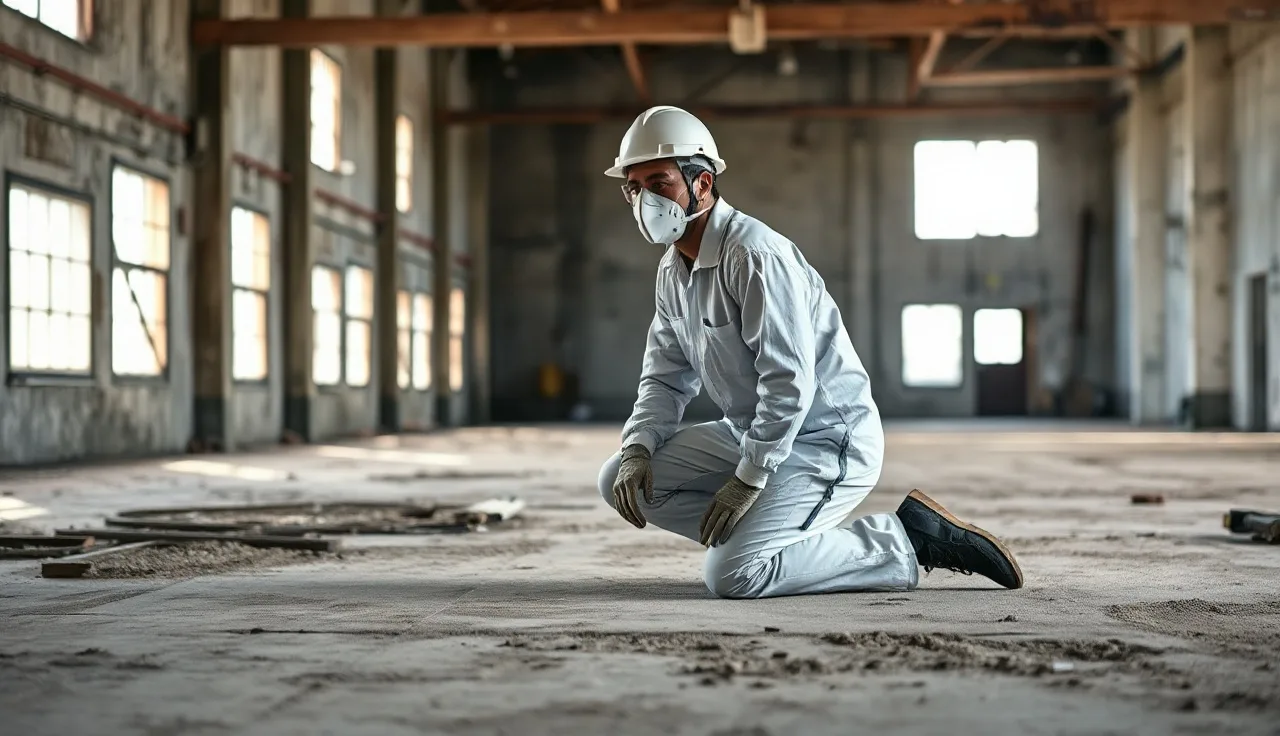
For skin and clothing: disposable full-body coveralls, gloves, and shoe covers are required where skin contact is possible. Clothing must not leave the work area. OSHA prohibits workers from taking ACM-contaminated clothing home, so the employer has to handle laundering or disposal.
Decontamination is not negotiable. Workers must pass through a decontamination enclosure system (clean room, shower, equipment room) when leaving Class I work areas. For Class II and III work without a full decon unit, OSHA requires prompt removal of contaminated clothing in the work area and washing of hands and face before leaving. [1]
How do you run a 15-minute asbestos toolbox talk step by step?
Running this talk does not require a safety consultant. It requires a supervisor who has read the standard, a sign-in sheet, and about 15 minutes before the shift. Here is an agenda you can follow.
Minutes 1-2: Set the scene. Tell workers exactly what work is happening today and why asbestos matters to it. "We are removing ceiling texture in this wing. The building went up in 1971, and the texture has not been tested, so we treat it as PACM."
Minutes 3-5: What asbestos is and why it matters. Keep it short and honest. Asbestos fibers are microscopic. Once inhaled, they stay in lung tissue permanently. The diseases they cause (mesothelioma, asbestosis, lung cancer) take 10 to 40 years to appear, which is why workers underestimate the risk. The American Cancer Society describes mesothelioma as a cancer with a latency period of decades from first exposure. [6] There is no cure for mesothelioma and no safe exposure level recognized by NIOSH. [4]
Minutes 6-8: Where it is today. Walk workers through which materials on this specific job are presumed to contain asbestos. Point to the actual locations. Show photos if you have them. If a bulk sample test has been done, share the result.
Minutes 9-11: What we do about it. Cover the controls in place for today's work: wet methods, HEPA vacuums, regulated area boundaries, signage. Cover the PPE required: which respirator, how to don and doff coveralls, decontamination steps. Do not assume workers remember from a previous job.
Minutes 12-13: When to stop. Tell workers exactly what to do if they hit something unexpected. If they find insulation or suspect material that is not in the plan, the answer is always the same: stop, back out, notify the supervisor. Do not work around unknown material.
Minutes 14-15: Questions and sign-in. Take real questions. Pass the sign-in sheet. If your jurisdiction or contract requires it, run a two-question verbal check ("What do you do if you find unexpected insulation?" works fine) to document comprehension.
For companies that need this level of documentation organized into a full written program, the SafetyFolio program generator walks you through building a compliant asbestos written program with the right training records structure in about 15 minutes.
What records do you need to keep after an asbestos toolbox talk?
Asbestos training records do not follow the usual three-year rule. Under 29 CFR 1926.1101(m)(4), the employer must keep training records for one year beyond the duration of employment. [1] Under 29 CFR 1910.1001(m)(4) for general industry, the requirement is the same. If someone works for you for 20 years, you keep their asbestos training records for 21 years.
Your training record for each session should include:
- Date of the talk
- Name and job title of each employee present (with signatures)
- Topics covered (map these to the 29 CFR 1926.1101(k)(9) requirements)
- Name of the trainer
- Any comprehension check conducted
Air monitoring records under 29 CFR 1926.1101(m)(1) must be kept for 30 years. Medical surveillance records under 29 CFR 1926.1101(m)(2) must also be kept for 30 years. [1] If you are doing anything beyond Class IV work, those retention rules hit hard. Build your filing system to handle that timeline from day one.
OSHA can and does request these records during inspections. An incident report documenting an exposure event will trigger a records request almost immediately. Clean, dated training records are the fastest way to show good-faith compliance.
What are the most common OSHA citations for asbestos violations?
OSHA's enforcement history on asbestos is long and the citations are expensive. The most frequently cited violations in construction asbestos cases cluster around a few recurring failures.
Missing initial or periodic air monitoring is the most common technical violation. Employers assume exposures are low without measuring, and OSHA's standard requires data, not assumptions. Under 29 CFR 1926.1101(f)(1), initial monitoring is required before Class I, II, and III work unless a prior exposure assessment documents expected levels. [1]
Training documentation gaps come in second. Workers may have sat through a talk; the employer just cannot prove it. The fix costs nothing: a dated sign-in sheet kept in the job file.
Failure to identify PACM before disturbance is another common citation anchor. If you did not test it, did not treat it as asbestos, and your crew disturbed it, you exposed workers and skipped the standard's presumption requirement.
Inadequate respiratory protection, specifically non-HEPA respirators for asbestos work, generates repeat citations. P100 filters are required. A standard N95 is not acceptable for asbestos fiber protection. Make sure workers know this before they grab the wrong mask from the PPE bin.
For a broader view of how OSHA builds citations and what an inspection looks like, the osha overview covers the process from inspection trigger through contest rights.
How does asbestos exposure connect to long-term health outcomes?
This section exists because workers follow controls more reliably when they understand the biology, more than the rule number.
Asbestos fibers are thin, durable, and when airborne, aerodynamic enough to reach the alveoli deep in the lung. Once there, the body cannot break them down. Macrophages try to engulf the fibers and fail. The repeated inflammatory response damages lung tissue over decades.
Three major diseases result. Asbestosis is a progressive scarring of lung tissue (fibrosis) that reduces breathing capacity. It is not cancer, but it is disabling and permanent. Mesothelioma is a cancer of the pleura (lung lining) or peritoneum (abdominal lining), almost exclusively caused by asbestos, and it carries a median survival of 12 to 21 months from diagnosis in most studies. [6] Lung cancer risk is elevated for asbestos-exposed workers, especially those who also smoke. The interaction between asbestos and cigarette smoking is multiplicative, not additive, so the combined risk is far higher than either alone. [4]
The latency period creates a false sense of safety. A 45-year-old worker disturbing ACM today will not see symptoms for another two to three decades, if ever. That distance makes it psychologically easy to skip the respirator or rush through decontamination. The toolbox talk is the moment to make that future harm feel concrete.
The National Cancer Institute reports roughly 3,000 new cases of mesothelioma diagnosed in the United States each year, mostly in older workers with occupational exposure histories. [7] There is no screening test that catches it early enough to change outcomes for most patients. Prevention at the point of exposure is the only lever that works.
Does the toolbox talk requirement differ for renovation versus demolition?
Yes, and the difference matters in practice.
For renovation work, the OSHA standard at 29 CFR 1926.1101 applies when activities may disturb ACM. The classification of work (Class I through IV) sets the training requirements. A renovation disturbing PACM without prior testing defaults to Class III or higher.
For demolition, 29 CFR 1926.1101(b) defines demolition as wrecking or taking out any load-supporting structural member and any related razing, removing, or stripping of asbestos. Before demolition of any structure that may contain asbestos, a thorough inspection by a competent person or industrial hygienist is required under both OSHA and EPA standards. The EPA's National Emission Standards for Hazardous Air Pollutants (NESHAP) for asbestos, at 40 CFR Part 61 Subpart M, requires an inspection for ACM before demolition of any structure and puts responsibility for proper notification and removal on the owner or operator before demolition begins. [8]
Put plainly: if you are tearing a building down, the asbestos gets removed by a licensed abatement contractor before the wrecking ball goes in. Your toolbox talk for demolition crews should hammer two things: stay out of areas where ACM has not been cleared, and learn the physical signs that something got missed (white fibrous insulation, old gray-white ceiling texture, corrugated cement panels).
State plan states can have stricter rules. California's Cal/OSHA asbestos standard (8 CCR 1529) and New York's regulations add training hour requirements and contractor licensing that exceed federal minimums. If you work in a state with an OSHA-approved state plan, check the state standard before relying on the federal requirements alone. [9]
What should workers do if they accidentally disturb unknown ACM?
This is the stop-work section, and it is worth practicing out loud in the talk rather than just mentioning it.
Step one: stop the work immediately. Do not try to clean it up. Do not finish the task. Stopping is the only correct move.
Step two: leave the immediate area without disturbing the material further. If coveralls and a respirator are not on, put distance between the worker and the material before anything else. Do not track dust into clean areas.
Step three: notify the supervisor immediately. The supervisor has to assess whether air monitoring is needed and whether a competent person must run an exposure assessment under 29 CFR 1926.1101(f)(2). [1]
Step four: secure the area. No other workers enter until the competent person determines the hazard classification and required controls.
Step five: document the incident. Time, location, nature of material disturbed, estimated duration of exposure, names of affected workers. This feeds the medical surveillance requirements. Workers who may have been exposed above the action level are entitled to medical examinations under 29 CFR 1926.1101(m)(3). [1]
For supervisors, the practical lesson is blunt: workers who hesitate to report accidental disturbances are the real danger. If your crew has seen a supervisor wave off a concern before, they will hesitate next time. Use the toolbox talk to say plainly that stopping work when uncertain costs nothing compared to what it costs not to.
If your company does not yet have a written asbestos program covering these response procedures, the SafetyFolio program generator can help you build one that meets the written program requirements under 29 CFR 1926.1101(g)(1)(ii).
How does asbestos awareness connect to a broader OSHA training program?
Asbestos awareness does not exist in isolation. For construction workers and maintenance employees, it sits alongside a cluster of other hazard-specific training requirements that stack on each other.
Hazard communication under 29 CFR 1910.1200 applies to any hazardous substance, asbestos included. Workers who can read a safety data sheet from your hazard communication program will apply that same skill to the SDS for asbestos-containing products. [10] Respiratory protection training under 29 CFR 1910.134 is required before any worker wears a respirator, which means asbestos respirator use without that training is itself a separate violation.
For maintenance and facilities employees who also run equipment, forklift certification and lockout tagout training are likely in play too. The simplest way to manage the overlap is a training matrix per employee that logs which standard each training addresses, the date, the trainer, and the retraining deadline.
For supervisors who want a formal framework tying these together, an OSHA 30 course covers asbestos as part of its construction or general industry curriculum, though it does not substitute for the hours-specific asbestos training required for Class I through III work.
Here is the broader point. A single toolbox talk is a good start and a genuine legal obligation for Class IV work. It is not a substitute for a written asbestos program, air monitoring, and the full training requirements for workers doing actual abatement or disturbance work. Build the full program once. Run the toolbox talk every time the work comes up.
Frequently asked questions
Is an asbestos toolbox talk legally required or just a best practice?
It is legally required under OSHA standards 29 CFR 1926.1101 (construction) and 29 CFR 1910.1001 (general industry) before workers engage in any Class IV asbestos work, which includes custodial work near ACM. For Classes I through III, more formal training is required in addition to the talk. A toolbox talk alone satisfies the two-hour awareness training for Class IV and counts as a required refresher for trained workers.
How long should an asbestos toolbox talk last?
For Class IV awareness purposes, OSHA's standard implies at minimum two hours of content across annual training. A single pre-task toolbox talk usually runs 10 to 20 minutes and covers the day's specific hazards. It works best as a pre-task refresher paired with documented annual training, not as a standalone substitute for the full two-hour awareness requirement.
What is the OSHA permissible exposure limit for asbestos?
OSHA's PEL is 0.1 fiber per cubic centimeter of air (f/cc) as an eight-hour time-weighted average, with an excursion limit of 1.0 f/cc over any 30-minute period. Both limits appear in 29 CFR 1926.1101 for construction and 29 CFR 1910.1001 for general industry. The action level that triggers mandatory controls and medical surveillance is also set at 0.1 f/cc TWA.
Can a general contractor run an asbestos toolbox talk, or does it require a certified trainer?
OSHA does not require a certified asbestos professional to conduct a Class IV awareness toolbox talk. A supervisor who knows the topics required under 29 CFR 1926.1101(k)(9) can run it. For Class I and II formal training, OSHA requires that training be conducted by a qualified person, which in practice usually means someone with formal asbestos abatement credentials.
What PPE is required for workers near asbestos-containing materials?
At minimum, any worker whose exposure may exceed the PEL must use a half-face P100 (HEPA-filter) respirator, disposable coveralls, gloves, and shoe covers per 29 CFR 1926.1101(h). Class I work requires supplied-air or full-face respirators. All respirator use must be part of a written respiratory protection program under 29 CFR 1910.134. Standard N95 masks are not acceptable for asbestos fiber protection.
How long do employers need to keep asbestos training records?
Under 29 CFR 1926.1101(m)(4), employers must keep asbestos training records for one year beyond the duration of the employee's employment. Air monitoring records must be kept for 30 years. Medical surveillance records must also be retained for 30 years. These are among the longest record-retention requirements in OSHA's construction standards, so build your filing system accordingly from the start.
What buildings are most likely to contain asbestos?
Buildings constructed before 1980 carry the highest risk. OSHA designates thermal system insulation and surfacing materials in pre-1980 buildings as PACM (presumed asbestos-containing material) unless testing confirms otherwise. High-risk materials include pipe and boiler insulation, floor tiles and mastic, sprayed ceiling texture, roofing felt and shingles, HVAC duct wrap, and transite siding panels. Workers must treat all untested PACM as ACM.
What should workers do if they find unexpected asbestos-like material on the job?
Stop work immediately. Do not disturb or attempt to clean the material. Back away without tracking dust, then notify the supervisor. The area must be secured and a competent person must assess the material before work resumes. Workers potentially exposed above the action level are entitled to a medical examination under 29 CFR 1926.1101(m)(3). Document the incident including time, location, and names of exposed workers.
Does the asbestos toolbox talk need to be different for demolition versus renovation?
Yes. For demolition, EPA's NESHAP standard at 40 CFR Part 61 Subpart M requires an ACM inspection and removal before demolition begins. The toolbox talk for demolition crews should emphasize staying out of uncleared areas and recognizing missed ACM visually. For renovation, the talk focuses on work classification, wet methods, regulated areas, and decontamination. Both contexts require OSHA 1926.1101 compliance.
Are there state-specific asbestos training requirements that go beyond federal OSHA?
Yes. States with OSHA-approved state plans can set stricter standards. California's Cal/OSHA asbestos standard (8 CCR 1529) and New York's regulations add training hours and contractor licensing requirements beyond federal minimums. Always verify your state's requirements before assuming federal standards are sufficient. A list of OSHA state plan states is available at osha.gov/stateplans.
How does smoking interact with asbestos exposure risk?
The interaction is multiplicative, not additive. A smoker exposed to asbestos has a far higher lung cancer risk than the sum of the two risks alone. NIOSH and OSHA both recognize this combined effect. Workers who smoke should be especially motivated to avoid any asbestos exposure and should strongly consider smoking cessation programs. This point is worth raising explicitly in the toolbox talk.
What is the difference between asbestos awareness training and operations and maintenance (O&M) training?
Asbestos awareness (Class IV) covers recognition and avoidance. It does not authorize workers to disturb ACM. It requires roughly two hours of training annually. Operations and maintenance (O&M) training, required for Class III work, is a 16-hour course covering actual maintenance and repair procedures involving ACM disturbance. Class I work requires 32 total hours. A toolbox talk alone only meets the awareness requirement.
What OSHA fine can a company face for missing asbestos training documentation?
Serious violations of 29 CFR 1926.1101 training requirements currently carry maximum penalties of $16,131 per violation. Willful or repeat violations can reach $161,323 per instance. OSHA adjusts these penalty caps periodically for inflation under the Federal Civil Penalties Inflation Adjustment Act. Training documentation gaps are among the easiest violations for an inspector to cite because the evidence is simply absent.
Can a toolbox talk cover both asbestos hazards and back safety at the same time?
Yes, and it often makes practical sense. Asbestos-related tasks like floor tile removal, drywall cutting, and pipe insulation work frequently involve awkward postures and heavy lifting that create back injury risk. Running a combined asbestos safety toolbox talk and back safety toolbox talk before those tasks takes about 20 minutes and addresses both OSHA training obligations in a single documented session.
Sources
- OSHA, 29 CFR 1926.1101 Asbestos (Construction Standard): OSHA work classification, PEL of 0.1 f/cc TWA, excursion limit of 1.0 f/cc, training requirements by class, air monitoring, PPE, decontamination, and recordkeeping requirements
- OSHA, Penalties page: Maximum penalties: serious violations $16,131, willful/repeat violations $161,323 per violation
- OSHA, 29 CFR 1910.1001 Asbestos (General Industry Standard): General industry training program requirement and annual retraining for employees exposed above the action level
- NIOSH, Asbestos: Health Effects: NIOSH treats asbestos as a carcinogen with no safe exposure level; smoking and asbestos exposure produce multiplicative lung cancer risk
- EPA, Asbestos Laws and Regulations: AHERA enacted 1986 for schools; EPA asbestos regulatory history including phase-out of most uses in the late 1970s
- American Cancer Society, What Is Malignant Mesothelioma?: Mesothelioma latency period of decades from first exposure; median survival after diagnosis of 12 to 21 months
- National Cancer Institute, Mesothelioma: Epidemiology and Etiology: Approximately 3,000 new cases of mesothelioma diagnosed annually in the United States, predominantly in workers with occupational exposure histories
- EPA, National Emission Standards for Hazardous Air Pollutants: Asbestos (40 CFR Part 61 Subpart M): NESHAP requires inspection for ACM before demolition and proper notification and removal before demolition begins
- OSHA, State Plans: OSHA-approved state plans may set stricter asbestos standards than federal minimums; includes California and New York
- OSHA, 29 CFR 1910.1200 Hazard Communication Standard: Hazard communication requirements apply to all hazardous substances including asbestos; SDS training is a related obligation
- OSHA, Asbestos Overview and Guidance: OSHA guidance on asbestos hazards, affected industries, and regulatory overview for construction and general industry