Last updated 2026-07-09
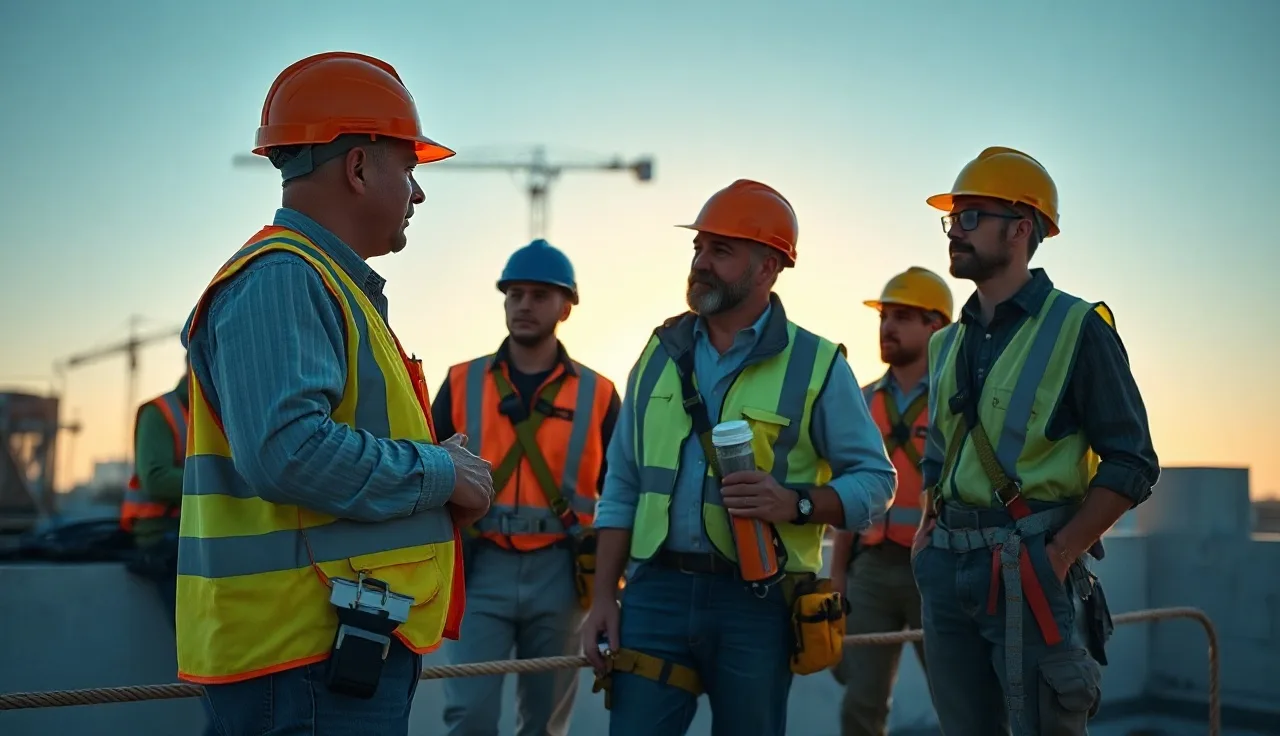
TL;DR
A fall protection toolbox talk is a short job-site safety meeting focused on fall hazards, protective equipment, and rescue procedures. OSHA doesn't mandate a specific format, but it requires fall protection training under 29 CFR 1926.503 (construction) and 29 CFR 1910.30 (general industry). The talks that work run 10 to 15 minutes, tie directly to the day's work, and leave behind a sign-in sheet you keep on file.
What is a fall protection toolbox talk and what should it cover?
A toolbox talk is a stand-up safety meeting held before a shift or a specific task starts. For fall protection, the goal is plain: every worker on site should know what hazards exist that day, what controls are in place, and what to do if something goes wrong. It doesn't replace formal fall protection training. It reinforces that training at the moment it matters most.
The content has to match the actual work. If a crew is patching a flat roof, talk about leading edges and guardrail gaps. If workers are on scaffolding, cover scaffold inspection and correct use of personal fall arrest systems. Generic talks that could apply to any job on any day are the ones workers tune out.
A solid fall protection toolbox talk covers six things: the specific fall hazards present that day, the hierarchy of controls (elimination first, then guardrails, then fall arrest), the condition and correct use of any PPE being worn, rescue and emergency procedures, who to report hazards to, and any changes to the worksite since the last meeting. That's the whole list. You don't need a 30-slide deck.
What does OSHA actually require for fall protection training and toolbox talks?
OSHA has no regulation that says "conduct toolbox talks." But two standards together create the legal duty to keep workers informed about fall hazards on an ongoing basis.
In construction, 29 CFR 1926.503 requires employers to train each worker who might be exposed to fall hazards. The training has to cover the nature of fall hazards in the work area, correct procedures for erecting and using fall protection systems, and the role of each employee in fall rescue procedures [1]. And 29 CFR 1926.503(c) requires retraining whenever the employer "has reason to believe that any affected employee who has already been trained does not have the understanding and skill required." A toolbox talk is the most practical way to close that gap before it becomes a citation.
In general industry, 29 CFR 1910.30 took effect in January 2017 as part of the updated Walking-Working Surfaces standard. It requires employers to train workers on fall and equipment hazards before those workers are exposed, and to retrain when necessary [2]. Inspection of personal fall protection systems falls under 29 CFR 1910.140.
Neither standard sets a frequency for toolbox talks. In practice, most safety professionals recommend at least a weekly fall protection talk for any crew working at height, plus a quick hazard review before any non-routine task. OSHA's General Duty Clause, Section 5(a)(1) of the OSH Act, can reach situations the specific standards miss [9]. So "no rule required it" is a weak defense if a worker gets hurt and there's no record of ongoing hazard communication.
Keep a sign-in sheet for every talk. Date it, note the topic, and have everyone present sign. That paper is your proof the training happened.
How bad is the fall hazard problem, really?
Falls are the leading cause of death in construction and a steady killer in general industry too. The Bureau of Labor Statistics counted 865 fatal falls, slips, and trips in 2022, roughly 20% of all private-industry fatal injuries that year [3]. In construction alone, falls from elevation consistently claim more than 300 lives a year.
OSHA cites fall protection more than any other hazard. In fiscal year 2023, fall protection in construction (29 CFR 1926.501) was the single most-cited standard, with over 7,200 violations recorded [4]. Scaffolding, ladders, and fall protection training all landed in the top ten the same year.
The cost runs past the fatalities. One fall injury means workers' compensation claims, potential OSHA penalties (up to $16,131 per serious violation and $161,323 per willful violation as of 2024 [4]), and a cost to a worker's family that no number captures. For a small business, one serious fall can end the business.
Toolbox talks don't eliminate falls. But the safety-climate research is consistent: workplaces where hazard communication is frequent and task-specific run lower incident rates. The mechanism isn't a mystery. Workers reminded of a specific hazard right before the task are more likely to check their gear and speak up when something's wrong.
What's the difference between a general industry fall protection toolbox talk and a construction one?
The standards differ, the typical hazards differ, and the PPE is often set up differently. The core message is the same, though: name the hazard, use the right control, inspect your gear.
In construction, the general trigger for fall protection is any walking-working surface with an unprotected edge four feet or more above a lower level, with exceptions for specific tasks (roofing has its own rules under 29 CFR 1926.502) [8]. Workers most often use personal fall arrest systems (PFAS), safety nets, or guardrails. The hazards change constantly as the structure goes up, which is exactly why frequent talks pay off.
In general industry, the four-foot trigger under 29 CFR 1910.28 covers most surfaces, but specific thresholds apply to different equipment and situations: the edge of a runway or ramp, a hoist area, a pit or tank [2]. The environments are more stable and no less deadly. Maintenance workers fall from fixed ladders and mezzanines. Warehouse workers fall from loading docks and elevated platforms.
A general industry talk should name the actual elevated surfaces in that facility. A dock leveler. A mezzanine with a gate that keeps getting propped open. A fixed ladder to a rooftop HVAC unit. Say the real locations out loud. Abstract talk about "working at height" never builds the mental map workers need.
For the construction-specific rules, our construction fall protection guide covers them in detail. For the Walking-Working Surfaces standard and what it covers, see the general industry fall protection guide.
How long should a toolbox talk be and how often should you hold one?
Ten to fifteen minutes is the target. Short enough that supervisors actually hold them, long enough to cover the real content. Talks under five minutes turn into a checkbox exercise. Talks over twenty minutes lose the room and start competing with the formal training they're meant to back up.
Frequency depends on how fast the hazards change. On a construction site where the work environment shifts daily, a daily check-in makes sense. In a warehouse with stable conditions, weekly is reasonable. Any time something changes (new equipment, a modified procedure, a near-miss, a worker back from time away), run a focused talk before the affected work starts.
Some companies tie talks to specific triggers: a new project phase begins, someone gets a new harness they haven't been fitted for, weather turns surfaces slick. Those event-driven talks tend to land better than scheduled ones because there's an obvious reason for them.
One thing I'd skip: the "talk of the week" habit where you download a generic topic from a calendar and read it aloud. Workers see through it in seconds. The supervisor who runs a canned roofing talk in January while the crew is doing interior framing has already lost the room.
What talking points make a fall protection toolbox talk effective?
Here's a set of talking points you can actually use. Pull the ones that fit the job in front of you that day.
Before the job starts
- Walk the area. Find every unprotected edge, hole, or elevated surface you'll work near.
- Confirm guardrails are in place and undamaged. If a section came off for material delivery, verify it went back on.
- Check that floor holes and openings are covered, and that the covers are secured and marked.
Personal fall arrest systems
- Inspect your harness before you put it on, every time. Look for frayed webbing, corroded hardware, and bent or cracked D-rings. Damage means pull it from service.
- Verify your anchor point can hold at least 5,000 pounds per attached worker, or is part of a certified engineered system [1].
- Calculate your free-fall distance before you hook in: lanyard length, plus any rope-grab movement, plus your height, plus deceleration distance and a safety factor. If the math doesn't work, you need a shorter lanyard, a self-retracting lifeline, or a different anchor.
- Know who to call and how, if someone falls and hangs suspended. Suspension trauma can set in within minutes.
Ladders
- Set extension ladders at a 4:1 angle (one foot out for every four feet of height). Secure top and bottom if you can.
- Three points of contact means two hands and one foot, or two feet and one hand, at all times while climbing.
- Don't carry materials in your hands while climbing. Use a tool belt or a hoist.
Aerial lifts and scissor lifts
- Wear a PFAS in boom lifts and tie off to the manufacturer's designated anchor inside the basket. Scissor lifts are different: check the manufacturer's manual, since many don't require tie-off on a stable, flat surface [2].
- Never go past the platform's rated capacity.
Housekeeping
- Clear cords, hoses, and debris from the work area before you go up. Trips come before falls.
End the talk by asking two or three workers to describe what they'd do if they spotted a hazard. Not as a quiz. As a way to surface confusion before it matters.
How do you document a toolbox talk to satisfy OSHA?
OSHA doesn't require a specific form. It requires evidence that training happened and what it covered. A simple sign-in sheet does the job if it includes the date, the topic, the name of whoever led the talk, and signatures or printed names of everyone there.
Keep those records for at least three years. That's not an OSHA-specified retention period for toolbox talks, but it matches OSHA's general recordkeeping approach under 29 CFR 1904 [10] and covers most statute-of-limitations windows for civil litigation after an incident.
If you get inspected or cited after a fall, your toolbox talk records are part of your defense. An employer who can show documented, frequent, task-specific training sits in a very different spot than one with nothing on paper.
A few formats that work: a paper sign-in sheet clipped to a site binder, a fillable PDF you print weekly (which is what most people mean when they search for a "fall protection toolbox talk PDF"), or a simple app that captures signatures digitally. The format doesn't matter. Producing the records when you need them does.
If your written safety program has no section on how toolbox talks get documented, that gap is worth fixing. SafetyFolio's safety program generator can produce a written fall protection program with documentation procedures built in, in about 15 minutes, without a consultant. Our written safety program guide walks through what a complete one includes.
What makes workers actually pay attention during a toolbox talk?
This is the part nobody writes about, because it isn't regulatory. It's also the part that decides whether toolbox talks prevent injuries.
The supervisor's credibility beats the content. A supervisor who's never climbed into a harness telling workers to "always inspect your equipment" gets ignored. A supervisor who says, "Last Tuesday I was about to hook into that anchor on the west parapet and felt it wobble, so I found a different tie-off point," gets listened to. Near-miss stories work exactly because they're real and local.
Ask questions instead of lecturing. "Who can tell me the minimum clearance below this anchor before I'd hit the lower level?" forces engagement. Workers who contribute to a talk remember it.
Keep it specific to today's job. If you're prepping work on a penthouse level with a different deck height than the floors below, talk about that exact elevation change. If a skylight has been a hazard before, point at it and name it.
Acknowledge real danger when it's real. Workers know when a supervisor is downplaying risk, and they resent it. "This is a tough anchor situation and we need to think it through together" builds more trust than "just follow the procedure and you'll be fine."
One approach that works for recurring hazards: hand a different worker the relevant section each week. They have to prepare, they own the topic in front of their peers, and it breaks the monotony of the supervisor-as-lecturer model.
What should you do right after a near-miss or fall incident?
Stop work on the affected area. That's not optional. It's the right call every time. A fall that didn't cause an injury is a near-miss, and near-misses are the best predictor of the injury that comes next. OSHA has long treated a near-miss as evidence that a hazard exists, and ignoring one can feed a willful-violation finding if an injury follows.
Hold an emergency toolbox talk right away. Not at the end of the shift. Now. Cover what happened without blame, what the hazard was, what control failed or was missing, and what changes are happening before work resumes. Ask workers if they've seen similar conditions anywhere else on site.
If the incident caused an injury needing more than first aid, you have OSHA recordkeeping duties under 29 CFR 1904 [10]. A fatality or inpatient hospitalization triggers reporting: eight hours to report a fatality, 24 hours to report an inpatient hospitalization, amputation, or loss of an eye [5].
Update your written fall protection program if the incident exposed a gap. An emergency talk with no follow-up to the written program is a wasted lesson. Workers notice whether supervisors actually fix things after incidents or just hold a talk and move on.
What are common mistakes that make fall protection toolbox talks useless?
Reading straight off a printed sheet without looking up. Workers check out inside 90 seconds. Use the sheet as an outline, not a script.
Holding the talk after the hazardous work already started. A pre-task talk delivered mid-task is close to pointless. The moment workers arrive is when the talk lands hardest.
Skipping comprehension checks. "Does everyone understand?" produces nodding, not learning. Ask concrete questions instead.
Ignoring PPE condition during the talk. If you're discussing harness inspection and a worker's harness shows visible wear, deal with it right there. Letting it slide tells everyone the inspection talk was theoretical.
Failing to translate. If part of your crew speaks a language other than English at home, the talk has to be accessible to them. OSHA's training standards require training "in a manner that the employee understands" [1]. A translated handout or a bilingual supervisor isn't a luxury. It's a legal requirement.
Skipping the documentation. Even the best talk is hard to prove without a record. Keep the sign-in sheet even for a five-minute informal chat.
Where can you find free fall protection toolbox talk templates and PDFs?
Several free, reliable sources exist. OSHA's own site has training materials and toolbox talk outlines under its fall prevention campaign [4]. The National Institute for Occupational Safety and Health (NIOSH) publishes hazard-specific training resources at cdc.gov/niosh [11]. The National Safety Council offers toolbox talk templates to members.
State OSHA plans often have more usable resources than federal OSHA. Cal/OSHA's training section, for one, has downloadable toolbox talk guides in English and Spanish. If your state runs its own OSHA plan, check its consultation services page first.
When you download a pre-made fall protection toolbox talk PDF, treat it as a starting point. Annotate it for your site: cross out irrelevant content, add the names of the actual locations and equipment on your job, and update the emergency contact section with real numbers.
One caution: some commercial vendors sell "toolbox talk libraries" for a monthly fee. The content isn't necessarily better than free OSHA resources, and the subscription can create a false sense that toolbox talks are handled just because you have access to templates. The talk has to happen, on your site, tailored to your hazards.
If your bigger need is a written fall protection program that includes a toolbox talk framework, SafetyFolio generates OSHA-compliant written programs specific to your industry in about 15 minutes. Our fall protection training guide covers what the formal side has to include.
How does fall protection training fit into a broader written safety program?
Toolbox talks are one layer of a system. The full system includes a written fall protection program (required in construction under 29 CFR 1926.502(k) whenever a fall protection plan is used instead of conventional fall protection [8]), initial training, equipment inspection records, and incident reporting procedures.
The written program is the foundation. It should name who's responsible for training, what training is required before workers face fall hazards, how equipment gets inspected and tagged out of service, and how documentation is kept. Toolbox talks are then one documented mechanism inside that program.
For small businesses, the written program doesn't need to be long. Two to four pages covering hazard identification, control methods, training requirements, and documentation is enough for most operations. What it can't be is generic. An OSHA inspector reviewing your program after a fall will check whether it addresses the hazards on your specific site.
If your written program doesn't cover fall protection at all, or has a section copied from a template and never customized, that's the priority. Everything else, including fancier toolbox talk content, builds on that foundation.
Frequently asked questions
Does OSHA require toolbox talks specifically?
OSHA has no regulation titled "toolbox talks." But 29 CFR 1926.503 (construction) and 29 CFR 1910.30 (general industry) both require training and retraining when workers are exposed to fall hazards or when their understanding of the hazard is in doubt. Regular toolbox talks are the most practical way to meet the retraining requirement and document compliance. OSHA's General Duty Clause can also apply when hazards exist without adequate communication.
How often should fall protection toolbox talks be held?
For construction crews working at height daily, a daily hazard review is a reasonable standard. For general industry with stable conditions, weekly is the floor most safety professionals recommend. Always hold a talk before any non-routine elevated task, after any near-miss or incident, when new workers join the crew, when PPE or procedures change, or when weather creates new slip or fall hazards. Frequency matters less than relevance to the actual work.
What records do I need to keep from a toolbox talk?
Keep a sign-in sheet showing the date, topic, the name of whoever led the talk, and signatures or printed names of everyone present. OSHA doesn't specify a retention period for toolbox talk records, but keeping them at least three years is standard practice. After a fall-related citation or civil claim, documented training records are a key part of your defense. Digital records are fine as long as they're retrievable.
Can I use a downloaded fall protection toolbox talk PDF as-is?
Use it as a starting point. The problem with fully generic templates is that they don't reference your actual site hazards, equipment, or emergency contacts. OSHA requires training "in a manner that the employee understands" and relevant to real conditions. Customize any downloaded template to name specific locations, equipment, and procedures at your site before you run it. A talk that mentions the ladder on the second-floor mezzanine beats one that says "ladders in general."
What's the anchor point requirement I need to cover in a toolbox talk?
Under 29 CFR 1926.502(d)(15) in construction, each personal fall arrest system anchor must support at least 5,000 pounds per attached worker, or be part of a system designed by a qualified person with a safety factor of two. In general industry, 29 CFR 1910.140(c)(13) uses the same 5,000-pound standard. Workers should be able to identify approved anchor points on their site and know not to tie off to pipe railings, electrical conduit, or other non-designated structures.
What do I do if a worker refuses to wear a harness?
Document the refusal in writing and do not let the worker perform the elevated work without fall protection. OSHA holds employers responsible for ensuring fall protection is used, more than provided. An employee's refusal doesn't erase the employer's liability. Handle it through your disciplinary procedures, and make sure those procedures are documented in your written safety program. If the pattern repeats, you may need to escalate to formal discipline or reassignment.
Do toolbox talks need to be in the worker's primary language?
Yes. OSHA requires training "in a manner that the employee understands," which courts and compliance officers have consistently read to include language accessibility. If part of your crew speaks primarily Spanish, Haitian Creole, or another language, the toolbox talk content has to reach them in a language they can follow. A bilingual supervisor, a translated handout, or a real-time interpreter can satisfy this. Running the talk only in English and assuming everyone got it does not.
What's the difference between a toolbox talk and formal fall protection training?
Formal fall protection training covers the full scope of hazards a worker may face, takes 30 minutes to several hours depending on the tasks, and is documented as a completed training event. A toolbox talk is shorter, task-specific, and recurring. Neither replaces the other. Workers need formal training before exposure to fall hazards (per 29 CFR 1926.503 and 1910.30), and they need regular toolbox talks to reinforce it as conditions change.
How do I make a toolbox talk engaging for workers who have heard it all before?
Rotate who leads sections of the talk. Reference real incidents, near-misses, or close calls from your own site instead of abstract statistics. Ask specific questions about today's job conditions rather than general policy questions. Keep it under 15 minutes. Workers tune out repetition, not relevant information. Changing one concrete element each time (a new near-miss, a changed site condition, a piece of equipment someone hasn't used) is enough to keep a familiar topic fresh.
What should I cover in a toolbox talk for roofing work specifically?
Roofing has its own criteria under 29 CFR 1926.502(b) for low-slope roofs and 29 CFR 1926.502(c) for steep-slope work. Cover the fall protection method in use that day (guardrails, PFAS, or a safety monitoring system if applicable), how edge conditions have changed since the last shift, the condition of roof hatches and skylights, and any wet or icy surfaces. If you're using a safety monitor, confirm the monitor knows their specific duties and hasn't been pulled into production tasks.
Can a toolbox talk substitute for a written fall protection program?
No. In construction, a written fall protection plan is required under 29 CFR 1926.502(k) when conventional fall protection is infeasible. More broadly, a written program documents your company's policies, responsibilities, and procedures, while a toolbox talk is a daily or weekly communication tool. After a fall citation, inspection, or lawsuit, an inspector will look for a written program first. Toolbox talk records alone, without a written program, are not enough.
What fall protection topics are most commonly missed in toolbox talks?
Rescue planning is the most consistently overlooked topic. Workers practice hooking in but rarely discuss what happens if someone falls and hangs suspended in a harness. Suspension trauma can cause loss of consciousness within minutes, so the rescue plan needs to be specific and communicated ahead of time. Other commonly skipped topics: calculating free-fall clearance before work starts, inspecting anchor integrity (more than harness hardware), and housekeeping as a fall precursor.
How do state-plan OSHA states affect toolbox talk requirements?
Twenty-two states and two territories run their own OSHA-approved plans, which must be at least as effective as federal OSHA but can be stricter. California's Cal/OSHA, for example, has specific Injury and Illness Prevention Program requirements that affect training documentation standards. Check your state plan's requirements in addition to the federal CFR standards. Most state plans publish their own toolbox talk resources in multiple languages.
Sources
- OSHA, 29 CFR 1926 Subpart M - Fall Protection (Construction), section 1926.503: Construction fall protection training requirements including retraining triggers, and anchor point 5,000-pound capacity standard under 29 CFR 1926.502(d)(15)
- OSHA, 29 CFR 1910 Subpart D - Walking-Working Surfaces (General Industry), section 1910.28: General industry fall protection requirements including four-foot trigger height and specific surface thresholds under 29 CFR 1910.28; training requirement under 29 CFR 1910.30
- Bureau of Labor Statistics, National Census of Fatal Occupational Injuries in 2022: Falls, slips, and trips accounted for 865 worker deaths in 2022, approximately 20% of all private-industry fatal injuries
- OSHA, Top 10 Most Cited Standards FY2023: Fall protection in construction (29 CFR 1926.501) was the most-cited OSHA standard in FY2023 with over 7,200 violations; maximum penalty figures for serious and willful violations
- OSHA, Reporting Fatalities, Hospitalizations, Amputations, and Loss of an Eye: Employers must report a fatality within 8 hours and an inpatient hospitalization, amputation, or eye loss within 24 hours under 29 CFR 1904
- OSHA, 29 CFR 1910.140 - Personal Fall Protection Systems: General industry anchor point requirement of 5,000 pounds per attached worker under 29 CFR 1910.140(c)(13)
- OSHA, 29 CFR 1926.502 - Fall Protection Systems Criteria and Practices: Written fall protection plan required under 29 CFR 1926.502(k) when conventional fall protection is infeasible; roofing fall protection requirements under 29 CFR 1926.502(b) and (c)
- OSHA, OSH Act of 1970 - General Duty Clause Section 5(a)(1): OSHA's General Duty Clause requires employers to address recognized hazards even where no specific standard applies
- OSHA, 29 CFR 1904 - Recording and Reporting Occupational Injuries and Illnesses: OSHA recordkeeping requirements under 29 CFR 1904 referenced for documentation retention guidance
- NIOSH, Fall Injuries Prevention in the Workplace: NIOSH publishes hazard-specific training resources and fall prevention guidance for workplace safety programs