Last updated 2026-07-09
TL;DR
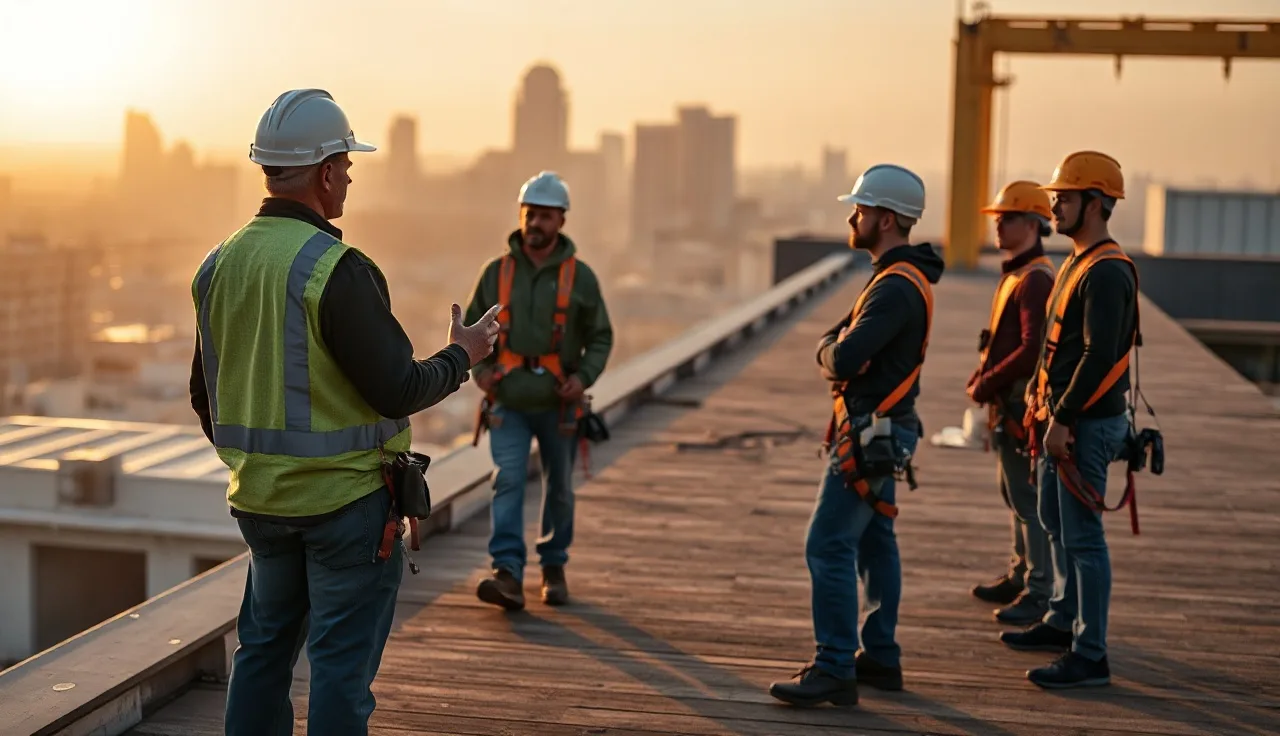
A fall prevention toolbox talk is a short jobsite meeting (5 to 15 minutes) where a supervisor reviews the fall hazards for that day's specific work. Falls caused 395 of 1,069 construction deaths in 2022 (about 37%), per BLS. A talk that works names the real hazards, checks the equipment, tells workers what to do when a control is missing, and gets signed.
Why fall prevention toolbox talks matter more than most safety meetings
Falls kill more construction workers than anything else. Every year, without exception. The Bureau of Labor Statistics counted 395 fatal falls to a lower level in construction in 2022, out of 1,069 total construction deaths [1]. That's 37 percent. No other single hazard comes close.
General industry isn't off the hook. OSHA's walking-working surfaces rules at 29 CFR 1910.22 through 1910.30 cover slip and fall hazards for every employer, not only builders [2]. Falls from elevation land near the top of the general industry citation list too.
A toolbox talk won't fix a missing guardrail by itself. It's the moment a supervisor can catch the hazard before anyone gets hurt. That's the whole point. Not paperwork. Not compliance theater. A real conversation about what could go wrong today, on this site, with these people.
The research on safety meetings is honestly mixed. Nobody has clean randomized trial data proving toolbox talks cut fatalities by some exact percentage. What we have is a pattern: fatality investigations keep finding that the affected worker got little or no pre-task hazard communication. The talk earns its keep as a forcing function. It's a scheduled minute where somebody has to stop and think about today's specific hazards before the first person starts climbing.
What OSHA actually requires for fall protection training and talks
OSHA never uses the phrase "toolbox talk" in any standard. That's a field term. The training requirements underneath it are real, specific, and enforced.
For construction, 29 CFR 1926.503 requires employers to train every employee who might be exposed to fall hazards. The training has to cover the nature of the hazards in the work area, the procedures for erecting and maintaining and disassembling fall protection systems, and the use of guardrails, personal fall arrest systems, and covers [3]. The standard requires a "competent person" to run it, meaning someone who can spot existing and predictable hazards and has authority to fix them.
For general industry, 29 CFR 1910.30 requires training in fall and equipment hazards before an employee works on a walking-working surface [2]. It has to be free, on the clock, and documented.
Neither standard says run a talk every morning. Here's the practical reality: a one-time annual class doesn't cover a worker facing a new fall hazard on a different job. OSHA's position is that retraining kicks in whenever there's reason to believe an employee lacks the understanding or skill needed. New worksites trigger it. So do new tasks and new equipment. Regular toolbox talks are how most employers meet that ongoing duty without staging a formal training event every time the work shifts.
Documentation is not optional. When OSHA shows up after an incident and asks what fall hazard communication your workers got, a signed sign-in sheet from that morning's talk is your best answer. Keep the records. Three to five years is a sensible retention window, though the standards don't set one for toolbox talks specifically.
What are the most common fall hazards to cover in your talk?
The hazards worth covering depend entirely on what the crew is doing that day. Generic fall talks are close to useless. The supervisor reading a laminated card about "always use guardrails" while the crew scrolls their phones is wasting everyone's morning.
That said, these are the hazards that turn up in fatal and serious-injury investigations over and over:
Unprotected edges and leading edges. Framers on an upper floor, roofers near a ridge, electricians beside an open floor penetration. OSHA's 1926.501 requires fall protection at 6 feet in construction and 4 feet in general industry above a lower level [3].
Scaffolding. The scaffolding standard (29 CFR 1926.451) sits near the top of OSHA's construction citation list every year [11]. Planks not fully decked, missing guardrails, overloaded platforms, no safe access. Scaffold falls are disproportionately fatal.
Ladders. Extension ladders at the wrong angle (the 4:1 rule: one foot of base out for every four feet of height), step ladders leaned like straight ladders, ladders unsecured at the top, workers climbing with materials in both hands. Ladder falls make up roughly 20 percent of all fatal work falls, per NIOSH [12].
Skylights and floor openings. Covered-hole hazards under 29 CFR 1926.502(j). A thin sheet of plywood over a skylight opening looks solid. It isn't. Covers have to be secured and marked "HOLE" or "COVER."
Aerial lifts and scissor lifts. No harness in a boom lift (required), guardrails not fully closed on a scissor lift, operating near power lines.
Wet and slippery surfaces. Floors wet from rain, concrete, or spills. Roofs with morning dew. Platforms with mud tracked in off boots.
Housekeeping. Cords across walkways, scrap with nails sticking up, materials piled in the egress path. Plenty of falls involve no elevation at all.
A 10-minute talk can cover two or three of these with real depth. Pick the ones that match today's work. That specificity is the whole difference between a talk that lands and one that doesn't.
How long should a fall prevention toolbox talk be?
Ten minutes is the sweet spot for most crews. Five minutes is too short to cover a real hazard with any depth. Fifteen works when you've got something genuinely complex, like a new fall protection plan for an unusual task. Past twenty minutes you're running a training class, not a talk, and attention falls off a cliff.
Structure matters as much as clock time. A tight ten minutes looks like this: two minutes on today's work and where the fall hazards are, four minutes on the controls in place (guardrails, harnesses, covers, warning lines), two minutes on what to do when something is missing, two minutes for questions. That's the whole thing.
Length without substance is what kills these meetings. A thirty-minute talk where the supervisor reads a binder while workers sign a sheet is worse than nothing. It teaches the crew that toolbox talks waste time, and then they tune out the good ones too.
What should a fall prevention toolbox talk script or outline cover?
You don't need a word-for-word script. You need an outline that keeps the supervisor on the right points and off the rambling. Here's a framework that holds up on most jobsites:
1. Today's work and specific fall exposure Name the actual task and location. "We're finishing the roof deck on the north side today. The open edge runs 28 feet along the west face. Anyone within 6 feet of that edge ties off."
2. What fall protection is in place Name the specific control. Guardrail system? Personal fall arrest? Safety net? Hole covers? Walk through what's installed, where, and why. If there's a gap, say so out loud and explain how to work around it safely until it's fixed.
3. Equipment inspection If workers are using harnesses and lanyards, remind them to inspect before they put anything on. What to look for: cuts or fraying in the webbing, corrosion on hardware, missing labels, any lanyard that has already arrested a fall (retire it immediately, even if it looks perfect). ANSI/ASSP Z359.2 calls for annual inspection by a competent person plus a pre-use visual check every single time [5].
4. What to do when something is wrong This is the piece most talks skip. A worker shows up and the scaffold guardrail isn't installed. Now what? Give a clear answer: don't start work on that section, tell the supervisor right away, don't improvise. Give people explicit permission to stop and report without fear of getting punished for it. Section 11(c) of the OSH Act protects that right [6].
5. Questions Actually ask. "Anything look different out there this morning? Anyone see something that doesn't match what I just said?" Silence is not the goal. One question from a worker often surfaces a hazard the supervisor missed.
6. Sign-in Every attendee signs with name, date, and topic. The supervisor signs too. File it. Done.
What fall protection equipment should you inspect before and during a toolbox talk?
The talk is a natural moment to do a quick physical check alongside the conversation. You don't need a formal inspection of every harness at every talk. You do need to confirm the right equipment is on site and that workers know how to check it themselves.
For personal fall arrest systems (29 CFR 1926.502(d)), the components that fail are the full-body harness, the connecting lanyard or self-retracting lifeline (SRL), and the anchor point [3]. Each fails in its own way.
Harnesses: look for frayed or cut webbing, especially where it runs through hardware. Confirm every buckle clicks and holds. Check that the back D-ring is centered and not bent or corroded. If a harness has been in a fall arrest, it comes out of service immediately, even undamaged to the eye. The shock load from stopping a fall deforms the fibers in ways you can't see.
Lanyards: shock-absorbing lanyards have a deployment indicator. If the pack has torn open, the lanyard has fired and it's done. Check that the snap hooks open and lock cleanly.
Self-retracting lifelines: pull the line out and let it draw back. It should retract smoothly under tension. Give it a sharp tug to test the brake. It should lock. SRLs also come out of service after a fall arrest.
Anchors: the anchor point has to support at least 5,000 pounds per worker attached, or be part of a system a qualified person designed to hold a safety factor of at least two [3]. Workers can't verify that by looking. The competent person on site confirms anchor adequacy before anyone ties off.
Keep a simple log of inspection dates. If OSHA investigates a fall, that log is evidence you were paying attention.
How do you document a toolbox talk to satisfy OSHA?
OSHA publishes no required form for toolbox talk documentation. Use whatever format you like. What matters is that the record proves the talk happened, shows who was there, and captures what got covered.
At a minimum, the record needs the date, the jobsite or location, the topic (fall prevention, and which hazard specifically), the name of the person who led it, and the printed names and signatures of everyone who attended. Add a one-sentence summary of the discussion if you can. That's smart, because writing it forces the leader to state the key point in plain words.
Paper sign-in sheets work fine. Apps and digital forms work fine. The medium doesn't matter. What matters is that you can pull the record fast when OSHA asks. Organize by date and jobsite. A binder per project is the simplest system for a small contractor.
Worth knowing: if OSHA issues a citation and you can show documented training and toolbox talks on the cited hazard, that record doesn't erase the citation, but it feeds directly into the penalty math. OSHA's penalty factors include good faith, and documented training is evidence of it [7].
If you're building your written fall protection program for the first time and want a faster route to having all this organized, a tool like SafetyFolio can generate the program framework in about 15 minutes, sign-in templates included.
How often should you run fall prevention toolbox talks?
Weekly is the common recommendation, rotating through different hazard topics. Fall prevention is serious enough that it should come up at least monthly, and more often on any site with active elevated work.
The trigger-based answer beats the calendar rule. Run a fall-specific talk any time there's a new task involving elevation, any time fall protection equipment gets introduced or swapped, after any near-miss or fall (even with no injury), when new workers join the crew, when conditions change (rain, ice, a seasonal shift in the roofing schedule), and at the start of any job phase that puts workers up higher.
Don't wait for the quarterly calendar entry if something changes today. The value of a toolbox talk is that it's fast and cheap to run. Use that.
How do you run a toolbox talk for workers who don't speak English as a first language?
This is an operational problem, not a nice-to-have. Hispanic workers carry a disproportionate share of construction fall deaths. BLS data for 2022 shows Hispanic workers made up about 30 percent of construction employment and a higher share of construction fatalities [1]. Language barriers in safety communication are part of that gap.
OSHA's standards require training in a language and vocabulary the employee understands. That's the plain reading of 29 CFR 1926.503(b) and 29 CFR 1910.30(b): training "in a manner that the employee understands" [3][2]. If your crew includes workers who aren't fluent in English, you have a legal duty to deliver the talk in their language, not hand them a translated sheet after the English version wraps.
Practical options: a bilingual foreman running the talk directly, a qualified interpreter, or two separate talks. OSHA hosts Spanish-language fall prevention materials on its site [3]. NIOSH also publishes multilingual construction safety resources [12].
Don't treat the translated version as a shortcut version. It covers the same hazards, controls, and Q&A as the English one, or it isn't doing its job.
What does a fall prevention toolbox talk look like in different industries?
The core structure holds across industries. The hazards and controls shift hard depending on the work environment.
| Industry | Primary fall hazards | Key OSHA standard | Common controls |
|---|---|---|---|
| Residential construction | Roof edges, floor openings, ladders | 29 CFR 1926 Subpart M | Personal fall arrest, covers, warning lines |
| Commercial construction | Scaffolding, leading edges, aerial lifts | 29 CFR 1926 Subpart M, 1926.451 | Guardrails, PFAS, safety nets |
| General industry (manufacturing) | Elevated platforms, mezzanines, pits | 29 CFR 1910.23, 1910.28 | Standard guardrails, stair railings, covers |
| Retail/warehousing | Rolling ladders, mezzanines, dock edges | 29 CFR 1910.23 | Fixed ladders, guardrails, dock barriers |
| Utilities/telecom | Poles, towers, elevated confined spaces | 29 CFR 1926.954 | Positioning systems, PFAS, rescue plans |
| Roofing | Roof edges, skylights, sloped surfaces | 29 CFR 1926.501, 1926.502 | Warning lines, PFAS, safety monitors |
Residential construction gets its own line because OSHA's 2011 residential fall protection rule (effective 2012) killed most of the exemptions that had let residential builders skip guardrails and personal fall arrest [10]. Some employers still haven't caught up.
For OSHA training purposes, supervisors running fall talks in general industry should also know 29 CFR 1910.22 through 1910.30, which OSHA rewrote in 2017 to consolidate and modernize the walking-working surfaces rules [2].
What should you do after a near-miss or fall incident before the next toolbox talk?
Run an immediate talk. Not the next scheduled one. The day of the incident, before work resumes in the affected area.
The content is different from a routine review. You cover what happened (factually, without blame), which hazard was involved, whether the existing controls failed or were simply missing, what corrective action you've already taken, and whether work in that area can safely start back up.
This isn't about pointing fingers. Workers who fear getting blamed for incidents stop reporting near-misses, and near-misses are the early-warning system that keeps a scare from becoming a funeral. Say that out loud.
You also complete an incident report. Even for a near-miss with no injury, documenting the event is how you catch a pattern before someone gets seriously hurt. OSHA requires employers to record work-related injuries and illnesses meeting certain severity criteria on OSHA Form 300, but near-miss documentation is an internal best practice, not a recording requirement [9]. A fall that costs lost work time goes on the 300 log.
For how to write up what happened, see our guide on incident reports.
After the immediate talk, do a root cause analysis. Equipment failure? A missing control? A behavior that points back to weak training? The root cause tells you whether you need a modified fall protection plan, retraining, new equipment, or an engineering change. A talk about the incident that doesn't fix the root cause is theater.
How do toolbox talks fit into a written fall protection program?
A written fall protection program is required by OSHA in specific situations. Under 29 CFR 1926.502(k), when an employer uses a fall protection plan as an alternative to conventional fall protection, that plan has to be in writing [3]. Beyond that, OSHA's process safety, hazard communication, and other standards require written programs with training components built in.
Even where no single standard demands one, a written program is the backbone that makes your toolbox talks worth anything. It defines the acceptable fall protection systems for your work types, names who's authorized as a competent person, sets how equipment gets inspected and retired, and lays out how incidents get investigated. The toolbox talk is where that program reaches workers before each work period.
Here's the clean way to think about it: the written program is your policy. The toolbox talk is the daily execution of it.
If your company has no written fall protection program yet, that's the gap to close first. Toolbox talks without a program behind them are conversations with no structure. If you want an efficient way to get the written program done, the SafetyFolio safety program generator walks you through the required elements in about 15 minutes.
For anyone going through OSHA 30 courses, fall protection in construction is one of the core topics precisely because it's where the written program, field training, and daily hazard communication all have to connect.
What are the most common mistakes supervisors make running fall talks?
Being generic. Reading a pre-written script that fits no particular job, no particular task, no particular date. Workers see through it in seconds.
Not walking the site first. A supervisor who hasn't looked at the work area will miss the one hazard that actually matters today. Five minutes walking the site before the talk is the most valuable five minutes you'll spend all morning.
Skipping the questions. "Any questions? No? Good." That isn't a safety conversation. That's a performance for the sign-in sheet.
Not involving workers. The people on the site often know more about the hazards in their corner than the supervisor does. Ask "What do you see out there that worries you?" and you'll surface real hazards. Treat the answers seriously or they'll stop coming.
Running the talk somewhere other than the hazard. A talk about the roof edge is far better standing near the roof edge, where workers can see exactly what the supervisor is pointing at, than in a break room.
Waving off near-misses. If a worker mentions a close call during the talk, that's a gift. Write it down, address it, thank the worker. Dismiss it and you teach everyone else to keep quiet.
One depth for every crew. Veterans who've worked together for years need a different conversation than a crew with new hires who've never worn a harness. Same hazards, different depth.
Frequently asked questions
Is a fall prevention toolbox talk required by OSHA?
OSHA doesn't require a "toolbox talk" by name. But 29 CFR 1926.503 (construction) and 29 CFR 1910.30 (general industry) both require fall hazard training before workers are exposed, plus retraining whenever hazards change. Regular toolbox talks are the most practical way most employers meet that ongoing requirement. Failure to train is one of OSHA's most cited violations.
How do I run a fall prevention toolbox talk for a small crew of 3-4 workers?
Small crews make this easier, not harder. Walk the site together, point at the actual hazards, check harnesses as a group, and ask each person what they're doing that day. A 5 to 7 minute conversation beats a formal presentation for a four-person crew. Get everyone to sign at the end. That's it. Small team size is an advantage for real communication.
What is the 6-foot rule for fall protection in construction?
Under 29 CFR 1926.501, construction employers must provide fall protection when workers are at or above 6 feet over a lower level. General industry uses a 4-foot threshold under 29 CFR 1910.28. Residential roofing follows the 6-foot rule. Protection can be guardrails, personal fall arrest systems, or safety nets depending on the task. Some exceptions exist for certain steel erection work.
Can a toolbox talk substitute for formal fall protection training?
No. A toolbox talk supplements formal training but doesn't replace it. OSHA's requirements under 29 CFR 1926.503 and 1910.30 require documented training by a competent person covering specific technical content: how fall protection systems work, equipment operation, and hazard recognition. A toolbox talk is typically 10 to 15 minutes and pre-task focused. Initial training for new workers has to be more thorough.
Who is qualified to lead a fall prevention toolbox talk?
OSHA requires fall protection training to be run by a competent person, meaning someone who can identify fall hazards and has authority to correct them. For toolbox talks, that's usually a foreman, crew lead, or site safety officer. The person leading needs to actually know the work, the site, and the controls in place. Reading a generic script without site-specific knowledge doesn't meet the standard.
How do I keep records of fall prevention toolbox talks in case of an OSHA inspection?
Keep a dated sign-in sheet for every talk showing the topic, the location, who led it, and printed names plus signatures of all attendees. Organize records by jobsite and date. Digital records are fine if you can retrieve them fast. OSHA doesn't set a retention period for toolbox talk records specifically, but three to five years is standard practice to cover most citation and litigation windows.
What OSHA standards cover fall protection for general industry (non-construction)?
The primary standards are 29 CFR 1910.22 (housekeeping and walking-working surfaces), 29 CFR 1910.23 (ladders), 29 CFR 1910.28 (duty to have fall protection), and 29 CFR 1910.29 (fall protection systems criteria). OSHA rewrote these in 2017. The general industry trigger is 4 feet above a lower level, compared to 6 feet in construction.
What should I do if a worker refuses to wear fall protection during a talk?
Address it directly during or right after the talk. Workers have a right to refuse genuinely unsafe work under OSHA Section 11(c), but refusing to use provided fall protection when it's required is a separate issue. It puts the worker and coworkers at risk and exposes the employer to citation under the multi-employer worksite policy. Document the refusal, retrain the worker, and follow your disciplinary policy consistently.
How do fall prevention toolbox talks reduce workers' comp costs?
Fall injuries are among the most expensive workers' compensation claims. Industry actuarial data puts the average cost of a fall-from-elevation claim well above $40,000, with fatal or permanent-disability cases reaching into the millions. Regular pre-task hazard communication reduces incident frequency, which reduces claim frequency. Fewer claims over three to five years improve your experience modification rate (EMR), which lowers your premium.
What's the difference between a toolbox talk and a Job Hazard Analysis (JHA) for fall prevention?
A Job Hazard Analysis (JHA), sometimes called a Job Safety Analysis (JSA), is a written document that breaks a task into steps and identifies hazards and controls for each step. It's prepared before work begins, usually by a supervisor or safety professional. A toolbox talk is a verbal discussion of those hazards with the crew. The JHA gives you the content. Ideally you run the talk using that day's JHA as your reference.
Do subcontractors on a multi-employer worksite need to attend fall prevention toolbox talks?
Yes, and OSHA's multi-employer citation policy makes this matter. Under that policy, a general contractor can be cited for fall hazards created by a subcontractor's workers if the GC had supervisory control of the site. Running joint toolbox talks with all trades, or requiring each sub to document their own and share them with the GC, is the standard way to manage that liability.
What fall protection topics should I cover after a recent OSHA inspection or citation?
Run a talk on the cited condition as soon as you receive the citation. Cover what the citation alleged, what the correct practice is, what you've done or will do to fix it, and the abatement deadline. Documenting this talk shows OSHA good faith in addressing the violation, which is relevant to penalty reduction at the informal conference. Never ignore a citation or delay abatement without contacting OSHA.
How should fall prevention talks address working on roofs specifically?
Roofing falls are one of OSHA's Focus Four hazard categories. A roofing-specific talk covers the exact roof slope and height, which fall protection system is in use (personal fall arrest, warning line with safety monitor, or controlled access zone), where the anchor points are, how harnesses are donned and attached, proximity to skylights or fragile sections, and weather or surface conditions. Warning-line systems require a safety monitor with specific qualifications under 29 CFR 1926.502.
Sources
- Bureau of Labor Statistics, Census of Fatal Occupational Injuries 2022: 395 fatal falls to a lower level in construction in 2022, out of 1,069 total construction fatalities; Hispanic worker overrepresentation in construction fatalities
- OSHA, 29 CFR 1910 Subpart D - Walking-Working Surfaces: General industry fall protection required at 4 feet; training required under 1910.30 before workers work on walking-working surfaces; updated 2017
- OSHA, 29 CFR 1926 Subpart M - Fall Protection: Construction fall protection required at 6 feet under 1926.501; training by competent person required under 1926.503; anchor point 5,000 lb minimum per worker; written fall protection plan requirements under 1926.502(k); Spanish-language fall prevention materials
- OSHA, Top 10 Most Cited Standards: Scaffolding (1926.451) is consistently among the most cited construction standards; fall protection (1926.501) is the most cited OSHA standard overall
- ANSI/ASSP Z359.2, Minimum Requirements for a Comprehensive Managed Fall Protection Program: Annual inspection by competent person and pre-use visual inspection every time for personal fall arrest equipment; harnesses must be removed from service after a fall arrest
- OSHA, Field Operations Manual - Penalty Calculation: OSHA's penalty calculation includes a good faith factor; documented training and safety programs are evidence of good faith that can reduce penalties
- OSHA, Recordkeeping Rule 29 CFR 1904: Employers must record work-related injuries and illnesses meeting severity criteria on OSHA Form 300; near-miss documentation is a best practice, not a recording requirement
- OSHA, Fall Protection in Residential Construction - Directive STD 03-11-002: OSHA's 2011 residential construction fall protection directive, effective 2012, eliminated most exemptions allowing residential builders to avoid guardrails and personal fall arrest systems
- OSHA, Scaffolding Standard 29 CFR 1926.451: Specific requirements for scaffold planking, guardrails, load capacity, and access in construction; scaffold falls are disproportionately fatal
- NIOSH, Fall Injuries Prevention in the Workplace: Ladder falls account for roughly 20% of all fatal work falls; NIOSH publishes multilingual construction fall prevention resources