Last updated 2026-07-10
TL;DR
A heat illness prevention program for outdoor workers needs six core elements: a written plan, water and shade access, acclimatization procedures, emergency response steps, supervisor and worker training, and heat monitoring protocols. OSHA's general duty clause (Section 5(a)(1)) currently governs most heat enforcement, though a federal heat standard is in rulemaking. Cal/OSHA's Title 8 Section 3395 is the most detailed template available and works for any employer.
Does OSHA require a written heat illness prevention program?
Not explicitly, at least not yet at the federal level. OSHA enforces heat safety under the General Duty Clause, Section 5(a)(1) of the OSH Act, which requires employers to provide a workplace free from recognized hazards likely to cause serious harm or death [1]. There is no standalone federal heat standard yet, though OSHA published an Advance Notice of Proposed Rulemaking in October 2021 and a proposed rule is still moving through the regulatory process as of 2025 [2].
Here's the thing. A written program is the single most defensible move you can make. When OSHA investigates a heat-related incident under the general duty clause, inspectors look for evidence that you identified the hazard, put controls in place, and trained your workers. A written program is your paper trail for all three. Without it, you're stuck arguing verbally that you did the right things, and that argument almost never wins.
If your workers are in California, Washington, Minnesota, Colorado, or Oregon, the ambiguity disappears. Those states run their own OSHA state plans with explicit heat regulations [7]. Cal/OSHA's outdoor heat illness prevention standard (Title 8, Section 3395) is the most detailed in the country, and writing your program to meet it protects you whether or not a federal rule ever lands.
Write the program. No federal standard mandates it in most industries yet, but logic and enforcement history do.
What are the required elements of a heat illness prevention program?
Using Cal/OSHA Title 8 Section 3395 as the template, since it's the most detailed existing regulation, a complete heat illness prevention program covers six categories [3].
1. Water One quart of cool drinking water per worker per hour is the Cal/OSHA standard. The water must sit as close to the work area as practicable. Federal OSHA guidance echoes this in its heat illness prevention materials [4].
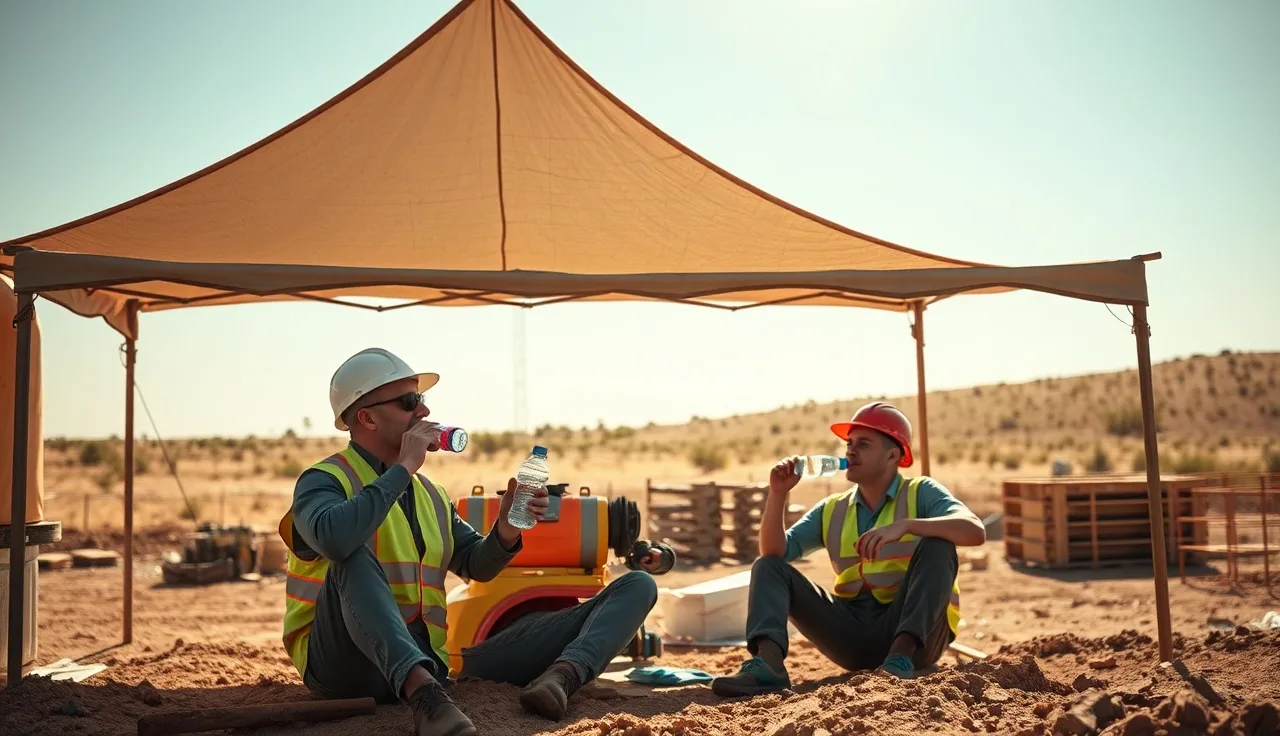
2. Shade When temperatures reach or exceed 80°F, shade must be available for workers who want to rest or cool down. The shade has to be big enough to hold the number of workers resting at one time, and close enough to the work area to actually get used during breaks. At 95°F or higher, Cal/OSHA requires a preventive cool-down rest period of at least five minutes in the shade whenever a worker asks for one.
3. Acclimatization This is the element employers skip most. New workers and workers coming back from a week or more off need a gradual ramp-up. The standard recommendation starts at 20 percent of normal heat exposure on day one and increases no more than 20 percent per day over five to seven days [5]. Your program has to describe how you'll manage new hires and workers returning from vacation in hot weather.
4. High-heat procedures At 95°F and above, extra steps kick in: observing workers for symptoms, mandatory buddy systems, more frequent supervisor check-ins, and making sure workers can reach their supervisor or emergency services right away.
5. Emergency response Your program must spell out exactly what happens when a worker shows signs of heat stroke or serious heat exhaustion. Who calls 911? Who stays with the worker? Where is the nearest emergency room? Write this section so a first-day employee could follow it without asking anyone.
6. Training Supervisors and workers both need documented training before they start working in heat. Supervisors need more depth because they monitor the crew and make the call to stop work.
A written program covering all six is the document an OSHA inspector will ask for. Missing any one of them is a potential citation.
How do you set up water and shade access that actually meets OSHA standards?
The one-quart-per-hour figure is a floor, not a target. On a 100°F day with heavy exertion, workers can sweat out one to one and a half liters an hour, so a single quart barely keeps up [5]. Cold water (50 to 60°F) absorbs into the bloodstream faster than room-temperature water. Stock coolers accordingly and assign someone to refill them.
For shade, "shade" means blockage of direct sunlight. A tree canopy that filters 80 percent of UV is not the same as a solid shade structure. Your program should name the type of shade (canopy, trailer awning, nearby structure) and its location relative to the work area. If workers have to walk five minutes to reach shade, they won't use it when they need it most. That's a real enforcement gap.
Some employers add cooling stations with misting fans or cool towels. That's genuinely useful, more than window dressing. Misting fans can drop the ambient temperature at the skin by five to ten degrees Fahrenheit, and that matters at 100°F. But cooling stations don't replace shade access. They supplement it.
Document shade locations in your written program, or attach a site diagram showing where shade and water sit. When an inspector shows up after an incident, a site diagram proves you planned this in advance.
What is heat acclimatization and why does your program need to cover it specifically?
Acclimatization is how the body adapts to working in the heat. Full adaptation takes seven to fourteen days of progressive exposure. During that window, a worker's heart rate at a given workload drops, sweat rate improves, core temperature during work decreases, and the blood volume available for cooling rises [5]. An unacclimatized worker doing heavy labor at 95°F faces a dramatically higher heat stroke risk than an acclimatized worker doing the same job.
The data here is not subtle. OSHA's heat illness data shows that roughly 50 to 70 percent of outdoor fatalities happen in a worker's first few days on the job [4]. That's the acclimatization window, and it kills people.
Your written program has to name this and set a protocol. Something like: "New employees and employees returning from absences of seven or more days will be limited to 20 percent of their normal heat exposure on day one, increasing by no more than 20 percent per additional day." Then describe who tracks it. Is it the foreman? The site safety officer? If nobody owns it, it won't happen.
Also call out medical conditions that slow acclimatization: obesity, certain heart medications, diabetes, prior heat illness. You're not diagnosing anyone. Your program can simply tell supervisors to check in with new workers about whether they have any condition that makes them more sensitive to heat.
What heat index thresholds should your program use to trigger action?
OSHA uses a four-tier risk scale based on heat index, which combines air temperature and relative humidity into a single "feels like" figure [4].
| Heat Index | Risk Level | Required Actions |
|---|---|---|
| Below 91°F | Lower | Routine precautions: water, shade available |
| 91 to 103°F | Moderate | Increase monitoring frequency; remind workers of hydration |
| 103 to 115°F | High | Additional rest breaks; buddy system; reduce physical workload |
| Above 115°F | Very High / Extreme | Consider suspending outdoor work; mandatory rest ratios |
Source: OSHA Heat Illness Prevention campaign [4]
Your written program should name these thresholds and attach specific supervisor actions to each one. Don't write "monitor workers more closely." Write "at 103°F, the supervisor will check in with each worker verbally every 30 minutes and log the check-in on the daily heat log."
The National Weather Service heat index calculator is free and takes about 30 seconds each morning. Your program should require someone to check it before work starts and log the reading. That log is your documentation that you were watching conditions.
Dry desert climates are a trap here. The heat index can understate risk because it's built for humid conditions. Above 90°F in low humidity, use actual air temperature as your trigger, not the heat index. Your program should state which metric you use and why.
What should the emergency response section of the program say?
Heat stroke is a medical emergency. Core body temperature above 104°F with confusion, slurred speech, or loss of consciousness means you have minutes, not hours. The emergency response section is the most important part of your program because it decides whether someone lives or dies.
The section should answer these questions in plain language:
- Who calls 911? (Name the role, not the person, since staff change.)
- Who stays with the worker and watches their breathing?
- What cooling steps happen while waiting for EMS? (Move to shade, apply ice packs to neck, armpits, and groin, fan the worker, apply cool wet cloths.)
- Where is the nearest hospital or urgent care with emergency capacity? (Put the address in the document.)
- Who does the supervisor notify internally?
- What records get created, and by when?
For remote worksites, this section also has to address how EMS finds you. A GPS coordinate or detailed driving directions belong in the program or attached to it. This sounds obvious. But agricultural fields and rural construction sites have killed people because dispatchers couldn't locate them.
Your incident report process should tie directly into this section. Any heat-related medical treatment beyond first aid is OSHA recordable. Heat stroke that leads to inpatient hospitalization must be reported to OSHA within 24 hours under 29 CFR 1904.39 [6].
What training does a heat illness prevention program require?
Workers and supervisors need different training because they carry different responsibilities.
Worker training covers: what heat illness is and why it happens, the symptoms of heat exhaustion and heat stroke, how to respond if a coworker seems ill, the right to request shade and cool-down rest without fear of retaliation, and why hydration and acclimatization matter.
Supervisor training covers all of that plus: how to monitor environmental conditions, how to run the high-heat procedures, how to recognize when a worker needs immediate emergency care, and how to handle the first day on the job for new and returning workers.
Cal/OSHA requires this training before the employee first works in heat, not as part of general annual training [3]. Federal OSHA's guidance mirrors that expectation even without a specific standard.
Document everything. Sign-in sheets, a training agenda, and a record of who delivered the training are your evidence. An OSHA training record showing a worker was trained before their first outdoor shift is far more defensible than a generic safety orientation sign-off.
For supervisors in companies that want more structured coverage, an OSHA 30 course covers general safety management principles that apply here, though it's no substitute for heat-specific supervisor training.
One honest note: online-only training for heat illness is a gray area. Cal/OSHA has stated that interactive, scenario-based training is preferred for supervisors because the judgment calls in heat response take more than slide-clicking. If you use an online module, pair it with a short in-person walkthrough of your site-specific emergency response steps.
How do you write the acclimatization and monitoring procedures for a specific worksite?
Generic language doesn't survive an OSHA inspection or, more to the point, a real heat emergency. Your procedures need to be site-specific.
Start by mapping your worksite. Where is the hottest work area? That's your highest-risk zone. Where is shade available? Where is water staged? What's the typical start time and peak heat hour? In most of the US, peak heat index hits between 2 and 4 PM. A crew that starts at 6 AM and finishes by 2 PM has a different risk window than a crew working noon to 8 PM.
Then write monitoring procedures that name a person and a frequency. "The lead supervisor will check the heat index using the OSHA-NIOSH Heat Safety Tool app at the start of each shift and at noon. Readings will be recorded on the daily job site log." That's specific enough to actually happen.
For acclimatization, build a simple tracking form. New worker's name, start date, and what percentage of heat exposure they're cleared for each day for the first ten days. The foreman initials it daily. This takes two minutes and creates a record proving you managed the ramp-up.
If your company generates safety documentation for multiple sites or needs to customize procedures fast, tools like the SafetyFolio program generator can produce a site-specific written program in about 15 minutes, which you then layer your location details and personnel onto. The faster you get a compliant draft, the less time your workers spend with no written protection at all.
Which workers are at highest risk and how should your program address vulnerable populations?
Not all workers face equal risk. Your program should identify the factors that raise individual risk and tell supervisors how to handle them.
Physical factors that raise risk: age over 65 or under 18, obesity (body mass index above 30), cardiovascular disease, kidney disease, prior history of heat illness, and physical deconditioning [5].
Medications that raise risk: diuretics, antihistamines, anticholinergics, beta blockers, and some antipsychotics impair the body's ability to regulate temperature or respond to dehydration [5].
Your program shouldn't require workers to disclose medical conditions. That's a privacy issue and creates ADA complications. Frame it this way instead: "Workers who believe they may have a medical condition or take medications that increase their sensitivity to heat are encouraged to discuss this with their supervisor or occupational health provider. Supervisors will not penalize any worker for requesting modified duties during a heat risk period."
Alcohol and certain drugs also impair heat regulation. You don't need to get into substance testing in your heat program, but the training section should note that workers shouldn't show up dehydrated from a night of drinking.
Workers new to the US from cooler climates carry a real acclimatization gap on top of the standard new-worker gap. Agricultural employers in particular should account for this when scheduling new seasonal workers in summer.
What records do you need to keep, and for how long?
OSHA's recordkeeping standard (29 CFR 1904) applies to heat-related illness just like any other workplace injury [6]. Any heat-related illness requiring medical treatment beyond first aid goes on your OSHA 300 log. Heat stroke that results in inpatient hospitalization triggers a 24-hour reporting requirement to OSHA directly.
Beyond the injury records, keep these for your own protection:
- Daily heat index logs (date, time, reading, who recorded it)
- Training records (name, date, topics covered, trainer name)
- Acclimatization tracking forms for new and returning workers
- Shade and water inspection records (especially for permanent cooling stations)
- Any written communications about heat conditions (emails, texts from supervisors)
How long? OSHA 300 logs must be kept for five years [6]. For the supplementary records above, three years is a reasonable minimum. Heat-related litigation drags on, and records from the incident year matter.
Store these where you can actually find them. A folder on a shared drive labeled by year and site, with subfolders for training and daily logs, beats a filing cabinet nobody opens. Wherever they live, make sure more than one person knows where they are.
How is a heat illness prevention program different for agricultural versus construction workers?
The biology is the same. The regulatory and practical context is not.
For agricultural workers, Cal/OSHA Title 8 Section 3395 explicitly covers agricultural employment [3]. Field work often means no fixed worksite, which complicates shade and water logistics. Portable shade structures, water trailers, and vehicle-based cooling are common answers. Agricultural employers also hire seasonally at scale, so the acclimatization problem gets sharp: you might bring on fifty new workers in one week at the start of peak season.
Construction's challenge is a heat profile that shifts constantly. A worker pouring concrete in the shade of a structure has very different exposure than the same worker doing roofing two weeks later. Your program should require a site-specific heat risk assessment at the start of each new phase of work, rather than only at the beginning of the season.
Landscaping workers face both patterns, especially crews that move between multiple job sites in a day. The worst case for landscaping is a crew that starts at a shaded residential site in the morning and finishes on an exposed commercial property with no shade trees and full afternoon sun. The program should account for that worst-case site.
Industries covered by specific OSHA standards (maritime, construction under 29 CFR 1926) fall under those standards plus the general duty clause for heat, since no federal heat standard exists yet. Your written program should cite the general duty clause as the basis unless your state plan says otherwise.
How do you actually put the document together?
The written program doesn't need to be long. An effective heat illness prevention program for a small outdoor crew fits in four to six pages. What it needs is specificity, not length.
Here's a structure that works:
Section 1: Purpose and scope. One paragraph. Who this covers, which worksite(s), and the regulatory basis (general duty clause, your state's regulation, or both).
Section 2: Responsibilities. Who owns each part of the program. The employer (you) provides water, shade, and training. Supervisors handle daily monitoring and emergency response decisions. Workers report symptoms and follow hydration guidelines.
Section 3: Water and shade procedures. Specific quantities, locations, and the person responsible for setup and restocking each shift.
Section 4: Heat monitoring. Which tool you use, who checks it, when, and what triggers each action level.
Section 5: Acclimatization procedures. The ramp-up schedule and who tracks it.
Section 6: High-heat procedures. What changes at 95°F and above.
Section 7: Emergency response. Step-by-step, role-based, with the hospital address.
Section 8: Training requirements. What training, who gets it, how it's documented, and how often it refreshes.
Section 9: Recordkeeping. What records, where stored, how long kept.
Attach a site diagram showing shade and water locations and a blank daily heat log as appendices.
If you want a compliant first draft fast, SafetyFolio's safety program generator walks you through the site-specific questions and produces a formatted document you can print or share with your team in minutes.
After you draft it, hand it to your supervisors and ask them where it doesn't match what they actually do. The gap between the written program and real field practice is the most common reason programs fail both inspections and real emergencies.
Frequently asked questions
Is there a federal OSHA heat standard yet, or is it still just the general duty clause?
As of mid-2025, there is no final federal OSHA heat standard. OSHA published an Advance Notice of Proposed Rulemaking in October 2021 and released a proposed rule, but it has not been finalized. Enforcement currently runs through the OSH Act's General Duty Clause, Section 5(a)(1). California, Washington, Oregon, Colorado, and Minnesota have their own state-plan heat regulations with specific numerical thresholds.
What temperature triggers OSHA heat illness enforcement?
OSHA uses a heat index of 80°F as the lower bound for basic precautions in its campaign guidance, and 91°F for escalated action. Cal/OSHA triggers shade requirements at 80°F and high-heat procedures at 95°F. No single federal temperature automatically triggers a citation, but conditions above 103°F with physical exertion have historically supported general duty clause citations when workers got hurt.
How much water does OSHA say outdoor workers need?
OSHA recommends at least one quart (roughly one liter) of cool water per worker per hour in hot conditions. Cal/OSHA's Section 3395 codifies this as a legal minimum. It's a floor, not a ceiling. In extreme heat with heavy exertion, actual sweat loss can exceed this rate, and workers should drink small amounts often rather than large amounts at once to avoid hyponatremia.
Do I need a heat illness prevention program if my workers are only outside part of the day?
Yes, if any hours put them in heat index conditions above 80°F. Partial outdoor exposure doesn't erase the risk, and moving between cool indoor spaces and hot outdoor ones can actually impair acclimatization. Your program can specify which tasks and time windows require heat precautions, but you still need the written program.
What's the difference between heat exhaustion and heat stroke, and does my program need to address both?
Heat exhaustion: heavy sweating, weakness, cool or pale skin, fast weak pulse, nausea. The worker is still alert. Move them to shade, cool them down, give water, monitor. Heat stroke: core temperature above 104°F, hot red skin (possibly dry), rapid strong pulse, possible unconsciousness or confusion. This is a 911 emergency. Your program must distinguish these because the response differs completely. Treating heat stroke with fluids and rest instead of calling 911 can be fatal.
Can I use an online template for my heat illness prevention program, or does it need to be custom?
A template is a legitimate starting point, and OSHA's own website provides model program language. The problem is that generic templates don't hold your site's shade locations, your water restocking schedule, your emergency contact names, or the specific conditions of your work environment. An inspector or a court will look for those specifics. Use a template for structure, then fill in every site-specific detail before you call it done.
How often do I need to update my heat illness prevention program?
Review it annually at minimum, before outdoor work season starts. Also update it after any heat-related incident or near-miss, when you add a worksite with different conditions, when your workforce changes significantly, or when a new state or federal regulation takes effect. Date every version and keep old ones. An outdated program that was never revised after an injury is a significant liability.
Does a heat illness prevention program need to be in Spanish or other languages?
OSHA requires safety training in a language and format workers can understand. If your outdoor workforce includes workers whose primary language is Spanish, Haitian Creole, Hmong, or anything else, your training materials and the key sections of your written program should be available in that language. A written program posted in English only, in a crew that reads primarily Spanish, does not satisfy the training requirement.
Are heat illness incidents OSHA recordable?
Yes. Under 29 CFR 1904, any work-related heat illness that results in medical treatment beyond first aid, restricted work, days away from work, or loss of consciousness must go on the OSHA 300 log. Heat stroke resulting in inpatient hospitalization must be reported to OSHA within 24 hours under 29 CFR 1904.39. A worker who recovers from heat exhaustion with only water and rest does not trigger recordability.
What does acclimatization look like in practice for a small landscaping crew?
In practice, it means starting a new hire on easier, shaded tasks for the first three to five days rather than throwing them on the hottest, most exposed job. Have someone check in with them every hour. Make sure they're drinking water consistently. Tell them plainly that feeling dizzy or nauseous is something to report right away, not push through. Document that you did this. It's simple, but it prevents most early-season heat fatalities.
What penalties can OSHA impose for a heat-related violation?
Under the general duty clause, OSHA can cite a serious violation at up to $16,550 per violation (2024 penalty level, adjusted annually for inflation). A willful or repeated violation can reach $165,514 per violation. If a worker dies and OSHA finds the employer knowingly failed to address the hazard, criminal referral is possible. Several employers have faced six-figure penalties after heat fatalities in agricultural and construction settings.
Do supervisors and workers need separate heat training, or can I do one combined session?
You can run a combined session, but supervisors need extra content workers don't. Supervisors need to know how to monitor environmental conditions, how to make the call to move workers to shade or stop work, how to manage acclimatization for new hires, and how to start emergency response. Workers need to know their own symptoms, their right to shade breaks, and how to report illness. Cover the shared content together, then add supervisor-specific content in a separate block.
What are the best tools for measuring heat index in the field?
OSHA and NIOSH jointly developed a free Heat Safety Tool app (iOS and Android) that calculates heat index from your GPS location and gives you risk level and recommended actions. It's the easiest option for most field supervisors. A sling psychrometer or digital thermo-hygrometer is more accurate if you need humidity-adjusted readings in enclosed or partially shaded areas. Whatever tool you use, name it in your written program so there's no ambiguity about the method.
Sources
- OSHA, OSH Act of 1970, Section 5(a)(1) General Duty Clause: Employers must provide a workplace free from recognized hazards likely to cause serious harm or death; this clause is the current enforcement basis for heat illness violations
- OSHA, Heat Injury and Illness Prevention in Outdoor and Indoor Work Settings ANPRM (Federal Register, October 2021): OSHA published an Advance Notice of Proposed Rulemaking on heat illness in October 2021; a federal heat standard has not yet been finalized
- California Code of Regulations, Title 8, Section 3395, Heat Illness Prevention (Cal/OSHA): Cal/OSHA's outdoor heat illness prevention standard requires water, shade, acclimatization procedures, and high-heat procedures at 95°F; it covers agricultural and non-agricultural outdoor employment
- OSHA, Heat Illness Prevention Campaign guidance and heat index action levels: OSHA recommends one quart of water per worker per hour and uses a four-tier heat index risk scale from below 91°F (lower risk) to above 115°F (very high/extreme); approximately 50-70% of outdoor heat fatalities occur in the first few days on the job
- NIOSH, Criteria for a Recommended Standard: Occupational Exposure to Heat and Hot Environments (2016): Full acclimatization takes 7-14 days; sweat rate during heavy work can exceed one liter per hour; obesity, cardiovascular disease, age, and certain medications increase heat illness risk
- OSHA, Recordkeeping and Reporting Occupational Injuries and Illnesses, 29 CFR 1904: Heat-related illness requiring medical treatment beyond first aid is OSHA recordable under 29 CFR 1904; inpatient hospitalization from heat stroke must be reported within 24 hours under 29 CFR 1904.39; OSHA 300 logs must be retained five years
- OSHA, State Plans page listing states with approved occupational safety and health plans: California, Washington, Oregon, Colorado, and Minnesota operate state OSHA plans with heat-specific regulations that are at least as effective as federal OSHA standards
- BLS, Census of Fatal Occupational Injuries, Heat-related fatalities data: Bureau of Labor Statistics tracks heat-related occupational fatalities annually; agricultural and construction workers account for a disproportionate share of heat deaths
- OSHA, OSHA-NIOSH Heat Safety Tool app description and guidance: OSHA and NIOSH jointly developed a free Heat Safety Tool smartphone app that calculates heat index by GPS location and provides risk levels and recommended protective actions
- OSHA, Penalties page listing current maximum penalty amounts: Serious violations carry maximum penalties up to $16,550 per violation; willful or repeated violations can reach $165,514 per violation (2024 amounts, adjusted annually)