Last updated 2026-07-11
TL;DR
Cannabis cultivators need a written pesticide exposure program covering hazard communication (29 CFR 1910.1200), respiratory protection when mists or vapors are present (29 CFR 1910.134), and PPE selection (29 CFR 1910.138). Most grows also fall under EPA's Worker Protection Standard (40 CFR Part 170). A missing written program is one of the most common citations small grows collect during state inspections.
Does my small cannabis grow actually need a written pesticide program?
Yes, almost certainly. If you employ even one worker who handles, mixes, applies, or re-enters a treated area after a pesticide goes down, federal OSHA and, in most states, the EPA's Worker Protection Standard (WPS) both put written program requirements on you. There is no small-employer exemption for these rules. None.
The WPS, codified at 40 CFR Part 170, covers agricultural establishments that use pesticides on plants grown for sale or distribution, and cannabis grown for commercial purposes fits that definition in every state where the EPA has clarified its jurisdiction [1]. The 2015 WPS revision expanded requirements for handlers and early-entry workers, and that revised rule has been in effect since January 2017.
On the OSHA side, the hazard communication standard (29 CFR 1910.1200) requires a written HazCom program the moment any hazardous chemical, including pesticide concentrates, is present in the workplace [2]. Pesticide labels do not replace Safety Data Sheets under HazCom. You need both. If workers mix concentrates or apply in enclosed or poorly ventilated spaces, respiratory protection triggers its own written program under 29 CFR 1910.134 [3].
Three or four federal rules stack on top of each other for cannabis pesticide work, and none of them care how small your canopy is.
Which federal standards apply to cannabis pesticide exposure?
Four regulatory frameworks overlap for most cannabis cultivators: the EPA Worker Protection Standard, OSHA Hazard Communication, OSHA Respiratory Protection, and OSHA's PPE rule. Each demands its own paperwork, and none of them substitute for another.
EPA Worker Protection Standard (40 CFR Part 170). The WPS covers any agricultural employer using EPA-registered pesticides on a commercial crop. It requires an application record-keeping system, training for handlers and early-entry workers before they touch pesticides, access to a pesticide safety poster, and designated decontamination supplies [1]. The 2015 revision added a designated representative who can access handler records, annual training instead of every five years, and stronger restrictions on entry during applications.
OSHA Hazard Communication (29 CFR 1910.1200). This is the written program most cannabis employers miss. Every pesticide concentrate in your facility counts as a hazardous chemical. You need a written HazCom plan, an SDS for every product, and a chemical inventory list [2]. See our overview of hazard communication for the full program structure.
OSHA Respiratory Protection (29 CFR 1910.134). If a pesticide label requires a respirator, or if airborne concentrations of the active ingredient can exceed OSHA permissible exposure limits, you need a written respiratory protection program, medical evaluations, and fit testing [3]. Many cannabis-approved pesticides (spinosad, azadirachtin, pyrethrin-based products) call for respirators during mixing and loading.
OSHA Personal Protective Equipment (29 CFR 1910.132 and 1910.138). A written hazard assessment, signed and dated, is required before you hand someone gloves and call it done [4]. The assessment has to name the hazard, the selected PPE, and the reason for that choice.
| Standard | What it requires in writing | Who enforces it |
|---|---|---|
| EPA WPS (40 CFR 170) | Application records, training records, central posting | EPA / state ag department |
| OSHA HazCom (29 CFR 1910.1200) | Written HazCom program, SDS binder, chemical inventory | Federal OSHA or state plan |
| OSHA Respiratory (29 CFR 1910.134) | Written respiratory protection program, medical eval records | Federal OSHA or state plan |
| OSHA PPE (29 CFR 1910.132) | Written hazard assessment, PPE selection rationale | Federal OSHA or state plan |
The EPA and OSHA programs are separate documents. One plan will not satisfy both agencies, though you can reference common sections so you are not rewriting everything twice.
What goes inside the written pesticide exposure program?
A workable written program has seven core parts. You do not need a consultant to write them, but you do need to be specific. A plan that says "workers will wear PPE" satisfies no one.
1. Scope and applicability. Name your facility, your state license number, and which job titles perform pesticide tasks. Name the program administrator (usually you, for a small grow).
2. Pesticide inventory and SDS library. List every product you use or store by trade name, EPA registration number, and active ingredient. Attach or reference the current SDS for each. OSHA requires SDSs to be accessible to workers during their shift. A binder in the grow room or a tablet-accessible folder both work [2].
3. Pesticide application procedures. Document who is authorized to apply, what license or certification they hold (most states require a private or commercial applicator license even for cannabis), the required pre-application notifications, and the re-entry interval (REI) for each product. The WPS requires the REI to be posted at a central location before any application begins [1].
4. PPE selection and use. For each task (mixing, loading, applying, early re-entry, equipment cleaning), document the required PPE. The pesticide label is the legal minimum. OSHA's PPE hazard assessment may require more. Include how PPE is inspected, cleaned, stored, and replaced.
5. Decontamination procedures. The WPS requires decontamination supplies within one quarter mile of the application site for handlers, and at a fixed location for early-entry workers [1]. Document where the supplies are, what they include (water, soap, towels, eyewash if needed), and who restocks them.
6. Emergency response and first aid. List the nearest emergency medical facility, the Poison Control Center number (1-800-222-1222 in the U.S.), and the product information a treating clinician will need. This section belongs in the written program, not only on a wall poster.
7. Training and recordkeeping. Document training dates, trainer qualifications, and topics covered for every worker. Under the revised WPS, handler training must happen before any pesticide work and must repeat annually [1]. Keep training records for at least two years.
How does the EPA Worker Protection Standard differ from OSHA HazCom for cannabis?
The WPS and HazCom share a purpose but run through different agencies, trigger on different conditions, and carry different penalties. The WPS is about field and crop operations. HazCom is about chemical information management.
The WPS is administered by the EPA and enforced by state departments of agriculture in most states. It applies to agricultural pesticide use, and cannabis cultivators count as agricultural employers under the WPS whether they grow indoors, in a greenhouse, or outdoors. EPA civil penalties for WPS violations can reach $19,816 per violation under the most recent Federal Civil Penalties Inflation Adjustment [5].
HazCom is administered by OSHA and enforced by federal OSHA or an OSHA state-plan agency. It applies to any workplace where hazardous chemicals are present, cannabis operations included. Maximum OSHA penalties for willful or repeat violations reach $15,625 per violation as of the 2024 inflation adjustment [6]. A cannabis employer using only organic or exempt pesticides still needs HazCom if those products meet the GHS hazard criteria.
Here is the split in plain terms. The WPS focuses on applications, REIs, central posting, and decontamination supplies near the work area. HazCom focuses on SDSs, the written program, and employee right-to-know training.
Both share one rule: training happens before the worker does the hazardous work, not after. That sequencing decides citations. An incident report filed after a worker exposure sends inspectors straight to your training records to check whether they predate the hire date.
What pesticides are actually legal to use on cannabis, and why does that matter for your program?
This is where cannabis genuinely differs from other crops, and it changes what your written program has to say. The EPA has not registered any pesticide for use on cannabis, so no U.S. label lists cannabis as a target crop.
Cannabis remains a Schedule I controlled substance under federal law, which is why the EPA will not register a product for it [7]. Applying any pesticide to cannabis in a way inconsistent with its label is a federal violation of FIFRA (Federal Insecticide, Fungicide, and Rodenticide Act), regardless of state legality. Under FIFRA, the label is the law [13].
States with legal cannabis programs built their own lists of pesticides they consider acceptable, usually limited to products that are minimum-risk under 25(b) exemptions or that carry a label broad enough to arguably cover cannabis (products labeled for "herbs" or "food/feed crops" under some state interpretations). California's Department of Pesticide Regulation maintains cannabis pesticide guidance, and Colorado's Marijuana Enforcement Division publishes a similar document [8].
Three things follow for your written program. Your inventory section must list only products legal under your state's cannabis guidance, or you are documenting a FIFRA violation in your own file. Your SDS and exposure information must match the actual formulation, since many cannabis-legal pesticides are concentrated biologicals (pyrethrin, neem oil, spinosad) that do not fit a generic entry. And if state auditors review your program and find prohibited products, that finding gets shared with both the cannabis licensing board and the state ag department.
What PPE is actually required for cannabis pesticide work?
The pesticide label sets the minimum required PPE, and under FIFRA that label is law [13]. No substitutions downward. OSHA's PPE standard can require more than the label when your workplace conditions add hazards the label writer never saw.
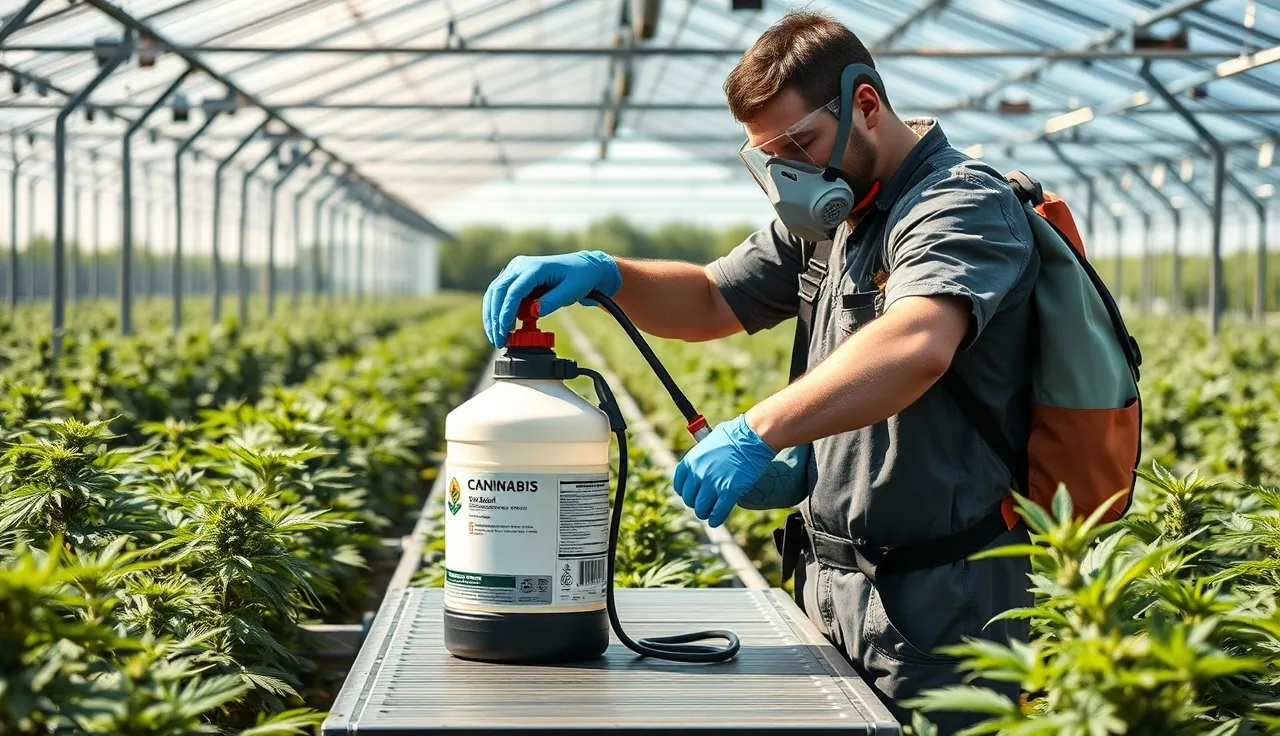
For mixing and loading concentrates, most cannabis-legal labels require at least chemical-resistant gloves (nitrile at 8-mil or neoprene, not latex), a long-sleeved shirt and long pants, chemical-resistant footwear, and often a half-face respirator with an organic vapor cartridge plus a P100 filter for dust-forming products. Pyrethrin-based concentrates frequently call for exactly this.
For spraying, requirements stay similar and add a chemical-resistant apron or coveralls for overhead work, plus eye protection (goggles rather than safety glasses when splashing is possible).
For early re-entry (entering a treated area before the REI expires), PPE requirements sit on the label under the "Agricultural Use Requirements" box.
Under 29 CFR 1910.138, you must document a written hazard assessment [4]. That assessment should name the specific chemical hazard, the route of exposure (dermal, inhalation, ocular), and the selected PPE with a reason. "Nitrile gloves because the label requires chemical-resistant gloves and 8-mil nitrile gives adequate breakthrough resistance for this formulation" is defensible. "Workers wear gloves" is not.
Glove and respirator fit matter more than people admit in indoor grows. A poorly fitted respirator gives close to zero protection against pesticide aerosols. Any respirator use, even voluntary use, pulls you into 29 CFR 1910.134 Appendix D, and a real respiratory protection program includes a medical evaluation and fit test before first use [3][12].
How do you conduct and document pesticide safety training for cannabis workers?
Under the WPS, handler training must be completed before a worker performs any handler task, must cover the topics listed at 40 CFR 170.230, and must be delivered by a certified applicator, a WPS trainer, or an EPA-approved training program [1]. Early-entry worker training has its own topic list at 40 CFR 170.130. Both repeat annually.
Under OSHA HazCom, initial training happens before exposure and covers how to read an SDS, what the hazard symbols mean, and what protective measures exist [2]. There is no fixed refresher interval, but retraining is required when new hazards show up or when workers clearly do not understand the material.
Under 29 CFR 1910.134(k), respiratory protection training covers why the respirator is necessary, its limits, how to don and adjust it, maintenance, and what to do if the wearer smells odors or feels irritation while wearing it [3]. Respirator training is annual too.
For a small grow, the practical move is one training session per new hire and one annual refresher that folds all three together. Document it with a sign-in sheet listing the date, trainer name, topics covered by standard citation (WPS 40 CFR 170.230, HazCom 29 CFR 1910.1200, and so on), and each worker's signature. Keep those records at least two years for WPS and at least three years for most OSHA training records.
OSHA does not dictate the format, so in-person, video, or online delivery all qualify as long as workers understand the content and can ask questions. If your workers are not proficient in English, training has to be in a language they understand. That is an active enforcement priority, not a footnote.
What are the medical surveillance requirements for pesticide-exposed cannabis workers?
OSHA's general industry standards do not mandate pesticide-specific medical surveillance the way they do for asbestos or lead. Two situations still trigger a medical evaluation requirement, and both are common in cannabis grows.
If your respiratory protection program requires employees to wear a respirator for pesticide work (it should, for most concentrate mixing and loading), 29 CFR 1910.134(e) requires a medical evaluation before the employee is fit-tested or uses the respirator the first time [3]. The evaluation uses OSHA's Respirator Medical Evaluation Questionnaire (the Appendix C form) and must be reviewed by a physician or other licensed health care professional (PLHCP). The employer pays. There is no set frequency for re-evaluation unless the PLHCP recommends it or the worker's health changes.
Second, if a worker is exposed to a pesticide whose OSHA permissible exposure limit (PEL) requires medical surveillance at certain levels, that standard applies. Organophosphates are the classic example. Most organophosphates are not on cannabis-use lists in legal states, but read your state's approved list carefully.
For acute exposures (a worker splashed, dosed heavily, or showing poisoning symptoms), you need a documented emergency protocol that includes calling Poison Control (1-800-222-1222) and getting the worker to emergency care. SDS Section 4 (First Aid Measures) governs what to do while waiting.
BLS data for 2022 show crop production workers logged roughly 30,900 recordable illness and injury cases, though cannabis is not broken out separately [9]. Pesticide poisoning is heavily underreported across agriculture. If you have 10 or more employees, your OSHA 300 log obligations are real, and the recordkeeping bar is higher than most owners assume. Our incident report guide covers what triggers a recordable entry.
How do state OSHA plans change pesticide exposure program requirements for cannabis?
Twenty-two states and two U.S. territories run their own OSHA-approved state plans, and several set pesticide requirements that go past the federal floor [10]. Cannabis cultivators in state-plan states answer to the state agency, not federal OSHA.
California is the sharpest example. Cal/OSHA's Pesticide Safety regulations (8 CCR 6700-6774) apply to all California agricultural employers and differ from both federal OSHA and the WPS. Cal/OSHA requires a written Injury and Illness Prevention Program that folds in pesticide hazards, medical supervision for workers handling certain restricted-use pesticides, and heat illness prevention for outdoor workers applying in hot conditions. California's Department of Pesticide Regulation has its own enforcement authority on top of that [8].
Oregon OSHA has its own agricultural pesticide standard. Washington L&I (Washington's state plan) adopted provisions largely parallel to the WPS with some independent enforcement. Michigan's MIOSHA enforces pesticide worker safety through its Agricultural Operations standard.
The takeaway: in a state-plan state, pull up your state OSHA agency's pesticide or agricultural safety page and compare it against the federal baseline. Some states are more protective, others are substantively the same. Do not assume federal standards cover you if your state runs its own plan.
SafetyFolio's program generator flags state-specific deviations when you pick your state, so you are not cross-referencing every state ag code by hand. Generator or not, the state-plan question is one you answer before you finalize the written program.
How do you handle a pesticide exposure incident in a cannabis operation?
Your written program needs a specific emergency response section, not a pointer that says "call 911." When someone gets splashed or dosed, the plan has to work in the first five minutes without anyone hunting for a phone number.
At minimum, the incident response section should include:
- The Poison Control Center number (1-800-222-1222) with instructions to call immediately for guidance on symptom severity and first aid.
- The name and address of the nearest emergency facility that can treat pesticide poisoning. Not every urgent care clinic has the resources or the exposure history to handle acute organophosphate or pyrethrin poisoning. Identify one in advance.
- The exact product information a treating physician needs: EPA registration number, active ingredient, concentration, route of exposure. Keep a laminated card with this in the grow room.
- Decontamination steps from the product's SDS before transport (remove contaminated clothing, flush skin with water for 15 to 20 minutes).
- OSHA recordkeeping obligations. A pesticide poisoning that needs medical treatment beyond first aid is an OSHA recordable illness, logged on the OSHA 300 [11]. An overnight hospitalization or loss of an eye is a reportable event, and you must notify OSHA within 24 hours.
After the incident, your program should require a root-cause investigation. Why did the exposure happen? Was PPE adequate and actually worn? Was the re-entry interval respected? Was training current? Document findings and corrective actions. An inspector reviewing your program after an incident looks for evidence you learned from it.
What records do you need to keep, and for how long?
Pesticide recordkeeping in cannabis runs at least three retention schedules at once. Mixing them up is how a routine license renewal turns into a scramble.
Under the WPS, pesticide application records must be kept for two years and include the product name, EPA registration number, active ingredient, total amount applied, location, date and time, and the REI [1]. These records must be available to the EPA and state ag department on request, and to workers' designated representatives.
Under OSHA HazCom, there is no explicit retention period for the SDS library itself, but you must keep current SDSs for all hazardous chemicals in use. Keep HazCom training records for at least three years as a practical matter, longer if they support your program defense.
Under 29 CFR 1910.134, respiratory protection medical evaluations must be retained for the duration of employment plus 30 years when the evaluation involves toxic substance exposure [3].
OSHA 300 logs, 300A summaries, and 301 incident reports must be kept for five years following the end of the calendar year they cover [11].
| Record type | Retention period | Governing rule |
|---|---|---|
| WPS pesticide application records | 2 years | 40 CFR Part 170 |
| WPS / HazCom training records | 2 to 3 years | 40 CFR 170, 29 CFR 1910.1200 |
| Respirator medical evaluations | Employment + 30 years | 29 CFR 1910.134 |
| OSHA 300, 300A, 301 | 5 years | 29 CFR 1904 |
For a small grow, the simplest system is one filing setup (physical or cloud) organized by worker name and year, with subfolders for application records, training, medical evaluations, and incident reports. Many state cannabis licensing boards now demand access to application records at renewal. Scattered records make that audit painful fast.
What does an OSHA inspection actually look for in a cannabis pesticide program?
OSHA compliance officers inspecting agricultural or cannabis operations tend to work a consistent sequence when pesticide hazards are present. Knowing the order tells you where your gaps will show first.
First, they ask to see your written HazCom program and your SDS binder. If you cannot produce a current SDS for every pesticide product in the facility within a reasonable time during the inspection, that is citable under 29 CFR 1910.1200(g) [2]. "We order from a supplier and they send the labels" is not a defense.
Second, they review training records to confirm workers were trained before performing pesticide tasks, not after. Missing signatures or undated sign-in sheets get treated as missing training.
Third, if any worker wore or is required to wear a respirator, they look for a written respiratory protection program, medical evaluation records, and fit-test documentation. A respirator sitting on a shelf without those records is the same as no program.
Fourth, they may walk the grow room checking how pesticides are stored (compatible chemicals separated, containers labeled, no unmarked spray bottles) and whether decontamination supplies are accessible.
Fifth, in state-plan states covering agriculture, they may coordinate with the state ag department to check WPS compliance at the same time.
The three most common citations in agricultural cannabis operations are a HazCom written program that is absent or incomplete, SDSs missing or outdated, and respiratory protection records missing. All three are preventable, because the paperwork costs nothing except time. The osha training foundation matters here: supervisors who know what inspectors check rarely have citable gaps.
Frequently asked questions
Is cannabis covered by the EPA Worker Protection Standard even though it's federally illegal?
Yes. The WPS covers agricultural establishments using EPA-registered pesticides on crops grown for sale or distribution. Cannabis cultivators selling into state-legal markets meet that definition. The EPA treats cannabis as an agricultural commodity for WPS purposes. Federal illegality of the crop does not exempt the employer from pesticide worker safety requirements.
Do I need a written pesticide program if I only use organic pesticides on my cannabis plants?
Yes, almost always. OSHA's HazCom standard applies to any hazardous chemical, including organic pesticide concentrates that are corrosive, flammable, or toxic by inhalation. Many "organic" concentrates (pyrethrin, neem oil at commercial strength) meet the GHS hazard criteria. You still need a written HazCom program, SDSs, and training. Only truly inert substances (water, food-grade materials) fall outside HazCom.
What happens if a cannabis employee gets sick from pesticide exposure and we don't have a written program?
You face layered consequences. The incident is likely OSHA recordable. OSHA can cite both the underlying exposure hazard and the missing written program. Serious violation penalties start around $1,000 and can reach $15,625 per violation. If the illness was preventable and your program was missing, willful or repeat classifications are possible. State cannabis licensing boards may also be notified, which can affect your license.
Can one written program cover both OSHA and the EPA Worker Protection Standard?
Partially. You can cross-reference shared content (training records, PPE requirements, decontamination procedures) between the two programs to cut duplication. But the WPS and OSHA HazCom programs stay separate legal documents with distinct required elements. One document will not satisfy both agencies. A practical setup is a master binder with an OSHA section and a WPS section that reference each other.
How often do cannabis workers need to be retrained on pesticide safety?
Under the WPS, handler and early-entry worker training must be completed annually. OSHA's respiratory protection standard also requires annual retraining. HazCom retraining is required when new hazards are introduced or when workers show they don't understand the material, with no fixed annual interval. Practically, one annual session covering all three requirements is the most efficient approach for a small grow.
Do I need a licensed pesticide applicator to apply pesticides in my cannabis grow?
Almost certainly, depending on your state. Most states require a private or commercial applicator license to buy and apply any pesticide beyond over-the-counter general-use products, even on your own property. Cannabis operations often use concentrates that require licensing. Check your state's department of agriculture for applicator requirements. Violations carry separate fines from OSHA penalties.
What is a re-entry interval and how does it affect my written program?
A re-entry interval (REI) is the time that must pass after a pesticide application before workers can enter the treated area without full handler PPE. REIs sit on the pesticide label and run from 4 hours to several days depending on the product. Your written program must document the REI for each product, require posting it before each application at the WPS central location, and prohibit early re-entry without the required PPE.
What are the most common OSHA citations for cannabis pesticide programs?
The most frequent are a missing or incomplete written HazCom program (29 CFR 1910.1200(e)), SDSs absent or not accessible to workers (29 CFR 1910.1200(g)), and no written respiratory protection program despite workers using respirators (29 CFR 1910.134(c)). Missing PPE hazard assessments under 29 CFR 1910.132(d) show up often too. All four are paperwork violations you can prevent without spending capital.
How do I get Safety Data Sheets for pesticides I use on cannabis?
The manufacturer or distributor must provide the SDS at first shipment and update it whenever significant new hazard information appears. You can download current SDSs from the manufacturer's website for most products. Search the product name plus "SDS." OSHA requires the SDS to follow the 16-section GHS format. If a supplier gives you only a label and no SDS, request one in writing before letting workers handle the product.
Does the written program need to be in Spanish or other languages for my workers?
Yes, if your workers are not proficient in English. Both OSHA and the WPS require training in a language workers understand. The written program itself, especially the emergency response section and the WPS posting requirements, must be accessible to workers who read a language other than English. The EPA offers WPS safety posters and training materials in Spanish, and OSHA provides many HazCom materials in Spanish at no cost.
What is the difference between a pesticide handler and an early-entry worker under the WPS?
A handler is any employee who mixes, loads, applies, or otherwise directly works with a pesticide, or who handles application equipment. An early-entry worker enters a treated area after an application but before the REI expires to perform agricultural tasks. Handlers face higher exposure and stricter training and PPE requirements. Most cannabis employees are one or both at different points. Each category carries its own WPS training content requirements.
Do greenhouses and indoor cannabis grows have to follow the WPS?
Yes. The WPS covers enclosed structures including greenhouses, grow rooms, and indoor agricultural facilities. Enclosed grow environments can present higher exposure risk than outdoor fields because air turnover is limited and workers re-enter more often. Your indoor written program should address ventilation during and after application, HVAC management during REIs, and possibly tighter PPE than label minimums if air movement is inadequate.
How long do I have to notify OSHA after a serious pesticide poisoning incident?
If a worker is hospitalized overnight from a work-related pesticide exposure, you must notify OSHA within 24 hours. Loss of an eye or an amputation carries the same 24-hour rule. A fatality must be reported within 8 hours. Notify by phone to the nearest OSHA area office or the 24-hour hotline at 1-800-321-OSHA. Failing to report on time is itself a citable violation.
Can I use a free template for my cannabis pesticide written program?
A template is a starting point, not a finished program. Generic templates miss cannabis-specific issues: state-approved pesticide lists, cannabis licensing board requirements, and state-plan deviations from federal OSHA. Whatever template you use, customize it with your actual chemicals, your workers' job titles, your state's requirements, and your facility layout. A template signed without customization can work against you in an inspection because it signals no real hazard assessment happened.
Sources
- EPA, Worker Protection Standard (40 CFR Part 170): WPS requires application record-keeping, annual handler training, central posting of pesticide information, and decontamination supplies; 2015 revision effective January 2017
- OSHA, Hazard Communication Standard (29 CFR 1910.1200): Requires a written HazCom program, an SDS for every hazardous chemical accessible to workers, a chemical inventory, and training before exposure
- OSHA, Respiratory Protection Standard (29 CFR 1910.134): Requires written respiratory protection program, medical evaluation before fit test or first use, and annual training and fit testing
- OSHA, PPE Standard (29 CFR 1910.132): Requires a written, signed, and dated hazard assessment identifying PPE selected and the basis for selection before workers use PPE
- EPA, Civil Monetary Penalty Inflation Adjustment Rule (FIFRA): EPA civil penalties for WPS violations can reach $19,816 per violation under the Federal Civil Penalties Inflation Adjustment
- OSHA, Penalties and Debt Collection: Maximum OSHA penalty for willful or repeat violations is $15,625 per violation as of 2024 inflation adjustment
- EPA, Pesticides: EPA has not registered any pesticide with cannabis as a target crop because cannabis remains a Schedule I controlled substance under federal law
- California Department of Pesticide Regulation, Cannabis Pesticide Guidance: California DPR maintains a list of pesticides considered acceptable for cannabis use; Cal/OSHA 8 CCR 6700-6774 covers agricultural pesticide safety independently
- Bureau of Labor Statistics, Injuries, Illnesses, and Fatalities program: Crop production workers experienced approximately 30,900 recordable illness and injury cases in 2022; pesticide poisoning cases are substantially underreported across agriculture
- OSHA, State Plans: Twenty-two states and two U.S. territories operate OSHA-approved state plans with authority to set standards at least as protective as federal OSHA
- OSHA, Recordkeeping Rule (29 CFR 1904): OSHA 300 logs, 300A summaries, and 301 incident reports must be retained for five years following the end of the calendar year they cover
- OSHA, Respiratory Protection, Appendix D (29 CFR 1910.134 App. D): Even voluntary respirator use requires that employees receive the information in Appendix D and, for non-filtering-facepiece respirators, the employer provide a written program
- EPA, Pesticide Registration (FIFRA label as law): Under FIFRA, applying a pesticide in a manner inconsistent with its label is a federal violation; the label is the legal minimum for PPE and application requirements