Last updated 2026-07-11
TL;DR
MSHA covers almost every mine and quarry in the country under the Mine Act of 1977, not OSHA. The dividing line is the dirt: if you're pulling minerals out of the earth, MSHA owns that site. OSHA can still reach an adjacent shop or office. Pick the wrong agency and you build the wrong program, expect the wrong inspections, and take on real penalty exposure.
What is the basic legal difference between MSHA and OSHA jurisdiction?
MSHA and OSHA are both federal agencies inside the U.S. Department of Labor, but they run on separate statutes and cover almost entirely separate workplaces. OSHA came from the Occupational Safety and Health Act of 1970 and covers most private-sector employers [1]. MSHA came from the Federal Mine Safety and Health Act of 1977 (the Mine Act) and covers mines [2]. Congress built them not to overlap.
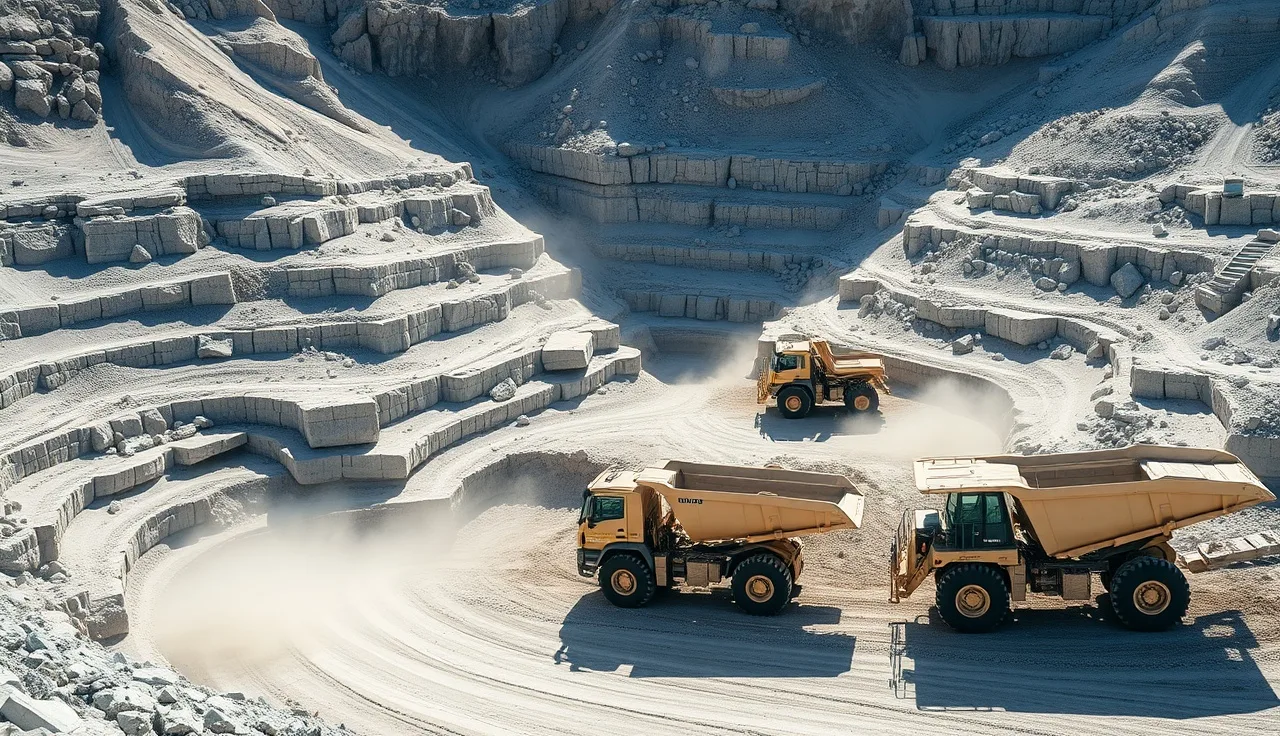
The Mine Act defines a "mine" broadly. Run a quarry, a sand and gravel pit, a stone crushing plant tied to an active extraction site, or any open-pit or underground operation that removes minerals from the earth, and MSHA is your agency, not OSHA. Section 4 of the Mine Act applies the law to "each coal or other mine" in the United States, and MSHA has read that jurisdiction hard for decades.
Get this wrong and the cost is real. Build your safety program around OSHA's General Industry standards (29 CFR 1910) or Construction standards (29 CFR 1926) while you operate a quarry, and you've built the wrong program. MSHA's standards sit at 30 CFR Parts 46, 47, 48, 50, 56, 57, and 77, among others. They don't swap in for OSHA's rules [3].
Neither agency is "stricter" across the board. MSHA runs more inspections (at least four times a year for surface mines, at least twice a year for underground) than OSHA's complaint-driven and programmatic model [2]. On some hazards like silica or noise, the exposure limits look similar but the paperwork and enforcement run through different channels.
Does MSHA cover quarries, or is that an OSHA site?
Quarries fall under MSHA, full stop. The Mine Act's definition of a mine reaches "an area of land from which minerals are extracted," and the agency has applied that to limestone quarries, granite quarries, sandstone operations, and other surface extraction sites for decades [2].
This surprises some small operators because they picture "mines" as underground coal shafts. The law doesn't work that way. MSHA covers surface metal and nonmetal mines (30 CFR Part 56), underground metal and nonmetal mines (30 CFR Part 57), surface coal mines (30 CFR Part 77), and underground coal mines (30 CFR Part 75). A limestone quarry is a surface nonmetal mine. It lives under 30 CFR Part 56 [3].
The Mine Act also reaches mills and processing operations that are part of or adjacent to a mine when they process minerals extracted from that mine. So your on-site crusher, screening plant, or wash plant handling material you dug up on that same property is MSHA too.
One narrow exception. If a processing plant is geographically separate from the mine and connected only by common ownership, OSHA might claim the processing facility. MSHA and OSHA signed a formal Interagency Agreement (last revised 1996) that sorts these edge cases [4]. Genuinely unsure? Ask either agency for a determination.
What kinds of operations does MSHA cover vs. what OSHA covers?
Here's the side-by-side.
| Operation Type | Governing Agency | Key Regulation |
|---|---|---|
| Underground coal mine | MSHA | 30 CFR Parts 75, 90 |
| Surface coal mine | MSHA | 30 CFR Part 77 |
| Underground metal/nonmetal mine | MSHA | 30 CFR Part 57 |
| Surface metal/nonmetal mine (quarry, gravel pit) | MSHA | 30 CFR Part 56 |
| On-site mill or crusher connected to mine | MSHA | 30 CFR Part 56 or 57 |
| Mine office building | MSHA or shared | 30 CFR / 29 CFR 1910 (contested) |
| Contractor on mine property | MSHA | Mine Act Sec. 4 |
| Aggregate processing plant NOT connected to extraction | OSHA (likely) | 29 CFR 1910 |
| Construction project at a non-mine site | OSHA | 29 CFR 1926 |
| Tunnel construction (not mineral extraction) | OSHA | 29 CFR 1926 Subpart S |
Look at the contractor row. Hire someone to do electrical work, haul material, or maintain equipment at your quarry, and that contractor is covered by the Mine Act while on your site, not by OSHA [2]. People miss this constantly. The contractor's crew doesn't get to run their OSHA hazard communication procedures instead of MSHA's. You, the operator, are on the hook for making sure contractors follow Mine Act requirements.
OSHA keeps jurisdiction over construction that genuinely builds a new mine (not operates one) and over processing facilities legally separated from the extractive site. The line blurs in practice. That's exactly why the 1996 Interagency Agreement exists [4].
Can both MSHA and OSHA have jurisdiction at the same site?
Yes, in limited cases. It's called "concurrent jurisdiction," and it shows up most at sites that both mine and manufacture or process.
The framework is the 1979 MSHA/OSHA Interagency Agreement and its 1996 update [4]. MSHA takes the mining and milling functions; OSHA covers truly separate administrative or manufacturing operations on the same property. Both agencies accept that their jurisdictions can sit next to each other at a single address.
Picture a quarry with a fabrication shop making cut stone products. The quarrying, primary crushing, and screening are MSHA. A physically separate fabrication shop could fall to OSHA. Workers who move between areas can be covered by different rules depending on where they're standing. Most small operators dodge the whole headache by running everything under MSHA voluntarily, because splitting programs invites audit risk.
Not sure who owns a slice of your operation? Both MSHA and OSHA run compliance assistance programs, and neither will cite you for asking. MSHA's Metal and Nonmetal Safety and Health district offices handle surface quarry questions. OSHA area offices handle the rest. Contacts for both are on their .gov sites.
How does MSHA inspect mines compared to how OSHA inspects workplaces?
The inspection frequency gap alone should get any quarry operator's attention. OSHA inspects most workplaces only on a complaint, a referral, a fatality, or a programmed targeting schedule. Plenty of small businesses go years without seeing an OSHA inspector [1].
MSHA inspects every surface mine at least four times a year and every underground mine at least twice. That's a statutory command under Section 103(a) of the Mine Act, not a policy choice [2]. No size exemption exists. A one-person gravel pit draws the same mandatory inspection schedule as a large open-pit mine.
MSHA inspectors also carry broader right-of-entry authority. They arrive unannounced, and operators can't legally stall an inspection. They can issue "withdrawal orders" that shut down all or part of a mine on an "imminent danger" finding, which moves faster and more directly than OSHA's process [2].
Penalties split too. MSHA civil penalties for significant and substantial (S&S) violations run from a few hundred dollars up to $70,308 per violation for flagrant violations under Section 110(b)(2) of the Mine Act [9]. OSHA's willful violation maximum is $161,323 as of 2024 [10]. Both structures adjust for size, history, and negligence.
On training, MSHA requires at least 24 hours of new miner training before a new surface miner works alone (30 CFR Part 46), not the 10 or 30-hour courses people associate with OSHA training. Those OSHA courses carry no weight at an MSHA-regulated site.
What written safety programs does MSHA require vs. what OSHA requires?
Both agencies want written programs. The specific programs differ, and they don't substitute for each other.
For surface nonmetal mines (quarries), MSHA's core written requirements include a written hazard communication program under 30 CFR Part 47 (MSHA's version, which differs from OSHA's 29 CFR 1910.1200 in places) [11], a written Part 46 training plan identifying each miner's training needs, and a written emergency response plan for mines with certain equipment or configurations. MSHA also has written requirements for respiratory protection, noise, and electrical safety.
OSHA's written programs for hazard communication (29 CFR 1910.1200), lockout/tagout (29 CFR 1910.147), and other standards apply only to the OSHA-covered parts of your operation. If your whole site is MSHA, those OSHA standards don't apply and you don't need OSHA-format written programs for the mining side.
Here's a practical break. MSHA's Part 47 hazard communication rules line up with OSHA's in many respects (both adopted the Globally Harmonized System for chemical labeling), so if you already run an OSHA-style HazCom program, much of the substance carries over. The regulatory citation, the training documentation format, and the inspection path are all different.
Run an office or shop under OSHA while your main site is MSHA and you genuinely need two separate safety programs. A tool like SafetyFolio's safety program generator can build the OSHA-side written programs for your office or standalone processing facility, but your mining operations need MSHA-specific documentation that cites 30 CFR, not 29 CFR.
What are the injury reporting rules under MSHA compared to OSHA?
Both agencies require injury and illness reporting. The timelines and forms are not the same.
Under OSHA, employers report fatalities within 8 hours and in-patient hospitalizations, amputations, or loss of an eye within 24 hours [7]. OSHA's recordkeeping rule (29 CFR 1904) requires the OSHA 300 log for employers with more than 10 employees in high-hazard industries.
Under MSHA (30 CFR Part 50), mine operators use a different system. Fatal accidents go to MSHA immediately by phone, with a written report within 10 days. Non-fatal lost-time injuries get reported within 10 working days on MSHA Form 7000-1 [3]. MSHA's definitions of a "reportable" event don't match OSHA's, so operators can't just hand in OSHA forms and call it compliance.
Context matters here. Mining ranks among the most hazardous industries by fatal injury rate. Bureau of Labor Statistics data and MSHA's own numbers show metal and nonmetal mining fatality rates per 100,000 workers running several times the all-industry average, which is part of why MSHA inspects and reports so aggressively [5].
For any OSHA-covered part of your operation, the standard incident report process applies. For the mine itself, follow 30 CFR Part 50 and call your MSHA district office.
Does the Mine Act cover contractors working at my quarry?
Yes. This is one of the most practical points for any operator who uses outside crews.
Section 4 of the Mine Act covers every person working at a mine, including independent contractors and their employees. The Act also puts responsibility on the operator to make sure contractors comply. MSHA's rule at 30 CFR 45.3 requires operators to give contractors a copy of the mine's relevant safety rules and to make sure contractors get appropriate training [3].
Contractors doing work at your quarry (drilling, blasting, hauling, maintenance, equipment install) are subject to MSHA standards for the whole job. Their OSHA certifications don't substitute. If a contractor employee never got Part 46 new miner or task training, that violation lands on you as the operator, more than the contractor.
The fix is simple: build contractor safety orientation into onboarding. Most experienced mine contractors already know this and carry their own Part 46 training records. Smaller or greener contractors may not. Ask for documentation before they start.
For non-mining contractors working at a physically separate, OSHA-covered shop on the same property, normal OSHA contractor management rules apply instead.
What is MSHA's Part 46 training requirement, and how is it different from OSHA training?
30 CFR Part 46 is MSHA's training standard for surface metal and nonmetal mines, including quarries [3]. It's the rule most small quarry operators need to learn first.
Part 46 requires at least 24 hours of new miner training before a new employee works alone. The training covers topics set in 30 CFR 46.5: hazard recognition, emergency procedures, health hazards, electrical hazards, and site-specific hazards. Experienced miners transferring from another MSHA mine need at least 8 hours of site-specific training before working alone [8].
Part 46 also requires annual refresher training of at least 8 hours for every miner, task training when a miner takes on a new job, and hazard training when new hazards show up.
This is built differently from OSHA training. OSHA has no single "new employee" training hour requirement that applies to all general industry workers. Instead, OSHA requires training on specific standards (lockout/tagout, hazard communication, respirators) with varying detail. The OSHA 30 course is voluntary awareness training, not a compliance requirement, and it counts for nothing as a Part 46 substitute at an MSHA site.
MSHA training records stay on-site and go to inspectors on request. The Part 46 training plan has to be written and site-specific. A generic template won't satisfy the rule.
What penalties can MSHA issue, and how do they compare to OSHA penalties?
MSHA runs a mandatory civil penalty system that differs from OSHA's in one big way: MSHA must issue a civil penalty for every violation it cites. OSHA has more room to issue a warning or a de minimis notice with no penalty.
MSHA's calculation uses six factors: operator history, size of the operator, negligence, gravity, good faith in abatement, and whether the violation was significant and substantial (S&S). Regular penalties run from under $100 to several thousand dollars per violation. A single unwarrantable failure (a higher negligence level) can reach into the tens of thousands. Flagrant violations under Section 110(b)(2) of the Mine Act can hit $70,308 per violation as of recent adjustments [9].
MSHA can also issue a "pattern of violations" notice under Section 104(e) of the Mine Act when a mine repeatedly draws S&S citations. That designation triggers a mandatory withdrawal order for each later S&S violation, shutting the mine down piecemeal until the pattern clears.
Compare OSHA: serious violation maximum $16,131 per violation, willful or repeated maximum $161,323 as of 2024 federal civil penalty adjustments [10]. Both agencies adjust amounts every year under the Federal Civil Penalties Inflation Adjustment Act.
Here's the takeaway. MSHA's mandatory penalties plus frequent inspections mean a quarry operator with sloppy recordkeeping or a weak Part 46 training plan can rack up serious fines fast, even without anyone getting hurt.
How do I know for sure if my specific operation is MSHA or OSHA?
The fastest honest answer: call MSHA's Metal and Nonmetal Mine Safety and Health district office for your region and describe your operation. They'll tell you whether you need to file an operator ID under the Mine Act. MSHA's office locator is at msha.gov [3]. The call is free, and MSHA's compliance assistance staff won't use it to launch an inspection.
You can also check whether MSHA already knows you exist. Never received a Mine Act inspection or citation, but your operation pulls material from the earth? The likely explanation is that MSHA hasn't found you yet, which is its own risk. MSHA runs a mine data retrieval system at msha.gov where you can search by location for an existing operator ID [6].
Signs that point hard toward MSHA: you extract rock, sand, gravel, stone, clay, or any mineral from the ground; you crush, screen, or wash material from your own extraction site; you use blasting, drilling, or heavy excavation for production; or you sell raw or processed aggregate.
Signs that might point toward OSHA: you buy aggregate from a mine and process or fabricate it at a separate facility; you do construction excavation but don't extract for sale; or you run a facility that receives mined material but does no extraction.
When you're building the OSHA-side written programs for any adjacent facilities, SafetyFolio's safety program generator can produce compliant 29 CFR-based programs in about 15 minutes instead of starting from a blank page.
What should a small quarry operator do right now to get into compliance?
Run a surface nonmetal quarry and haven't dealt with MSHA yet? Here's the order I'd work in.
First, register as a mine operator. MSHA requires every operator to notify the agency within 30 days of opening a new mine or acquiring an existing one. You do it through MSHA's online operator information system or by calling your district office [3]. Already operating and not registered? Do it now. The longer you wait, the uglier the penalty math when MSHA finds you through an accident or complaint.
Second, write your Part 46 training plan. This document shows MSHA what training each miner category needs, who delivers it, and how you document it. MSHA posts a free model training plan template on msha.gov that surface nonmetal operators can adapt. It's genuinely usable, more than a starting point.
Third, get your training records in order. Every miner needs a record showing new miner or experienced miner training, annual refreshers, and task training. Keep them on-site.
Fourth, work through 30 CFR Part 47 for your chemical inventory and hazard communication. Use diesel fuel, explosives, lubricants, or any other chemicals? You need an MSHA-compliant HazCom program [11].
Fifth, if you also run a separate office, shop, or processing facility under OSHA, build those written programs on their own. Lockout/tagout (29 CFR 1910.147) and hazard communication (29 CFR 1910.1200) are the two OSHA standards most often cited in maintenance and processing settings.
Frequently asked questions
Does MSHA cover a small one- or two-person gravel pit?
Yes. The Mine Act has no size exemption. A single-employee gravel pit that extracts material from the earth is subject to MSHA jurisdiction and must register as a mine operator, keep Part 46 training records, and receive mandatory inspections at least four times a year for surface mines. Size affects penalty calculations but not whether the law applies.
Do I need an OSHA 300 log if my entire operation is under MSHA?
No. OSHA's recordkeeping standard (29 CFR 1904) and the OSHA 300 log apply only to OSHA-covered employers. If your whole operation is an MSHA-covered mine, you use MSHA's injury and illness reporting system under 30 CFR Part 50, including MSHA Form 7000-1, not OSHA forms. If you have a separate OSHA-covered facility on the same property, those employees need OSHA 300 records.
Can an OSHA inspector walk onto my quarry and cite me?
Generally no. Once MSHA has jurisdiction over a mine, OSHA has no enforcement authority over that same area. The 1979 and 1996 Interagency Agreement between MSHA and OSHA formalizes this. If an OSHA inspector shows up at your quarry, point them to your MSHA contact information. The exception is a genuinely OSHA-covered area like a separate administrative building.
Is silica dust compliance handled by MSHA or OSHA at a quarry?
At an MSHA-covered quarry, MSHA handles silica exposure. MSHA's permissible exposure limit for respirable silica at metal and nonmetal mines is 0.1 mg/m³ as a TWA under 30 CFR Part 56.5001. OSHA's silica rule at 29 CFR 1910.1053 does not apply to MSHA-regulated operations. The numeric limit matches OSHA's, but the monitoring, documentation, and enforcement run through MSHA.
What is the MSHA Part 46 training requirement for a new quarry employee?
A new surface mine miner must receive at least 24 hours of training under 30 CFR Part 46 before working without close supervision. Topics include hazard recognition, emergency procedures, electrical hazards, and site-specific risks. Experienced miners from other MSHA-regulated mines need at least 8 hours of site-specific training. Annual refresher training of at least 8 hours is required for every miner regardless of experience.
Does MSHA cover independent contractors at a mine?
Yes. Section 4 of the Mine Act covers every person at a mine, including contractors and their workers. The mine operator is responsible for making sure contractors get appropriate Part 46 training or carry documented training from a previous MSHA-regulated site. Ask contractors for their training records before work begins. Contractor violations at your site can result in citations issued against you as the operator.
Are tunnel construction workers covered by MSHA or OSHA?
Tunnel construction workers are generally covered by OSHA under 29 CFR 1926 Subpart S, not MSHA, as long as the tunneling is construction rather than mineral extraction. Purpose is the key. Building an infrastructure tunnel is construction; driving a tunnel to reach an ore body is mining. MSHA covers the mining tunnel; OSHA covers the construction tunnel.
How often does MSHA inspect surface quarries?
MSHA must inspect every surface metal and nonmetal mine, including quarries, at least four times a year under Section 103(a) of the Mine Act. That's a statutory minimum, not a policy choice. MSHA may inspect more often if it finds hazards or a high rate of violations. Compare OSHA, which typically inspects only on complaint, referral, fatality, or programmed targeting.
What form do I use to report a mining injury to MSHA?
Non-fatal lost-time injuries at MSHA-regulated mines get reported on MSHA Form 7000-1 within 10 working days of the incident under 30 CFR Part 50. Fatal accidents get reported immediately by phone. This is separate from any OSHA reporting obligation. If your site has OSHA-covered areas, a fatality there still triggers OSHA's 8-hour reporting requirement under 29 CFR 1904.39.
Can I use my OSHA-compliant hazard communication program at my quarry?
Not directly. MSHA has its own hazard communication standard at 30 CFR Part 47. While both MSHA and OSHA adopted the Globally Harmonized System for chemical labeling, the regulatory citation, training documentation, and inspection pathway differ. You need a written HazCom program that cites 30 CFR Part 47, not 29 CFR 1910.1200, for the mine side of your operation.
What happens if I operate a quarry and never register with MSHA?
Failing to register is itself a Mine Act violation, and MSHA can assess mandatory civil penalties retroactively once it discovers the operation. Because MSHA inspects every mine multiple times a year, unregistered mines get found through neighboring operator reports, fatalities, or targeted outreach. There is no grace period. Registering late beats continuing to operate unregistered.
Does MSHA or OSHA cover the office building at my mine?
This is a genuine gray area. MSHA generally holds that administrative facilities on mine property fall under the Mine Act. OSHA has argued that purely administrative functions may fall under OSHA. The 1996 Interagency Agreement addresses it but doesn't resolve every case. In practice, most operators apply MSHA standards to all on-site facilities to avoid running two parallel programs.
Are aggregate processing plants covered by MSHA or OSHA?
It depends on the physical and operational connection to an extraction site. If the plant processes material from an adjacent or connected mine on the same property, MSHA usually claims jurisdiction. If the plant is geographically separate and buys material from outside mines, OSHA generally applies. The MSHA/OSHA Interagency Agreement governs these edge cases, and either agency can issue a formal determination.
Is blasting at a quarry regulated by MSHA, OSHA, or ATF?
Blasting safety at MSHA-covered mines is regulated by MSHA under 30 CFR Parts 56 and 57. OSHA's explosives standards at 29 CFR 1910.109 do not apply at MSHA-regulated sites. The Bureau of Alcohol, Tobacco, Firearms and Explosives (ATF) regulates storage, purchase, and licensing of explosives separately from either MSHA or OSHA, and that federal requirement applies regardless of which safety agency covers your site.
Sources
- OSHA, U.S. Department of Labor, OSH Act overview and penalty schedule: OSHA was created by the Occupational Safety and Health Act of 1970 and covers most private-sector employers; 2024 maximum willful violation penalty is $161,323
- MSHA, U.S. Department of Labor, Federal Mine Safety and Health Act of 1977 (Mine Act): Mine Act Section 103(a) requires at least four annual inspections for surface mines; Section 110(b)(2) flagrant violation maximum penalty; Section 4 covers every mine in the U.S.
- MSHA, U.S. Department of Labor, 30 CFR regulations (Parts 46, 47, 50, 56): 30 CFR Part 56 covers surface metal and nonmetal mines (quarries); Part 46 requires 24 hours new miner training; Part 47 requires written HazCom program; Part 50 requires injury reporting on Form 7000-1
- MSHA/OSHA, Interagency Agreement on jurisdiction (1996 update referenced on MSHA site): The MSHA/OSHA Interagency Agreement (last revised 1996) establishes how the two agencies divide jurisdiction at facilities with overlapping activities
- Bureau of Labor Statistics, Census of Fatal Occupational Injuries, industry data: Mining consistently ranks among the most hazardous industries by fatal injury rate per 100,000 workers compared to the all-industry average
- MSHA, Mine data retrieval system and operator information: MSHA maintains a mine data retrieval system where operators can search for existing site operator IDs by location
- OSHA, 29 CFR 1904 recordkeeping regulation: OSHA 29 CFR 1904 requires the OSHA 300 log for covered employers with more than 10 employees in high-hazard industries; fatal reporting within 8 hours
- MSHA, 30 CFR Part 46, new miner training requirements for surface mines: 30 CFR 46.5 requires at least 24 hours of training before a new surface miner works without close supervision; experienced miners need at least 8 hours site-specific training; annual refresher is 8 hours
- MSHA, Civil penalties and enforcement information: MSHA must issue civil penalties for every cited violation; flagrant violations under Section 110(b)(2) can reach $70,308 per violation; penalty calculations use six statutory factors
- OSHA, Penalty schedule, 29 CFR 1903: OSHA serious violation maximum is $16,131 per violation; willful or repeated maximum is $161,323 as of 2024 federal civil penalty adjustments
- MSHA, 30 CFR Part 47, hazard communication for mines: MSHA's hazard communication standard at 30 CFR Part 47 applies to MSHA-covered mines and differs in compliance mechanics from OSHA's 29 CFR 1910.1200
- MSHA, 30 CFR Part 56.5001, permissible exposure limit for respirable silica at metal/nonmetal mines: MSHA's PEL for respirable crystalline silica at surface metal and nonmetal mines is 0.1 mg/m³ as a TWA under 30 CFR 56.5001