Last updated 2026-07-11
TL;DR
No single OSHA standard covers foundries. More than a dozen 29 CFR 1910 rules apply together, covering silica dust, molten metal, noise, hexavalent chromium, lockout/tagout, and PPE. Silica and noise cite small shops hardest. A serious violation costs up to $16,550 as of January 2024; a repeat runs up to $165,514.
Does OSHA have a specific standard for foundries?
No. There is no dedicated foundry standard the way there's a separate set of rules for shipyards or construction. Small foundries and metal casting shops fall under OSHA's general industry standards at 29 CFR Part 1910, and almost any major standard in that part can apply depending on what you pour and how you finish it.
That's harder for you, not easier. A shipyard owner works from one booklet. You have to sort through silica, noise, molten metal, confined spaces, lockout/tagout, hazard communication, respiratory protection, and half a dozen more programs, then figure out which ones touch your floor.
OSHA publishes a foundry safety and health topics page that groups the relevant standards together, and the agency has issued enforcement guidance referencing metal casting hazards directly. [1] Start there. It's the fastest way to map which rules land on your shop before you write a single program.
What are the most frequently cited OSHA standards in foundry operations?
Silica and noise cite small foundries harder than anything else, because both do their damage slowly and owners assume the way they've always run the floor is fine. It isn't. Based on OSHA inspection data and agency guidance, these are the standards that show up most in foundry enforcement.
| Standard | Topic | Common Violation |
|---|---|---|
| 29 CFR 1910.1053 | Crystalline silica | No written exposure control plan; no air monitoring |
| 29 CFR 1910.95 | Occupational noise | No audiometric testing; no hearing conservation program |
| 29 CFR 1910.147 | Lockout/tagout | No written program; incomplete energy control procedures |
| 29 CFR 1910.94 | Ventilation (abrasive blasting) | Inadequate exhaust for blast rooms |
| 29 CFR 1910.132-138 | PPE | No hazard assessment; wrong gloves or face shields |
| 29 CFR 1910.1200 | Hazard communication | Missing or outdated SDS; no chemical inventory |
| 29 CFR 1910.146 | Permit-required confined spaces | Furnace interiors, pits, tanks not assessed |
| 29 CFR 1910.303/.304 | Electrical safety | Unprotected panel boxes; missing ground fault protection |
| 29 CFR 1910.179 | Overhead cranes | No annual inspection records; missing limit switches |
| 29 CFR 1910.217 | Mechanical power presses | Inadequate guarding on trim presses |
The pattern across foundry citations is the paperwork, not the hardware. Shops that have the ventilation and the guarding still get cited because the written plan, the monitoring data, or the training log doesn't exist. [2]
What does OSHA's crystalline silica standard require for foundries?
The silica standard at 29 CFR 1910.1053 is the biggest compliance headache in most small foundries. Sand casting, core making, shakeout, and abrasive cleaning all throw respirable crystalline silica into the air. The permissible exposure limit is 50 micrograms per cubic meter as an 8-hour time-weighted average. [3]
If any employee is exposed above the action level of 25 µg/m³ TWA, the obligations kick in:
- Written exposure control plan, site-specific, not a generic template
- Air monitoring to measure exposure, or a documented negative exposure assessment
- Engineering controls first (local exhaust ventilation, water suppression, enclosed shakeout), then work practice controls, then respirators as a last resort
- Medical surveillance for employees exposed at or above the action level 30 or more days per year
- Training on silica hazards at initial assignment and annually after
- Housekeeping that doesn't kick up new dust (no dry sweeping; wet methods or HEPA vacuums)
The medical surveillance piece catches owners off guard. Cross that 30-day threshold and you pay for a baseline chest X-ray and periodic physicals from a physician or licensed health care professional. General industry has had to comply since June 23, 2018. [3]
Silicosis is irreversible and can kill. In the final rule, OSHA estimated the standard would prevent "more than 600 deaths" a year once fully in effect. [3] That's the number behind every silica citation an inspector writes.
How does OSHA's noise standard apply to metal casting shops?
Foundry floors are loud enough to take your hearing over a career. Shakeout equipment, tumble blast machines, and compressed air cleaning routinely push past 90 decibels. OSHA's noise standard at 29 CFR 1910.95 sets the PEL at 90 dBA as an 8-hour TWA and requires a hearing conservation program any time noise hits 85 dBA TWA or above. [4]
A hearing conservation program covers noise monitoring, baseline and annual audiometric testing, hearing protector selection and fitting, training, and recordkeeping. The audiometric testing has to be run by a licensed or certified audiologist, an otolaryngologist, or a technician they oversee.
Engineering controls come first, and they pay off. Enclose the shakeout, isolate the noisy processes, add vibration dampening to the hoppers, and you drop the level before anyone reaches for earplugs. Earplugs are cheap, and workers lose them or leave them out. A shakeout enclosure works every shift without anyone remembering to put it on.
Nobody has clean data on average noise across all small foundries, but OSHA's technical manual and NIOSH studies consistently put shakeout areas at 100 to 105 dBA without controls. At 100 dBA, the permissible exposure duration without protection is 2 hours per OSHA's exposure table. [4]
What PPE is required for molten metal work?
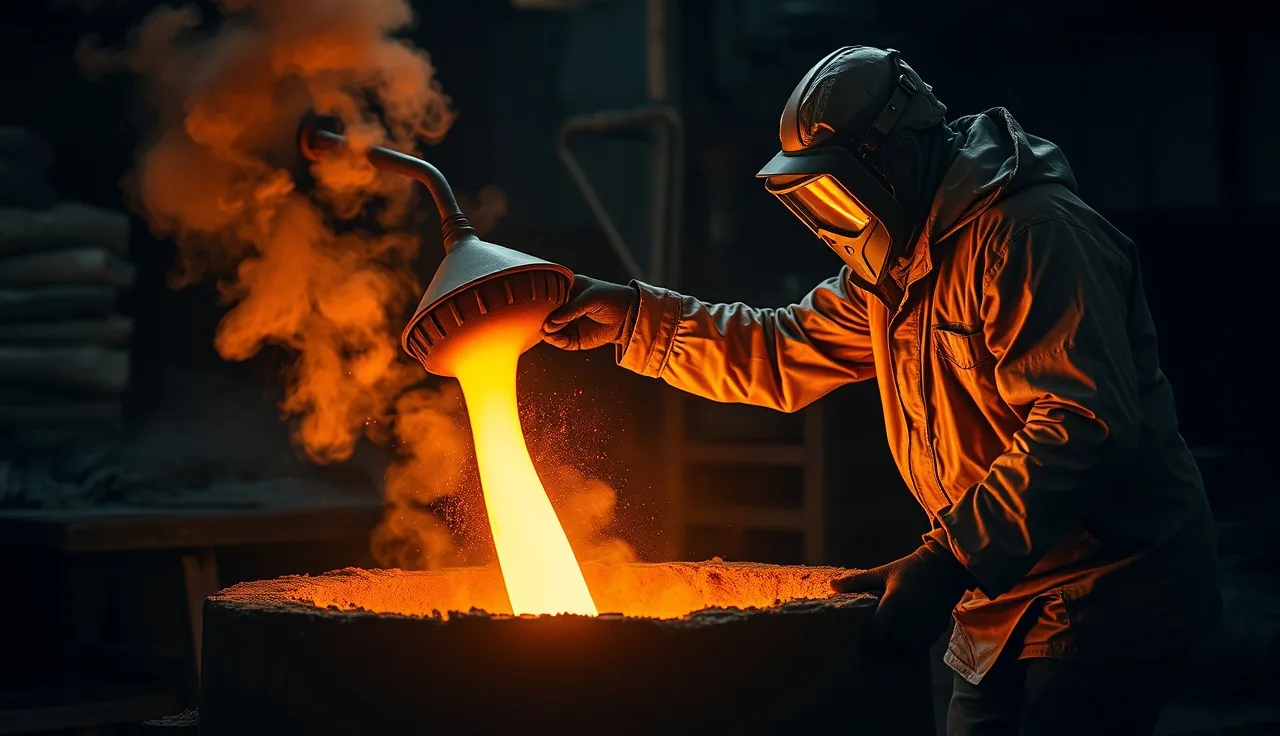
OSHA's PPE standards at 29 CFR 1910.132 through 1910.138 require a written hazard assessment before you pick PPE for any task, and you have to sign it. [5] For molten metal work, the minimum stack usually runs:
- A face shield worn over safety glasses, not a face shield alone. 29 CFR 1910.133 requires side protection and sets impact standards.
- An aluminized or flame-resistant foundry jacket and leggings or full coveralls rated for molten metal splash. Cotton alone won't do it.
- Foundry boots with no external lace hooks (laces catch molten metal and hold it against the foot), steel or composite toe, metatarsal guards
- Leather or heat-resistant gloves matched to the task, never latex or rubber
- Hearing protection (see the noise section)
- Respiratory protection depending on fume levels (see below)
Keep polyester and nylon away from molten metal, full stop. They melt and stick to skin. Only natural fibers or purpose-built FR fabrics belong in the pour area.
The written PPE hazard assessment (sometimes called a PPE certification) has to name the workplace, carry a date, list the hazards found, and be certified by whoever did the assessment. It's one page. Inspectors ask for it by name, so write it. It pairs with your hazard communication documentation.
What written safety programs does a small foundry actually need?
"Written program" is OSHA's phrase for the standards that make you document your procedures, more than follow them. A foundry of almost any size needs most of this list:
1. Hazard Communication Program (29 CFR 1910.1200): chemical inventory, SDS management, labeling, training records 2. Respiratory Protection Program (29 CFR 1910.134): medical evaluation, fit testing, respirator selection, maintenance, training 3. Lockout/Tagout Program (29 CFR 1910.147): written energy control procedures for each machine, plus the overall program document 4. Crystalline Silica Exposure Control Plan (29 CFR 1910.1053): specific to your processes 5. Hearing Conservation Program (29 CFR 1910.95): if monitoring shows 85 dBA or above 6. Permit-Required Confined Space Program (29 CFR 1910.146): if you have furnace pits, below-grade areas, or any confined space 7. Emergency Action Plan (29 CFR 1910.38): evacuation routes, assembly points, who calls 911 8. PPE Hazard Assessment Certification (29 CFR 1910.132) 9. Bloodborne Pathogens Exposure Control Plan (29 CFR 1910.1030): if you have first aid responders on staff
Run forklifts and you also need a documented operator training and evaluation program under 29 CFR 1910.178. The lockout tagout and forklift certification articles cover those two in depth.
A 10-person shop does not need 300-page manuals. Each program has to hit the required elements, match your actual workplace, and get used. Generic downloaded templates fail inspections because they reference equipment you don't own and skip hazards you do have. If writing all of this from scratch feels impossible while you're running the floor, SafetyFolio's safety program generator walks you through the required elements in one session instead of weeks of consultant meetings.
What are the air contaminant and fume hazards beyond silica?
Silica gets the attention. Foundry air is more complicated than that. Depending on your alloys, binders, and coatings, workers can breathe:
- Metal fumes (iron, steel, aluminum, brass, bronze): metal fume fever at acute exposures; OSHA sets PELs for most metals under 29 CFR 1910.1000
- Manganese: the PEL is a 5 mg/m³ ceiling under 29 CFR 1910.1000 Table Z-1; chronic exposure causes a Parkinson's-like neurological syndrome
- Hexavalent chromium under 29 CFR 1910.1026: in play if you cast stainless steel or use chromite sand; PEL is 5 µg/m³ as an 8-hour TWA, action level 2.5 µg/m³ [6]
- Carbon monoxide from combustion equipment and cupola furnaces: OSHA PEL is 50 ppm TWA under 29 CFR 1910.1000
- Polycyclic aromatic hydrocarbons from burning organic binders: recognized carcinogens; no specific OSHA standard, so the general duty clause applies
- Formaldehyde from some resin binder systems: 29 CFR 1910.1048 sets a PEL of 0.75 ppm TWA and requires a written program once exposure reaches the 0.5 ppm action level [7]
Local exhaust ventilation, source capture, and solid general dilution are your first defense across all of these. Respirators fill the gap when the engineering controls can't get you under the PEL.
Read the SDS for every material in the shop and you'll know which PELs are live. Never done that exercise? The hazard communication requirements at 29 CFR 1910.1200 make it mandatory anyway.
What lockout/tagout requirements apply to foundry equipment?
29 CFR 1910.147 controls hazardous energy during servicing and maintenance. In a foundry the equipment list is long: furnaces, conveyors, shakeout machines, blast equipment, cranes, hydraulic presses, trim presses, grinders, and anything automated.
The standard requires a written energy control program plus a written procedure for each machine that has more than one energy source, or where isolating energy isn't obvious and identical every time. OSHA's enforcement position is simple: if an inspector asks for the procedure on a specific machine and you can't hand it over, that's a citation.
Each machine procedure documents the shutdown steps, the location and type of every energy isolation point, the lockout hardware used, and how you verify a zero energy state. Anyone who does servicing or maintenance needs annual training, plus retraining whenever a procedure changes or there's a close call.
Lockout/tagout is consistently in OSHA's top 10 most-cited standards across all of general industry. [8] For foundries it sits in the top five. Write the machine-specific procedures before an inspector shows up asking, because you won't write ten of them in the hour you have.
What does OSHA require for overhead cranes used in foundries?
Most foundries move ladles, molds, and castings with overhead cranes. OSHA's overhead and gantry crane standard at 29 CFR 1910.179 carries several requirements that inspection reports flag over and over in foundries:
- A designated person visually inspects the crane before each shift for visible defects in hooks, hoist chains, and rope
- A qualified person runs a periodic inspection at intervals from monthly to annually depending on service class
- Every inspection result gets documented in writing with date and findings
- Cranes come out of service if any deficiency affecting safe operation shows up
- Hooks worn past the threshold (5% reduction from original dimension per ASME B30.2) get replaced
- Load ratings stay posted and never get exceeded
Foundry cranes fall into heavy or severe service, which pushes the periodic inspection frequency higher than a light-use warehouse crane. Inspect them monthly. An inspector will ask for the log, and gaps in it are a citation.
Crane operator training is expected under the general duty clause even though 29 CFR 1910.179 doesn't spell out hours. ASME B30.2 and CMAA specifications set the practice OSHA treats as the recognized good practice.
What OSHA training is required for foundry employees?
Training isn't optional, and "I showed them around on day one" doesn't count. The required events tied to foundry-relevant standards:
- Hazard Communication (1910.1200): at hire and when new chemicals arrive; covers the SDS system, label reading, and the specific chemical hazards on your floor
- Silica (1910.1053): at initial assignment and annually for exposed workers
- Respiratory Protection (1910.134): before first use and annually after; specific to the respirator assigned
- Lockout/Tagout (1910.147): before assignment to covered tasks; retraining when procedures change
- Hearing Conservation (1910.95): annually for workers in the program
- PPE (1910.132): before first use
- Permit-Required Confined Spaces (1910.146): before initial assignment
- Powered Industrial Trucks (1910.178): before initial operation, then every three years or after an incident
Document every session with the employee's name, the date, the topic, and the trainer's name. Training with no record is no training in OSHA's view.
If a supervisor runs your safety functions, an osha 30 or osha training course gives them the reasons behind each requirement, which makes the day-to-day easier than handing them a rule book. See osha 30 training for what that course actually covers.
What recordkeeping does OSHA require for a foundry?
Foundries with 10 or more employees keep OSHA injury and illness records under 29 CFR Part 1904 using the 300 Log, the 300-A Summary, and the 301 Incident Report. [9]
The NAICS codes covering foundries (331511, 331512, 331513, 331514, 331523, 331524, 331529) sit on OSHA's list of higher-hazard industries that must submit 300-A data electronically each year through the Injury Tracking Application. [9] The submission is due by March 2 of the year after the calendar year it covers.
Beyond injury records, foundry standards make you keep:
- Air monitoring results for silica, hexavalent chromium, noise, and other substances (silica records 30 years; noise exposure records 2 years, and audiometric records for the duration of employment)
- Medical surveillance records (30 years past employment for silica; duration of employment for noise)
- Crane inspection logs (keep them indefinitely; OSHA asks for the last 12 months at minimum)
- Lockout/tagout annual inspection certifications (1 year)
- Respiratory protection fit test records (until the next fit test)
- PPE hazard assessment certifications (no stated retention period, so keep them indefinitely)
The BLS Survey of Occupational Injuries and Illnesses puts iron and steel foundries well above the private sector on recordable injuries. Recent years run roughly 4.0 to 6.0 recordable cases per 100 full-time workers, against a private sector average near 2.7. [10] That gap is why OSHA watches foundries. A clean incident report process is worth getting right on day one.
Want the required written programs in place before an inspection? SafetyFolio's safety program generator takes the foundry-relevant standards one at a time and outputs compliant, site-specific documents.
What are OSHA's penalties if a small foundry gets cited?
OSHA raises its maximum penalties every January for inflation. As of January 2024, a serious violation tops out at $16,550. Willful or repeated violations reach $165,514 each. [11]
Small employers (fewer than 250 employees, with 10 or fewer at the same establishment) get a cut in the gravity-based penalty, often 60 to 80% for very small shops. That reduction applies after OSHA sets the initial number, and multi-item citations still stack up fast.
Here's where it gets expensive. A repeat citation for the same standard within five years is assessed at the maximum rate with no small-employer discount. A $3,000 silica citation in year one becomes a $165,000 repeat in year four.
Targeting matters too. Foundries fall under OSHA's Site-Specific Targeting program because the sector's injury rates run high. A high TRIR or DART rate in the 300-A data you submitted electronically can put you on a programmed inspection list without anyone filing a complaint.
Does your state have its own foundry-related OSHA rules?
Twenty-two states and two territories run OSHA-approved State Plans that cover private sector employers. [12] A State Plan has to be at least as effective as federal OSHA, and it's allowed to be stricter. California (Cal/OSHA), Washington (L&I), and Michigan (MIOSHA) have historically enforced certain standards harder or set lower limits than federal OSHA.
California is the one to watch. Cal/OSHA adopted its own respirable crystalline silica regulation aligning with the federal 50 µg/m³ PEL, effective for general industry, under Title 8 of the California Code of Regulations. [12] If you're in a State Plan state, check your state agency's site for anything that runs past federal minimums.
Federal OSHA covers private-sector foundries in the states without a State Plan. You can confirm whether your state runs one on OSHA's State Plans page.
Frequently asked questions
Is there a single OSHA standard that covers all foundry operations?
No. OSHA has no foundry-specific standard. General industry rules in 29 CFR Part 1910 apply collectively based on your processes. The most relevant ones cover crystalline silica (1910.1053), noise (1910.95), lockout/tagout (1910.147), PPE (1910.132-138), hazard communication (1910.1200), and ventilation (1910.94). OSHA's foundry safety and health topics page groups these as a starting point.
What is the OSHA silica PEL for foundry workers?
The permissible exposure limit for respirable crystalline silica under 29 CFR 1910.1053 is 50 micrograms per cubic meter as an 8-hour time-weighted average. The action level is 25 µg/m³. Above the action level for 30 or more days a year, workers go into medical surveillance at the employer's expense. The rule has been enforceable for general industry since June 23, 2018.
Do small foundries with fewer than 10 employees have to keep OSHA injury logs?
Employers with 10 or fewer employees at all times during the previous calendar year are partially exempt from the OSHA 300 Log under 29 CFR 1904.1. They still must report any work-related fatality within 8 hours and any in-patient hospitalization, amputation, or eye loss within 24 hours. The exemption never removes the reporting duty or compliance with the substantive safety standards.
What respiratory protection do foundry workers need?
It depends on measured air concentrations. For silica above the PEL after engineering controls, a NIOSH-approved half-face respirator with N95 or better filtration is the floor; higher concentrations need P100 or powered air-purifying respirators. Any respirator use triggers 29 CFR 1910.134: a medical evaluation, fit testing, a written respiratory protection program, and training before the respirator goes on.
What PPE is required for pouring molten metal?
At minimum: an aluminized or FR-rated foundry jacket and leggings or coveralls, foundry boots without external lace hooks and with metatarsal protection, leather or heat-resistant gloves matched to the task, a face shield worn over safety glasses, and hearing protection. Never use polyester or nylon near molten metal. The exact PPE follows a written hazard assessment under 29 CFR 1910.132. Respiratory protection may also apply depending on fume levels.
How often do overhead cranes in a foundry need to be inspected?
29 CFR 1910.179 requires a visual check by a designated person before each shift, plus periodic inspections by a qualified person at intervals from monthly to annually depending on service class. Foundry cranes in heavy or severe service get inspected monthly. Every inspection is documented in writing. Missing records are a common citation. If any deficiency affects safe operation, the crane comes out of service.
When does a furnace pit or below-grade area in a foundry qualify as a permit-required confined space?
29 CFR 1910.146 defines a permit-required confined space as one big enough to enter and work in, with limited entry or exit, and one or more serious hazards: atmospheric (CO, oxygen deficiency), engulfment, or configuration. Furnace pits, below-grade charging areas, and enclosed hoppers almost always qualify. When they do, you need a written permit space program, permits, trained entrants and attendants, and an emergency rescue plan.
Does OSHA require medical surveillance for foundry workers?
Yes, under several standards. Silica (1910.1053) requires surveillance for workers exposed at or above 25 µg/m³ for 30 or more days a year. Hexavalent chromium (1910.1026) requires it for workers above the 2.5 µg/m³ action level for 30 or more days a year. Noise (1910.95) requires baseline and annual audiometric testing for workers in the hearing conservation program. The employer pays for all of it.
What OSHA training records must a foundry keep?
Every training event required by a standard gets documented with the employee name, date, subject, and trainer. Part 1910 sets no universal retention period, but keeping records for the duration of employment plus three years is the practical move. Silica training records, lockout/tagout retraining certifications, and respiratory protection training records are the ones foundry inspectors ask for most.
Can a small foundry be inspected by OSHA without a complaint being filed?
Yes. OSHA's Site-Specific Targeting program schedules programmed inspections at establishments with elevated injury and illness rates. Foundries whose 300-A electronic data shows above-average TRIR or DART rates can land on the SST list. OSHA also runs National Emphasis Programs on silica and other hazards, which can bring an inspection to a foundry regardless of complaint history.
What is the OSHA general duty clause and how does it apply to foundries?
Section 5(a)(1) of the OSH Act, the general duty clause, requires employers to provide a workplace free of recognized hazards likely to cause death or serious physical harm, even where no specific standard exists. In foundries, OSHA has used it to cite PAH exposure from burning organic binders and molten metal splash hazards lacking written procedures, hazards documented in industry guidance but not tied to a numbered standard.
Do foundry employers need a written emergency action plan?
Yes. 29 CFR 1910.38 requires a written Emergency Action Plan for any employer with more than 10 employees. It has to cover evacuation procedures, escape routes, procedures for employees who stay to run critical equipment, how to report fires and emergencies, headcount after evacuation, and the names of responsible people. Employers with 10 or fewer employees may communicate the plan orally instead of in writing.
What are OSHA's penalties for a small foundry that gets cited?
As of January 2024, the maximum penalty per serious violation is $16,550. Willful or repeated violations reach $165,514 per violation. Small establishments usually get a 60 to 80% reduction in the gravity-based penalty. But a repeat citation for the same standard within five years loses that reduction and is assessed at the maximum. Electronic injury data can flag high-rate shops for programmed inspections before any complaint arrives.
What ventilation requirements apply to abrasive blasting in a small foundry?
29 CFR 1910.94 covers ventilation for abrasive blasting. Blast-cleaning enclosures need exhaust ventilation that keeps airflow away from workers and toward the intake. The standard sets minimum air volumes based on the cross-sectional area of the booth opening. Dust collectors have to handle that airflow and discharge cleaned air within applicable air quality rules. Silica abrasives fall under 29 CFR 1910.1053 as well.
Sources
- OSHA, Top 10 Most Frequently Cited Standards: Lockout/tagout, hazard communication, and PPE standards are among the most cited across general industry; silica enforcement has increased since 2018
- OSHA, 29 CFR 1910.1053 Respirable Crystalline Silica standard (Federal Register final rule, March 25, 2016): PEL of 50 µg/m³ TWA, action level of 25 µg/m³, medical surveillance requirements, and June 23, 2018 general industry compliance date; OSHA estimated more than 600 deaths prevented per year
- OSHA, 29 CFR 1910.95 Occupational Noise Exposure: PEL of 90 dBA TWA; hearing conservation program required at 85 dBA TWA; permissible duration at 100 dBA is 2 hours per OSHA exposure table
- OSHA, 29 CFR 1910.132 PPE General Requirements: Written PPE hazard assessment certification required before PPE selection for any work task
- OSHA, 29 CFR 1910.1026 Hexavalent Chromium: PEL of 5 µg/m³ as an 8-hour TWA; action level of 2.5 µg/m³; medical surveillance required above action level for 30 or more days per year
- OSHA, 29 CFR 1910.1048 Formaldehyde: PEL of 0.75 ppm TWA; action level of 0.5 ppm triggers air monitoring and written program requirements
- OSHA, 29 CFR 1910.147 Control of Hazardous Energy (Lockout/Tagout): Lockout/tagout is consistently among OSHA's top 10 most cited general industry standards; requires written machine-specific energy control procedures
- OSHA, Injury Tracking Application and electronic recordkeeping requirements (29 CFR Part 1904): Foundry NAICS codes are on the list of industries required to submit 300-A data electronically by March 2 each year; employers of 10 or fewer are partially exempt from 300 Log maintenance
- U.S. Bureau of Labor Statistics, Survey of Occupational Injuries and Illnesses, Iron and Steel Foundries (NAICS 33151): Iron and steel foundries consistently record TRIR values of approximately 4.0 to 6.0 per 100 full-time workers, above the private sector average of roughly 2.7
- OSHA, OSHA Civil Penalties (Federal Register inflation adjustments, effective January 2024): Maximum penalty per serious violation is $16,550 as of January 2024; willful or repeated violations up to $165,514 per violation
- OSHA, State Plans page: 22 states and 2 territories operate OSHA-approved State Plans covering private sector employers; state plans must be at least as effective as federal OSHA and may be stricter
- OSHA, 29 CFR 1910.146 Permit-Required Confined Spaces: Defines permit-required confined spaces and requires written program, permits, trained entrants and attendants, and emergency rescue procedures