Last updated 2026-07-09
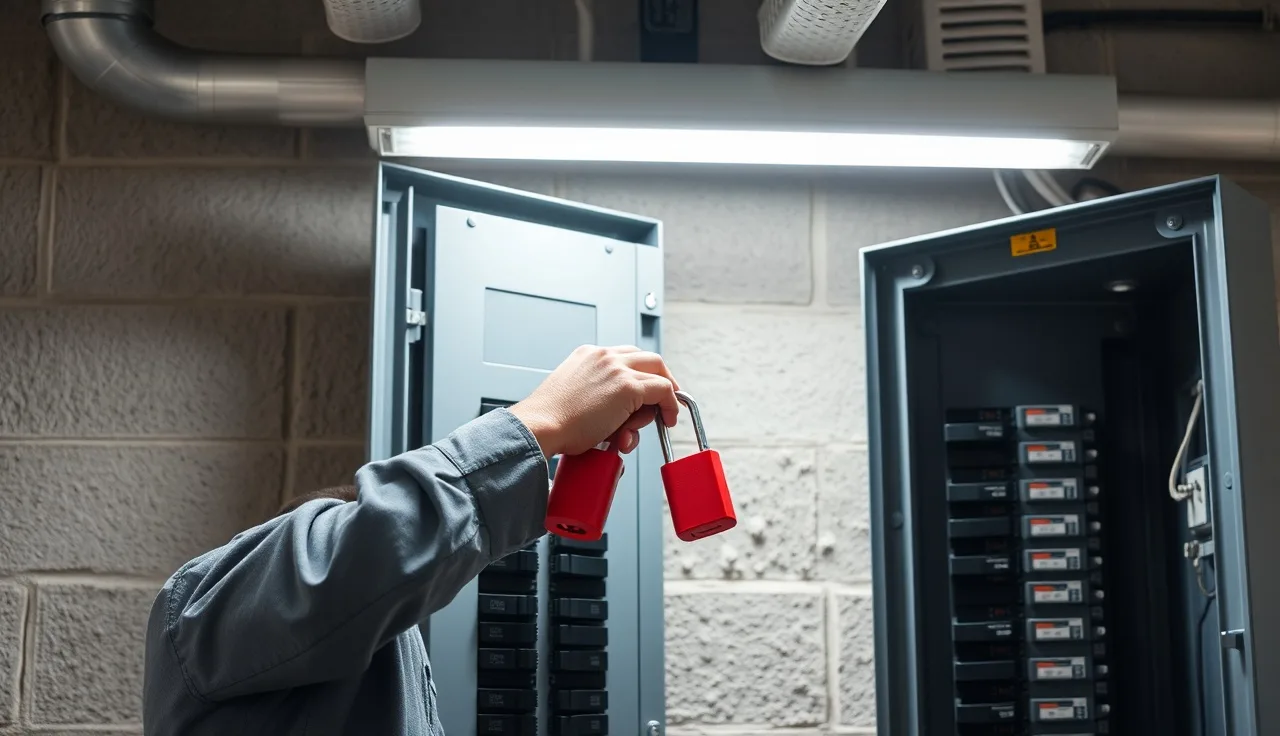
TL;DR
OSHA's lockout/tagout rule, 29 CFR 1910.147, requires you to de-energize and lock out a breaker panel before any servicing or maintenance where unexpected re-energization could hurt someone. Flipping the breaker off is not enough. You need a physical breaker lockout device with a padlock. Tagout alone is allowed only when the equipment design makes a lock physically impossible.
What does OSHA require for locking out a breaker panel?
OSHA requires four things before anyone works inside a breaker panel: a written energy control program, equipment-specific procedures where the lockout is complex or involves more than one energy source, trained employees, and real lockout hardware. Miss any one of them and you have a citable violation. The governing rule is 29 CFR 1910.147, "The Control of Hazardous Energy (Lockout/Tagout)." [1]
The standard kicks in any time an employee services or maintains equipment where unexpected energization, start-up, or a release of stored energy could cause injury. Work near or inside an electrical breaker panel is squarely covered. [1]
Here is the point that trips up small shops. Turning a breaker to "off" is not lockout. A co-worker can flip it back on. A visitor can. Vibration can. Lockout means a physical lock stops the breaker from moving. A breaker lockout device (a small plastic clip that snaps over the breaker handle and accepts a padlock) costs about $3 to $10, and it's what makes the lockout real instead of a suggestion. [2]
If you truly cannot attach a device because of how the equipment is built, OSHA allows tagout instead. But the rule is blunt: "Tagout provides less protection than lockout." Tags warn people. They don't stop anyone. When tagout is your only option, OSHA expects you to squeeze every bit of protection out of it and add extra safeguards on top. [1]
When is a breaker panel lockout actually required vs. when can you skip it?
Lockout is required for almost any servicing or maintenance task on equipment fed by a breaker. The exceptions are narrow. OSHA carves one out in 1910.147(a)(2)(ii) for "normal production operations" and for minor tool changes and adjustments that are routine, repetitive, and integral to production, provided an alternative measure gives full protection. That's a smaller door than most people assume.
Changing a light fixture. Replacing a motor. Running new wire. Reaching inside a panel for anything other than a specifically authorized, risk-assessed live-work task. Any job where a hand could touch an energized conductor. All of it needs lockout. No exceptions you can talk your way out of.
Deliberate live work is a different animal. It's governed by NFPA 70E and, in OSHA's general industry rules, by 29 CFR 1910.333, which permits energized work only when de-energizing creates a greater hazard (say, shutting down life-safety systems) or is genuinely infeasible. OSHA's guidance is clear that "inconvenience" and "production pressure" are not acceptable reasons to skip de-energization. [3]
A field test that works: if you'd be upset watching a new hire do the job without a lock, it needs lockout. That line isn't in the CFR, but it tracks how compliance officers size up risk.
What hardware do you need for breaker panel lockout tagout?
A compliant breaker panel program needs five things, and the whole set is cheap. The catch is that each piece has to be right for your panel.
Breaker lockout devices come first. They snap over a single-pole, double-pole, or three-pole breaker handle and accept a padlock through a hasp. Brady, Master Lock, and Panduit all make them. Match the device to your breaker brand (Square D, Eaton, Siemens, and so on) because they are not universal.
Padlocks are second. OSHA requires each authorized employee to have their own individually keyed lock. One employee, one lock, one key. The lock stays until that employee removes it with their own key. No supervisor override. No master key. [1]
Tags are third. LOTO tags have to be durable, standardized, legible, and warn against re-energization. They go on the lock or the isolating device. "Danger: Do Not Operate" or equivalent.
A lockout hasp is fourth, needed whenever more than one person works the same circuit. A hasp is a multi-hole bar that lets five or six padlocks share one attachment point. The circuit stays locked until the last lock comes off.
A lockout station or shadow board is fifth. The CFR doesn't require it, but compliance officers read an organized, accounted-for hardware setup as a sign the program is real. Missing hardware reads as a program that exists on paper only.
| Hardware item | Approx. cost per unit | OSHA-required? |
|---|---|---|
| Breaker lockout clip (single-pole) | $3 to $8 | Yes, or equivalent |
| Padlock (individually keyed) | $8 to $20 | Yes |
| Danger tag | $0.50 to $2 | Yes |
| Lockout hasp (6-hole) | $6 to $15 | Yes, for group lockout |
| Lockout station/shadow board | $40 to $200 | No, but recommended |
A starter kit for a 5-person shop servicing its own equipment usually runs $75 to $200 in hardware. Weigh that against the downside. OSHA's maximum serious penalty is $16,131 per violation, and willful violations reach $161,323 per violation as of 2024. [4]
What are the exact steps for a breaker panel lockout tagout procedure?
OSHA wants a documented procedure for each piece of equipment where the energy control steps aren't obvious or where more than one energy source is involved. For a simple single-circuit breaker lockout on one machine, the sequence mirrors the nine-step procedure in OSHA's 1910.147 Appendix A. [8]
Step 1: Prepare for shutdown. Identify every energy source (electrical, pneumatic, hydraulic, gravity, spring tension) and figure out which breaker or breakers feed the equipment.
Step 2: Notify affected employees. Anyone who runs the equipment or works nearby needs to know it's going down for maintenance.
Step 3: Shut down the equipment. Use the normal stopping procedure at the machine's controls.
Step 4: Isolate the energy. Go to the panel and switch the breaker to off.
Step 5: Apply lockout devices. Snap the breaker clip over the handle, thread your padlock through it, lock it, and attach your danger tag to the lock or clip.
Step 6: Release or restrain stored energy. Let capacitors discharge, bleed hydraulic lines, block parts that could drop under gravity. This is the step people skip, and it's where arc flash burns and crush injuries happen.
Step 7: Verify isolation. Try to start the equipment at its normal controls. Then use a properly rated voltage tester to confirm zero voltage at the point of work. Do not skip this. Breakers can fail to open fully, which is why OSHA treats verification as essential under 1910.333. [3]
Step 8: Do the work.
Step 9: Restore energy. Clear the area, pull your tools, reinstall guards. Remove your lock and device only when you're fully clear. Tell affected employees before you flip the breaker back on.
With multiple authorized employees, each one applies their own lock to the hasp before Step 8. Nothing gets re-energized until the last lock is off.
What does a written lockout tagout program need to include?
A written energy control program is required, not optional. 29 CFR 1910.147(c)(1) demands one from any employer whose people do maintenance or servicing covered by the standard. The rule says the program shall include "the scope, purpose, authorization rules, and techniques to be used for the control of hazardous energy, and the measures to enforce compliance." [1]
In plain language, the program needs six pieces.
A scope statement that spells out what work and which employees are covered.
Rules for who is authorized to apply locks ("authorized employees") versus who just needs to know lockout is happening ("affected employees").
The general energy control procedure that applies across your facility.
Equipment-specific procedures for any machine with multiple energy sources, a unique lockout sequence, or where the general procedure falls short. A panel feeding one machine through one breaker can ride on the general procedure. A main distribution panel feeding a dozen circuits needs its own written steps.
A hardware inspection and audit schedule. The standard requires each energy control procedure to be reviewed at least once a year, with each authorized employee's knowledge and skills checked during that review. [1]
Coordination rules for outside service personnel. Bring in an electrician and 1910.147(f)(2) requires you and the contractor to tell each other about your respective LOTO procedures and make sure everyone's people are protected.
Building that document from scratch is the part that stalls most owners. SafetyFolio's safety program generator walks you through the required elements and produces a compliant written LOTO program in about 15 minutes, tuned to your facility and equipment.
For energy control beyond breaker panels, our lockout tagout article covers hydraulic, pneumatic, and gravity hazards too.
What training does OSHA require for breaker panel lockout tagout?
OSHA sorts employees into three groups and trains each differently, under 29 CFR 1910.147(c)(7). There's no mandated number of training hours. The standard says training must be "sufficient" for the employee to do the job safely, which puts the burden on you to prove competence, not seat time. [1]
Authorized employees, the ones who actually apply locks, need training on the types of hazardous energy in their workplace, the methods to control those hazards, and the specific procedures they'll use.
Affected employees, who operate locked-out equipment or work in the area, have to understand the purpose of LOTO and know never to restart locked-out equipment. Lighter training, but it still has to be documented.
Other employees who simply pass through areas where LOTO is used must be told not to restart or re-energize anything that's locked out.
Retraining is required when you have reason to believe an employee has lost the procedures, when procedures change, or when the annual inspection turns up gaps.
You must certify training in writing with the employee's name, the date, and the subject. A verbal walk-through with no paper is not compliant. [1]
General OSHA training documentation rules apply here too. If you're standing up a broader program, an OSHA 30 course for supervisors folds hazardous energy control into the general industry curriculum.
How often does OSHA cite lockout tagout violations, and what are the penalties?
Lockout/tagout has landed in OSHA's top 10 most cited standards every year for decades. In fiscal year 2023, 1910.147 ranked 5th overall with 2,074 violations. [4]
OSHA cites it constantly because it's easy to check. A compliance officer can pull your written program, scan the wall for locks and tags, ask a worker to explain the procedure, and audit your training records, all inside an hour. Few standards are this fast to verify.
Serious violations (substantial probability of death or serious harm) run up to $16,131 per violation as of 2024. Willful or repeat violations reach $161,323 per violation. [4] Those maximums adjust every year under the Federal Civil Penalties Inflation Adjustment Act. OSHA also applies reductions for size, history, and good faith, so a small employer with a clean record can often knock the number down. But you need the program in place first to claim the good-faith credit.
The injury data is the real reason the rule exists. OSHA's training materials estimate that failure to control hazardous energy causes roughly 10% of serious accidents across many industries, with an estimated 50,000 injuries and 120 deaths a year tied to poor LOTO compliance. Those figures come from OSHA guidance and have been cited by the agency since the 1990s. Pinning down more recent LOTO-specific injury counts is hard because the way BLS codes injury causes changed, so nobody has a clean modern number. [5]
The honest framing: the fine is quantifiable, but the injury risk is why anyone bothers.
What is the difference between lockout and tagout for a breaker panel?
Lockout uses a physical device to stop the breaker from moving. Tagout uses a warning tag that tells people not to touch it. One is a barrier. The other is a request. For breaker panels, you can almost always achieve lockout, so you almost always should.
With lockout, the lock keeps the isolating device (the breaker) from being operated. The breaker can't go from off to on unless someone cuts the lock or breaks the clip. That's physical isolation.
With tagout, a tag hangs on the isolating device saying don't operate it. Somebody could still flip the breaker. That gap is exactly why OSHA's standard says: "Whenever possible, lockout shall be used." [1]
Breaker lockout clips exist for virtually every panel brand sold. If you claim you can't lock out a breaker because no device fits, OSHA expects you to have documented that finding and to have added extra protection under tagout.
Run into a panel design where nothing commercially available fits? Call the breaker manufacturer before you default to tagout. That call is cheaper than the citation.
How do you handle group lockout tagout when multiple workers are on the same circuit?
Group lockout means every worker on the same energy control gets equal protection: each person applies their own lock, and power can't come back until the last lock is gone. The rule lives in 1910.147(f)(3). [1]
For a breaker panel feeding a work area where several electricians or techs work at once, the standard tool is a group lockout hasp. The breaker device goes on the breaker, the hasp attaches to that device, and each worker threads their own padlock through a hole in the hasp. Six workers, six padlocks, one hasp. The circuit stays dead until the last person pulls their lock.
If the job crosses a shift change, you need a transfer procedure. The incoming worker adds their lock before the outgoing worker removes theirs. There is never a moment when the circuit sits accessible with no lock on it.
On big distribution panels where dozens of circuits feed the work area, some shops use a lockout box. All the breaker keys go inside, each worker locks the box with their personal lock, and nobody gets a key back until every lock is off. OSHA has accepted lockout boxes as compliant in letters of interpretation, as long as the procedure keeps each employee's protection equal and continuous. [6]
What are common mistakes that lead to OSHA citations for breaker panel LOTO?
A handful of failure patterns show up over and over in OSHA's inspection and enforcement records. Most are cheap to fix before an officer ever walks in.
No written program. This is the anchor citation, filed under 1910.147(c)(1). The program doesn't have to be long or slick. It has to exist in writing.
No equipment-specific procedures. The written policy covers the big picture, but individual machine procedures are also required where needed. A wall panel feeding five machines with no documented sequence is a clean citation.
Using the breaker's off position as the only protection. Flipping a breaker without a lock is the single most common field-level mistake. It's also the easiest one for an inspector to catch.
Skipping verification. Workers de-energize and then skip test-before-touch. Use a voltage tester rated for the panel's voltage to confirm zero energy at the work point before any hands go in.
Undocumented training. The work gets done right, but nobody can produce a record. OSHA requires written certification. Good habits without paper still draw a citation.
Ignored contractor coordination. An outside electrician shows up and the host program says nothing about how the two sets of locks interact. Section 1910.147(f)(2) requires that coordination to happen and to be documented.
Missed annual inspection. 1910.147(c)(6) requires at least one annual inspection of each energy control procedure, done by an authorized employee other than the one who uses it. Skip a single year and it's citable.
For how officers actually run an inspection and what documentation carries weight, our incident report article covers practices that apply across standards.
Does OSHA's breaker panel LOTO standard apply to construction sites?
General industry LOTO is 29 CFR 1910.147. Construction runs on a separate rule, 29 CFR 1926.417, which requires similar physical lockout or tagging of deactivated controls but is thinner than 1910.147 and doesn't demand the same written program. [7]
Still, plenty of construction contractors apply 1910.147 to their own maintenance work anyway, because their general industry shop, yard, and equipment are covered by 1910.147 regardless of what happens on the jobsite. If your construction company has a shop or warehouse where maintenance happens, 1910.147 governs that work.
OSHA has also said in several letters of interpretation that when construction employees do work that looks more like industrial maintenance than construction, 1910.147 can apply even on a construction site. The line is fuzzy. When in doubt, the more protective standard (1910.147) is the safer bet. [6]
For maritime employment, the LOTO standard is 29 CFR 1915.89, which tracks 1910.147 closely but adds shipyard-specific requirements. [10]
How do you build a breaker panel LOTO program if you're a small business without a safety manager?
Most small businesses don't have a safety director. The owner or ops manager handles compliance between a dozen other jobs, which is exactly how LOTO ends up as one paragraph in a handbook instead of a working program. Here's a sequence that fits a shop of 5 to 50 people.
Start with an equipment list. Walk the floor and write down every machine that needs servicing or maintenance. For each, note the energy sources (which breaker, what voltage, any secondary sources like pneumatics or stored spring energy).
Decide which machines need their own written procedure. One energy source and an obvious breaker usually rides on the general procedure. Two breakers, a pneumatic cylinder, and a capacitor bank need documented steps of their own.
Write the general procedure. One to two pages: the sequence, who's authorized, how locks and tags go on, how verification happens. Short is fine.
Buy the hardware. Spend an afternoon matching breaker clips to your actual panels. A panel you can't lock out because you bought the wrong clip is a problem you want solved before an inspector, not during.
Train and document. Do a hands-on walk-through with every authorized employee, have them demonstrate the procedure, and sign a record.
Schedule the annual inspection. Put it on the calendar now. Walking each procedure with an authorized employee and signing off takes a couple of hours.
The written-program piece is where SafetyFolio's program generator earns its keep. Answer questions about your equipment and workforce and it produces a written LOTO program with the required elements already structured, which kills the blank-page problem. The hardware and training are still on you.
Frequently asked questions
Can I just flip the breaker off instead of using a lockout device?
No. 29 CFR 1910.147 requires a physical lockout device that keeps the isolating device from being operated. A breaker switched off without a lock can be switched back on by anyone. A breaker lockout clip with a padlock costs about $10 to $25 and is what the standard actually requires. Turning the breaker off is Step 4 of a nine-step procedure, not the whole thing.
Do I need a written lockout tagout program for a small business?
Yes. 29 CFR 1910.147(c)(1) requires a written energy control program any time employees service or maintain equipment where unexpected energization could injure them. There is no size exemption. A shop with two maintenance employees still needs a written program, equipment-specific procedures where required, and documented training. Officers check for this in nearly every general industry inspection.
What is the penalty for not having a lockout tagout program?
Serious LOTO violations carry penalties up to $16,131 per violation as of 2024. Willful or repeat violations reach $161,323 per violation. OSHA can also cite per instance, so if five machines lack documented procedures, that can be five violations. Small businesses with good faith and clean records can negotiate reductions, but only after the citation lands.
How often do I need to inspect my lockout tagout procedures?
At least once a year, per 29 CFR 1910.147(c)(6). The inspection must be done by an authorized employee other than the one who uses the procedure. The inspector reviews the procedure and watches an employee perform it. You must certify it in writing with the machine name, date, employees involved, and inspector's name. Skipping even one annual cycle is citable.
What is a group lockout and when do I need one?
Group lockout applies when more than one authorized employee works on equipment under the same energy control at once. Each worker applies their own padlock to a shared hasp on the isolating device. Power can't be restored until every lock is off. During shift changes, the incoming worker adds their lock before the outgoing worker removes theirs, so protection never lapses.
Does OSHA's lockout tagout standard cover residential electricians or just industrial workers?
29 CFR 1910.147 covers general industry. Residential construction falls under 29 CFR 1926.417, which is similar but thinner. If an electrical contractor has a shop or yard where maintenance happens, 1910.147 applies to that work. For electricians doing work that looks more like industrial maintenance than construction, OSHA has said 1910.147 can apply even on a construction site, per its letters of interpretation.
What voltage tester should I use to verify a circuit is de-energized?
Use a non-contact voltage tester or a digital multimeter rated for the voltage and category of the panel. For a standard 120/240V residential or light commercial panel, a CAT III or CAT IV rated tester is appropriate. Test a known live circuit first to confirm the tester works, then test the de-energized circuit. This is the verification step, and OSHA's guidance treats it as essential.
What happens if a contractor comes in and my lockout tagout program does not cover them?
29 CFR 1910.147(f)(2) requires the host employer and contractor to inform each other of their energy control procedures and make sure each other's employees are protected. If your written program says nothing about contractors, that's a gap. You need a short documented process: who talks to the contractor, how locks are coordinated, and how you confirm the contractor's program is equivalent.
Can a supervisor remove an employee's lockout lock if the employee is not available?
Only under specific documented conditions. 29 CFR 1910.147(e)(3) says that if the employee who applied a lock isn't available to remove it, the employer may remove it only after verifying the employee is not in the facility, making a reasonable effort to reach them, and ensuring they know the lock was removed before returning to work. This must be a written procedure, never a casual call.
How is lockout tagout different from electrical safe work practices under NFPA 70E?
OSHA 1910.147 governs the energy control process: de-energize, lock out, verify, work safely. NFPA 70E governs electrical safety when work has to be done live or during verification, covering arc flash hazard analysis, PPE selection, and approach boundaries. The two work together. OSHA treats NFPA 70E as the recognized standard for live electrical work under 1910.333 and the general duty clause.
Do I need individual procedures for every breaker panel or just one general procedure?
You need equipment-specific procedures when the general procedure isn't enough, meaning multiple energy sources, a unique isolation sequence, or stored energy that requires special steps. A simple panel feeding one machine through one breaker can be covered by your general procedure. A main distribution panel, or any panel feeding multiple machines with different energy sources, usually needs its own documented procedure.
What training records does OSHA require for lockout tagout?
29 CFR 1910.147(c)(7)(iv) requires the employer to certify that training happened. The certification must include the employee's name, the training date, and the subject. A sign-in sheet from a group session works if it names the subject. Online completion records work if they show the individual's name and completion date. No specific format is mandated, but something must be on file.
What breaker lockout devices work for Square D, Eaton, and Siemens panels?
Breaker lockout clips are brand-specific because handle shapes differ. Brady, Master Lock, and Panduit all make devices for the major brands. Brady's catalog, for instance, lists part numbers for Square D QO and Homeline breakers, Eaton BR and CH series, and Siemens QP series. Measure your breaker handle and check the manufacturer's compatibility guide before buying in bulk. A clip that doesn't stay secure isn't a compliant lockout.
Is tagout ever acceptable instead of lockout on a breaker panel?
Only when the equipment design makes lockout physically impossible, which is rare for breaker panels since clips exist for nearly every brand. OSHA's standard says lockout shall be used whenever possible and states plainly that tagout provides less protection. If you go tagout, you must document why lockout can't be achieved and add extra protective measures under 1910.147.
Sources
- OSHA, 29 CFR 1910.147 (The Control of Hazardous Energy): Establishes requirements for written energy control programs, lockout hardware, employee training, and annual procedure inspections; source of quoted language that tagout provides less protection than lockout and that lockout shall be used whenever possible.
- OSHA, Control of Hazardous Energy (Lockout/Tagout) topic page: OSHA guidance that lockout devices must physically prevent operation of the energy-isolating device; context for breaker-specific lockout hardware requirements.
- OSHA, 29 CFR 1910.333 (Electrical Safety-Related Work Practices): Governs live electrical work conditions; production pressure is not a valid reason to skip de-energization; verification of a de-energized state is required.
- OSHA, Top 10 Most Frequently Cited Standards: 29 CFR 1910.147 ranked 5th most cited standard in FY2023 with 2,074 violations; serious violation penalties up to $16,131 and willful/repeat up to $161,323 per violation in 2024.
- OSHA, Control of Hazardous Energy training and outreach materials: OSHA estimate that failure to control hazardous energy causes roughly 10% of serious accidents in many industries, with about 50,000 injuries and 120 deaths per year; figures cited by the agency since the 1990s.
- OSHA, Standard Interpretations for 29 CFR 1910.147: OSHA has accepted lockout boxes as compliant when each employee's protection is equal and continuous; letters address contractor coordination and applicability of 1910.147 to construction-adjacent maintenance work.
- OSHA, 29 CFR 1926.417 (Construction: Lockout and Tagging of Circuits): Construction-specific lockout/tagout requirement; less detailed than 1910.147 and does not require the same written energy control program structure.
- OSHA, 29 CFR 1910.147 Appendix A (Typical Minimal Lockout Procedure): OSHA's published minimal energy control sequence, the basis for the step-by-step breaker lockout procedure described in this article.
- Bureau of Labor Statistics, Injuries, Illnesses, and Fatalities program: BLS injury and fatality data used for context; LOTO-specific cause coding changed in later survey years, making precise isolation of LOTO incidents difficult.
- OSHA, 29 CFR 1915.89 (Shipyard Employment: Control of Hazardous Energy): Maritime LOTO standard that mirrors 1910.147 with shipyard-specific requirements; applies to maritime employment instead of 1910.147.