Last updated 2026-07-09
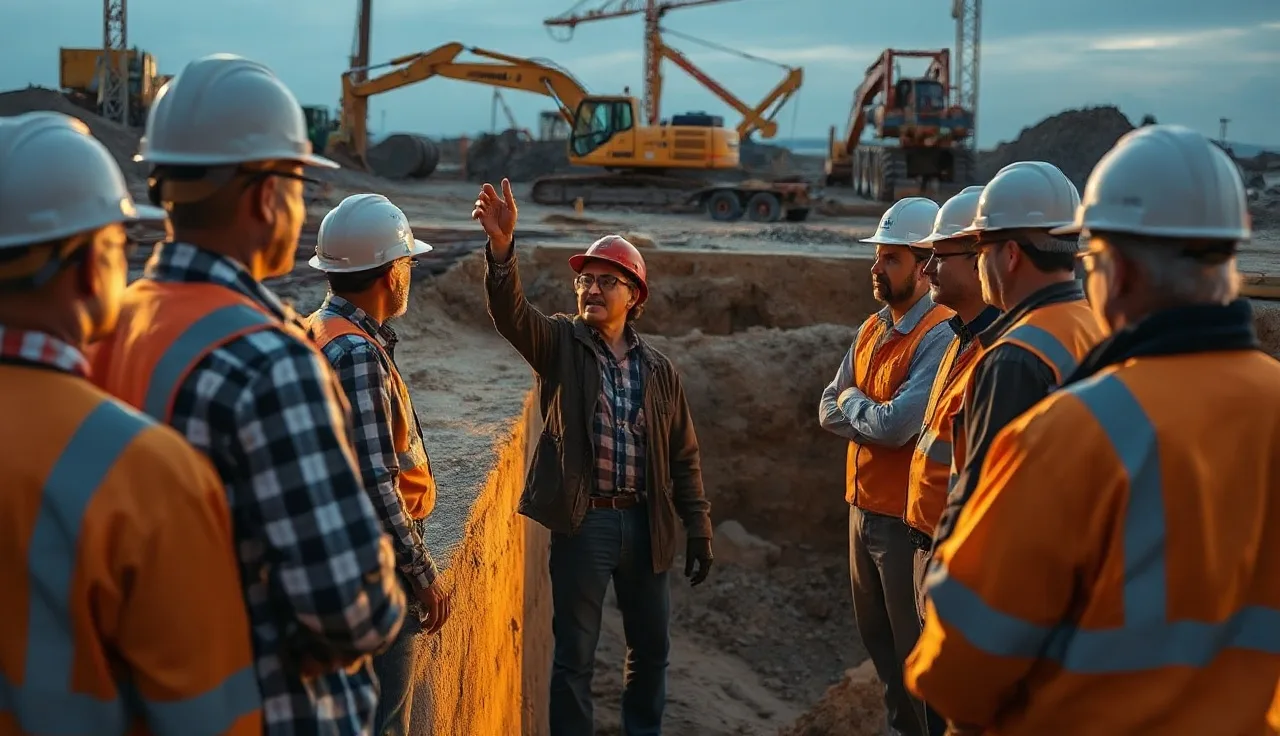
TL;DR
An excavation toolbox talk is a short pre-shift safety meeting covering cave-in hazards, soil classification, protective systems, underground utilities, atmospheric testing, and PPE before anyone enters a trench. OSHA requires a competent person to inspect the excavation daily under 29 CFR 1926.651. A focused 10 to 15 minute talk, tied to that day's actual conditions, can be the line between a near-miss and a fatality.
Why excavation toolbox talks matter more than most people think
Trenching is one of the most consistently deadly jobs in American construction, and the death toll has barely moved in a decade. The Bureau of Labor Statistics puts trench collapse fatalities at roughly 23 workers a year [1]. OSHA estimates cave-ins alone kill about two construction workers every month.
The toolbox talk is not paperwork. It is the last checkpoint before workers drop below grade, the moment a competent person can catch changed soil, a fresh utility mark, or a dewatering pump that quit overnight. Miss that window and there is no second chance.
Excavation hazards get misjudged in one specific way: people underestimate how fast a wall lets go and how heavy dirt is. A single cubic yard of soil weighs 2,700 to 3,000 pounds [2]. A worker buried to the chest by even a partial collapse cannot breathe, because the soil pins the diaphragm and stops it from moving. Say that out loud at the tailgate and watch it reset the crew's complacency in a way a laminated poster never does.
The talk also builds a record. If OSHA shows up after an incident and asks what pre-shift safety communication happened, a signed attendance sheet from that morning is your first line of defense. Keep every one of them.
What does OSHA actually require for excavation safety?
OSHA's excavation rules sit in 29 CFR 1926 Subpart P, mostly sections 1926.650 through 1926.652. Four obligations drive everything else.
A competent person must inspect the excavation, adjacent areas, and protective systems every day before work starts, again after rain or any hazard-increasing event, and as needed during the shift [3]. The definition carries weight here. A competent person can identify existing and predictable hazards and has authority to stop work. A laborer who happens to be standing at the edge does not qualify.
Any excavation five feet deep or greater needs a protective system (sloping, shoring, or a trench box) unless it is cut in solid rock. At four feet and deeper, a ladder, ramp, or other safe egress must sit within 25 lateral feet of every worker [3].
Surface encumbrances that could fall in must be removed or supported. Spoil piles stay at least two feet back from the edge [3].
When oxygen deficiency or a hazardous atmosphere is possible, the air gets tested before entry and controls go in place. This one blindsides people on urban jobs near old gas lines or in organic soils.
The toolbox talk does not replace these inspections. It carries them to the crew, so everyone knows the hazards, the protective system in use that day, and what to do the moment something changes.
| OSHA Requirement | Trigger Depth | Standard Reference |
|---|---|---|
| Competent person inspection before entry | Any excavation | 29 CFR 1926.651(k) |
| Protective system required | 5 feet or deeper | 29 CFR 1926.652(a) |
| Egress (ladder, ramp, etc.) within 25 ft. | 4 feet or deeper | 29 CFR 1926.651(c) |
| Spoil pile setback from edge | Any excavation | 29 CFR 1926.651(j)(2) |
| Atmospheric testing (if hazard possible) | Any excavation | 29 CFR 1926.651(g) |
| Water removal or control | Water accumulation present | 29 CFR 1926.651(h) |
What should an excavation toolbox talk actually cover?
A good talk runs 10 to 15 minutes and covers the hazards in front of the crew that day, not generic slides from a binder. Here is a structure that holds up.
Open with the conditions right now. What changed overnight? Did it rain? Are there new utility marks? Does the soil at the edge look different this morning? This frames everything after it as real, not theoretical.
Soil classification. Nobody has to become a geotechnical engineer, but everybody needs to know the soil they are in. Type A is stable cohesive soil like hard clay. Type B is moderately stable. Type C is the least stable, including granular and submerged soils. The type sets the required slope angle. For Type C, OSHA's Appendix B to Subpart P calls for a 1.5:1 horizontal-to-vertical ratio, meaning the walls get cut way back [3]. Tell the crew which type applies today.
The protective system in use. Using a trench box? Show them where it sits, how to stay inside its protection zone, and what happens if it has to move. Sloping instead? Point to the angle and say why it matters. Workers who understand the system follow it more.
Underground utilities. Dial 811 before every job. On dig day, remind the crew that locates are approximate and hand-digging (potholing) is required inside the tolerance zone, usually 18 to 24 inches either side of a mark depending on state law [4]. An electrical strike can kill before anyone moves.
Atmospheric hazards. Any chance of low oxygen, combustible gas, or toxic vapor (near landfills, old industrial sites, sewer lines) means testing before entry and periodically after. Name the person testing that day.
Eye hazards and PPE. This is where eye safety fits naturally into an excavation meeting. The work throws debris from jackhammers, soil from spoil handling, and chemicals from concrete or grout. Safety glasses with side shields, or goggles where splash is possible, are required under 29 CFR 1926.102 [5]. Point at the PPE this site needs today, not a generic list.
Emergency response. Who calls 911? Who has first aid training? Where is the nearest hospital? When a wall collapses, the instinct is to jump in. That instinct kills rescuers. Tell people to call 911 first and stay out of an unstable trench.
Sign the sheet. Everyone signs the attendance log before work starts. Date it, note the site address, keep it where you can find it.
How long should an excavation toolbox talk be?
Ten to fifteen minutes. That is the standard, and it comes from how attention actually works, not convention. Passive listening drops off hard after about 20 minutes, and by then a crew standing in the cold is already at the work face in their heads.
The point is not to run a full training course at 6:45 a.m. The point is to connect the crew to the hazards 30 feet away. A 12-minute talk that references the actual trench beats a 45-minute slide deck every time.
Got a complex dig with utility conflicts, adjacent structures, and a high water table stacked together? You can stretch to 20 minutes, but break it: five on cave-in protection, five on utilities, five on emergency procedures. Keep it modular and conversational. Nobody learns anything from a lecture at dawn.
Who should lead the excavation safety toolbox talk?
The competent person should lead it, or at the very least attend and confirm the content. On a small job that is usually the foreman or superintendent. On a big site it might be a safety coordinator.
Whoever runs it has to know the material cold. Reading a script and then fumbling a follow-up question kills your credibility fast. The crew clocks it the instant the leader cannot tell Type B from Type C soil, and they stop listening.
Rotating who leads works well on crews with several trained workers. It builds buy-in, because people take the content more seriously when they know they teach it next week. If your foremen have finished osha training or an osha 30 course, they should be your default pick. The OSHA 30 construction course includes a module on excavations.
What is soil classification and why does it matter for a toolbox talk?
Soil type decides what protective system the law requires and whether a slope is safe. Get it wrong and it is not a paperwork error. It is how people die.
OSHA's Appendix A to 29 CFR 1926 Subpart P names three soil types [3]. Type A is the most stable: cohesive soil with an unconfined compressive strength of 1.5 tons per square foot or greater, hard clay being the classic case. Type A cannot have been previously disturbed, subject to vibration, or fissured. Type B covers cohesive soils between 0.5 and 1.5 tons per square foot, previously disturbed soils, granular cohesionless soils, and soil next to open water. Type C is the worst: gravel, sand, loamy sand, submerged soil, and anywhere water is freely seeping.
A quick manual test (thumb penetration or a pocket penetrometer) helps classify soil in the field, but the competent person still has to account for water, fissures, layering, and vibration from traffic or heavy equipment.
For the talk, keep it practical. Show the crew the soil at the current work face, name the type, say what protection that type requires. If the dig hits a sandy layer in what started as clay, work stops until the competent person reassesses. No exceptions.
How do you handle eye safety in an excavation toolbox talk?
Eye injuries on excavation jobs come from every direction: jackhammers, concrete breaking, pneumatic tools, and spoil moved by backhoe or loader. OSHA's construction PPE standard at 29 CFR 1926.102 requires eye and face protection whenever there is a reasonable probability of injury that equipment could prevent [5].
Safety glasses with side shields are the floor. When there is grinding, concrete cutting, or chemical grouting, goggles or a face shield fit better. Folding the eye safety message into the excavation talk makes it stick, because the crew can see the exact tasks throwing the hazard.
A few practical points worth raising: anti-fog coatings matter when workers move between a cool trench and warm air above grade; scratched lenses cut clarity and are a fine reason to swap glasses; and contact lens wearers face extra risk from dust in a dry trench.
Have the PPE on site before the talk, more than named as a concept. If workers have to go hunt for glasses to comply, they will not comply.
What are the most common excavation violations OSHA cites?
OSHA's excavation standard lands near the top of the most-cited construction standards year after year. The violations that show up most under 29 CFR 1926 Subpart P [6]:
No protective system (1926.652(a)(1)): No sloping, shoring, or trench box in place. This is the big one.
No competent person inspection (1926.651(k)(1)): Nobody qualified looked before workers went in.
Inadequate egress (1926.651(c)(2)): No ladder, ramp, or exit within 25 lateral feet.
Spoil too close to the edge (1926.651(j)(2)): Excavated material piled inside two feet, adding surcharge load and raising the collapse risk.
No atmospheric testing (1926.651(g)(1)(ii)): Skipped testing where a hazardous atmosphere was reasonably possible.
Willful excavation violations can top $16,131 per violation under OSHA's 2024 penalty structure [7], and repeat or willful cases involving a death have drawn six-figure penalties. Beyond the fine, a single fatality typically triggers an inspection that combs through every part of your safety program.
If you need a written program covering excavation procedures, SafetyFolio's program generator can produce a compliant excavation safety program in about 15 minutes, and it makes a solid backbone for your toolbox talks.
Your best defense is a consistent, documented talk program. A worker who can describe the protective system in place and name the soil classification at his site is a worker who was prepared, and OSHA compliance officers can tell the difference on sight.
How do you document a toolbox talk to satisfy OSHA?
OSHA does not mandate a specific form, but you need enough on paper to prove the meeting happened, who was there, and what got covered. One page does it: date, site address, topic, name of who led the talk, printed names and signatures of everyone present, and a short note on the site-specific conditions discussed.
Some foremen use a carbon-copy triplicate so one copy stays on site, one goes to the office, one goes to the safety coordinator. Others photograph the sheet and drop it in a job folder. Either works fine.
The real failure mode is not the form. It is skipping the talk entirely. Courts and OSHA investigators treat missing documentation as evidence the training never happened, even when it did. Get the signatures before work starts.
After a recordable incident or a fatality, the first thing OSHA asks for is proof workers got hazard-specific training. An incident report is filed after the fact. The toolbox talk record is your evidence that you tried to prevent the thing in the first place.
Keep records at least three years. Some attorneys push for five on excavation work, given how severe the potential claims run.
What is a sample agenda for an excavation toolbox talk?
Here is a working agenda to adapt. It is not a script to read word for word. It is a checklist so nothing important slips.
1. Today's conditions (2 minutes) What changed since yesterday? Weather, new equipment, new people, updated locates. Name the specific trench or area you are talking about.
2. Soil type and what it means today (2-3 minutes) Name the classification for today's work face. Give the required slope ratio or note the trench box in place. Any concern about the soil, say it out loud.
3. Protective system check (2 minutes) Confirm the trench box is set right, the slope is cut as required, or the shoring is installed to spec. Make sure the crew knows where the protection zone is and that they stay inside it.
4. Underground utilities (1-2 minutes) Confirm locates are current. Remind the crew of the hand-dig rule inside the tolerance zone. Name who is holding the locate ticket on site.
5. Atmospheric hazards (1 minute, more if it applies) Confirm whether testing is required. Name who tests and the action threshold (stop work if oxygen drops below 19.5% or combustible gas reads above 10% of the lower explosive limit).
6. PPE, including eye protection (1-2 minutes) Point at the PPE for today's tasks. Call out safety glasses for jackhammer, concrete, and spoil work. Cover face shields if there is chemical grouting.
7. Emergency procedures (1 minute) Who calls 911? Where is the first aid kit? Remind everyone not to jump into an unstable trench to reach a buried coworker.
8. Questions and sign-off (1-2 minutes) Open the floor and mean it. Workers often know about a changed condition the supervisor missed. Sign the log.
What should you do differently if you have new or young workers on the crew?
Young workers, especially those under 25, die in construction at rates higher than their share of the workforce [8]. And workers in their first month on any job face elevated risk regardless of age, because they have not built the pattern recognition to notice when something looks wrong.
With new workers on the crew, add five minutes and get explicit about two things. First, normalize stopping to ask questions. A new worker rarely raises a concern unless the culture openly invites it. Say the words: "If anything looks different to you, you have the right to stop and ask before you get in that trench."
Second, walk the ground physically. Standing at the edge and pointing to the soil type, the trench box, and the ladder beats describing all of it in the abstract. New workers take in spatial detail by looking, not by hearing a list.
If your crews regularly carry people new to excavation, pair each one with an experienced hand for the first week and document that mentorship alongside the toolbox talk record. OSHA does not require it. It still matters, both for safety and for where you stand legally after an incident.
Are toolbox talks required by OSHA or are they just a best practice?
OSHA never uses the words "toolbox talk" in any standard. What the law requires is that employers train workers exposed to hazards, and for excavations specifically, that workers be trained to recognize and avoid unsafe conditions per 29 CFR 1926.21(b)(2) [9].
The toolbox talk is the construction industry's practical way to meet that training requirement, timely and tied to the site. It is not the only way, but it is the one compliance officers expect to see evidence of on an active excavation.
So a talk that was never documented does not protect you, even if it happened. And a generic monthly safety meeting that covers cave-ins in the abstract is a weaker defense than a daily pre-shift meeting anchored to real conditions.
29 CFR 1926.21(b)(2) itself states the employer "shall instruct each employee in the recognition and avoidance of unsafe conditions" in his work environment [9]. A talk that says "watch out for cave-ins" without naming the soil type, the protective system in use, and where the ladder is does not clear that bar.
For the wider view of your OSHA obligations on construction sites, see our guide to osha training.
What are common mistakes that make excavation toolbox talks ineffective?
The biggest mistake is running the talk as a checkbox instead of a conversation. Workers read that energy in seconds. A foreman visibly trying to finish in three minutes so the crew can start produces a crew that absorbs nothing.
Second most common: generic content. A slide deck last updated in 2019, showing stock trenches that look nothing like your site, connects to nobody's real experience. If you want engagement, point at the actual trench.
Third: skipping the question period. The last two minutes are when a worker mentions the thing he noticed but did not think worth raising. Someone says the water in the trench looked different this morning, or that a line runs where the locate showed nothing. Those two minutes can prevent a death.
Fourth: not adjusting for conditions. If the pre-shift inspection turned up a concern (a crack in the wall, seepage, heavy equipment vibrating nearby), that concern has to reach the talk. A fixed agenda that never changes with the inspection is not really site-specific.
Fifth: thin documentation. Date, site address, topic, signatures. That is the floor. A form that reads "excavation safety" with no date and no site is close to worthless as a legal record.
Frequently asked questions
How often should you run an excavation toolbox talk?
Daily, before work begins in or near an excavation. OSHA's competent person requirement under 29 CFR 1926.651(k) calls for inspection before entry each day, and the toolbox talk is the natural companion to that inspection. If conditions change mid-shift (rain, equipment vibration, new excavation area), a brief impromptu talk is warranted before work resumes.
What is a competent person in excavation and do they have to run the toolbox talk?
OSHA defines a competent person as someone capable of identifying existing and predictable hazards and who has authority to take corrective action. For excavations under 29 CFR 1926.650(b), this person must inspect the site daily. They do not have to personally lead every toolbox talk, but they should verify the content is accurate for that day's conditions and be present to answer questions.
Can you use a toolbox talk template or does it have to be custom?
Templates are a reasonable starting point, but the content must be specific to the day's conditions and hazards. OSHA guidance under 29 CFR 1926.21(b)(2) requires training that addresses the specific hazards workers face, not generic scenarios. Use a template as a checklist, then fill in the soil type, protective system, utility conditions, and emergency contacts that are accurate that day.
What PPE is required for excavation workers?
Hard hats are standard. Safety glasses with side shields or goggles are required under 29 CFR 1926.102 when tools like jackhammers, concrete breakers, or pneumatic equipment are in use. High-visibility vests are required near traffic. Hearing protection may apply near loud equipment. Respiratory protection or supplied air may be needed if atmospheric testing reveals hazardous conditions.
What is the two-foot rule for spoil piles near a trench?
OSHA's 29 CFR 1926.651(j)(2) requires that excavated material (spoil) be kept at least two feet from the edge of the excavation. This reduces the risk of surcharge loading that can collapse the trench wall and prevents loose material from falling onto workers below. Two feet is the minimum; more setback is better, especially in soft or wet soils.
Do you need to test air quality before entering a trench?
Yes, when conditions make a hazardous atmosphere reasonably possible. Under 29 CFR 1926.651(g)(1), testing is required before entry when excavations are in an area with a history of combustible gas, near landfills, adjacent to sewer lines, or where oxygen-deficient or toxic atmospheres could exist. Oxygen below 19.5% is deficient; combustible gas at or above 10% of LEL requires evacuation.
What is the difference between sloping, shoring, and a trench box?
Sloping means cutting back the trench walls at an angle that matches the soil type (OSHA Appendix B to Subpart P). Shoring uses timber, hydraulic, or mechanical systems to brace the walls. A trench box (shield) is a prefabricated steel or aluminum box that protects workers inside it but does not necessarily prevent wall collapse. All three are OSHA-accepted protective systems under 29 CFR 1926.652.
How do you handle an excavation near an existing building or structure?
Excavation adjacent to a structure introduces risk of undermining the foundation and lateral surcharge loading on the trench wall. OSHA's 29 CFR 1926.651(i) requires that support or underpinning be provided to protect the structural stability. The toolbox talk for this scenario should specifically address the setback from the structure, any shoring requirements, and who is responsible for monitoring for movement.
What should workers do if they see a crack in the trench wall?
Exit the excavation immediately using the nearest safe egress point and notify the competent person. A tension crack parallel to the trench edge is one of the clearest warning signs of imminent collapse. Work must not resume until the competent person evaluates the conditions, and a new protective system assessment may be required. Document the observation and any remedial action taken.
Is there an OSHA fine for not having a toolbox talk on an excavation site?
OSHA does not cite specifically for 'missing toolbox talk.' The citations come from the underlying standards: lack of training (1926.21), no competent person inspection (1926.651(k)), inadequate protective system (1926.652), and similar. Penalties for serious violations can reach $16,131 per violation under 2024 OSHA penalty adjustments. Willful violations are significantly higher.
How do you run a toolbox talk for a multilingual crew?
Use a bilingual crew member or foreman as a translator if the leader does not speak workers' primary languages. OSHA's training standards require that training be provided in a language workers understand. Written forms can be prepared in multiple languages. Visual aids and physical walkthrough of the trench are especially valuable when language is a barrier; pointing at a trench box is universally clear.
What is the minimum age for workers in an excavation?
Federal OSHA and the Fair Labor Standards Act's Hazardous Occupations Order 17 generally prohibit workers under 18 from excavation work in non-agricultural settings. Workers 18 and over have no age restriction, but first-week workers of any age have statistically elevated injury risk. Supervisors should consider extended orientation and pairing with experienced workers for anyone new to excavation.
Do subcontractors need to attend the excavation toolbox talk?
Yes. Subcontractors whose workers enter or work adjacent to the excavation are exposed to the same hazards. OSHA's multi-employer worksite policy holds that the controlling employer has responsibility for ensuring all workers on site are protected. The safest practice is to require all workers at or near the excavation to attend and sign the daily toolbox talk regardless of employer.
Sources
- Bureau of Labor Statistics, Census of Fatal Occupational Injuries: Trench collapses kill an average of about 23 workers per year in the U.S.
- OSHA, Trenching and Excavation Safety: A cubic yard of soil weighs approximately 2,700 to 3,000 pounds.
- OSHA, 29 CFR 1926 Subpart P (Excavations), including Appendices A and B: Competent person inspection requirements, protective system triggers at 5 feet, egress at 4 feet, spoil pile setback, and soil classification criteria.
- Common Ground Alliance, Best Practices Guide: Hand-digging (potholing) is required within the tolerance zone, typically 18 to 24 inches on either side of a utility locate mark.
- OSHA, 29 CFR 1926.102 Eye and Face Protection: Eye and face protection required in construction when there is a reasonable probability of injury that could be prevented by such equipment.
- OSHA, Top 10 Most Frequently Cited Standards in Construction: 29 CFR 1926 Subpart P excavation violations are among the most frequently cited construction standards annually.
- OSHA, Civil Penalty Adjustments for Inflation (2024): Maximum serious violation penalty is $16,131 per violation under OSHA's 2024 inflation-adjusted penalty structure.
- NIOSH, Young Worker Safety and Health: Young workers under 25 are overrepresented in construction fatalities relative to their share of the workforce.
- OSHA, 29 CFR 1926.21(b)(2) Safety Training and Education: Employers must instruct each employee in the recognition and avoidance of unsafe conditions in the work environment.