Last updated 2026-07-09
TL;DR
A first aid toolbox talk is a short crew meeting (5 to 15 minutes) built around one first aid topic: kit locations, bleeding control, burn response, or similar. OSHA requires first aid training under 29 CFR 1910.151. A good talk keeps that training alive in the field, costs nothing, and is one of the highest-return safety habits a small business can build.
What is a first aid toolbox talk?
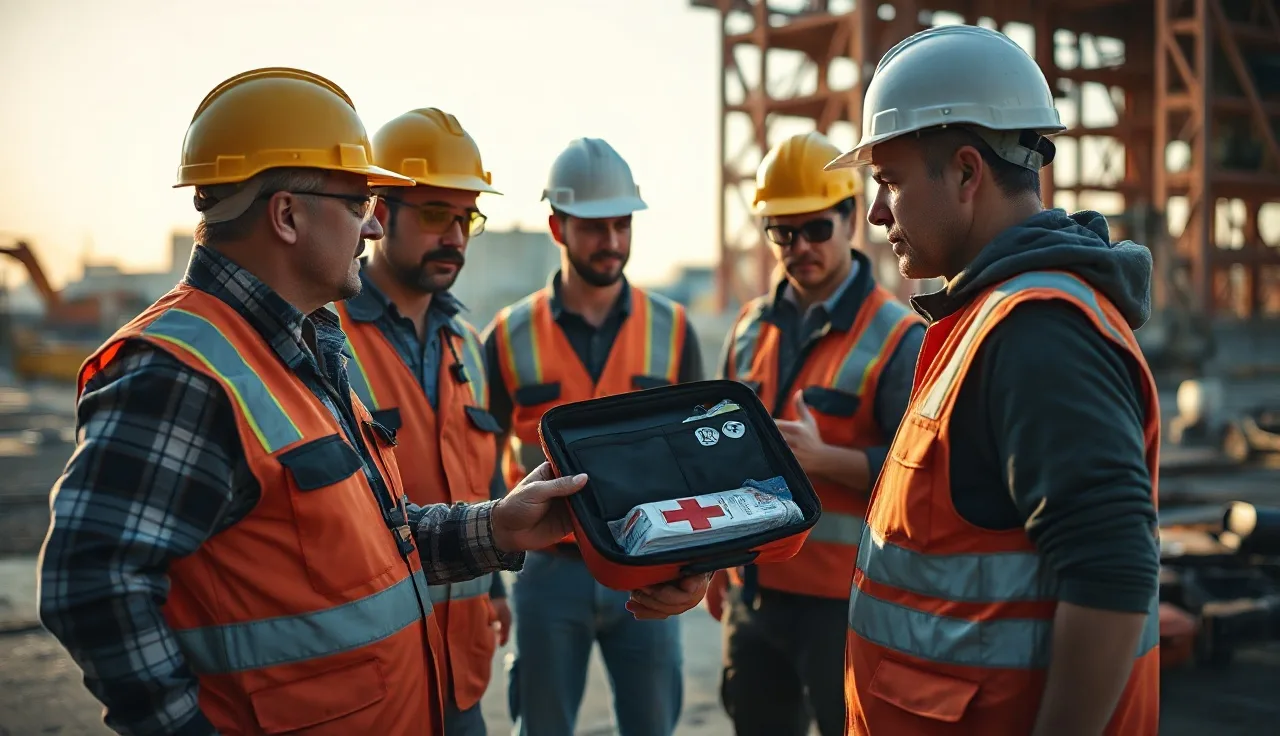
A toolbox talk is a short, informal safety meeting held before a shift or at the start of a task. The first aid version zeroes in on emergency response: where the kit is, what's in it, how to stop bleeding, when to call 911 versus handle it in-house, and who on the crew is trained.
The format is deliberately low-stakes. No projector. No quiz. No sign-in sheet required by law, though keeping one is smart. You gather the crew for 5 to 15 minutes, cover one concrete topic, answer questions, and get back to work.
The word "toolbox" comes from construction, where workers gathered around a literal toolbox for a quick briefing. The name stuck across industries. You'll hear the same thing called a "tailgate talk" in highway and utility work, a "safety huddle" in healthcare, or a "pre-task briefing" in manufacturing. Same idea, different label.
What sets a first aid talk apart from a fire safety talk or a fall protection talk is how immediately it applies. Every worker on every job can get cut, burned, or drop with a medical emergency. First aid never feels like an abstract regulatory checkbox the way some topics do.
Does OSHA require first aid toolbox talks?
OSHA has no rule that says "you must hold toolbox talks." It does require first aid training and first aid supplies, and toolbox talks are the most practical way to keep that training fresh. That's the honest read.
The core standard is 29 CFR 1910.151, which covers medical services and first aid for general industry. It states: "In the absence of an infirmary, clinic, or hospital in near proximity to the workplace which is used for the treatment of all injured employees, a person or persons shall be adequately trained to render first aid." [1] That's a real obligation, not a suggestion.
For construction, 29 CFR 1926.50 is the parallel standard. It requires first aid kits, trained responders, and emergency procedures at every site. [2]
Here's the practical version. If OSHA inspects and finds that your workers don't know where the first aid kit is, can't describe basic bleeding control, or don't know who to call in an emergency, that's evidence your training program isn't working. Regular toolbox talks are both the habit and the paper trail that keep you out of trouble. A sign-in sheet from each talk isn't legally required under 1910.151, but it's cheap insurance if you ever face an inspection or fight a citation.
Learn more about your baseline legal obligations at osha training.
What are the most important first aid topics to cover?
The best topics are the ones tied to hazards your workers actually face. A machine shop has different priorities than a restaurant or a landscaping crew. A handful of topics, though, pay off almost everywhere.
Bleeding control. Uncontrolled hemorrhage is the leading cause of preventable death from trauma. OSHA's bloodborne pathogen standard (29 CFR 1910.1030) governs workplace exposure to blood, and anyone in a hands-on trade will eventually deal with a cut. [8] The Stop the Bleed campaign, supported by the Department of Homeland Security, teaches three techniques: direct pressure, wound packing for deep wounds, and tourniquet application. Any one of them fills a 10-minute talk. [3]
Recognizing a heart attack or stroke. The Bureau of Labor Statistics counted 318 fatal cardiovascular events at work in 2022. [4] The warning signs are learnable in a single session. The acronym FAST (Face drooping, Arm weakness, Speech difficulty, Time to call 911) takes two minutes to teach and sticks for years.
Burn response. Cool running water for 10 to 20 minutes. Not ice. Not butter. When to go to urgent care versus the ER. How to tell a second-degree burn from a third-degree one. Simple, sticky, worth a dedicated talk.
Kit location and contents. Sounds too basic to bother with. It isn't. OSHA inspectors regularly find workers who can't say where the kit is. Walk the crew to every kit on the site. Open it. Show what's inside. Eight minutes, and you've closed a real compliance gap.
Opioid overdose and naloxone. Construction has the highest drug overdose death rate of any industry, according to CDC/NIOSH data. [5] More employers now stock naloxone (Narcan). If yours does, workers need to know how to use it before they need to use it.
Sprains, strains, and musculoskeletal injuries. These are the most common nonfatal workplace injuries by a wide margin. BLS data shows sprains, strains, and tears account for roughly 31% of all days-away-from-work injury cases. [4] RICE (Rest, Ice, Compression, Elevation) is the old guidance. Current sports medicine leans toward POLICE (Protection, Optimal Loading, Ice, Compression, Elevation). Either beats guessing.
Eye injuries. CDC/NIOSH estimates about 2,000 workers per day in the U.S. sustain job-related eye injuries needing medical treatment. [6] A quick talk on eyewash station locations and proper flushing (15 minutes of continuous flushing for chemical exposure, per 29 CFR 1910.151(c)) is time well spent. [9]
The right cadence is roughly one topic a week. A 52-talk annual calendar that mixes first aid, hazard-specific topics, and emergency procedures is realistic for any employer with regular crew meetings.
How do you actually run a first aid toolbox talk step by step?
Running a good toolbox talk is about preparation and follow-through, not polish. Here's a format that works at any site.
Step 1: Pick one topic and one scenario. The biggest mistake people make is cramming. If the talk is "first aid kit," make it only the first aid kit. If it's "bleeding control," that's all you do. One topic, one scenario, one takeaway.
Step 2: Open with a real incident or near-miss. Not a made-up story. A real situation from your company, your industry, or an OSHA case file. OSHA publishes incident and fatality reports you can search at osha.gov. A short "last week on a job like ours, someone did X and Y happened" grabs attention faster than reading a regulation aloud.
Step 3: Cover the what, where, and who. What is the hazard or situation? Where is the equipment (kit, AED, eyewash station)? Who is the trained first aid responder on this shift? Three questions, answered.
Step 4: Demonstrate something physical. If the topic is kit contents, open the kit. If it's tourniquet application, put one on your own arm. Showing beats telling for retention, and it wakes people up.
Step 5: Ask one question back. "Where's the closest eyewash to your station?" "What do you do first for a deep cut?" This isn't a gotcha. It's a check that the message landed, and it forces people to actually think.
Step 6: Write it down. Date, topic, who attended, who ran it. Keep it in a folder or a shared drive. If you get inspected, that record shows a working safety program. If an incident happens later, it shows you trained the crew. File a proper incident report any time a real injury follows, no matter how minor it looks.
What should a first aid toolbox talk handout or talking points look like?
A talking-points sheet should fit on one page, ideally half a page. Long documents don't get read on a job site. Here's what belongs on it:
- Date and topic at the top
- 2-3 key facts about the hazard (specific numbers land best: "Burns need 10 to 20 minutes of cool water, not ice")
- Location of relevant equipment (fill this in per site)
- Who to call (first aid designee's name and number, 911 for anything life-threatening)
- One thing workers should do differently after this talk
- Signature lines for attendance (optional but recommended)
You do not need to buy a template. Write those items in plain language in a shared doc, print it, done. The conversation matters far more than the design of the sheet.
If you want to build the written program that sits behind your toolbox talks (the document that ties your training to OSHA's requirements), SafetyFolio's safety program generator can produce a compliant first aid written program in about 15 minutes, which you then use to anchor your ongoing talks.
How often should you run first aid toolbox talks?
There's no OSHA-mandated frequency for toolbox talks. What OSHA's general duty clause requires is that employers keep the workplace free of recognized hazards, and regular refresher training is how you do that.
In practice, most construction safety programs run toolbox talks weekly. In general industry, the range is weekly to monthly depending on how hazardous the work is.
For first aid specifically, a reasonable schedule for a small employer looks like this:
| Frequency | Topic type | Example |
|---|---|---|
| Monthly | Core first aid skill | Bleeding control, CPR review, burn response |
| Quarterly | Kit audit + location review | Walk every kit, restock, confirm everyone knows the location |
| Annually | Full first aid program review | Confirm trained responders, update emergency contacts, review your written program |
| After any incident | Incident-specific debrief | What happened, what went right, what to change |
After a workplace injury is the highest-value moment for a first aid talk. The incident is real, the crew is paying attention, and the lessons match the actual work. Don't waste that window by skipping the debrief.
Who should run a first aid toolbox talk?
The foreman, supervisor, or crew lead is the right person. Not HR. Not a safety consultant who shows up once a quarter.
The reason is context. Whoever runs the talk needs to know the specific site, the specific hazards, and the specific crew. A supervisor who walks the floor every day knows where the pinch points are, which worker has a known medical condition, and which machine keeps drawing blood. That knowledge makes the talk credible instead of generic.
The supervisor doesn't need to be a certified first aid instructor to run a talk. They're reinforcing training, not replacing it. The formal first aid and CPR training required under 29 CFR 1910.151 should come from a certified provider like the Red Cross, the American Heart Association, or the National Safety Council. Toolbox talks are the follow-up that keeps that training alive between renewals.
If your supervisors hold an OSHA 30 card, they're well-positioned to run first aid talks because they've covered emergency response content in depth. For a look at what that course includes, see our overview of osha 30 training.
What first aid equipment does OSHA require, and should you cover it in talks?
29 CFR 1910.151(b) requires that "adequate first aid supplies shall be readily available." The word "adequate" is intentional. OSHA doesn't spell out a kit list, but it points to American National Standard ANSI/ISEA Z308.1, which sets minimum contents by workplace class. [7]
For a Class A kit (the baseline for most workplaces), ANSI Z308.1-2021 sets minimums that include an absorbent compress, adhesive bandages, adhesive tape, antiseptic, a CPR breathing barrier, a first aid guide, non-latex gloves, a roller bandage, sterile pads, and a triangular bandage, among others.
Higher-hazard workplaces need more. A shop with chemical exposure needs an eyewash station (29 CFR 1910.151(c) requires one where the eyes or body may be exposed to injurious corrosive materials). [9] A site with electrical hazards should stock a burn kit. A site with heavy machinery is a strong candidate for a tourniquet and hemostatic dressing.
A toolbox talk on kit contents doubles as an audit. Open the kit in front of the crew and you'll find out on the spot whether items are missing, expired, or the wrong size. That's not an embarrassment. That's the point. Fix it while everyone's standing there.
AEDs (automated external defibrillators) aren't required by OSHA's general industry standard, but OSHA has published guidance encouraging them, and some state plans go further. If your workplace has one, workers need to know where it is and how to turn it on. A basic AED walkthrough runs under 10 minutes.
How do first aid toolbox talks connect to your written safety program?
Your toolbox talks should trace back to a written first aid program. That document names your trained responders, identifies your supplies, describes your emergency procedures, and proves OSHA compliance. The talks are the delivery system that keeps the program alive on the floor.
Without a written program behind them, toolbox talks are just conversations. Good conversations, but ones that don't survive an OSHA inspection. An inspector who finds no written program, no record of first aid training, and no record of talks has everything needed to cite you under the general duty clause or directly under 29 CFR 1910.151.
Here's the chain. The written program defines what you do. Formal certified training teaches workers how. Toolbox talks refresh it. Incident reports capture what actually happened. That loop is what a working safety program looks like.
Hazard communication is a good example of where talks add real value. If your crew works around chemicals, walking through the first aid section (Section 4) of a safety data sheet during a talk ties chemical safety to emergency response in a way that sticks. Our article on hazard communication covers that program in full.
If you don't have a written first aid program yet, SafetyFolio's generator walks you through the required elements for your industry and produces a compliant document you can use the same day.
What are common mistakes that make first aid toolbox talks ineffective?
The most common failure is making the talk too generic. Reading a paragraph from a printed pamphlet that could apply to any workplace anywhere isn't a toolbox talk. It's a recitation, and workers tune out inside 90 seconds. The fix is specificity: your site, your equipment, your hazards.
Second failure: no follow-up. The talk happens, workers nod, everyone drifts back to work, nothing changes. Strong talks end with one concrete action. "Before lunch, find the eyewash at your station and confirm the seal is intact." Assigned actions create accountability.
Third: treating the talk as a box to check instead of a conversation. The best ones run two-way. Workers on the floor know things supervisors don't. The kit that keeps getting raided and never restocked. The eyewash with a slow drain. The trained first-aider who quietly moved to nights. That information only surfaces when people feel free to speak up.
Fourth: skipping the documentation. If it isn't written down, it didn't happen. Sounds like paranoia. It's just how OSHA and workers' comp investigations work. One sheet per talk, filed somewhere, is all you need.
Fifth: holding talks on a phantom schedule. Monthly talks that actually happen every three months aren't monthly talks. Consistency beats frequency. A reliable twice-monthly rhythm beats a chaotic stab at weekly.
What does a complete first aid toolbox talk look like for a specific scenario?
Below is a sample talking-points outline for a bleeding control talk. A real example you can adapt, not a placeholder.
Topic: Controlling bleeding on the job Time: 10 minutes
Open (2 min): "Cuts and lacerations are one of the most common reasons work injuries land people in the emergency room. We work around [specific equipment/materials]. Today we're covering what to do in the first three minutes after a serious cut."
Key points (5 min): 1. Stop what you're doing. Shout for help. Don't move the injured person unless staying put is more dangerous. 2. Put on gloves from the kit before touching blood. Kit is at [location]. 3. Apply firm, direct pressure with clean cloth or gauze. Don't lift to peek for 5 to 10 minutes. 4. If blood soaks through, add more material on top. Don't remove what's already there. 5. For a limb wound that won't stop: tourniquet goes 2 to 3 inches above the wound. Tighten until bleeding stops. Note the time. Don't remove it. Call 911. 6. Call 911 for any wound that won't stop in 10 minutes, any wound with spurting blood, any wound deep enough to see tissue.
Walkthrough (2 min): Walk to the kit. Show the gloves, the gauze, the tourniquet. Confirm they're there and reachable.
Question back (1 min): "If someone gets a deep cut on the forearm and direct pressure isn't working after 10 minutes, what do you do?"
Wrap (30 sec): "Trained first-aider on this shift is [name]. If something happens and I'm not here, find them first."
That's the whole talk. Ten minutes. Specific, actionable, documented.
How do toolbox talks fit into a broader OSHA training program?
Toolbox talks don't replace formal OSHA training. They complement it.
Formal first aid and CPR training from a certified provider (Red Cross, American Heart Association, National Safety Council) gives workers the hands-on skill foundation. CPR/AED certification typically expires in two years, and first aid certification varies. That's the baseline OSHA requires under 29 CFR 1910.151.
Toolbox talks are what fill the gap between those formal sessions. They keep skills and awareness current, cover site-specific updates, and give workers a low-pressure moment to ask the question they forgot in the classroom.
For supervisors and safety-designated employees, an osha 30 course covers first aid requirements and emergency response planning in depth. That credential signals the person running your talks has real grounding.
The osha training requirements page lays out what's required by regulation across topics, which helps when you're building an annual training calendar that pairs formal courses with ongoing toolbox talks.
Frequently asked questions
Is a first aid toolbox talk required by OSHA?
OSHA doesn't mandate toolbox talks by name. But 29 CFR 1910.151 requires that workers be adequately trained in first aid when medical facilities aren't immediately accessible. Toolbox talks are the most practical way to document ongoing first aid training and keep compliance current. Skipping them entirely is a risk if an inspector finds your workers can't describe basic emergency procedures.
How long should a first aid toolbox talk be?
Five to fifteen minutes is the target. Under five minutes and you can't cover a topic with any depth. Over fifteen and you lose the format's main advantage: low disruption to the work schedule. Most experienced supervisors land around ten minutes with even brief prep. If a topic needs longer than fifteen minutes, it probably belongs in a formal training session, not a toolbox talk.
What topics should I cover in first aid toolbox talks?
The highest-value topics for most workplaces are kit location and contents, bleeding control, burn response, heart attack and stroke recognition, eye injury and eyewash procedures, calling 911 versus in-house response, and naloxone use if your workplace stocks it. Pick based on your actual hazards. A chemical plant prioritizes chemical exposure first aid; a construction crew prioritizes trauma.
Do workers need to sign in for a toolbox talk?
OSHA doesn't require attendance records for general toolbox talks, but keeping them is strongly recommended. If you're ever inspected or hit a workers' comp dispute, a dated sign-in sheet showing consistent training is concrete evidence. It also helps you track who missed a session and needs a makeup. The paperwork is one sheet per talk. Do it.
Who needs to be trained in first aid under OSHA?
29 CFR 1910.151 requires at least one person per shift be adequately trained to render first aid when your workplace isn't in near proximity to a clinic, hospital, or infirmary. "Near proximity" isn't defined in the standard, but OSHA letters of interpretation have pointed to roughly 3 to 4 minutes as a practical benchmark. Construction carries similar requirements under 29 CFR 1926.50.
Can I use a toolbox talk template, or do I need to write my own?
Templates are fine as starting points, but you have to customize them for your site, equipment, and hazards. A generic template read word-for-word beats nothing, but it's noticeably weaker than a talk that references real conditions workers recognize. At minimum, fill in the kit locations, the name of the trained first-aider on shift, and one incident or near-miss from your own operation.
What should I do after someone gets injured at a toolbox talk site?
Provide first aid or emergency care as needed, then file an incident report documenting what happened. OSHA requires recording work-related injuries that result in days away from work, restricted duty, medical treatment beyond first aid, or certain diagnoses under 29 CFR 1904. After the immediate response, run a debrief toolbox talk within a day or two. That post-incident talk is your highest-retention teaching moment.
Does OSHA require a written first aid program?
29 CFR 1910.151 doesn't use the words "written program," but the general duty clause plus the requirement to have trained responders and adequate supplies effectively demands documentation to prove compliance. Many employers meet this through their Emergency Action Plan (required under 29 CFR 1910.38 for worksites with more than 10 employees) plus separate first aid training records.
How do I find good first aid toolbox talk topics for my industry?
Start with your own incident and near-miss logs. What injuries actually happened in the last 12 months? Those are your topics. Then check BLS industry injury data for your NAICS code, which shows the leading causes of injury in your sector. OSHA's website also publishes fatality and catastrophe reports by industry, sobering and highly specific. One real case from your industry beats any generic handout.
What first aid kit does OSHA require for a small business?
OSHA says kits must be "adequate" under 29 CFR 1910.151(b) and points to ANSI/ISEA Z308.1 as the guiding standard. For most small employers, a Class A kit meeting ANSI Z308.1-2021 is the baseline. Higher-hazard operations (chemical handling, heavy machinery, electrical work) need supplemental items. Cover kit contents and location in a toolbox talk at least quarterly, and restock anything used or expired right away.
Are first aid toolbox talks different in construction versus general industry?
The format is the same. The content differs. Construction falls under 29 CFR 1926.50 rather than 1910.151, and the hazard profile is different: falls, struck-by, caught-in/between, and electrocution drive most serious injuries. First aid topics for construction should weight trauma response, tourniquet use, and fall injury management more heavily than a typical office or light manufacturing setting would.
How do I track first aid toolbox talks for OSHA compliance?
Keep a simple log: date, topic, presenter, attendee signatures, and any corrective actions identified. A paper binder or shared folder works fine. Consistency and accessibility are what matter. If an OSHA compliance officer asks to see your safety training records, you want to hand over a folder showing a regular pattern of talks over the past 12 months, not a gap-filled spreadsheet.
What is the difference between a toolbox talk and formal first aid training?
Formal first aid training (Red Cross, American Heart Association, National Safety Council) involves hands-on skill practice, testing, and certification. It satisfies the 29 CFR 1910.151 requirement for trained responders. A toolbox talk reinforces that training but doesn't replace it. Think of formal training as earning a skill and toolbox talks as practicing and refreshing it. Both are necessary; neither substitutes for the other.
Sources
- OSHA, 29 CFR 1910.151 Medical Services and First Aid: Requires that a person or persons be adequately trained to render first aid in the absence of a nearby medical facility
- OSHA, 29 CFR 1926.50 Medical Services and First Aid (Construction): Requires first aid kits, trained responders, and emergency procedures at construction sites
- Stop the Bleed, U.S. Department of Homeland Security: Recommends direct pressure, wound packing, and tourniquet application as the three core bleeding control techniques
- Bureau of Labor Statistics, National Census of Fatal Occupational Injuries 2022: 318 fatal cardiovascular events at work in 2022; sprains and strains account for roughly 31% of days-away-from-work injury cases
- CDC, Drug Overdose Deaths Among Workers by Industry and Occupation, United States: Construction has the highest drug overdose death rate of any industry
- CDC/NIOSH, Eye Safety in the Workplace: Approximately 2,000 workers per day in the U.S. sustain job-related eye injuries requiring medical treatment
- ANSI/ISEA Z308.1-2021 Minimum Requirements for Workplace First Aid Kits and Supplies: Sets minimum kit contents by workplace class, including Class A kit components; referenced by OSHA as the standard for adequate first aid supplies
- OSHA, 29 CFR 1910.1030 Bloodborne Pathogens: Governs workplace exposure to blood and requires use of personal protective equipment such as gloves when handling blood
- OSHA, 29 CFR 1910.151(c) Eyewash Stations: Requires suitable facilities for quick drenching or flushing of the eyes and body where workers may be exposed to injurious corrosive materials
- OSHA, 29 CFR 1910.38 Emergency Action Plans: Requires written emergency action plans for employers with more than 10 employees in covered workplaces
- Bureau of Labor Statistics, Employer-Reported Workplace Injuries and Illnesses 2022: Cuts and lacerations represent a significant share of emergency department visits for work-related injuries annually
- OSHA, 29 CFR 1904 Recording and Reporting Occupational Injuries and Illnesses: Requires recording of work-related injuries resulting in days away from work, restricted duty, or medical treatment beyond first aid