Last updated 2026-07-10
TL;DR
A lockout tagout hasp is a multi-lock device that fits through a single lockout point and holds up to 6 (sometimes 13) individual padlocks at once. OSHA's Control of Hazardous Energy standard, 29 CFR 1910.147, requires each authorized employee to apply their own lock before working on shared equipment. A hasp makes that possible when only one lockout point exists.
What is a lockout tagout hasp?
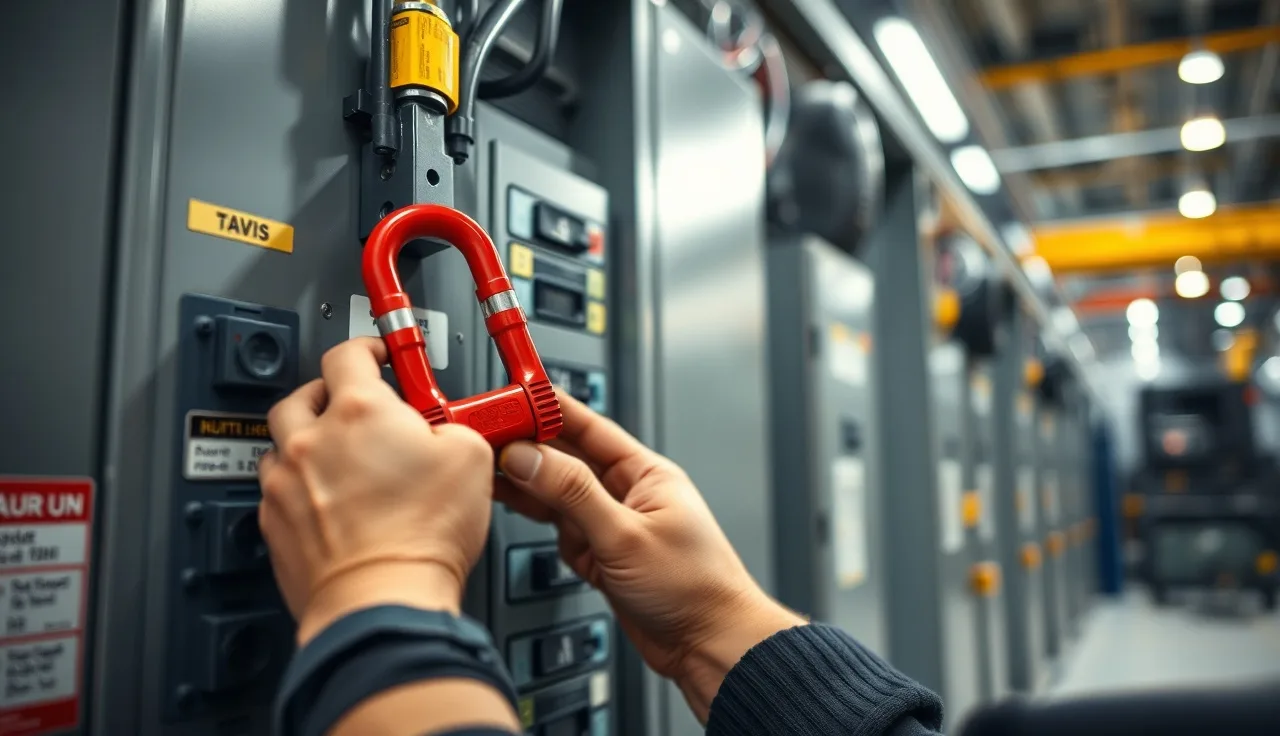
A lockout tagout hasp is a small hinged clamp, usually hardened steel or reinforced nylon, with a jaw that fits through the hole of a lockout device (a circuit breaker lockout, valve lockout, or similar) and a row of holes along its body where individual padlocks hang. Open the hasp, thread it through the lockout point, close the clasp, then every worker on the job adds their own padlock. The equipment cannot be re-energized until every lock comes off. That's the whole idea. One lockout point, many locks, zero chance one worker walks away while another is still exposed.
Hasps show up on almost every group lockout job. Picture a conveyor system where an electrician, a mechanic, and a lubrication tech all work at the same time, all fed by the same circuit breaker. Without a hasp, only one of them can physically lock the breaker. With a hasp, all three lock it independently. If the electrician finishes and pulls her lock, the other two locks still hold the breaker off.
Most standard hasps hold six padlocks. Heavy-duty models hold up to thirteen. The number matters when you run large crews. Size the hasp to your biggest expected group before you write your lockout procedure.
What does OSHA actually require about hasps?
OSHA's Control of Hazardous Energy standard is 29 CFR 1910.147 [1]. It never uses the word "hasp," but it mandates the outcome a hasp achieves. Section 1910.147(f)(3) says: "Each authorized employee shall attach a personal lockout or tagout device to the group lockout device, group lockout box, or comparable mechanism when he (she) begins work, and shall remove those devices when he (she) stops working on the machine or equipment." [1]
That language means one individual lock per worker. When there is only one physical lockout point and multiple workers, a hasp or a lockout box is the only practical way to meet it. OSHA's compliance directive, CPL 02-00-147, reinforces this reading [2].
The standard also requires that lockout devices be "singularly identified" and "the only devices(s) used for controlling energy" (1910.147(c)(5)(ii)). Each padlock on a hasp has to be individually keyed, so only the employee who applied it can remove it. Master-keyed locks that let a supervisor pop any lock violate this unless your written program documents a specific release procedure for when a worker leaves the site unexpectedly [1].
For general industry, the sections that matter run from 1910.147(c) through (f). Construction has its own electrical provisions at 29 CFR 1926.417, which mirrors the intent of 1910.147 for electrical work [3]. Maritime work falls under 29 CFR 1915.89 [8]. If your business crosses more than one sector, confirm which standard applies before you write your procedure.
See our full guide to lockout tagout for the broader framework, including energy control program requirements.
What types of lockout tagout hasps are there?
The differences matter more than most buyers realize. Here is a comparison of the main types:
| Type | Material | Holes / Locks | Best For | Approximate Cost |
|---|---|---|---|---|
| Standard steel | Hardened steel | 6 | General industrial | $8, $15 each |
| Heavy-duty steel | Hardened steel | 13 | Large crews, shift work | $18, $35 each |
| Nylon / plastic | Reinforced nylon | 6 | Chemical environments, corrosion risk | $5, $12 each |
| Aluminum | Aluminum alloy | 6 | Lightweight portability | $10, $18 each |
| Safety scissors | Steel or nylon | 6 to 8 | Tight spaces, recessed lockout points | $10, $20 each |
| Cable hasp | Steel cable + body | 2 to 6+ locking points | Large valve groups, irregular shapes | $15, $30 each |
Prices are street-level estimates from major safety suppliers as of mid-2025. Actual prices vary by brand and quantity.
Steel hasps are the default for most shops. The jaw closes tight and resists tampering. Nylon hasps earn their place anywhere corrosive chemicals or wash-down water would eat metal, but check the load rating before you trust nylon in a high-vibration spot.
Scissor-style hasps have two hinged arms that open wide for easy threading, then close around the lockout point. They earn their keep when a standard hasp is hard to thread through a recessed circuit breaker lockout or a small-diameter valve handle.
Cable hasps are a different animal. Instead of a rigid body, a flexible steel cable passes through several lock points at once. They work for a bank of valves on one line, or for odd shapes where a rigid hasp can't get purchase. The trade-off is that cable can kink and wear. Inspect cable hasps more often than rigid ones.
How do you use a lockout tagout hasp step by step?
This follows the sequence 1910.147(d) requires for any energy control procedure [1]. The hasp fits into step five.
1. Prepare for shutdown. Identify all energy sources for the equipment: electrical, pneumatic, hydraulic, gravitational, thermal, chemical. Pull the written energy control procedure.
2. Notify affected employees. Everyone who works near the machine needs to know it is going down.
3. Shut down the equipment using the normal stopping procedure.
4. Isolate energy. Operate all energy-isolating devices, such as the main circuit breaker, valve, or pneumatic shutoff.
5. Apply the hasp to the energy-isolating device. Open the hasp jaw, thread it through the locking hole of the breaker or valve lockout device, and close the clasp. The lead authorized employee usually applies the hasp and adds the first padlock, but the order among the other workers does not matter as long as everyone locks.
6. Each authorized employee adds their own individually keyed padlock to the hasp. Attach a lockout tag to each padlock, or directly to the hasp if your procedure requires tags alongside locks. The tag should carry the employee's name, contact info, and date applied.
7. Release and restrain stored energy. Bleed pneumatic lines, block elevated parts, discharge capacitors, drain hydraulic pressure. Do not skip this. Stored energy kills even when the breaker is locked out.
8. Verify zero energy state. Attempt to start the machine (at the normal start point) to confirm it cannot run. Test with a meter for electrical equipment.
9. Work is performed.
10. To restore energy, each employee removes only their own padlock when their work is done. The last lock removed (often the lead's) frees the hasp. Then energy can be restored after the work area is cleared and the restart sequence is followed.
One thing that trips up small shops: the person who applies a lock must be the person who removes it. If a worker leaves before the job is done, your written procedure needs a specific protocol for transferring or removing that lock, documented in writing. OSHA letters of interpretation address this situation directly [2].
How many locks does a hasp actually need to hold?
Size your hasp to the most authorized employees who will ever work on that machine at once, plus one hole for margin. A six-lock hasp covers most two- and three-person crews with room to spare. Run five or six trades on the same equipment and you want the thirteen-hole heavy-duty model. Running out of holes is not a hypothetical. A full hasp and a seventh worker who needs to start is a live compliance gap.
For shift-change lockout, each incoming shift adds locks before the outgoing shift removes theirs. That overlap can briefly double the lock count on the hasp. Plan for it. A hasp that is "usually enough" becomes the reason a worker can't add a lock and skips the step.
The Bureau of Labor Statistics consistently reports that workers in installation, maintenance, and repair occupations carry some of the highest rates of fatal injuries from contact with objects and equipment [4]. That category includes the caught-in and caught-between deaths lockout is built to prevent. Hasp sizing is not paperwork. It decides whether every person on the crew actually locks out.
What should a written lockout hasp procedure include?
OSHA requires a written energy control program for every employer subject to 1910.147 [1]. That program has to document the specific procedures for each machine or type of equipment where lockout is used, and group lockout with a hasp needs its own documented procedure or a clear addendum to the machine-specific one.
At minimum, the written procedure should cover:
- The specific machine or equipment covered
- All energy sources and their locations (breaker panel, valve location, etc.)
- The type and location of the hasp and padlocks used
- Which employee acts as the "lead" authorized employee responsible for applying the hasp
- The process for shift-change lock transfer, with documentation requirements
- The process for removing a lock when an employee is unexpectedly absent (usually a supervisor sign-off, a documented attempt to reach the worker, and verification of zero energy state before removal)
- How to verify zero energy state after all locks are applied
If you are building or updating your written lockout program, the SafetyFolio program generator produces a compliant draft in about 15 minutes, including the group lockout section. You still add the machine-specific energy source details, but the structure and required elements come ready.
Review the program at least annually and after any incident or near-miss involving lockout. OSHA requires a periodic inspection (at least annually) of each energy control procedure [1], and that inspection must be certified in writing, listing the date, the equipment covered, the employees involved, and the name of the inspector.
What are the most common lockout hasp violations OSHA cites?
29 CFR 1910.147 is one of OSHA's most-cited standards year after year. In fiscal year 2023 it ranked fifth among all standards for total violations, with 2,554 citations issued [5]. The violations cluster around a handful of repeat failures.
The most frequent problem is a written program that exists on paper but doesn't match how work actually gets done. Inspectors ask employees to describe the lockout procedure, then read the written one. When the two don't line up, that's a citation.
For group lockout specifically, these generate citations most often:
- Workers sharing a single padlock instead of each applying their own
- No hasp at a multi-worker lockout point (only one lock applied)
- Tags used without locks (tagout-only programs need a documented justification showing locks are technically infeasible)
- Hasps and locks not individually identified, so nobody can tell which employee applied which lock
- No procedure for absent-worker lock removal
- Lead employee pulls the hasp before all other employees have finished
OSHA penalty amounts changed in 2023. Serious violations can now reach $15,625 per violation, and willful or repeat violations can reach $156,259 per violation [6]. For a small business with two or three grouped lockout violations on one inspection, that adds up fast.
To understand how inspections work more broadly, our article on osha training covers the citation process and what inspectors look at first.
How is a hasp different from a lockout box?
Both solve the same problem: multiple workers, one lockout point. They solve it differently.
A hasp attaches straight to the energy-isolating device (the lockout point itself). It is compact, cheap, and works well when there is a physical hole or loop to grab. It fails when the lockout point has no attachment hole, or when you need to control several energy-isolating devices under one administrative point.
A lockout box (sometimes called a group lockout box or shadow box) is a secured container. The authorized employee who performed the isolation locks the energy source, then drops the key to that lock inside the box. Each worker then puts their own padlock on the box. Nobody gets the key to the energy source until the box opens, and the box opens only when all padlocks come off. This works well for complex equipment with energy sources scattered across a building, because every isolation key goes into one box no matter where the actual lockout points sit.
For most small shops with discrete machine lockout points, a hasp is cheaper and simpler. For facilities with complex, multi-source equipment, or where a single lockout spreads workers across a wide area, a lockout box may be the better administrative tool. Some facilities use both.
More on the broader program both tools fit into is in our lockout tagout guide.
How should you train workers on hasp use?
OSHA requires training for all authorized employees (those who perform lockout), affected employees (those who work in areas where lockout is used), and other employees who might encounter a locked-out machine [1]. That training has to cover the purpose and function of the energy control program, the hazards of uncontrolled energy, and the specific lockout procedures employees are authorized to use.
For group lockout with a hasp, add these specifics to your authorized-employee training:
- A hands-on demonstration, not a video. Have employees thread a hasp, apply their lock, and try to remove the hasp while another lock is still on it. That physical moment sticks.
- The "last lock on, last lock off" idea: each person's lock stays on for the full duration of their work, never pulled early because someone assumes another crew member is almost done.
- The shift-change protocol, if your facility runs multiple shifts.
- What to do when the hasp is full (stop, report to the supervisor, do not proceed without your own lock applied).
Retraining is required when there is reason to believe an employee doesn't understand the procedure, or when procedures change [1]. A near-miss where a hasp got skipped or misused is reason enough to retrain the workers involved.
Our resource on osha training goes deeper on training documentation, which is often a secondary citation point during inspections.
What padlocks should you pair with a lockout hasp?
The lock matters as much as the hasp. OSHA requires lockout devices to be durable, standardized, substantial, and identifiable [1]. Here is what each of those means in practice.
Durable: the lock has to survive its environment. A standard brass padlock in a wash-down area will corrode and seize. Use stainless steel or coated locks in wet or chemical spots.
Standardized: your facility should keep one consistent look for lockout locks, typically a single color used only for lockout, often red or yellow. Anyone walking past should read it instantly as a lockout lock, not a storage lock or a cabinet lock.
Substantial: OSHA's guidance is that the lock should be "equivalent to the minimum requirements of a listed, labeled, or certified equipment" padlock. In plain terms, a safety-rated padlock, not a $3 hardware store lock. Most safety padlocks have a 1/4" to 3/8" shackle, hardened steel, and a rating against cutting or prying.
Identifiable: each lock is assigned to one specific employee. The name, employee number, or a unique ID belongs on the lock body or attached to it. Keyed-differently means each padlock has its own key, so only that employee opens it. Never use keyed-alike lockout sets for multi-worker situations.
A sensible practice is a personal lockout kit for each employee: one or two individually-keyed padlocks, a lockout tag, and a small carry case. When the hasp goes on, the kit comes out. Kits run roughly $20, $50 each depending on contents.
Where can you buy lockout tagout hasps?
Lockout tagout hasps are commodity safety hardware. Brady, Master Lock (Safety Series), and Panduit are the dominant brands. ABUS, Tradesafe, and Zing also make compliant products at lower price points.
Major safety distributors like Grainger, Uline, Amazon Business, and Zoro carry the full range. A standard six-hole steel hasp runs $8, $15 each. Buying for a whole facility, kits that bundle hasps, padlocks, tags, and lockout devices for common equipment (circuit breakers, valves) start around $50 and climb to $250 depending on scope.
A few things to check before you order:
- Jaw opening size: make sure the hasp jaw is wide enough for your specific lockout device. Some circuit breaker lockouts have small holes. Measure first.
- Material compatibility: steel hasps corrode in chlorine environments. Check the material spec.
- Shackle hole diameter: confirm the holes in the hasp body accept your facility's padlock shackle, typically 5/16" to 3/8".
- Quantity for compliance: buy enough that every multi-worker lockout point has a hasp staged nearby, not locked in a cage across the building.
No single brand is meaningfully better than the others for basic steel hasps. Spend the money you save on extra padlocks and tags, because running out of locks is the actual problem.
Do small businesses with just one or two employees need a hasp?
Probably not for routine single-person lockout, but maybe for certain jobs. Here is the honest answer.
If one authorized employee always works alone on a locked-out machine, that employee's single padlock on a circuit breaker lockout or valve lockout is enough. No hasp needed. The hasp becomes necessary the moment two or more workers are on the same machine under the same lockout at the same time.
For very small businesses, that situation comes up during:
- Contractor or vendor work alongside your own employee (both need separate locks)
- Two employees troubleshooting or repairing together
- A training scenario with a trainee and an authorized employee both working
Under 1910.147(f)(2), when a single authorized employee performs all lockout, the one-lock procedure is enough [1]. The moment the job becomes a group job, 1910.147(f)(3) kicks in and individual locks are required. A hasp is the standard way to satisfy that.
So the practical answer for a small business: own at least two or three hasps and stage them near your most commonly locked-out equipment. They cost less than $15 each. An OSHA citation for a missing group lockout procedure starts at $15,625. That math is easy.
Frequently asked questions
Can I use a single padlock with a tagout tag instead of a hasp for group work?
No. OSHA's 1910.147(f)(3) requires each authorized employee to apply their own personal lock during group work. One shared lock does not meet that requirement, because removing the shared lock exposes every worker at once. A hasp lets everyone apply an individual lock to a single lockout point. Tagout alone is only allowed when the employer can demonstrate that locks are technically infeasible.
Does OSHA specify what color a lockout hasp has to be?
No specific color is mandated in 1910.147, but the standard requires lockout devices to be standardized within the facility by color, shape, or size. Red is the conventional color for lockout hardware and is widely recognized, though yellow and orange are common too. What matters is that lockout devices look distinct from all other hardware in your facility, and the color stays consistent in your written program.
How many locks can a standard lockout hasp hold?
Most standard hasps hold six padlocks. Heavy-duty models hold up to thirteen. Cable-style hasps vary by configuration. Check the product spec before buying, and size your hasp to your maximum expected crew plus one extra hole. When you run out of holes on a full hasp, the last worker has no compliant way to apply a lock, which is both a safety gap and an OSHA violation.
What happens if an employee who applied a lock to a hasp leaves the worksite unexpectedly?
Your written energy control program must have a documented procedure for this. It typically requires a documented attempt to contact the employee, supervisor authorization in writing, a re-verification of zero energy state before lock removal, and a record kept in the lockout log. OSHA letters of interpretation confirm that employer removal of an employee's lock is permissible under a documented protocol, but it cannot be routine practice.
Is a lockout hasp required by OSHA, or is it just one option?
OSHA does not require a hasp by name, but 1910.147(f)(3) requires individual locks for each worker in a group lockout. When only one lockout point exists, a hasp or lockout box is the practical way to meet that. OSHA has confirmed this interpretation in enforcement guidance. So the hasp itself is not mandated by name, but the outcome it produces is.
Can a supervisor use a master key to remove any worker's lock from a hasp?
Not as routine practice. OSHA requires each lock to be removable only by the employee who applied it. Master-keyed sets that allow supervisor override violate the personal-lock requirement unless your program has a documented emergency removal procedure and you can show it is not used casually. Some facilities keep a sealed envelope with a master key, opened only with supervisor sign-off and documented in the lockout log.
Does a lockout hasp work for both electrical and hydraulic/pneumatic lockout?
Yes. A hasp attaches to whatever physical lockout device you use at the isolation point: a circuit breaker lockout, a valve lockout, a plug lockout. The hasp itself is agnostic to energy type. What matters is a physical lockout device with a hole or loop the hasp jaw can thread through. Most standard valve and breaker lockout devices are built to accept a hasp.
How often should lockout hasps be inspected or replaced?
OSHA does not set a specific inspection interval for hasps themselves, but requires that lockout devices be inspected and replaced if they show wear, damage, or corrosion. Practically, inspect a hasp every time you use it: check the jaw closure for deformation, verify the hinge moves freely, and look for cracks in nylon models. Replace any hasp where the jaw does not close fully or the body shows visible damage. Annual program inspections should include a physical audit of lockout hardware.
Do the same hasp rules apply in construction?
Construction electrical work falls under 29 CFR 1926.417 rather than 1910.147. The construction standard requires similar individual-lock control for workers on electrical circuits, and the same group lockout logic applies. Non-electrical energy control in construction is less specifically regulated at the federal level, though many OSHA compliance officers apply 1910.147 principles under the general duty clause. Check whether your state plan has additional construction-specific requirements.
What is the difference between a lockout hasp and a lockout station?
A lockout hasp is the individual multi-lock device that attaches to the energy-isolating device. A lockout station is the storage rack or shadow box where lockout equipment (hasps, padlocks, tags, lockout devices) lives near the equipment. Stations keep hardware handy at the point of use and kill the excuse that the hasp was too far away to bother with. Both are useful, but the hasp is the compliance hardware and the station is just organized storage.
How do I write a group lockout procedure for a machine with multiple energy sources?
Document each energy source in sequence: location, type, isolation method, lockout device used, and verification step. For each isolation point where multiple workers will lock out, specify that a hasp goes on first, applied by the lead authorized employee, then each worker adds an individual lock. If energy sources are spread across the facility, consider a lockout box as the control point. The procedure must be machine-specific, written, and reviewed at least annually under 1910.147(c)(4).
Are there OSHA-approved lockout hasp brands or certifications?
OSHA does not certify or approve specific brands. The standard requires lockout devices to be durable, standardized, substantial, and identifiable. In practice, any hasp from a major safety manufacturer (Brady, Master Lock Safety Series, Panduit, ABUS) will meet those criteria if used correctly. The compliance question is about the program and procedure, not the brand stamped on the hasp.
Can workers use their own personal padlocks instead of company-issued ones on a hasp?
Technically yes, if the lock meets the durability and standardization requirements of 1910.147. Practically, most safety professionals advise against it, because personal locks often don't match the facility's lockout color standard and may not be keyed-differently from locks used elsewhere. Company-issued, individually assigned safety padlocks are the clean approach and keep the annual procedure inspection simple.
Sources
- OSHA, 29 CFR 1910.147 Control of Hazardous Energy (Lockout/Tagout): OSHA's group lockout requirement: each authorized employee must attach a personal lockout or tagout device to the group lockout device (1910.147(f)(3)); individual lock identification, durability, and standardization requirements at 1910.147(c)(5)(ii); annual procedure inspection requirement at 1910.147(c)(6); written energy control program requirement at 1910.147(c)(4).
- OSHA, CPL 02-00-147 The Control of Hazardous Energy Enforcement Policy and Inspection Procedures: OSHA compliance directive interpreting 1910.147 group lockout requirements, including guidance on employee-absent lock removal procedures.
- OSHA, 29 CFR 1926.417 Lockout and Tagging of Circuits (Construction): Construction electrical lockout standard requiring individual control of circuits, the construction analog to 1910.147 group lockout principles.
- Bureau of Labor Statistics, Census of Fatal Occupational Injuries Summary: Workers in installation, maintenance, and repair occupations have among the highest rates of fatal injuries from contact with objects and equipment, the category lockout/tagout is designed to prevent.
- OSHA, Top 10 Most Frequently Cited Standards FY2023: 29 CFR 1910.147 ranked fifth among all OSHA standards in fiscal year 2023 with 2,554 total citations.
- OSHA, Penalties: As of 2023 OSHA penalty adjustments: serious violations up to $15,625 per violation; willful or repeat violations up to $156,259 per violation.
- OSHA, Lockout/Tagout (LHEP) eTool: OSHA's interactive guidance on energy control procedures, including group lockout with hasps and lockout boxes.
- OSHA, 29 CFR 1915.89 Control of Hazardous Energy (Maritime): Maritime sector lockout/tagout standard, parallel to 1910.147 for shipyard employment.
- OSHA, Lockout/Tagout Fact Sheet: OSHA fact sheet on lockout/tagout program requirements and the hazards of uncontrolled energy release.
- NIOSH, Hierarchy of Controls: NIOSH classification of lockout/tagout as an engineering and administrative control within the hierarchy of controls for energy hazards.