Last updated 2026-07-11
TL;DR
Secondary containment rules for chemical storage come from three overlapping sources: OSHA 29 CFR 1910.106 (flammable liquids), EPA Spill Prevention Control and Countermeasure rules (40 CFR 112), and NFPA 30. Most require containment sized to hold 10% of total stored volume or 100% of the largest container, whichever is greater. Small employers under EPA thresholds still face OSHA general duty obligations.
What is secondary containment and why does it apply to small businesses?
Secondary containment is a physical barrier, usually a berm, dike, or containment pan, placed around chemical storage so a spill, leak, or container failure can't spread past a defined area. The idea is simple. Primary containment is the drum, tank, or bottle itself. Secondary containment is everything that catches the chemical when the primary containment fails.
Small businesses often assume these rules only touch refineries or chemical plants. That's wrong. A dry cleaner storing perchloroethylene, an auto shop with used oil and solvent drums, a landscaper with bulk pesticide, a restaurant supply company with ammonia refrigerant: all of these can trigger secondary containment requirements under federal OSHA, EPA, or both [1][2].
The stakes are real. EPA penalties for Spill Prevention Control and Countermeasure (SPCC) violations can reach tens of thousands of dollars per day per violation [3]. OSHA general duty citations for inadequate chemical containment run into the tens of thousands for willful cases. Neither number includes cleanup, which for even a small petroleum release can run into six figures.
Secondary containment isn't glamorous and it isn't hard engineering. Most small employers handle it with off-the-shelf containment pallets, formed concrete berms, or prefabricated poly basins. The hard part is knowing which rule applies to you, and what size you actually need.
Which OSHA standards cover secondary containment for chemical storage?
OSHA has no single standard called "secondary containment." The requirement shows up across several standards, and which one binds you depends on the chemical type and your industry.
29 CFR 1910.106 (Flammable Liquids) is the main standard for most general industry employers. Section 1910.106(b)(2)(vii)(c) requires outdoor storage areas for flammable liquids to have drainage or containment designed to keep liquid from flowing to a place where it presents a fire or explosion hazard [1]. Indoor storage rooms need a raised sill or ramp at least 4 inches high at each doorway, per 1910.106(d)(4)(i), to hold spills inside the room.
29 CFR 1910.119 (Process Safety Management) covers highly hazardous chemicals above threshold quantities, but most small employers don't hit PSM thresholds [12]. If you do, secondary containment falls under the broader mechanical integrity and process hazard analysis obligations.
29 CFR 1910.120 (HAZWOPER) applies to sites with hazardous waste and requires containment as part of site control.
The General Duty Clause, Section 5(a)(1) of the OSH Act, is the backstop. If a recognized hazard exists and a feasible fix exists (secondary containment clearly qualifies), OSHA can cite you with no specific standard on the books [10]. The agency has used this route for acid storage, pesticide storage, and corrosive spill scenarios at facilities that didn't trip a specific standard.
For construction, 29 CFR 1926.152 mirrors the flammable liquids requirements and adds containment provisions for fuel storage on job sites.
If your workplace runs a hazard communication program, the Safety Data Sheets (Section 7 and Section 13) often call out spill containment procedures by name. That language isn't legally binding on its own, but OSHA inspectors lean on SDS guidance when they decide whether a hazard was "recognized" [2].
What EPA rules on secondary containment apply to small businesses?
EPA's main containment tool for oil and petroleum products is the Spill Prevention, Control, and Countermeasure (SPCC) rule under 40 CFR Part 112. Store more than 1,320 gallons of oil in aboveground containers (or more than 42,000 gallons underground) and you need an SPCC plan, with secondary containment as a core element [3].
EPA defines "oil" broadly: petroleum, fuel oil, sludge, oil refuse, vegetable oils, and more. A farm with diesel, an auto shop with used motor oil, a restaurant with cooking oil stored in bulk. All can qualify.
Under 40 CFR 112.7(c), the SPCC rule requires secondary containment structures to hold the volume of the largest single container plus enough freeboard for precipitation [3]. The standard sizing benchmark is 110% of the largest container's capacity, though EPA also accepts the 10%/100% rule (10% of aggregate capacity or 100% of the largest container, whichever is greater) as a common engineering equivalent.
Small facilities get some relief. The "Qualified Facility" tier under 40 CFR 112.3(g) allows a simplified self-certified SPCC plan if your total aboveground oil storage is under 10,000 gallons and you've had no discharge to navigable waters in the past three years [3]. You still need secondary containment. You just don't need a licensed PE to certify the plan.
For hazardous substances other than oil, EPA's Resource Conservation and Recovery Act (RCRA) rules at 40 CFR 264/265 require secondary containment for tank systems storing hazardous waste. These kick in based on waste generator status, not facility size.
The biggest mistake small employers make is figuring that if they're not a "big" company, EPA rules can't reach them. The SPCC threshold is lower than most people expect. A single 275-gallon IBC of used oil, plus a 1,000-gallon diesel tank, plus a few 55-gallon drums, can push you past 1,320 gallons total.
How much secondary containment capacity do you actually need?
Size your containment to 110% of the largest single container you store, confirm the structure holds that net volume after container displacement, and add freeboard if it's open to rain. That single rule satisfies EPA, most local fire codes, and NFPA 30 at once. The sizing question trips up small employers because different rules give slightly different numbers. Here's how to think it through.
The 110% rule comes from EPA SPCC (40 CFR 112) and is the most common benchmark [3]. If your largest tank holds 500 gallons, your secondary containment must hold at least 550 gallons.
NFPA 30 (Flammable and Combustible Liquids Code), which many jurisdictions adopt by reference and which OSHA treats as a recognized industry standard, takes a similar approach: containment must hold the full volume of the largest tank, with at least 6 inches of freeboard in diked areas for drainage [4].
For multiple containers, you add volume but can take credit for the space the containers themselves occupy when you calculate net capacity. A dike that holds 600 gallons gross but contains three 55-gallon drums (165 gallons of container volume) has a net capacity of only 435 gallons. That math matters.
| Rule / Standard | Sizing Requirement | Applies To |
|---|---|---|
| EPA SPCC (40 CFR 112) | 110% of largest single container | Oil/petroleum, >1,320 gal total |
| NFPA 30 (2021 ed.) | 100% of largest tank + freeboard | Flammable/combustible liquids |
| OSHA 1910.106 | Drainage control to prevent fire hazard spread | Flammable liquids, general industry |
| RCRA (40 CFR 264/265) | 100% of largest container + 10 yr rain event | Hazardous waste tanks |
| Local fire code (IFC/UFC) | Varies, often 110% rule mirrored | All chemicals, jurisdiction-dependent |
Start with the 110% figure and you're covered almost everywhere. Just recheck the net number after you account for container displacement, because that's where a compliant-looking dike quietly fails.
What types of secondary containment systems are accepted?
OSHA, EPA, and NFPA all describe the performance requirement instead of naming a product. That gives you flexibility. Here are the accepted types.
Formed concrete berms or dikes are the most permanent solution and the cheapest per gallon of containment over time. They work well for fixed tank farms, chemical storage rooms, and outdoor storage pads. They need sealing or coating with a material compatible with what you store, because concrete is porous and will absorb some solvents and acids over time.
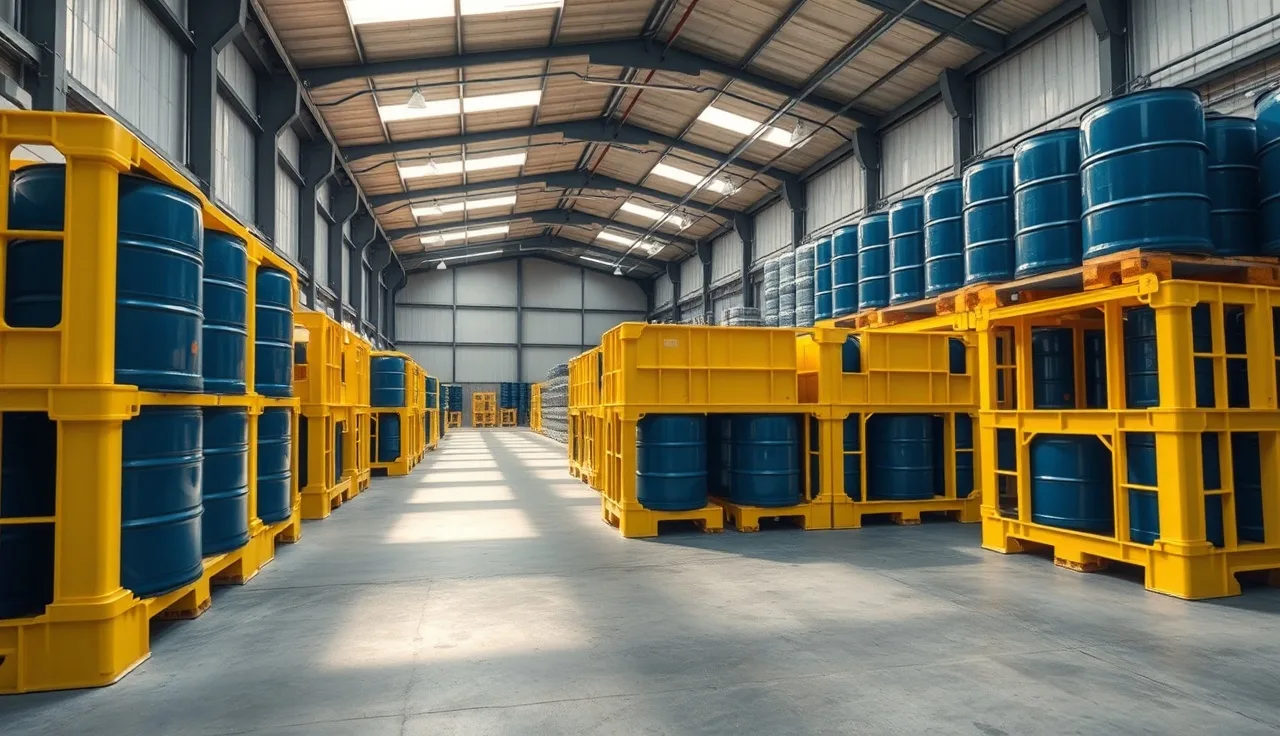
Prefabricated containment pallets are the go-to for drum storage. A polyethylene pallet rated for four 55-gallon drums, with integral grating and a sump, runs roughly $150 to $400 depending on size and material [5]. They're visible, easy to install, and move with your operation. Confirm the pallet material handles what you're storing: standard polyethylene works for most acids and petroleum products but degrades with some ketones and aromatic solvents.
Flexible berms and spill containment bladders fit temporary or construction settings. A modular foam berm sets up in minutes and stores flat. Quality matters here. Cheap foam berms collapse under drum weight.
IBC containment basins are the right answer for intermediate bulk containers (totes). A 275- or 330-gallon IBC needs a basin rated to at least 300-plus gallons net. Poly basins for IBCs run roughly $500 to $1,200 depending on construction.
Lined earthen berms are common in agriculture and accepted by EPA for SPCC if the liner is impermeable enough and the berm height and slope are engineered right.
One thing that never counts as secondary containment: absorbent material like kitty litter or dry sand placed around a drum before a spill. That's spill response, not containment. OSHA inspectors and EPA auditors both draw that line.
Do secondary containment rules apply differently by chemical type?
Yes. The specific standard that governs you depends almost entirely on what you're storing.
Flammable and combustible liquids (gasoline, diesel, acetone, ethanol, paint thinner): OSHA 1910.106 and NFPA 30 are your primary references. The fire prevention focus means containment has to handle ignition source separation too, not only spill volume [1][4].
Corrosives (sulfuric acid, hydrochloric acid, sodium hydroxide): no single OSHA standard names secondary containment for these, but general duty clause cases and letters of interpretation make clear that containment is expected [10]. Concrete containment must be acid-resistant (epoxy-coated or lined). The hcl safety data sheet for hydrochloric acid is a good example of how SDS data drives containment material choice.
Pesticides: EPA's FIFRA regulations and many state agriculture department rules require secondary containment for bulk pesticide storage. Most state rules use the 110% sizing standard.
Used oil and waste oil: EPA SPCC applies if you exceed thresholds. RCRA generator rules apply if the used oil is managed as hazardous waste. Plenty of small auto shops are surprised that used oil counts toward SPCC totals.
Propane and compressed gases: liquid-spill containment doesn't apply to most compressed gas cylinders, but distance, ventilation, and restraint requirements under 29 CFR 1910.101 and NFPA 58 do. Liquefied gases like anhydrous ammonia carry their own containment expectations under PSM if above thresholds.
Cryogenic liquids: OSHA and NFPA 55 require bunded areas for large cryogenic storage, because liquid oxygen or liquid nitrogen spills can create oxygen enrichment or asphyxiation hazards.
The cleanest approach: inventory every chemical by volume and type, pull the applicable SDS for each, and map each chemical against its governing standard. Most small shops finish this in an afternoon. The hazard communication program you already have to maintain is the logical home for that inventory.
What does an OSHA inspector actually look for in a secondary containment inspection?
An inspector who shows up for a complaint or programmed inspection at a facility with chemical storage works through a few things in sequence.
First, they confirm you have an accurate chemical inventory and that your hazard communication program and SDS binder covers everything on-site [2]. A binder that's missing chemicals or out of date is a citation before they even look at your containment.
Next, the physical storage arrangement. Are flammable liquids stored away from ignition sources? Are incompatible chemicals segregated? Are containers closed when not in use?
Then the containment itself. Common violation patterns in OSHA enforcement records include:
- Containment pallets rated for four drums but holding six
- Containment sumps full of accumulated liquid (which wipes out capacity)
- Cracked or damaged concrete berms that no longer hold liquid
- Containment made of material incompatible with the chemical (a carbon steel pan under an acid, say)
- No containment at all for the secondary flammable liquid storage room
For 1910.106 violations, OSHA usually cites "serious," with penalties running from about $1,000 to $16,131 per instance under current 2024 penalty adjustments [6]. A willful violation (you knew the rule and ignored it) can reach $161,323 per violation.
One check surprises small employers: inspectors verify that drains in chemical storage areas are either sealed or fitted with emergency shut-off valves. An open floor drain under a drum storage area is a direct path to the municipal sewer, which is an EPA violation and an OSHA material storage concern at the same time.
How do state plan states handle secondary containment differently?
Twenty-two states and two territories run their own OSHA-approved state plans, which must be "at least as effective" as federal OSHA and can go further [7]. A few do.
California (Cal/OSHA) has its own hazardous materials storage regulations layered on top of the federal requirements. California's unified hazardous materials program under Health and Safety Code 25500 et seq. requires secondary containment for any hazardous material stored above set quantities, with local Certified Unified Program Agencies (CUPAs) running the inspections. Cal/OSHA's storage rules in Title 8 reference NFPA 30 directly.
Washington (L&I) and Oregon (Oregon OSHA) both adopt federal OSHA standards but carry additional environmental agency requirements that small employers track separately from their L&I obligations.
In state plan states, you can face dual enforcement. The state plan OSHA equivalent cites workplace safety violations, and a separate state environmental agency (California DTSC, Oregon DEQ, and others) can pursue spill hazards under state environmental law.
If you're in a state plan state, check your state's plan page at OSHA.gov [7]. The standards it adopts and any state-specific additions are listed there. For most secondary containment purposes the federal frameworks in this article still hold as the baseline, but state rules can set lower thresholds or demand extra documentation.
What should a written secondary containment program include?
OSHA doesn't mandate a standalone "secondary containment program" document the way it mandates a written Hazard Communication Program or a written Lockout/Tagout program. But EPA's SPCC rule requires a written SPCC Plan once you exceed oil storage thresholds [3], and the general duty clause creates a practical obligation to document your containment approach if you store meaningful chemical quantities [10].
A solid written program for a small employer covers these pieces.
Chemical storage inventory: every chemical, CAS number if available, maximum quantity stored, container types and sizes, and storage location. This doubles as the backbone of your HazCom program.
Containment design documentation: for each storage area, note the containment type, its rated capacity (gross and net), the material, and the last inspection date. Keep the product spec sheet for any commercial containment pallet or basin.
Inspection schedule and records: secondary containment needs regular inspection. Monthly visual checks are a reasonable baseline. Document what you check: structural integrity, accumulated liquid, drain status, container compatibility. SPCC plans under 40 CFR 112 require documented inspections.
Spill response procedures: secondary containment buys you time. Your program has to spell out what employees do after containment catches a spill, including who to notify (supervisor, state emergency response hotline, EPA National Response Center at 1-800-424-8802 for reportable quantity spills) [9].
Training records: employees who work in or around chemical storage need documented training on the containment systems, spill response, and their PPE. The related guidance on osha training covers how to structure those records.
Want to build this program without hiring a consultant? SafetyFolio's safety program generator walks you through chemical storage and containment documentation in about 15 minutes and produces a written program you can hand straight to an inspector.
What are the most common secondary containment mistakes small employers make?
A handful of patterns come up over and over in OSHA enforcement data and EPA inspection findings.
Miscounting total storage volume. Employers count only their "big" tanks and forget the drums, IBCs, and portable containers. Every container counts toward EPA thresholds, and every storage area counts toward OSHA compliance.
Ignoring accumulated liquid in sumps. A containment pallet with 3 inches of rainwater, used oil, or spilled chemical in its sump has far less effective capacity than the nameplate rating. Inspectors measure actual available capacity, not the theoretical number. Clean sumps are part of containment maintenance.
Using incompatible materials. Carbon steel containment corrodes under acids. Plain polyethylene gets attacked by some solvents. Unsealed concrete absorbs hydrocarbons and eventually cracks from freeze-thaw cycles outdoors. Match the material to the chemical, and document that you checked.
Treating containment as set-and-forget. Berms crack, pallets UV-degrade, drain plugs go missing. SPCC rules require periodic inspection. OSHA's general duty standard implies ongoing maintenance. Build an inspection record.
Assuming a small quantity exemption covers everything. EPA's SPCC exemption threshold applies to oil only. RCRA thresholds apply to hazardous waste. The general duty clause has no quantity threshold at all. A single 55-gallon drum of concentrated sulfuric acid gets no exemption. If the hazard is recognized and the fix is feasible, you're expected to contain it.
Skipping the local fire marshal. The International Fire Code, adopted in most jurisdictions, carries containment requirements enforced by local fire marshals completely apart from OSHA and EPA. You can be OSHA-compliant and still fail a fire marshal inspection. Confirm your containment design with your AHJ (Authority Having Jurisdiction) before you finalize it.
How do you document and maintain secondary containment for ongoing compliance?
Documentation isn't busywork here. It's your protection when an inspector shows up or a spill triggers an enforcement inquiry.
At a minimum, keep the following.
A site map or diagram showing where each chemical storage area sits, what's stored there, and where the containment structures are. It doesn't need to be a professional drawing. A clear hand-drawn or CAD sketch with dimensions and labels works.
Containment capacity calculations for each storage area, showing gross capacity, container displacement, and net available capacity. For SPCC-covered facilities, EPA expects these calculations in the plan itself [3].
Inspection logs: a simple monthly form with the date, inspector name, items checked, findings, and corrective actions. Many SPCC plans carry this form as an appendix.
Training records for every employee who handles chemicals or works in storage areas: name, date, topics covered, trainer signature. OSHA inspectors ask for these, and missing records turn a compliance question into a recordkeeping violation on top of whatever they already found.
Corrective action records for any deficiency found during inspection. If you found a cracked berm in March and fixed it, document the sequence. It shows good faith and is often the difference between a warning and a citation.
For EPA SPCC plans, the rule requires a complete review and update every five years (40 CFR 112.5), plus an amendment whenever you make a change that materially affects the potential for a discharge [3]. Set a calendar reminder.
If you've had a recordable injury tied to chemical handling, that incident report connects straight to your containment documentation. A chemical splash or burn that hits OSHA recordable status invites scrutiny of your storage and containment practices, so your incident report should reference your containment inspection history.
Frequently asked questions
Does OSHA require secondary containment for all chemical storage?
OSHA doesn't require secondary containment for every chemical in every quantity. The explicit requirement lives in 29 CFR 1910.106 for flammable liquids. For corrosives, acids, and other hazardous chemicals without a specific standard, the General Duty Clause creates the obligation when the hazard is recognized and containment is feasible. In practice, store enough of any hazardous chemical to injure someone or harm the environment in a spill and OSHA will expect containment.
What is the minimum size for a secondary containment berm or pallet?
The most widely applicable rule is 110% of the largest single container you store, from EPA's SPCC regulation (40 CFR 112). NFPA 30 uses 100% of the largest tank plus freeboard. For multiple containers, size to the largest single container or 10% of total aggregate volume, whichever is greater. Subtract the volume the containers themselves displace to get net capacity, and verify that net number still meets the applicable threshold.
Does the EPA SPCC rule apply to small businesses with under 1,320 gallons of oil?
No. Facilities with 1,320 gallons or less of total aboveground oil storage capacity (in containers 55 gallons or larger) are exempt from SPCC requirements. But state environmental regulations may still apply at lower quantities, and OSHA's general duty clause has no quantity threshold. If you store any oil or petroleum in a way that could spill and reach a floor drain, a waterway, or the ground, some containment is still the smart move.
Can secondary containment pallets be used instead of a concrete berm?
Yes. Commercial containment pallets are a fully accepted form of secondary containment under OSHA, EPA, and most fire codes, as long as the pallet is sized correctly, made of material compatible with the chemical, and kept in good condition. They're practical for drum and IBC storage. They're not the right pick for large fixed tanks, where a formed concrete dike or earthen berm is more appropriate and cheaper at scale.
What chemicals require secondary containment beyond flammable liquids?
Beyond flammable and combustible liquids, containment expectations apply to petroleum and oil products (EPA SPCC), hazardous waste (RCRA 40 CFR 264/265), concentrated corrosives like sulfuric or hydrochloric acid (OSHA general duty), bulk pesticides (EPA and state ag rules), and liquefied hazardous gases above PSM thresholds. Your SDS for each chemical lists spill containment guidance in Sections 7 and 13, which OSHA inspectors use to establish that the hazard was recognized.
Are there secondary containment exemptions for very small businesses?
EPA's SPCC rule has a Qualified Facility tier for facilities with under 10,000 gallons of total aboveground oil storage, allowing a self-certified simplified plan without a licensed PE. There's no general OSHA exemption from the General Duty Clause based on employer size. Small employers with fewer than 10 employees are exempt from some OSHA programmed inspections, but not from complaint inspections or from the underlying legal obligations.
What happens if you have a chemical spill and no secondary containment in place?
Without containment, a spill can reach floor drains, storm drains, or the ground, triggering EPA National Response Center reporting for spills above reportable quantities (as low as 1 pound for some chemicals, 10 gallons or more for many petroleum products depending on release conditions). OSHA may cite a General Duty violation. Your local fire marshal may issue a notice of violation. Cleanup, NRC reporting, and fines can easily top $10,000 for one drum spill that reaches a waterway.
Do secondary containment rules apply to outdoor chemical storage?
Yes. OSHA 1910.106(b)(2)(vii)(c) specifically addresses outdoor flammable liquid storage and requires drainage control to keep liquid from flowing to a fire hazard location. EPA SPCC applies whether storage is indoors or out. Outdoor containment structures must account for precipitation: EPA guidance recommends designing for enough freeboard to handle a 24-hour, 25-year storm event without overflow, or installing a way to remove accumulated rainwater safely.
How often should secondary containment structures be inspected?
EPA SPCC plans require documented periodic inspections, and monthly visual inspections are the commonly recommended frequency in EPA guidance. NFPA 30 recommends regular inspection of containment structures as part of facility maintenance. OSHA sets no mandated interval in 1910.106, but having no inspection records makes it very hard to show you maintained your system if an incident or inspection hits. Monthly inspections with a simple log is the practical standard.
Can a floor drain in a chemical storage area serve as secondary containment?
No. An open floor drain is the opposite of secondary containment. It routes a spill straight to the municipal sewer or a surface water body, an EPA violation for many chemicals. Drains in chemical storage areas must be sealed, plugged, or fitted with emergency shutoff valves that close before a spill reaches them. A sealed drain inside a bermed area is fine: the berm contains the spill, and the sealed drain keeps it from leaving the containment area.
What does a written SPCC plan need to include for a small employer?
For a Qualified Facility (under 10,000 gallons aboveground oil storage, no reportable discharge in three years), the self-certified SPCC plan under 40 CFR 112 must include a facility description, a site diagram, the total oil storage inventory, a description of containment structures with capacity calculations, inspection and testing procedures, personnel training records, and spill response procedures. No licensed PE certification is required for Qualified Facilities, which is the key small-employer relief provision.
What materials can secondary containment structures be made from?
Accepted materials include reinforced concrete (sealed or lined for chemical compatibility), high-density polyethylene (HDPE), fiberglass, carbon steel (for petroleum only, not acids), lined earthen berms, and prefabricated poly or steel containment pallets. The critical factor is chemical compatibility: the material must resist degradation from what you store. For acids, use HDPE, fiberglass, or epoxy-coated concrete. For fuels, concrete or steel works. Check the SDS or a chemical compatibility chart before you specify.
Do secondary containment requirements apply to chemical storage in a small shop or garage?
Yes. OSHA 1910.106 applies to any general industry workplace storing flammable liquids, with no size exemption. A small auto repair shop, a print shop, or a cabinet shop storing flammable solvents has to meet the containment and drainage requirements. Meaningful enforcement focus usually lands on quantities above 25 gallons indoors, but even smaller amounts must be stored in approved containers and away from ignition sources, per 1910.106.
How does secondary containment interact with fire code requirements?
Local fire codes, usually the International Fire Code (IFC) or the Uniform Fire Code, are adopted by most jurisdictions and enforced by local fire marshals independently of OSHA and EPA. IFC Chapter 57 (flammable and combustible liquids) requires secondary containment sized generally to NFPA 30 standards. Passing an OSHA inspection doesn't guarantee you pass a fire marshal inspection, and vice versa. Confirm your containment design with your local Authority Having Jurisdiction before you finalize it.
Sources
- OSHA, 29 CFR 1910.106 Flammable Liquids standard: OSHA 1910.106 requires drainage or containment for outdoor flammable liquid storage and a 4-inch door sill for indoor flammable liquid storage rooms
- OSHA, Hazard Communication standard 29 CFR 1910.1200: SDS Sections 7 and 13 document storage, handling, and spill containment requirements that OSHA inspectors use to establish that a hazard was recognized
- EPA, Spill Prevention, Control, and Countermeasure (SPCC) rule, 40 CFR Part 112: The SPCC rule applies to facilities storing more than 1,320 gallons of oil aboveground and requires secondary containment; Qualified Facilities under 10,000 gallons may self-certify
- NFPA 30, Flammable and Combustible Liquids Code (2021 edition): NFPA 30 requires secondary containment capable of holding 100% of the largest tank volume plus freeboard for precipitation
- OSHA, Penalties and Debt Collection, 2024 civil penalty adjustments: OSHA serious violations carry penalties up to $16,131 per violation; willful violations up to $161,323 per violation as of 2024 inflation-adjusted amounts
- OSHA, State Plans overview page: 22 states and 2 territories operate OSHA-approved state plans that must be at least as effective as federal OSHA and may exceed federal requirements
- EPA, National Response Center reporting requirements: Spills above reportable quantities must be reported to the EPA National Response Center at 1-800-424-8802
- OSHA, General Duty Clause, Section 5(a)(1) of the OSH Act: The General Duty Clause requires employers to provide a workplace free from recognized hazards likely to cause death or serious physical harm, and is used to cite chemical containment failures when no specific standard applies
- OSHA, Process Safety Management standard, 29 CFR 1910.119: 29 CFR 1910.119 covers highly hazardous chemicals above threshold quantities and includes secondary containment as part of mechanical integrity obligations