Last updated 2026-07-10
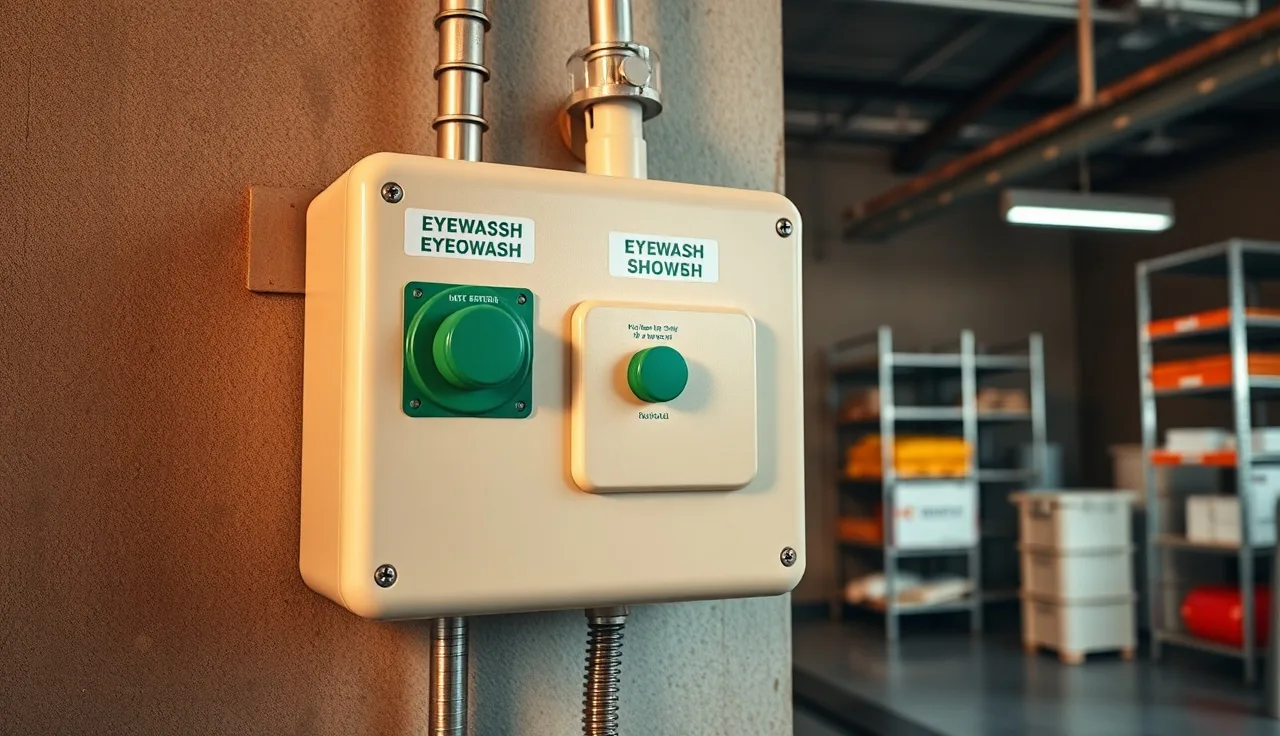
TL;DR
OSHA's eye wash rule lives in 29 CFR 1910.151(c): wherever workers can be exposed to corrosive materials, you need "suitable facilities for quick drenching or flushing of the eyes and body" within reach. The ANSI Z358.1 standard fills in the numbers: 10-second travel time, 0.4 gallons per minute for 15 continuous minutes, tepid water (60 to 100 degrees F), and weekly activation checks. A serious violation runs up to $16,550.
What does OSHA actually require for eye wash stations?
The rule is one sentence. 29 CFR 1910.151(c) says: "Where the eyes or body of any person may be exposed to injurious corrosive materials, suitable facilities for quick drenching or flushing of the eyes and body shall be provided within the work area for immediate emergency use." [1] That's the whole thing.
OSHA wrote it as a performance standard, not a prescription. The agency does not put gallons per minute or travel distances in the CFR text. Instead it points to ANSI/ISEA Z358.1 as the yardstick for what "suitable" and "immediate" mean in the real world. [2] OSHA's letters of interpretation say so plainly, including a 2003 letter that names Z358.1 as the guidance inspectors use to judge compliance. [3]
General industry runs on 1910.151(c). Construction runs on 29 CFR 1926.50(g), which uses nearly the same language. [11] Maritime has its own provisions with the same underlying logic.
State-plan states can go stricter. California's Title 8 Section 5162 spells out requirements that reach past the federal floor. If you operate in a state plan state, read your state agency's rules directly instead of assuming federal minimums cover you. [10]
What is the 10-second rule and how do you measure it?
ANSI Z358.1 sets a 10-second travel time. A worker with a chemical splash has about 10 seconds before the pain and the reflex to rub and shut the eyes make it nearly impossible to find anything. The station has to be reachable inside that window from any spot where a corrosive exposure can happen. [2]
Ten seconds works out to roughly 55 feet of clear walking for most adults. Both OSHA and ANSI say to walk the path yourself, not trust a tape measure. Stairs, tight corners, doors you have to open, and wet floors all burn through the time budget. Keep the path clear and mark it.
A few things people get wrong:
- The 10 seconds is travel time, not discovery time. The worker already knows they've been splashed.
- "Immediate work area" means the zone where the hazard exists, not the building. A chemical storage room and a separate production floor may each need their own unit.
- Portable squeeze bottles usually don't count. They can't deliver 15 minutes of continuous flow. ANSI allows personal eyewash devices as supplementary first aid only, never as primary compliance.
If your layout truly cannot put plumbed water within 10 seconds of a hazard, a self-contained gravity-fed unit holding a 15-minute supply (water or buffered saline) is acceptable under ANSI Z358.1, as long as the fluid hits the temperature and volume targets. [2]
What are the flow rate and water temperature requirements?
ANSI Z358.1 sets a minimum flow of 0.4 gallons per minute (GPM) for eyewash units, delivered to both eyes at once. Combination eye/face wash units need 3.0 GPM. Full body drench showers need 20 GPM. [2]
Temperature is where a lot of facilities fail and never know it. ANSI Z358.1 requires "tepid" water, defined as 60 degrees F to 100 degrees F (15.6 to 37.8 degrees C). [2] Water that's too cold triggers thermal shock and drives the injured worker off the station early. Water that's too hot can deepen a chemical burn. An untempered hose bib in an unheated warehouse in January almost certainly fails this test.
Tepid water in a cold climate usually means a thermostatic mixing valve or a dedicated tepid recirculation loop. In hot climates the problem flips: supply lines baking in the sun can deliver water above 100 degrees F. Both cases need engineering controls, not a line in the safety manual.
Self-contained units have to stay tepid too. Plenty of facilities park these in unheated spaces and never check the fluid temperature in February. That's a real problem and a real inspection finding.
| Unit Type | Minimum Flow Rate | Flush Duration |
|---|---|---|
| Eyewash | 0.4 GPM | 15 minutes |
| Eye/face wash | 3.0 GPM | 15 minutes |
| Drench shower | 20 GPM | 15 minutes |
| Personal eyewash (supplement only) | 0.4 GPM | N/A (not primary) |
Source: ANSI/ISEA Z358.1-2014 [2]
How often do eye wash stations need to be inspected and tested?
ANSI Z358.1 sets two intervals: weekly and annual. Miss either and you've handed an inspector an easy citation.
Weekly activation: run every plumbed eyewash long enough to flush the line and confirm the unit works. In practice that means running it until the water runs clear, usually 15 to 30 seconds. The point is to clear stagnant water that can grow Legionella and other bacteria, and to check that the heads pop open freely. [2]
Annual inspection: a formal check of flow rate, water temperature, unit condition, and unobstructed access. Most facilities have a safety officer or a plumbing contractor with flow-testing gear handle it.
Self-contained units run on a different clock. Check fluid level and condition on the manufacturer's schedule, usually monthly or quarterly. Buffered saline has an expiration date. Plain water in a sealed tank can grow microorganisms. Replace the fluid on the schedule, not when it crosses your mind.
Document every check. An undocumented inspection is an uninspected station as far as a compliance officer is concerned. A paper log taped to the unit or a digital entry in your safety system both work. Show the date, who checked it, and any problems found. [4]
Facilities writing a formal hazard communication program can fold eyewash inspection records right into their chemical safety documentation.
Which chemicals actually trigger the eye wash station requirement?
The standard says "corrosive materials," but inspectors read it wider in practice. If a chemical's Safety Data Sheet (SDS) carries an eye hazard statement, or tells you to flush the eyes immediately on contact, that chemical triggers the requirement. [5]
Common categories that require eyewash access:
- Strong acids (sulfuric, hydrochloric, nitric, phosphoric). For a close look at one of the most common, see the hcl safety data sheet guide.
- Strong bases (sodium hydroxide, potassium hydroxide, ammonia solutions)
- Oxidizers (hydrogen peroxide above 3%, bleach, chlorine compounds)
- Solvents carrying eye irritation or corrosion GHS classifications
- Pesticides and herbicides with ocular hazard statements
- Epoxy resins and hardeners
- Battery acid (concentrated sulfuric acid)
Not sure about a specific product? Pull the SDS and read Section 2 (Hazard Identification) and Section 4 (First Aid Measures). If Section 4 says to flush the eyes with water for 15 minutes, the standard applies. [5]
Mild irritants (some soaps, diluted cleaners, products classified only as "eye irritant" category 2) sit in a gray zone. The answer that avoids a citation is to provide the station anyway. A station costs a few hundred dollars. An eye injury settlement does not.
What are OSHA's penalties for eye wash station violations?
OSHA penalties adjust for inflation every year. As of 2025 a serious violation runs up to $16,550. Willful or repeated violations reach $165,514 each. [6] Multiple missing stations in one facility can mean multiple citations, stacked.
Eye wash violations usually land as "serious" because the risk of permanent eye injury is obvious. OSHA has cited them as "willful" when an employer knew the rule and skipped it anyway.
Most eyewash violations turn up during inspections triggered by something else, a complaint or a referral. The officer walks the floor, spots the chemical hazards, and if there are carboys of acid with no station in reach, that's a citation. The upside is that this is one of the easier things to fix before anyone shows up.
Beyond the fine, a single serious eye injury from a missing station brings workers' comp costs, likely OSHA 300 log entries (see our guide on incident report documentation), and possible civil liability. BLS data puts eye injuries involving days away from work at a median of about 3 days off, though severe cases run far longer, and eye injuries as a category account for tens of thousands of lost-time cases a year. [7]
Does OSHA require eye wash stations for battery charging areas?
Yes, and this one catches a lot of small businesses flat-footed. Lead-acid batteries hold concentrated sulfuric acid. Charging them makes hydrogen gas and can bubble or splash electrolyte. OSHA's 1910.178(g) covers battery charging for powered industrial trucks, and the corrosive hazard pulls in the 1910.151(c) eyewash requirement. [8]
Same logic covers any forklift battery room, UPS battery banks in data centers, and golf cart or electric vehicle charging areas running flooded lead-acid batteries. Sealed AGM and gel batteries carry a lower splash risk but still hold acid, so most safety pros put access there too.
If you're running forklift certification and battery maintenance training at the same time, bundle this in: show workers the eyewash, have them activate it, log the training.
Can a garden hose or safety shower substitute for an eyewash station?
A garden hose with a sprayer does not meet ANSI Z358.1, period. The problem is control. An eyewash unit puts a gentle, steady flow on both eyes at once at a set pressure. A hose nozzle throws variable pressure that can hurt a chemically burned eye, and it takes a hand to hold, so only one eye gets rinsed at a time. [2]
A drench shower doesn't substitute for an eyewash either. They do different jobs. The shower handles large body contamination. The eyewash handles the eyes. Most corrosive hazards need both, each within 10 seconds. Many facilities install a combination unit that delivers both from a single plumbing connection, which is fine and usually the cheapest way to cover a permanent workstation.
One narrow exception exists. If an eye exposure is essentially impossible given the chemical's physical form and the process (a solid that produces no mist and poses no splash risk to the face), you can argue the requirement doesn't apply. But if there's any real splash path to the face, put in the combination unit. Don't try to sell the exception to an inspector.
What should a written eye wash program include to satisfy OSHA?
OSHA does not require a standalone written eyewash program the way it requires one for lockout/tagout or hazard communication. Still, a documented procedure protects you during an inspection and keeps every shift doing the same thing.
A solid procedure covers:
1. Every location where corrosive or eye-hazardous chemicals are used or stored, mapped to specific eyewash units 2. The inspection schedule (weekly for plumbed units, manufacturer schedule for self-contained) 3. Who is responsible for inspections at each location 4. The inspection log format and where records live 5. Training: every new employee working with covered chemicals gets shown the nearest unit and trained to use it before their first exposure 6. What to do after an exposure: activate the station, hold the eyes open (the reflex is to shut them), flush a full 15 minutes, then get medical evaluation 7. Maintenance contacts for repairs and fluid replacement
Building this into a broader chemical safety program? The SafetyFolio program generator can produce a complete written chemical safety program, eyewash provisions included, in about 15 minutes. That's the practical alternative to paying a consultant for a task this simple.
If you're also working through a lockout tagout program, chemical safety documentation usually runs alongside it and shares the same responsible people, so build them together.
How do you train employees to use an eye wash station correctly?
Training has to be hands-on, not a video and a slide. Under stress, an injured worker does whatever their hands already know how to do. If they've never touched the station, they'll fumble with it for seconds they don't have while the chemical keeps burning.
Good training includes:
- Walking each employee to every station they might need, backups included
- Having them activate the station so they know the exact motion and the feel of the flow
- Practicing holding the eyes open under the water, which feels wrong and has to be rehearsed
- Explaining the 15-minute flush and why it matters. Sodium hydroxide keeps penetrating tissue after the splash, and a 30-second rinse does not stop the reaction.
- Knowing when to call 911 versus urgent care after flushing
Document it with employee signatures, the date, and the topics covered. OSHA's 1910.151 doesn't set a training frequency, but the practice most inspectors expect is initial training before first exposure and refresher training whenever the equipment or procedure changes. [4]
For anyone running broader chemical handling training, the framework in our osha training guide applies straight to eyewash training.
What are the most common eye wash station citations OSHA issues?
OSHA enforcement patterns and compliance guidance point to a short, predictable list of deficiencies. [9] Here's what officers write up most.
No station present at all. The most common finding. A small auto shop, metal finisher, or cleaning-supply distributor keeps corrosives with no eyewash anywhere near them.
Station present but not within 10 seconds. The unit sits in the hallway, the chemicals sit at the back of the building. Common where chemicals got added after the layout was fixed.
Obstructed access. Boxes stacked in front of the unit. A locked door between the hazard and the station. Both draw direct citations.
Station not functional. A corroded push-plate that won't pop open. Heads clogged with mineral scale. Plumbed units shut off during a renovation and never turned back on.
No tepid water. An unheated supply line in a cold warehouse, or plumbing that delivers only cold or scalding.
No inspection records. The station works, but there's no log. This can bump the finding up because it shows the employer isn't monitoring its own hazard controls.
Self-contained unit with expired or wrong fluid. Saline past its date, or plain water with visible contamination.
Fix any of these before an inspection and the violation is off the table. Most take an afternoon with a plumber, a mounting bracket, and a log sheet.
Frequently asked questions
Does OSHA require eyewash stations for cleaning products like bleach or ammonia?
If the product's SDS lists an eye hazard or tells you to flush immediately in Section 4, the 29 CFR 1910.151(c) requirement applies. Household-concentration bleach (3 to 6% sodium hypochlorite) is a borderline case, but industrial concentrations above 10% are clearly corrosive. When in doubt, check Section 2 for the GHS hazard classification. Providing a station for any eye-hazardous product is the safer call every time.
Does a plumbed eye wash station need to be connected to tempered water?
Yes. ANSI Z358.1 requires tepid water at 60 to 100 degrees F. A standard cold-water supply in a northern climate or an uninsulated line in a hot warehouse won't meet it. You'll need a thermostatic mixing valve or a tepid water supply system. This is one of the most commonly missed requirements during facility upgrades, and inspectors do check the water temperature.
How much does an eyewash station cost to install?
A wall-mounted plumbed combination eyewash/drench shower unit usually costs $300 to $800 for the equipment. Plumbing installation adds $200 to $600 depending on how far the nearest water line is. A self-contained gravity-fed unit runs $100 to $400 with no install cost beyond mounting. Annual fluid replacement for self-contained units adds $50 to $150 a year. First-year total for most small facilities lands between $400 and $1,400.
What is the required flush duration for an eye wash station?
ANSI Z358.1 requires continuous flushing for at least 15 minutes at the minimum flow rate. That's why personal squeeze bottles, which hold about an ounce, aren't primary compliance units. The 15-minute duration is set by the time needed to dilute and remove most corrosive chemicals from eye tissue. After flushing, the worker should see a medical professional no matter how minor it looks.
Are portable eye wash stations OSHA compliant?
Self-contained portable or gravity-fed units can satisfy 29 CFR 1910.151(c) if they deliver 0.4 GPM for 15 minutes at tepid temperature (60 to 100 degrees F). They're acceptable as primary units only where plumbed water can't reach the hazard within 10 seconds, and they need more upkeep than plumbed units. Personal squeeze bottles and travel-size eyewash are supplementary only and never replace a primary unit.
Does OSHA require eye wash stations in offices or retail spaces?
Generally no, if the only chemicals present are consumer products like hand sanitizer or glass cleaner at household strength. The trigger is corrosive or eye-hazardous material. If a retail or office space stores industrial cleaning chemicals, battery acid, or anything with a GHS eye hazard category 1 or corrosion classification, the requirement applies to that use and storage area.
How do I know if my state has stricter eyewash station rules than federal OSHA?
Twenty-two states and two territories run their own OSHA-approved state plans and can set stricter standards. California (Cal/OSHA Title 8 Section 5162), Washington (WISHA), and Michigan (MIOSHA) are known for more detailed eyewash rules. Check your state labor department's site directly. OSHA's state plan directory at osha.gov lists every state plan agency with contact information.
What records do I need to keep for eye wash station inspections?
OSHA sets no mandatory format, but ANSI Z358.1 recommends logging weekly activation checks with date, time, and the name of who did it. Annual inspection records should cover flow rate, water temperature, head and valve condition, and any corrective actions. Keep records at least three years to cover typical OSHA lookback periods. A paper log mounted near the unit works fine.
Do eyewash stations need to be ADA accessible?
ADA accessibility applies to facilities covered by the Americans with Disabilities Act in areas used by the public or employees. For industrial eyewash stations in areas where disabled employees work, the station has to be usable by those employees. ANSI Z358.1 doesn't specify ADA dimensions, but the access path can't have barriers that would stop a wheelchair user from reaching it within 10 seconds if that employee could be exposed.
Can I use a safety shower as my only emergency eyewash equipment?
No. A drench shower handles body contamination and delivers water from overhead. It doesn't direct water to the eyes well, and it forces a worker to tilt their head and hold their eyelids open by hand under a downpour, which is impractical during an eye injury. ANSI Z358.1 treats drench showers and eyewash units as separate required equipment. Most corrosive hazards need both within 10 seconds of the exposure point.
What happens if an employee is injured because we didn't have an eyewash station?
The injury goes on your OSHA 300 log if it causes days away from work, restricted duty, or medical treatment beyond first aid. OSHA may investigate and cite up to $16,550 for a serious violation. Workers' comp claims for permanent vision loss can run into six figures. Civil liability is significant if the employer knew or should have known about the requirement. Eye injuries account for tens of thousands of lost-time cases a year, per BLS data.
How close does an eyewash station need to be to a chemical storage area?
ANSI Z358.1 requires the station within 10 seconds of travel time from the hazard, which usually means no more than 55 feet of unobstructed walking. It applies anywhere an exposure can occur, including storage areas where workers open containers, transfer chemicals, or handle spills. Storage areas where sealed containers just sit and never get opened carry a lower but non-zero risk.
What is the difference between an eyewash station and an eye/face wash station?
An eyewash unit directs water to the eyes at 0.4 GPM minimum. An eye/face wash unit covers the whole face, forehead to chin, at 3.0 GPM minimum. ANSI Z358.1 recommends eye/face wash units anywhere the whole face could be contaminated, not the eyes alone. For most corrosive splash hazards, an eye/face wash or combination unit is the right choice.
Sources
- OSHA, 29 CFR 1910.151 - Medical services and first aid: 29 CFR 1910.151(c) requires suitable facilities for quick drenching or flushing of the eyes and body where corrosive materials are present
- ANSI/ISEA Z358.1-2014, Emergency Eyewash and Shower Equipment (referenced via OSHA.gov): ANSI Z358.1 specifies 10-second travel time, 0.4 GPM minimum flow for eyewash units, 15-minute flush duration, and tepid water range of 60-100 degrees F
- OSHA Letter of Interpretation, July 7, 2003 - Eyewash and shower facilities: OSHA compliance officers use ANSI Z358.1 as the benchmark for evaluating whether eyewash facilities meet the 1910.151(c) requirement
- OSHA, Recordkeeping and reporting (recordkeeping guidance section): OSHA expects documented hazard-control monitoring and training records; undocumented inspections are treated as not performed during compliance reviews
- OSHA, Hazard Communication (Safety Data Sheets, 29 CFR 1910.1200): SDS Section 4 first aid measures and Section 2 hazard identification determine whether a chemical triggers eyewash requirements
- OSHA, Penalties (2025 inflation-adjusted figures): As of 2025, maximum OSHA penalty for a serious violation is $16,550 per violation; willful or repeated violations up to $165,514 per violation
- Bureau of Labor Statistics, Injuries, Illnesses, and Fatalities program: BLS data reports median days away from work for eye injuries and counts tens of thousands of lost-time eye injury cases annually
- OSHA, 29 CFR 1910.178 - Powered Industrial Trucks (battery charging provisions): 29 CFR 1910.178(g) addresses battery charging safety; lead-acid battery electrolyte is concentrated sulfuric acid triggering 1910.151(c) eyewash requirements
- OSHA, Enforcement (top cited standards and enforcement data): OSHA enforcement data identifies common 1910.151 citation patterns including missing stations, obstructed access, and lack of inspection records
- OSHA, State Plans directory: Twenty-two states and two territories operate OSHA-approved state plans that may set stricter standards than federal OSHA
- OSHA, 29 CFR 1926.50 - Medical services and first aid (construction): 29 CFR 1926.50(g) requires eyewash facilities for construction workers exposed to corrosive materials, parallel to the general industry standard