Last updated 2026-07-10
TL;DR
OSHA's respirable crystalline silica standard (29 CFR 1926.1153) makes masonry contractors control dust by engineering means before reaching for respirators. The main threshold is 50 µg/m³ as an 8-hour time-weighted average. Wet methods, on-tool vacuum extraction, and enclosed cabs are the controls that actually work. Table 1 in the standard tells you which control to use for each task.
What does OSHA actually require for silica dust control on masonry jobs?
Engineering controls come first, respirators come last. That's the whole logic of OSHA's respirable crystalline silica standard for construction, 29 CFR 1926.1153, which took effect for most contractors in September 2017 [1]. The rule sets a permissible exposure limit (PEL) of 50 micrograms per cubic meter of air (µg/m³) as an 8-hour time-weighted average and an action level of 25 µg/m³. Those two numbers are the goalposts for your entire dust program.
The hierarchy is not a suggestion. You only reach for respirators after you've applied every feasible engineering control and they still can't get you below the PEL. Respirators are the backup, never the plan. This matters for small masonry contractors because an OSHA compliance officer will ask what engineering controls you tried before you handed out N95s.
The most contractor-friendly part of the standard is Table 1 [1]. It lists specific tasks (angle grinder use, handheld power saw use, jackhammering, tuck-point grinding, and more) next to the exact engineering control required for each. Follow Table 1 and OSHA presumes your exposure is below the PEL, so you skip air monitoring. For a two- or three-person crew, that's a real paperwork break.
Stray from Table 1, say you're using a tool or method not listed there, and you have to assess employee exposure and possibly run air monitoring [1]. For most small masonry shops, staying on Table 1 is the smarter business decision.
What engineering controls does OSHA's Table 1 specify for common masonry tasks?
Table 1 is organized by task and equipment type. Match your task to the row and you know the control. Here's how the most common masonry tasks map [1]:
| Task | Required Engineering Control | Respiratory Protection Required? |
|---|---|---|
| Handheld power saw (outdoors) | Water delivery that feeds blade continuously | No (for up to 4 hrs/shift) |
| Handheld power saw (indoors or enclosed) | Water delivery OR vacuum dust collection | Yes, minimum APF 10 (half-face) |
| Angle grinder, tuck-point grinding | Vacuum dust collection (HEPA, shrouded) | Yes, minimum APF 25 (half-face) |
| Jackhammer / chipping hammer | Water mist at the point of impact | Yes, minimum APF 10 |
| Walk-behind saw | Water delivery system | No (outdoors, up to 4 hrs) |
| Stationary masonry saw | Integrated water delivery | No |
| Core drilling | Water delivery or dust collection | No |
| Crushing (large ops) | Water spray or enclosure | Varies |
The respiratory protection column matters, but it sits behind the engineering control column. You still provide and use the respirator where Table 1 requires it. The point is that the engineering control does the heavy lifting.
Here's what contractors miss. Table 1 requires the control to be used the way OSHA specifies, more than present on the truck. A wet saw with a clogged water feed doesn't count. A vacuum with a full filter bag doesn't count. Your workers have to run and maintain the equipment for the presumption to hold.
How does wet cutting work and is it good enough on its own?
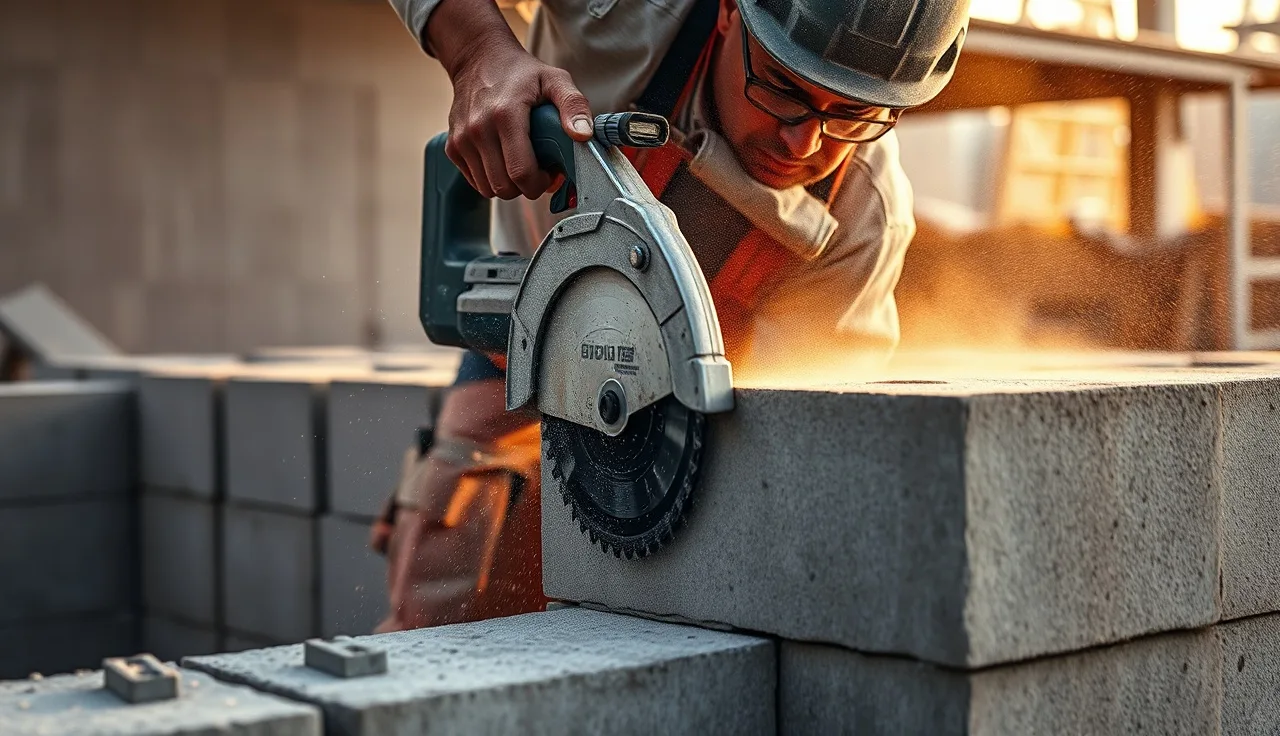
Wet cutting wets the particles before they go airborne. You feed water continuously to the blade or bit during the cut. It's the oldest engineering control for masonry silica dust and still the most common. Most handheld masonry saws take a water delivery kit from the manufacturer, usually a small reservoir or a garden-hose connection running about 1 to 2 gallons per minute.
Outdoors, on horizontal cuts, wet cutting alone usually keeps exposures below the PEL. That's why Table 1 asks for no respirator on outdoor wet saw work up to 4 hours per shift [1]. The water has nowhere to accumulate and the airborne fraction stays low.
Indoors is a different animal. The mist hangs longer in enclosed spaces and the silica that does escape lingers in the breathing zone. Table 1 requires respiratory protection for indoor saw use even with water running. Cutting in a basement, a garage, or any room with weak air movement? Don't assume the water solves it.
A practical warning: water systems fail all day on active sites. Hoses kink. Reservoirs run dry. Fittings pop loose. The fix is cheap. Assign one person to check flow at the start of each cut and keep a spare fitting kit on the truck. Skip that step and you'll have crews dry-cutting without knowing the water quit.
Water also leaves a slurry of silica-laden sludge on the surface. When that slurry dries, it becomes a second dust hazard. Wet sweeping or a wet-dry vacuum to collect the slurry before it dries is part of the control, even though Table 1 doesn't spell it out.
What is on-tool vacuum extraction and when does it beat wet methods?
On-tool vacuum extraction captures dust at the point it's made. You attach a shroud or dust-collection hood directly to the tool (an angle grinder, tuck-point grinder, or circular saw) and connect it to a HEPA-filter vacuum. The hood grabs the dust before it leaves the work zone. The vacuum pulls that air through the HEPA filter, which captures particles down to 0.3 microns at 99.97% efficiency.
This is the required control for tuck-point grinding under Table 1, and for that task it beats wet methods. Wet-cutting a vertical mortar joint is awkward, the water runs down the wall, and exposure stays high when the water misses the cut. A shrouded grinder with HEPA extraction is cleaner and easier to control.
The vacuum itself decides whether this works. Not every shop vac is a HEPA vac. A standard 5-gallon shop vac with a paper filter catches the big particles but can blow fine respirable silica right back into the breathing zone if the filter isn't rated for fine dust. Look for an H-class rating under European standard EN 60335-2-69, or confirm the unit meets HEPA specifications per NIOSH guidance [2]. Professional units from Milwaukee, DeWalt, Festool, or Hilti in the $200 to $600 range usually carry the rating.
Shroud fit is the other failure point. A loose shroud leaves air gaps and dust escapes around the edges. Shrouds are tool-specific. One made for a given grinder model won't seal on another. Buy the shroud built for the exact tool you run.
For a stationary masonry saw, a local exhaust ventilation (LEV) hood at the blade, feeding a dust collector with a HEPA after-filter, beats wet methods in an indoor shop. A well-designed LEV hood can capture 90 to 99% of generated dust at the source [3].
Does local exhaust ventilation count as an engineering control for silica?
Yes, and it's one of the strongest controls you can run, especially for stationary or semi-stationary work like a block saw in a masonry yard or a tile saw in a shop. LEV captures dust at the source through a hood set close to where the dust is made, pulls the contaminated air through ductwork, and filters it before discharge.
OSHA's general industry ventilation standard at 29 CFR 1910.94 gives the foundational design requirements, and the American Conference of Governmental Industrial Hygienists (ACGIH) Industrial Ventilation manual gives detailed velocity and capture specs for masonry work [3]. The number that matters for a capture hood is face velocity, usually 100 to 200 feet per minute at the hood face, though the required velocity depends on how much air is already moving in the space.
For a small contractor doing mostly site work, LEV is less practical. You can't drag a full dust-collection cabinet to a residential block wall. On-tool extraction and wet methods are the field-ready options. Save LEV for the yard or shop.
One thing to burn into memory: general dilution ventilation, meaning opening windows or running a box fan, does not count as an engineering control for silica. Dilution might lower concentrations a little, but OSHA won't accept it as a substitute for source capture. The ACGIH position is that dilution ventilation is inappropriate when the contaminant is highly toxic, and respirable crystalline silica causes silicosis and lung cancer, so it qualifies [3].
What does silica exposure actually cost a masonry worker and the business?
Silicosis is irreversible. No treatment restores lung function once it's gone. Accelerated silicosis, which hits at high exposures over a shorter window, can progress to total disability or death in as little as 5 years from first exposure [4]. Chronic silicosis takes longer, usually 10 or more years above the PEL, but it runs the same direction.
The money side is real too. OSHA's silica rule carries a current maximum penalty of $16,131 per serious violation and up to $161,323 for willful or repeated violations [5]. OSHA has cited masonry contractors for silica since enforcement began, and those citations often stack multiple violations per inspection.
Workers' compensation claims for occupational lung disease run long and expensive. A settled silicosis claim can reach six or seven figures depending on the state and the degree of disability. Most small masonry contractors don't have the liquidity to eat that.
NIOSH has tracked silica disease burden for decades. It estimates roughly 2.3 million U.S. workers face silica dust on the job, with construction workers, masons and concrete workers among them, making up a large share [2]. The math on controls is not close: a wet saw kit runs $30 to $80, a HEPA vacuum with shroud runs $300 to $700, and neither comes anywhere near the cost of one silicosis claim or one OSHA citation.
If you need a written silica control program to document all this, a tool like SafetyFolio can generate one fast so you're not staring at a blank page the night before an inspection.
Do you need air monitoring for silica if you're a small masonry contractor?
Not necessarily. This is where Table 1 earns its keep for small contractors.
If all of your tasks appear on Table 1 and you run the specified engineering controls exactly as written, OSHA's standard lets you operate without air monitoring [1]. That compliance path is called the "specified exposure control methods" option, and using it means OSHA presumes your workers are protected below the PEL.
You lose that presumption the moment you deviate: a non-listed tool, a listed tool without its specified control, or a task that isn't covered at all. Then you have to assess exposures. The assessment can be an objective data review (industry sampling data showing the task at your scale usually falls below the action level) or actual air monitoring with a calibrated sampling pump and analysis by an accredited lab.
Air monitoring runs roughly $200 to $500 per sample once you count the industrial hygienist's time and lab fees. For a small shop with a shifting task mix, one early round of monitoring to confirm your Table 1 controls actually work is worth doing even when you're not required to. It buys documentation and peace of mind. Nobody has clean data on how often small masonry contractors blow past the PEL while thinking they're compliant, but NIOSH field sampling suggests real-world exposures on masonry sites swing widely and controls underperform when they aren't maintained [2].
If the assessment puts a worker at or above the action level of 25 µg/m³, you're in the full monitoring regime: more frequent sampling, medical surveillance, and tighter recordkeeping.
What written program does a masonry contractor need for silica compliance?
You need a written exposure control plan, and it's a document, not a mental note. 29 CFR 1926.1153(e) requires it from any employer with employees exposed above the action level, or using Table 1 controls for tasks that require respiratory protection [1].
The standard spells out the contents: each task that involves silica exposure, the engineering controls and work practices for each task, your housekeeping measures, and the procedures for restricting access to high-dust areas. It also has to name a "competent person" in OSHA's language, someone who can spot silica hazards and has the authority to fix them.
A three-person crew doesn't need 30 pages. A one- or two-page task list with matching controls, signed by the competent person, meets the intent. Review and update the plan at least once a year and whenever you add a new task or tool [1].
Keep the plan on the job site or otherwise available to workers. An OSHA inspector can ask for it during a visit, and "it's back at the office" won't land well. A photo of the document on a supervisor's phone is defensible. Nothing is not.
The SafetyFolio program generator is built for exactly this: answer questions about your tasks and tools and it produces the written plan in a format that matches OSHA's requirements, usually in under 15 minutes. Worth saying because writing this from scratch eats most of an afternoon the first time.
Good hazard communication practices overlap with your silica program, since your workers need to know the health hazards of what they're cutting and grinding.
What housekeeping practices count as silica engineering controls?
Housekeeping isn't technically an engineering control, but OSHA gives it its own rules in 29 CFR 1926.1153(f) because bad cleanup can create exposure that rivals the cutting itself [1].
The rule bans dry sweeping and dry dusting wherever wet sweeping or HEPA vacuuming is feasible. That matters more than it sounds. Dry sweeping a floor after a day of cutting throws settled silica right back into the breathing zone. A broom on a block-and-mortar floor can spike a worker's exposure even if every cut was done wet.
Allowed housekeeping methods for silica dust:
- Wet sweeping (mopping or wet-brushing)
- HEPA vacuum (industrial-grade, not a shop vac without HEPA filtration)
- Wet-dry HEPA vacuum for collecting slurry
Compressed air to blow down surfaces is prohibited where silica dust is present, unless no other method is feasible and workers wear appropriate respiratory protection [1]. On a masonry site there's almost always a feasible alternative, so treat compressed air cleanup as off the table.
Here's the spot people forget: the inside of vehicles and equipment cabs. A worker who drives between sites with dusty clothes or tools in the cab re-exposes himself and everyone else. Set up a "dirty" area to brush off clothing before climbing into the cab, and HEPA-vacuum cab interiors on a schedule. It's a real practice worth writing into your procedure.
What training do workers and the competent person need under the silica rule?
29 CFR 1926.1153(i) requires you to train workers in a way they understand, covering the health hazards of silica, the tasks and tools that create exposure, the engineering controls in use, the limits of those controls, and the purpose and proper use of any respirator you provide [1].
This training has no minimum hour count, which sets it apart from some other OSHA standards. OSHA cares that the training works, not that it hits a clock. A 30-minute tailgate session before the first silica-generating task, with a sign-in sheet, is defensible for most small contractors. Longer, more formal training makes sense if your crew runs high-exposure tasks daily.
The competent person designation gets less attention than it deserves. OSHA defines a competent person as someone who can identify existing and predictable hazards and has the authority to take corrective action [1]. For silica, that means knowing which tasks push exposure above the action level, judging whether controls are working, and being willing to stop work when they aren't. You don't need an outside consultant. A lead mason or foreman who completes a silica-specific training course (several run through CPWR, the Center for Construction Research and Training) can hold the role [8].
For supervisors who want a broader base in OSHA compliance, OSHA 30 training covers construction hazards including silica and is a reasonable buy for the person you name as competent person.
When are respirators required on top of engineering controls for masonry silica?
Respirators are required under Table 1 for several common masonry tasks even when the engineering control is running right. Tuck-point grinding, indoor saw work, and jackhammer use all require respiratory protection whether or not the vacuum or the water is on [1].
The required minimum assigned protection factor (APF) tells you which respirator to grab. An APF of 10 means a half-face air-purifying respirator (an N95, or a half-face elastomeric with P100 cartridges). An APF of 25 for tuck-point grinding means a powered air-purifying respirator (PAPR) or a half-face elastomeric, not a disposable N95.
Respiratory protection under the silica rule pulls in the full respiratory protection program under 29 CFR 1910.134 [7]. That means fit testing for tight-fitting respirators, a medical evaluation before first use, and a written program. None of it is optional because you're small. OSHA has no small-employer exemption for respirator program requirements.
For more on the overall OSHA compliance framework, the OSHA training page covers what written programs and documented training need to look like for construction employers.
N95 disposables cover only the APF 10 tasks, and only for short duration. For daily tuck-point grinding, a reusable half-face or a PAPR is more practical and more protective.
What medical surveillance is required for masonry workers exposed to silica?
Medical surveillance under 29 CFR 1926.1153(h) is required for any employee who will be exposed above the action level for 30 or more days a year [1]. For most masonry contractors running daily cutting, grinding, or jackhammering, that threshold is easy to cross.
The exam covers a medical and work history with a focus on respiratory disease, a physical exam of the respiratory system, a chest X-ray read by a NIOSH-certified B Reader or a board-certified radiologist, pulmonary function testing (spirometry), and tuberculosis testing where appropriate. The first exam is due within 30 days of a new employee crossing the exposure threshold.
After the initial exam, follow-up exams come every 3 years [1]. The employer pays for all of it. Workers can't be charged, not even partly.
The physician gives a written medical opinion to the employee and, in limited form, to the employer. Your version can't include specific medical findings, only whether the worker can use a respirator and whether any work restrictions are recommended.
Finding an occupational medicine physician who reads B-reader chest X-rays can be tough in rural areas. NIOSH keeps a B Reader directory on its website [9], and some occupational health clinics run mobile spirometry for small employers. Costs run roughly $150 to $400 per exam depending on region and which tests are included, though this varies enough that you should call local occupational medicine clinics for real quotes.
Frequently asked questions
What is the OSHA PEL for respirable crystalline silica in construction?
OSHA's PEL for respirable crystalline silica under 29 CFR 1926.1153 is 50 micrograms per cubic meter of air (µg/m³) as an 8-hour time-weighted average. The action level, which triggers more requirements including exposure monitoring and medical surveillance, is 25 µg/m³. These thresholds apply to all construction employers including small masonry contractors.
Does OSHA's silica rule apply to small masonry contractors with just two or three employees?
Yes. OSHA's construction silica standard at 29 CFR 1926.1153 has no small employer exemption. If your workers cut, grind, or jackhammer masonry or concrete materials, the rule applies regardless of crew size. The Table 1 compliance pathway makes implementation simpler for small contractors, but the requirements themselves are the same.
What is Table 1 and how does it help small contractors comply with the silica rule?
Table 1 is a task-by-task chart within 29 CFR 1926.1153 that lists specific masonry and concrete tasks alongside the required engineering control for each. If you follow Table 1 exactly, OSHA presumes your exposures are below the PEL and you don't need air monitoring. For small contractors, this is the practical path to compliance without hiring an industrial hygienist.
Is a regular shop vac good enough for silica dust collection?
No. Standard shop vacuums without HEPA filtration can exhaust fine respirable silica particles back into the air. You need a vacuum that meets HEPA specifications, meaning it filters 99.97% of particles at 0.3 microns. Look for H-class rated vacuums or confirm the unit is specified as HEPA-filtered. Models from major tool brands in the $200 to $600 range typically qualify.
Can you use dry sweeping to clean up silica dust on a masonry job site?
No. OSHA's silica standard at 29 CFR 1926.1153(f) prohibits dry sweeping where wet sweeping or HEPA vacuuming is feasible. Dry sweeping resuspends settled silica particles and can create exposures as high as the cutting task itself. Use wet mopping, wet brushing, or a HEPA vacuum to clean up masonry dust.
What does a written silica exposure control plan need to include?
Under 29 CFR 1926.1153(e), the plan must identify each task with silica exposure, the engineering controls and work practices for each task, housekeeping measures, and procedures for restricting access to high-dust areas. It must also designate a competent person. The plan must be reviewed at least annually and updated when tasks or tools change.
How often do masonry workers need medical exams under the silica rule?
Workers exposed above the action level (25 µg/m³) for 30 or more days per year must receive an initial medical exam and follow-up exams every 3 years under 29 CFR 1926.1153(h). The exam includes chest X-ray read by a NIOSH B Reader, spirometry, and a respiratory-focused physical. The employer pays the full cost.
Does using a wet saw for masonry cutting eliminate the need for a respirator?
For outdoor wet saw work on tasks listed in Table 1, no respirator is required for up to 4 hours per shift. For indoor wet saw work, Table 1 still requires respiratory protection at a minimum APF of 10 (half-face respirator) even with water delivery running. The indoor air keeps dust suspended longer regardless of how wet the cut is.
What OSHA fines can a small masonry contractor face for silica violations?
OSHA's current maximum penalty is $16,131 per serious violation and up to $161,323 for willful or repeated violations as of 2024. Silica inspections often include multiple violations (missing written plan, no medical surveillance, improper controls), so actual citation totals can be several times the per-violation maximum. Small contractor status can reduce penalties but does not eliminate them.
What qualifications does a competent person for silica need?
OSHA defines a competent person as someone who can identify silica hazards, knows which tasks and tools create exposure above safe levels, can evaluate whether controls are working, and has authority to stop work when hazards exist. No specific certification is required, but training through CPWR's silica courses or similar programs is a practical way to qualify a lead worker or foreman.
Does compressed air count as a housekeeping method for silica dust?
Almost never. OSHA's silica standard prohibits using compressed air to clean surfaces or clothing where silica dust is present unless no other feasible method exists and proper respiratory protection is worn. In practice, wet sweeping or HEPA vacuuming is always feasible on masonry sites, so compressed air cleanup is effectively off the table.
What's the difference between an engineering control and an administrative control for silica?
Engineering controls physically reduce or eliminate the hazard at the source, things like wet cutting, HEPA vacuum extraction, and enclosed cabs. Administrative controls change how work is done to reduce exposure time, like rotating workers or scheduling high-dust tasks when fewer people are nearby. OSHA requires engineering controls first; administrative controls are supplemental, not a substitute.
How long does it take to develop a compliant silica written program for a small masonry operation?
Writing one from scratch takes most small contractors two to four hours the first time, mainly because OSHA's language is technical and the task-by-task format takes thought. Using a structured generator cuts that to 15 to 30 minutes. Either way, a complete plan for a typical two- to four-task masonry operation is a short document, not a binder.
Sources
- OSHA, 29 CFR 1926.1153 Respirable Crystalline Silica Standard for Construction: PEL of 50 µg/m³, action level of 25 µg/m³, Table 1 engineering controls, written exposure control plan requirements, medical surveillance at 30+ days above action level, housekeeping prohibitions on dry sweeping, training requirements, and competent person designation all sourced here.
- NIOSH, Occupational Exposure to Respirable Crystalline Silica: Approximately 2.3 million U.S. workers exposed to silica dust at work; construction workers including masons are a significant portion; field sampling shows real-world exposures vary widely and controls underperform when not maintained.
- ACGIH, Industrial Ventilation: A Manual of Recommended Practice: Local exhaust ventilation design requirements including capture velocity of 100-200 fpm and the ACGIH position that dilution ventilation is inappropriate for highly toxic contaminants like respirable silica.
- CDC/NIOSH, Silicosis: A Preventable Disease: Accelerated silicosis can progress to total disability or death in as little as 5 years from first high-level exposure; silicosis is irreversible.
- OSHA, Penalties page: Maximum OSHA penalty of $16,131 per serious violation and up to $161,323 for willful or repeated violations.
- OSHA, Table 1 to 29 CFR 1926.1153 (Specified Exposure Control Methods): Task-by-task engineering controls for handheld power saws, angle grinders, tuck-point grinders, jackhammers, walk-behind saws, stationary masonry saws, and core drilling, including required respiratory protection APF levels.
- OSHA, 29 CFR 1910.134 Respiratory Protection Standard: Written respiratory protection program, fit testing, and medical evaluation required when respirators are used, including in silica-generating tasks.
- CPWR - The Center for Construction Research and Training, Silica Resources: Silica-specific training courses available for workers and competent persons in masonry and construction.
- NIOSH, B Reader Program Directory: NIOSH maintains a directory of certified B Readers for interpreting chest X-rays required under silica medical surveillance.
- OSHA, Small Entity Compliance Guide for Construction Silica Standard: Guidance on Table 1 compliance pathway, written plan requirements, and medical surveillance procedures specifically for construction employers.