Last updated 2026-07-09
TL;DR
A toolbox talk is a short safety meeting held right before a shift or task. Run it in 5 to 15 minutes: pick one hazard, open with a real question, name the risk and the control, then let workers talk. Log who was there. OSHA doesn't mandate a format for most industries, but the sign-in sheet is what defends you if something goes wrong.
What is a toolbox talk and why does it matter?
A toolbox talk is a short, informal safety meeting held at the job site, usually right before work starts or before a new task begins. Other names for it: tailgate talk, safety briefing, pre-shift huddle. The name comes from construction crews gathering around a toolbox. The format has spread to manufacturing, warehousing, landscaping, and pretty much any trade where workers face physical hazards.
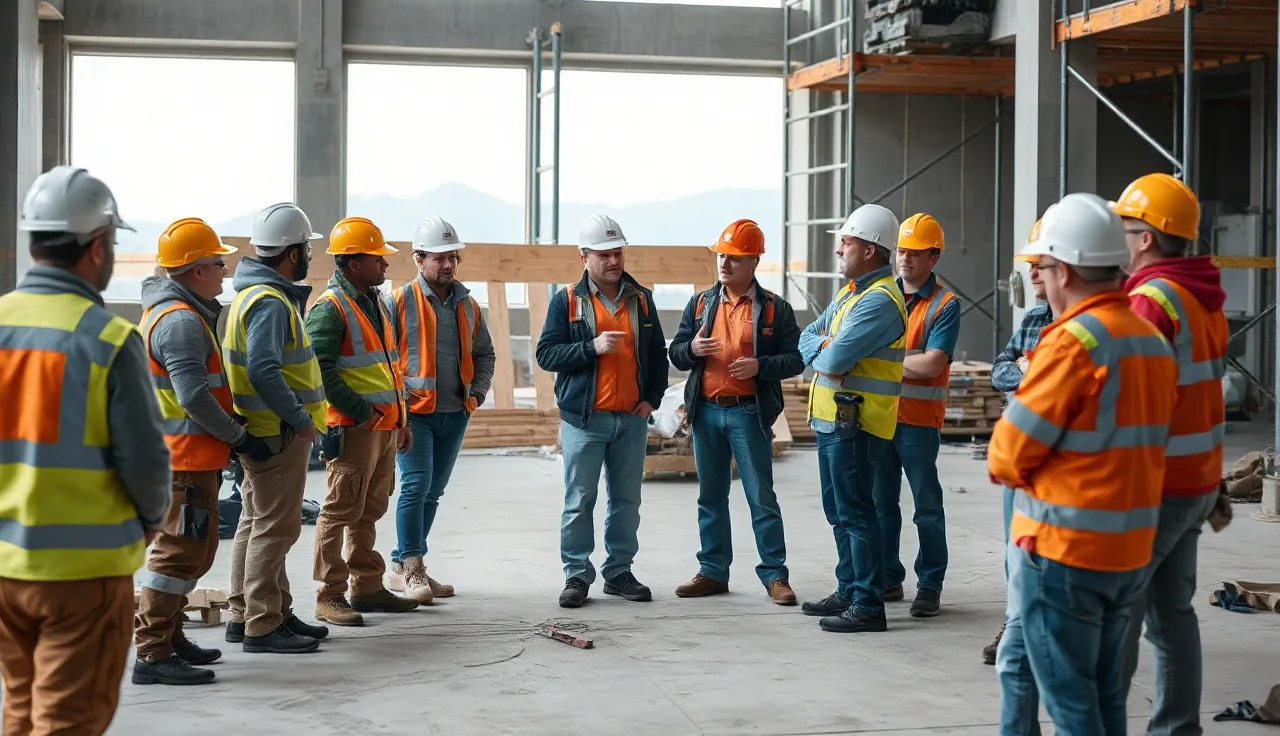
The idea is simple. One topic, one location, 10 minutes or less, everyone working that day. No PowerPoint. No classroom. A supervisor or lead worker talks through one real hazard and asks the crew what they'd do about it.
Here's why it matters. The Bureau of Labor Statistics counted 5,283 fatal work injuries in 2023 [1]. A large share of those hit workers who knew the general rule but lost track of it during a routine task. Toolbox talks close the gap between knowing and doing. They put the hazard front of mind right before exposure, which is the only moment a reminder has a real shot at sticking.
They're also about the cheapest safety investment a small business can make. A 10-minute talk costs you 10 minutes of labor per worker. A single recordable injury runs $40,000 or more in direct costs, by OSHA's own estimate [2]. The math isn't hard.
Does OSHA require toolbox talks?
No OSHA regulation says "you must hold toolbox talks." No single CFR section names the format. What OSHA does require is employee training on specific hazards, and that's where toolbox talks earn their keep.
Take 29 CFR 1926.21(b)(2). It requires employers to instruct each employee "in the recognition and avoidance of unsafe conditions" specific to their work [3]. In construction, that's a standing mandate for ongoing, job-specific safety instruction. A documented toolbox talk is one of the cleanest ways to prove you did it.
Other standards have explicit training rules that toolbox talks help satisfy. Hazard communication under 29 CFR 1910.1200 requires refresher training on chemical hazards [4]. Lockout tagout under 29 CFR 1910.147 requires retraining when procedures change or when a supervisor thinks a worker doesn't understand the program [5]. A documented talk on either topic, with a signed attendance list, is real evidence that training happened.
Here's where toolbox talks become nearly mandatory in practice. If OSHA cites you after an incident, one of the first things the inspector asks for is training records. "We told them" without a sign-in sheet is worth almost nothing. "Here's the date, the topic, and the name of every worker who was there" is worth a lot.
State-plan states sometimes go further. California's Cal/OSHA requires employers to run an injury and illness prevention program, and many employers meet its communication element through documented safety meetings. If you're in a state-plan state, check your state's rules on top of federal OSHA.
How long should a toolbox talk be?
Five to fifteen minutes. That's the honest answer, and it isn't arbitrary.
Research on adult learning shows attention drops off after roughly 10 minutes without a change in format or an interactive element [6]. A talk that runs 25 minutes with no discussion has stopped being a talk and turned into a lecture. Workers tune out. The safety message stops landing.
Five minutes is plenty for most topics if you stay focused. One hazard, one control, one real question for the crew fits inside that window. Fifteen minutes works for heavier topics, like introducing a new chemical or walking through a changed procedure, but only if the extra time is discussion, not monologue.
The biggest mistake supervisors make is trying to cover too much. Pick one thing. Not "electrical safety." Pick "inspect your extension cord before you plug it in." Not "fall prevention." Pick "how to check a ladder for damage before you climb." Narrow topic, short talk, better retention.
What topics should you cover in a toolbox talk?
The best topics come from your own workplace, not a generic list off a vendor's website. Your job site, your tasks, your near misses. That's your queue.
Keep a running log of near misses, incident reports, and close calls. Those events are your topic list. If a worker nearly got clipped by a forklift on Tuesday, Wednesday morning's talk is about pedestrian and forklift separation. The link between a real event and the safety message is exactly what makes workers listen.
Plan the proactive topics around what's happening that week. Crew going up on scaffolding Thursday? Wednesday's talk is fall protection. New chemical coming in? Cover the SDS before the drum shows up.
These categories generate the most useful topics for most small businesses:
- Struck-by and caught-in hazards (OSHA's "fatal four" in construction account for over 60% of construction deaths [3])
- Slips, trips, and falls (a leading cause of general industry injuries [1])
- Chemical handling and SDS review
- Equipment pre-use inspection (forklifts, ladders, power tools)
- Emergency procedures and exit routes
- Personal protective equipment use and fit
- Heat illness, especially seasonal
- Electrical safety basics
- Lockout/tagout reminders before maintenance tasks
- New workers, or workers coming back after time off
For forklift operators, OSHA requires refresher training after a near miss or accident under 29 CFR 1910.178(l)(4) [5]. A talk documented right after an incident supports that refresher requirement. More on forklift certification and what the training has to include.
You don't have to write every talk from scratch. OSHA's website at osha.gov has a library of free topics. NIOSH publishes hazard-specific fact sheets you can pull from. Adapt them to your actual conditions, always. "In our facility, the specific problem is..." beats a generic script every time.
Step-by-step: how to run a toolbox talk
Here's the format that holds up. Five steps, none of which need more than about 10 minutes of prep the night before.
Step 1: Choose one specific topic. Not a category. A hazard or a task. Write it in one sentence: "Today we're checking your harness D-ring for wear before you clip in." If you can't say it in one sentence, you've picked two topics.
Step 2: Open with a real question, not a lecture. "Has anyone here ever grabbed a tool that looked fine but turned out to be broken? What happened?" You'll get real answers if the crew trusts you. That answer becomes your opening story, and it beats anything you'd make up.
Step 3: Name the hazard and the consequence, fast. Be specific. "A worn D-ring can fail under load. If it fails during a fall, the lanyard doesn't catch you." One sentence for the hazard, one for the consequence. Don't pile on. Workers already know bad things happen. They need the mechanism, not a general warning.
Step 4: Cover the control, hands-on if you can. Talking about inspecting a harness? Hold one. Point at the part you're describing. Talking about chemical labels? Hold up the actual container from your shelf. Tangible beats abstract. This is also the moment to tie the talk to your written safety program: "Our procedure says inspect before every use and pull it from service if you find any of these." That connects the talk to your documented program.
Step 5: Ask for questions, then close with one action item. "Starting today, physically pull on the D-ring before you put the harness on. If it moves, tag it out and come find me." One action. Not "be more careful." One physical thing they'll do differently.
Then pass the sign-in sheet while everyone's still standing there. Don't let people walk off first.
If you run written safety programs and need somewhere to anchor these talks, SafetyFolio's safety program generator maps toolbox talk topics to your specific hazards in about 15 minutes and hands you a 12-month topic calendar you'd otherwise spend hours building.
How do you get workers to actually participate?
Most participation problems are leadership problems, not worker problems. When a crew won't talk, it's usually because past talks never invited real conversation, or because someone running a talk shut down a comment and made a person feel dumb for asking.
A few things that reliably help.
Use their words. If your crew calls a tool something other than its technical name, use their name for it. If English is a second language for some workers, you may need bilingual talks or a bilingual crew member co-leading. OSHA's training standards require training in a language workers understand [4]. A talk nobody understood didn't happen, legally or practically.
Let workers lead sometimes. Rotating who runs the talk spreads knowledge and signals that management trusts the crew's expertise. A mechanic who's been at it 20 years has something real to say about pre-use equipment checks. Let them say it.
Ask questions with no single right answer. "What would you do if you found a broken rung and the spare ladder was across the site?" pulls better conversation than "What's the rule on broken ladder rungs?" The first engages judgment. The second tests memory.
Don't punish honesty. If a worker says "honestly, nobody checks that," that's the most useful thing they could have told you. React defensively and you'll never hear the truth again.
What should you document after a toolbox talk?
Your record has to answer four questions if an OSHA inspector asks: who was there, when, what topic, and who led it. Everything else is optional.
At minimum, the sign-in sheet should capture:
- Date and time
- Location or site
- Topic covered
- Name of the person who led the talk
- Printed name and signature of each attendee
Keep these records at least three years. That isn't an OSHA number for toolbox talks specifically, but OSHA's recordkeeping rule requires injury and illness records to be kept for five years (29 CFR 1904.33) [7], and inspectors typically look back three years. Some attorneys recommend matching the five-year injury-log window, especially in construction. Keeping talk records five years is the safe call.
Where you store them matters too. A binder of paper sheets works. A shared drive folder works. A stack of loose papers nobody can find two years later does not. Pick a system and stay with it.
Add one sentence describing what got discussed and what action you asked for. "Covered D-ring inspection; workers told to physically test the ring before each use." That sentence is the difference between a record that shows training happened and a record that just shows attendance was taken.
What are common mistakes that make toolbox talks useless?
Reading straight off a printed sheet without looking up. Workers can tell when you're going through the motions. It tells them you don't think the content matters, and they'll match your energy.
Covering too many topics. Three topics in 10 minutes means zero topics landed.
Holding the talk after work already started. The whole point is to reach workers before exposure. A ladder-safety talk at 11 AM, after four people have been on ladders for two hours, is compliance theater.
No follow-through. Tell workers to bring you a damaged tool, and you'd better respond well when they do. If the first person who reports a bad tool catches grief about slowing the job down, word travels fast and nobody reports anything again.
Skipping the late arrivals. Note who missed it and give them a two-minute one-on-one catch-up. That keeps the whole crew on one baseline.
Treating it as a checkbox. A meeting held purely to generate a sign-in sheet is obvious to workers and doesn't move injury numbers. The safety-culture research is consistent: workers' perception of whether management genuinely cares about safety predicts injury rates better than any single program [8].
How do toolbox talks fit into a written safety program?
The written safety program is the foundation. Toolbox talks are one of the ways you make that program real in daily work. The program says what workers need to know. The talk record shows they were told, repeatedly and on time.
Your written program should list the training requirements for each hazard it covers. Toolbox talks document that you're meeting those requirements as work goes on. The two lock together.
For a small business with no safety director, toolbox talks are often the main training vehicle after onboarding. That makes your topic calendar the thing to get right. If you cover fall protection twice a year but you work at height every day, your documentation won't match your exposure when something goes wrong.
A rough benchmark that fits most small businesses: hold talks at least weekly. For high-hazard work like construction, roofing, and chemical handling, daily talks before each shift are standard in companies with strong safety records. For lower-hazard settings, weekly is defensible and manageable.
For more on the OSHA training requirements your program should address, those underlying rules set the floor for what your documentation has to cover.
What topics does OSHA inspect most often, and how should that shape your toolbox talk calendar?
OSHA publishes its top 10 most-cited standards every year [9]. These aren't only the most-cited violations. They're a map of where injuries and enforcement pile up, which makes them a ready-made calendar of what to talk about.
Here's the fiscal year 2023 list:
| Rank | Standard | Violations |
|---|---|---|
| 1 | Fall Protection (1926.501) | 7,762 |
| 2 | Hazard Communication (1910.1200) | 3,213 |
| 3 | Ladders (1926.1053) | 2,978 |
| 4 | Scaffolding (1926.451) | 2,859 |
| 5 | PPE (Eye/Face) (1910.133) | 2,074 |
| 6 | Powered Industrial Trucks (1910.178) | 2,019 |
| 7 | Lockout/Tagout (1910.147) | 1,977 |
| 8 | Respiratory Protection (1910.134) | 1,745 |
| 9 | Fall Protection Training (1926.503) | 1,555 |
| 10 | Machine Guarding (1910.212) | 1,410 |
Source: OSHA, Top 10 Most Cited Standards FY2023 [9]
Fall protection tops that list by a wide margin, cited 7,762 times in FY2023, so if your crews work at height you should be running fall protection talks more than once a year. Same logic for hazard communication and ladders.
For any business that handles chemicals, a talk on reading a safety data sheet is worth doing quarterly. The HCl safety data sheet breakdown shows exactly what a worker needs to pull off an SDS in a real work situation.
Map your calendar to your top five hazard exposures first, then fill in the gaps from the OSHA top-10 list. That covers the compliance angle and the actual risk in one move.
Do toolbox talks count toward OSHA 30 or OSHA 10 training?
No. Toolbox talks do not count toward OSHA 10 or OSHA 30 certification. Those programs have set curricula, minimum hours, and must be delivered by an OSHA-authorized trainer through an authorized training provider [10].
OSHA 10 is a 10-hour course. OSHA 30 is a 30-hour course. Both cover standardized content across a fixed set of topics. A pile of toolbox talk sign-in sheets, however tall, can't substitute for that credential.
What toolbox talks do is complement the formal programs. A worker who finished OSHA 30 training two years ago benefits from talks that keep the content fresh and tied to current conditions. Formal training sets the baseline. Talks maintain it.
If you want workers holding the OSHA 30 credential, they have to go through an authorized course. The OSHA 30 overview covers what that process looks like.
How do you handle toolbox talks for multilingual crews?
This is where the gap between compliance and actual safety gets widest, and it's worth being blunt about it.
OSHA's letter of interpretation on training language states that training must be presented "in a manner that employees can understand" [11]. A talk delivered in English to workers whose first language is Spanish doesn't meet that requirement, no matter who signed the sheet.
Options that work for real small businesses:
Bilingual co-leader. A trusted bilingual worker or supervisor sums up the key points in the second language right after each segment. That adds maybe two minutes and reaches everyone in the circle.
Translated talk sheets. Write the key points in both languages so workers can follow along in theirs. This pays off most on topics that recur, since you reuse the sheet.
Visual aids. Diagrams, photos of your actual equipment, and live demonstrations cut down the language dependence. Showing someone how to inspect a harness ring while holding the harness works in any language.
Paying a translation service for the initial written materials is worth the one-time cost if you run multilingual crews regularly. The alternative is liability exposure every time a non-English-speaking worker is in an incident and all your training records are in English.
Where can you find ready-made toolbox talk templates?
A handful of genuinely good free sources exist, and a lot of paid ones that aren't worth the money.
OSHA's website at osha.gov has free quick-reference resources sorted by industry and hazard. The National Safety Council at nsc.org publishes free toolbox talk materials, and trade groups like the Associated Builders and Contractors and the National Roofing Contractors Association put out talks written for their specific trades. NIOSH hazard topic pages at cdc.gov/niosh often include material you can adapt.
My honest take: a template from a trade association usually beats a generic one because it uses the real equipment names and task sequences your workers recognize. A fall protection talk written for roofing lands better with a roofing crew than one written for general industry.
What I'd skip: paid packs of 52 "pre-written toolbox talks" you read verbatim once a week. Workers hear when content is canned. Personalizing a template, even by adding one sentence about a specific piece of your gear, makes a real difference in engagement.
If your bigger problem is connecting the talks to a written program that documents your hazards and controls, the SafetyFolio safety program generator builds an OSHA-aligned written program that gives these talks a framework to sit in. That's the piece to start with if you're at zero.
Workers also do better when they understand what OSHA is and what authority it holds. The what does OSHA stand for overview is a decent starting point for anyone new to the regulatory side.
Frequently asked questions
How often should you hold toolbox talks?
For construction and high-hazard work, daily talks before each shift are standard. For lower-hazard general industry, weekly is defensible and manageable. The floor is simple: frequency should match exposure. If workers face a hazard every day, a once-a-year talk on it isn't enough. OSHA's general duty clause, Section 5(a)(1) of the OSH Act, requires employers to address recognized hazards, and how often you train is part of that showing.
Do toolbox talks need to be a certain length to be valid?
OSHA sets no minimum length for most industries. Five to fifteen minutes is the range that works in practice. What matters for compliance is that the training was enough for the worker to understand the hazard and the control, under whatever standard applies. A 5-minute talk that covered one topic clearly and sparked real discussion is more defensible than a 30-minute reading session where nobody said a word.
Can a worker refuse to attend a toolbox talk?
Employees generally can't refuse mandatory safety training without consequence. OSHA standards require worker participation in training the employer is obligated to provide. The practical response: document the refusal, run it through your normal disciplinary process, and give the worker a one-on-one makeup session. Document both attempts. Forcing someone into a room doesn't create learning. A private follow-up often does.
What should you do if a worker raises a hazard during a toolbox talk that you can't fix right now?
Write it down in front of the group. Say when you'll respond. Then actually respond. Acknowledging a hazard you can't fix on the spot beats waving it off. Log the concern in your hazard log. If it's an imminent danger, workers have the right under Section 13 of the OSH Act to refuse the unsafe work. Taking the concern seriously is both the right thing and the move that protects you legally.
How do you run a toolbox talk for remote workers or workers at multiple sites?
Video calls work but take extra effort to get participation. Keep it to 5 to 7 minutes, use video over audio so you can see who's engaged, and ask direct questions to specific people by name. Document attendance with a screenshot or a log of who joined. For genuinely remote locations, a written summary sent and confirmed by text or email is reasonable, with a follow-up call for questions.
Are there OSHA penalties specifically for not holding toolbox talks?
OSHA doesn't cite employers for skipping toolbox talks by name. Penalties come from missing specific training requirements under applicable standards, like 29 CFR 1926.21(b)(2) in construction or standard-specific training rules. Those violations run from a few hundred dollars to over $16,000 per willful or repeated violation, with amounts adjusted for inflation each year. Documented talks cut your exposure to those citations.
Who should lead a toolbox talk, a supervisor or a safety manager?
Either works, but frontline supervisors are often more effective because workers deal with them daily and trust them on practical matters. The requirement is that the person leading actually understands the topic. A safety manager reading a script about a task they've never done loses the crew fast. A crew lead speaking from direct experience usually lands better, polish aside. Rotating the lead also builds knowledge across the team.
Can toolbox talks replace formal OSHA training requirements?
No. Some standards require formal documented training with specific content, minimum topics, and sometimes hands-on demonstrations. Lockout/tagout under 29 CFR 1910.147, for example, requires workers to demonstrate proficiency, more than sit through a talk. Toolbox talks supplement formal training and serve as refreshers, but they don't satisfy initial certification or standard-specific training. Use them on top of required training, never instead of it.
What's the best way to track which topics you've covered so you don't repeat too often?
A simple 12-month spreadsheet with date, topic, and lead works well. Log each talk as it happens. Review the log monthly to see what's covered and what's overdue. Match the topic cycle to your seasonal hazards: heat illness in late spring, cold stress in fall, new-equipment topics when equipment arrives. Revisiting high-priority topics quarterly is fine. Running the exact same talk every month signals there's no real planning behind it.
Do toolbox talks need to cover regulatory citations, or just the practical hazard?
Practical hazard information beats reciting CFR numbers to a work crew. Workers don't need to memorize 29 CFR 1926.502. They need to know what fall protection is required at what height (six feet in construction under that standard), how to inspect it, and what to do if it's damaged. If someone asks about the rule behind the requirement, give them the citation. But leading with regulatory language loses most audiences inside 60 seconds.
How do you handle a toolbox talk for a task that changes unexpectedly during the day?
Run a brief second talk on the spot. A quick verbal heads-up on a changed condition doesn't need a full sign-in sheet, but log it in your daily record as a pre-task safety briefing with the topic and who was present. For bigger changes, like a new chemical, a changed lifting procedure, or unexpected height, stop the crew, cover the hazard, and document it. The two-minute interruption pays off every time.
What's the difference between a toolbox talk and a Job Hazard Analysis?
A Job Hazard Analysis (JHA) is a written document that breaks a task into steps and names the hazard and control at each step. It's a planning tool. A toolbox talk is a verbal communication tool. They pair well: run a JHA before a new or high-risk task, then use that JHA as the content for the talk. The JHA is the analysis. The talk delivers its findings to the workers who'll do the job.
Can toolbox talk records help you defend against an OSHA citation after an incident?
Yes, and meaningfully. If OSHA investigates an incident and asks what training workers got, documented talk records showing the relevant topic was covered recently, with a signed attendance list, support your defense. They won't erase liability if a hazard was ignored, but they show good faith and an active safety program. OSHA review boards do weigh documented training history when setting penalty amounts and deciding whether a violation was willful.
Sources
- Bureau of Labor Statistics, Census of Fatal Occupational Injuries 2023: 5,283 fatal work injuries in the United States in 2023
- OSHA, Safety Pays Program: OSHA estimates the average direct cost of a recordable injury at $40,000 or more
- OSHA, 29 CFR 1926.21(b)(2) Safety Training and Education: Employers must instruct each employee in the recognition and avoidance of unsafe conditions; OSHA's fatal four account for over 60% of construction deaths
- OSHA, 29 CFR 1910.1200 Hazard Communication Standard: Hazard communication standard requires training on chemical hazards and that training be conducted in a language workers understand
- OSHA, 29 CFR 1910.178 Powered Industrial Trucks: OSHA requires refresher training for forklift operators when a near miss or accident occurs; lockout/tagout requires retraining when procedures change
- National Institutes of Health / PMC, Adult Learning and Attention Span Research: Research on adult learning shows attention drops sharply after approximately 10 minutes without a format change or interactive element
- OSHA, 29 CFR 1904.33 Recordkeeping Retention Requirements: OSHA injury and illness records must be retained for five years; three years is the standard inspection lookback window
- NIOSH, Worker Safety Culture Research: Worker perception of management's genuine commitment to safety predicts injury rates more than any specific program
- OSHA, Top 10 Most Cited Standards FY2023: Fall Protection (1926.501) was cited 7,762 times in FY2023, the most of any OSHA standard; the full top 10 list is published annually
- OSHA Outreach Training Program, Authorized Training Providers: OSHA 10 and OSHA 30 credentials require delivery by an authorized trainer through an authorized training provider and cannot be satisfied by toolbox talk records
- OSHA, Letter of Interpretation on Training Language Requirements: OSHA requires that training be presented in a manner and language that employees can understand