Last updated 2026-07-09
TL;DR
A toolbox talk is a short, informal safety meeting, usually 5 to 15 minutes, held before a shift or task. OSHA never uses the term as a requirement, but many standards require the exact training a talk can deliver. This article gives 25 real topic examples, a reusable template, three full example talks, and honest advice on what makes these meetings worth the time.
What is a toolbox talk and what does OSHA actually require?
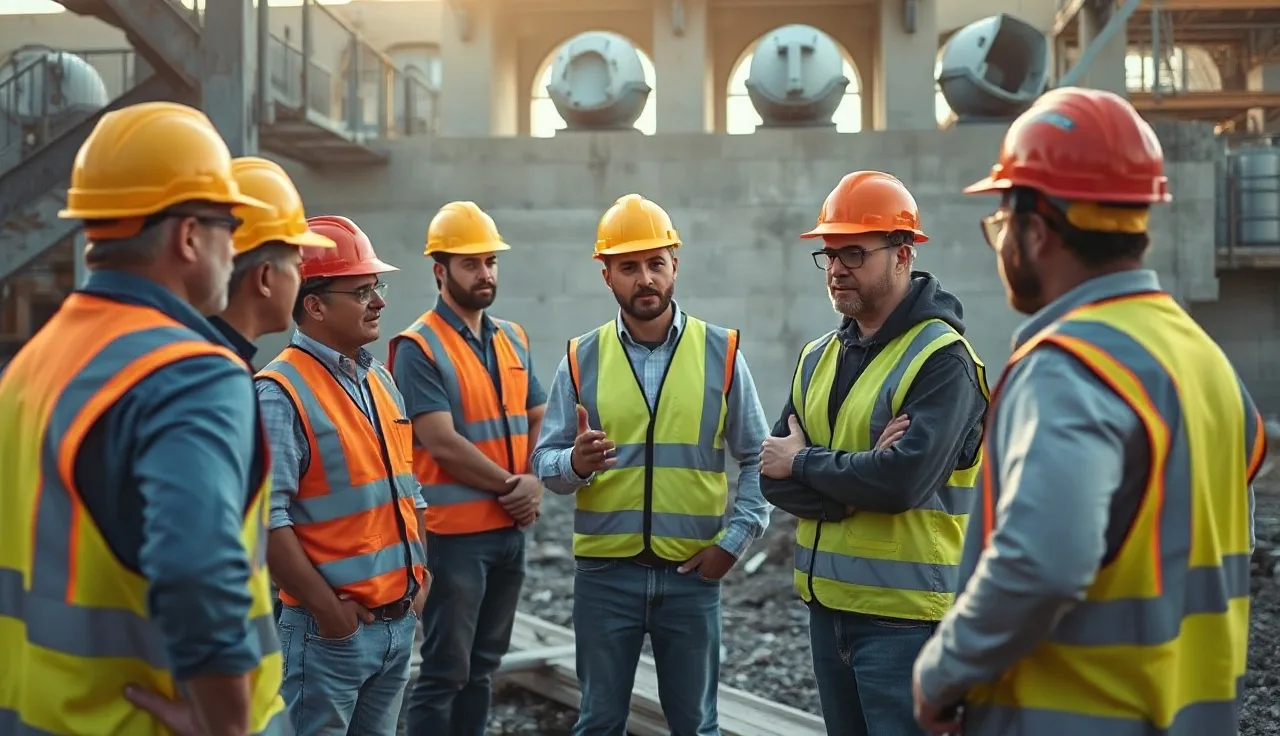
A toolbox talk is a short informal safety meeting focused on one hazard or procedure. Other names for it: tailgate talk, safety briefing, jobsite huddle. The name comes from the old habit of gathering workers around a toolbox before a shift. Most run 5 to 15 minutes. No slides. No classroom.
OSHA has no single standard that says "conduct toolbox talks." What it has instead is a web of training requirements scattered across specific standards, and toolbox talks are one documented way to satisfy them. 29 CFR 1926.21(b)(2) requires that employers instruct each employee in the recognition and avoidance of unsafe conditions on construction sites [1]. 29 CFR 1910.132(f) requires PPE training before employees use protective equipment [2]. A toolbox talk with a sign-in sheet is proof that training happened.
The legal value is the record. If OSHA cites you for inadequate training, a dated sign-in sheet showing the topic and who attended is concrete evidence. Without it, it's your word against the inspector's, and that's a losing hand.
For general industry, the hazard communication standard at 29 CFR 1910.1200 requires training at initial assignment and whenever a new hazard shows up in the work area [3]. A 10-minute talk on a new chemical, with a sign-in sheet, satisfies that. Same logic applies to lockout tagout under 29 CFR 1910.147, which requires training for authorized and affected employees.
Toolbox talks are not required by name. They are the most practical way small employers document the training that actually is required.
How long should a toolbox talk be, and how often should you hold one?
Long enough to cover the hazard clearly, short enough that workers stay engaged. That's the honest answer. Most safety professionals land on 5 to 15 minutes. The National Safety Council cites 10 minutes as the typical target [4].
Frequency depends on your industry and your hazard exposure. Construction contractors on federal projects under the Army Corps of Engineers EM 385-1-1 safety manual are required to hold daily safety briefings [5]. Most commercial construction sites do them daily, before the first task of the morning. General industry employers usually run weekly talks. High-hazard operations like chemical plants and utilities often run them every shift.
For a small business with a stable, experienced crew doing repetitive work, weekly is usually enough. Onboarding new hires, starting a new task type, or entering a high-hazard season (heat in summer, ice in winter) is your cue to increase frequency. No regulation caps or floors the frequency for most employers.
Consistency matters more than frequency. A weekly talk held every Monday at 7:00 AM that everyone expects becomes part of the culture. An ad-hoc talk held whenever someone remembers it gets ignored.
What are the most common toolbox talk topics?
These 25 topics cover the hazards behind most workplace injuries. The Bureau of Labor Statistics reported 2.6 million nonfatal workplace injuries and illnesses in private industry in 2023 [6]. The leading causes (contact with objects and equipment, falls, overexertion, and exposure to harmful substances) map straight to the list below.
Fall prevention 1. Ladder safety (proper angle, three points of contact, inspection before use) 2. Scaffolding hazards (guardrails, planking, weight limits) 3. Walking surface hazards (wet floors, floor openings, housekeeping) 4. Fall arrest system inspection and donning 5. Roof work and leading edge protection
Struck-by and caught-in/between 6. Forklift pedestrian safety (see forklift certification for the full operator training picture) 7. Overhead work and dropped tools 8. Machinery guarding inspection 9. Struck-by from vehicles in traffic work zones
Electrical 10. Ground fault circuit interrupter (GFCI) use and testing 11. Extension cord inspection and proper use 12. Arc flash awareness for workers near energized equipment 13. Lockout/tagout procedures (29 CFR 1910.147 requires this as a standalone training topic)
Chemical and health 14. Reading a Safety Data Sheet (SDS) (ties directly to hazard communication training requirements) 15. Chemical storage and segregation 16. Respiratory protection basics 17. Heat illness prevention (OSHA has an active rulemaking on this; California already mandates written plans)
Ergonomics and overexertion 18. Safe lifting technique and team lift signals 19. Hand and wrist strain in repetitive tasks
PPE 20. Selecting and inspecting gloves for the task 21. Eye and face protection for grinding and chemical handling 22. Hard hat inspection and fit
Emergency and housekeeping 23. Fire extinguisher selection and PASS technique 24. Emergency evacuation routes and muster points 25. Housekeeping and slip/trip prevention
This list is not exhaustive, and you shouldn't treat it as a checklist to march through. Pick topics from your actual injury history and your OSHA 300 log. Three hand lacerations in the past year means glove selection is your next talk. Don't rotate through a canned list when the data is telling you something else.
What does a good toolbox talk template look like?
A toolbox talk does not need to be a formal document. It does need enough structure to keep the conversation on track and produce a record you can defend. Here is a template you can copy, fill in, and file.
---
TOOLBOX TALK RECORD
Date: _____________ Time: _____________ Location: _____________
Facilitator name: _____________
Topic: _____________
Hazard summary (2-3 sentences, plain language): _____________
Specific OSHA standard or site procedure referenced: _____________
Key points covered (bullet list, 3-5 items): _____________
Employee question or concern raised: _____________
Action item(s) from this talk (who, what, by when): _____________
Employee signatures (or printed name + initials if signatures are impractical):
Supervisor signature: _____________
---
The action item row is the part most employers skip. If a worker raises a hazard during the talk and nobody writes it down with an owner and a deadline, it disappears. That is how OSHA citations happen: a worker flagged the problem, nothing was fixed, an injury followed.
Keep completed talk records for at least three years. That gives you coverage for most OSHA inspection lookback windows. OSHA 300 log forms themselves have to be kept five years under 29 CFR 1904.33, so if you file talk records alongside them, matching the five-year window is simpler [7].
If your safety program is still being built, the SafetyFolio program generator can produce a written safety program framework in about 15 minutes, including documentation checklists that pair with talk records like this one.
How do you run a toolbox talk that workers actually pay attention to?
Most toolbox talks fail the same way. A supervisor reads verbatim from a sheet while workers stare at their phones. The talk becomes a box-checking ritual and nobody learns a thing.
Here is what actually works.
Pick one thing. One hazard. One procedure. One incident from your site or a nearby one. Trying to cover fall protection, chemical handling, and fire safety in 10 minutes means covering nothing.
Open with a real event. Not a made-up scenario. A real near-miss from your site last week, a fatality summary from OSHA's public fatality inspection database, or a sentence from an incident report your crew filed. Real beats hypothetical every time.
Ask questions instead of lecturing. "What would you do if the GFCI trips three times on the same circuit?" beats reading the answer off a card. Let workers answer. Correct gently. The conversation is the training.
Make it two-way. The best toolbox talks pull a real question or concern out of the crew. If nobody ever says anything, either the topics are irrelevant or workers don't feel safe speaking up. Both are problems worth fixing.
End with a specific action. "Today, everyone check their fall arrest harness D-ring before climbing" is an action. "Be safe out there" is noise.
Facilitators don't need to be safety managers. A lead worker who knows the task can run an excellent talk, and peer-led talks often land better than supervisor-led ones. The OSHA training page outlines what OSHA considers "qualified" instruction, but for informal toolbox talks there is no credential requirement.
What are some full example toolbox talks you can use right now?
Here are three complete example talks, ready to read aloud or adapt.
---
Example 1: Ladder safety (10 minutes)
Topic: Safe ladder use Standard: 29 CFR 1926.1053 (construction) / 29 CFR 1910.23 (general industry)
Opener: Falls from ladders kill roughly 150 to 160 workers a year in the U.S., and the Bureau of Labor Statistics counts thousands more serious injuries [6]. Almost all of it is preventable.
Key points:
- Inspect the ladder before every use. Look for cracked rungs, bent rails, and missing feet. Any defect and the ladder gets tagged out and pulled from service.
- Set the angle right. For straight and extension ladders, the base goes one foot out for every four feet of height. That's the 4:1 rule.
- Three points of contact always: two hands and one foot, or two feet and one hand, on the ladder at all times.
- Do not carry tools in your hands on the way up. Use a tool belt or hoist the tool separately.
- Secure the top of an extension ladder when you can. If you can't, put a spotter on the base.
Discussion question: Has anyone here had a close call on a ladder? What happened?
Action item: Before work starts today, every crew member inspects their ladder and signs off. Defective ladders come to me.
---
Example 2: Heat illness prevention (10 minutes)
Topic: Recognizing and preventing heat illness Standard: OSHA General Duty Clause, Section 5(a)(1) of the OSH Act (no federal heat standard yet, but enforcement is active)
Opener: Heat is the leading cause of weather-related worker death in the U.S. OSHA fields thousands of heat-related complaints every summer.
Key points:
- Water. Rest. Shade. OSHA's heat illness prevention campaign says workers need about one cup (8 oz) of water every 15 to 20 minutes in hot conditions.
- New workers are the highest risk. The body takes 7 to 14 days to acclimatize. Start new hires and returning workers on reduced outdoor exposure the first two weeks.
- Know heat exhaustion when you see it: heavy sweating, weakness, cold and pale skin, fast weak pulse, nausea. Move the person to shade and give cool water.
- Heat stroke is a medical emergency: hot red skin, no sweating, rapid strong pulse, possible unconsciousness. Call 911 immediately.
- Buddy system in extreme heat. Nobody works alone when the heat index is above 103 degrees F.
Discussion question: Where is our nearest shaded rest area, and does everyone know where the water supply is on this site?
Action item: Crew lead confirms water supply location and confirms buddy pairs for today.
---
Example 3: Lockout/tagout basics (10 minutes)
Topic: Controlling hazardous energy Standard: 29 CFR 1910.147
Opener: OSHA estimates that failure to control hazardous energy contributes to roughly 50,000 injuries and 120 fatalities per year [8].
Key points:
- LOTO applies any time you service, clean, or unjam equipment that could start up or release stored energy.
- The steps: notify affected employees, shut down using the normal stopping procedure, isolate the energy source, apply your personal lock, release or restrain stored energy, verify zero energy before you start work.
- Your lock, your key. Nobody else removes your lock. If a lock gets left on at end of shift, the removal procedure lives in our written LOTO program, not in a supervisor's head.
- Tagout-only systems (no physical lock possible) carry more risk. If that's your situation, tell a supervisor, because the standard requires extra protective measures.
- Affected employees: if you work near equipment being serviced, you need to know LOTO is happening, but you don't apply locks. Never try to re-energize equipment that has a lock or tag on it.
Discussion question: Name one piece of equipment on this site that requires LOTO before servicing.
Action item: Anyone who services equipment and has not been through formal LOTO authorized-employee training, see me after this talk. We schedule it this week.
How do toolbox talks differ across industries?
The core structure is the same everywhere. What changes is the hazard focus, the regulatory hooks, and sometimes the format.
| Industry | Typical frequency | Top hazard topics | Key standard hooks |
|---|---|---|---|
| Construction | Daily | Falls, struck-by, excavation, electrical | 29 CFR 1926 Subpart E, M, P |
| Manufacturing | Weekly | Machine guarding, LOTO, chemical exposure | 29 CFR 1910.147, 1910.212, 1910.1200 |
| Warehousing/logistics | Weekly | Forklift safety, ergonomics, fire exits | 29 CFR 1910.178, 1910.36 |
| Healthcare | Weekly or per-event | Bloodborne pathogens, patient handling, sharps | 29 CFR 1910.1030 |
| Landscaping/agriculture | Before tasks | Heat, equipment, pesticide exposure | 29 CFR 1928, EPA WPS |
| Retail | Monthly | Slips and falls, lifting, violence prevention | 29 CFR 1910.22, General Duty Clause |
Construction is the one industry where daily talks are near-universal, and the fatality math explains why. BLS data for 2022 counted 1,069 construction fatalities at a rate of 9.6 per 100,000 full-time equivalent workers, versus a private industry average of 3.4 [6]. That's nearly triple the baseline.
Healthcare employers dealing with bloodborne pathogen exposure should treat SDS training talks (see hazard communication) and bloodborne pathogens refreshers as separate, documented events. OSHA's 1910.1030 standard requires annual refresher training for every worker with occupational exposure. A toolbox talk alone probably won't satisfy that, but it's a useful supplement between annual sessions.
What should you do when a worker raises a hazard during a toolbox talk?
Write it down immediately. On the talk record, in the action item box, with a name and a date.
This matters for two reasons. Section 11(c) of the OSH Act prohibits retaliation against workers who report hazards [9]. If a worker raises a problem during a safety meeting and then faces any adverse action, OSHA looks hard at that timeline. A written record that the concern was received, recorded, and acted on protects both the employer and the worker.
The second reason is blunter. Unaddressed hazards are how fatalities happen. The pattern in most OSHA fatality investigation reports repeats itself: hazard existed, hazard was noticed or reported, nothing changed, injury occurred.
When the hazard can't be fixed before the shift starts, workers need the interim control spelled out. Tell them: "We can't get the guardrail installed until tomorrow. Until then, nobody works within six feet of that edge without a personal fall arrest system connected. That is not optional."
If the hazard is outside your authority to fix, document that you escalated it and to whom. That documentation is your protection.
For how incident documentation works alongside talk records, the incident report process is a natural companion to your safety meeting program.
Do toolbox talks count toward OSHA training hour requirements?
Sometimes yes, sometimes no. It depends on the standard.
Some OSHA standards specify content but not hours. 29 CFR 1910.132(f) for PPE training requires that workers understand when PPE is necessary, what type is required, how to put it on and adjust it, and its limitations. A well-run 15-minute toolbox talk on PPE selection and fit can satisfy that, as long as you document the content and who attended [2].
Other standards set training that a toolbox talk can't touch. Hazwoper training under 29 CFR 1910.120 requires 40 hours of initial training for workers on uncontrolled hazardous waste sites. A 10-minute talk doesn't make a dent [10]. Same with OSHA 30 hour training, which is 30 hours of structured instruction and cannot be replaced by talks.
Use toolbox talks for what they're good at: refreshers, site-specific reminders, and documenting informal training events. Use structured programs for the content that standards explicitly require as formal instruction. The two work together. They are not interchangeable.
One honest caveat: OSHA compliance officers have discretion in how they judge training adequacy. There is no published formula that says X toolbox talks equal Y hours of training credit. What matters is whether a reasonable inspector would conclude that workers actually understood the hazard and the required controls.
How do you handle toolbox talks for workers who don't speak English?
OSHA's position is clear. Training has to be conducted in a language and vocabulary the employees understand. This comes from 29 CFR 1910.132(f)(4) for PPE and shows up in similar language across dozens of individual standards [2]. OSHA's 2010 training standards policy states that instruction given in a language a worker cannot understand does not meet the training requirement [2].
For toolbox talks, that means a few concrete things.
- If your crew includes Spanish speakers, you need a bilingual facilitator or a qualified interpreter in the room. A translated handout by itself doesn't cut it.
- A translated written version of the talk helps, but it doesn't replace verbal explanation and the ability to ask questions.
- Bilingual crew leads are one of the smartest investments a small contractor can make. Many command higher wages for that skill, and rightly so.
OSHA publishes free construction toolbox talk materials in Spanish through its eTools at osha.gov [12]. They're a reasonable starting point.
Sign-in sheets should capture the language the training was delivered in. If you ran the talk in both English and Spanish, note it. A worker's signature acknowledging a talk conducted only in a language they don't understand gives you no protection in an OSHA investigation.
What are common mistakes that make toolbox talks useless or legally worthless?
A handful of failures show up again and again when toolbox talk programs go wrong.
No sign-in sheet. The talk happened. Nobody can prove it. In OSHA's view, no record means it didn't happen. This is the most common failure and the easiest to fix.
Too many topics in one talk. Seven hazards in 10 minutes teaches nothing. Workers hear noise. Pick one.
Reading verbatim with no discussion. A supervisor reading a laminated card without looking up is not training. It's liability theater, and workers check out inside 90 seconds.
Canned topics with no connection to the actual work. A scaffolding talk at a facility that has never had scaffolding wastes everyone's time. Pull topics from your OSHA 300 log, your near-miss reports, and what the crew is doing this week.
No follow-through on action items. A worker flags a trip hazard. It goes on the action item line. Nobody fixes it. Next week's talk happens over the same unfixed hazard. Workers learn the talks are for show.
Forgetting remote or multi-site workers. Off-site crews need the same documented training. A text message is not a toolbox talk. A video call with a verbal Q&A and a collected digital signature is closer.
Not adjusting for new hires. A worker starts mid-week. The Monday talk already happened. That worker gets a one-on-one version before starting work. OSHA investigations regularly find the injured worker had been on the job fewer than six months.
How do you build a yearly toolbox talk schedule?
Start with your hazard inventory, not a calendar. Pull your OSHA 300 log for the past three years, list every injury type and any near-miss reports you have. The topics that keep showing up are your priorities.
Layer in the regulatory requirements next. If you have forklift operators, forklift certification requires refresher training at least every three years under 29 CFR 1910.178(l)(4)(iii). Schedule at least one forklift safety talk per quarter to keep the topic fresh between formal evaluations. If you handle hazardous chemicals, your hazard communication program should drive at least one SDS-related talk each quarter.
Then add the seasonal stuff. Heat illness talks belong in April and May, before the heat lands. Ice and slip talks belong in October. These are predictable hazards. Get ahead of them.
A sample annual schedule for a 20-person manufacturing operation might look like this.
| Month | Topic |
|---|---|
| January | Cold weather ergonomics, hand care |
| February | Fire extinguisher use and location |
| March | Eye protection for spring cleaning tasks |
| April | Heat illness awareness (early) |
| May | GFCI use for outdoor equipment |
| June | Hydration and shade during heat |
| July | Machine guarding inspection |
| August | Housekeeping and aisle clearance |
| September | Emergency evacuation review |
| October | Wet and slippery surfaces |
| November | Forklift pedestrian zones |
| December | Chemical storage and year-end inventory |
That's 12 talks for monthly scheduling. For weekly scheduling, repeat the high-priority topics quarterly and fill the gaps with task-specific talks tied to what's happening that week.
If your written safety program is still being assembled, the SafetyFolio program generator can help you build the documented framework a schedule like this supports, including training record templates and the required written programs for the standards that apply to your business.
Are there free toolbox talk resources from OSHA?
Yes, and several are genuinely good.
OSHA's website at osha.gov hosts free safety and health topic pages with talking points, standards references, and in some cases downloadable handouts [12]. The OSHA construction safety eTool includes topic-specific materials, some with Spanish-language versions.
The National Institute for Occupational Safety and Health (NIOSH) publishes hazard-specific guidance at cdc.gov/niosh that can form the backbone of topic-specific talks.
The National Safety Council offers free toolbox talk downloads through its safety resources at nsc.org, organized by hazard category [4].
For construction specifically, CPWR (The Center for Construction Research and Training) publishes free downloadable talks at cpwr.com. They're thorough and backed by funded research.
State OSHA plan offices, in the 29 states and territories that run their own OSHA-approved plans, often publish state-specific templates [13]. Cal/OSHA, Washington L&I, and Michigan OSHA all have free downloadable resources that go past what federal OSHA publishes.
One caution with any canned resource, government ones included: read it before you use it. Some are outdated. Some don't match the version of the standard currently in force. Check the publication date and cross-reference the CFR section it cites before you run it.
Frequently asked questions
Does OSHA require toolbox talks by name?
No. OSHA has no regulation that uses the term "toolbox talk" as a requirement. What OSHA does require is training on specific hazards under dozens of individual standards. Toolbox talks are a practical, documented way to satisfy many of those requirements. The value is in the record you create, not the format itself.
How long does a toolbox talk need to be?
There is no OSHA-specified minimum length. Most safety professionals target 5 to 15 minutes, and the National Safety Council cites 10 minutes as the typical target. What matters is that the hazard gets covered clearly enough that workers understand it, can ask questions, and the meeting is documented with a sign-in sheet.
Can a toolbox talk replace formal OSHA training?
For some standards, yes. A well-documented toolbox talk on PPE selection and fit can satisfy 29 CFR 1910.132(f). For others, no. Standards like Hazwoper (1910.120) require 40 hours of formal training, and OSHA 30 hour training cannot be replaced by talks. Use talks as refreshers and supplements, not substitutes for structured programs that standards explicitly require.
Who should lead a toolbox talk?
Any competent person who knows the topic: a supervisor, crew lead, or experienced worker. OSHA does not require a certified safety professional for informal toolbox talks. Peer-led talks often see better engagement than supervisor-led ones. For topics tied to standards with "competent person" definitions (like excavation), make sure the facilitator meets that definition.
How do you document a toolbox talk for OSHA purposes?
Use a written record that captures the date, topic, facilitator name, a summary of what was covered, the OSHA standard referenced if applicable, any employee questions or hazards raised, action items with owners and deadlines, and employee signatures or printed names. Keep records for at least three years. Without documentation, the talk has no legal value in an OSHA inspection.
What toolbox talk topics are required for construction?
No specific list is mandated by name, but 29 CFR 1926.21(b)(2) requires instruction in recognition and avoidance of unsafe conditions. Falls cause roughly one-third of construction fatalities, so fall protection is the top topic. Other high-priority areas include struck-by hazards, excavation, electrical safety, and scaffold safety, all with specific training requirements in the Subparts of 1926.
What is the difference between a toolbox talk and a safety meeting?
Mostly formality and length. A toolbox talk is short (5 to 15 minutes), informal, focused on one topic, and held at the worksite before or during a shift. A safety meeting is typically longer, may cover multiple agenda items including incident reviews and program updates, and is often held monthly or quarterly. Both need documentation to carry compliance value.
How do you handle a worker who refuses to attend toolbox talks?
Attendance at required safety training is a condition of employment, not optional. Document the refusal in writing, address it through your normal disciplinary process, and make sure the worker gets the training separately before returning to the hazardous task. Letting workers skip documented training and then get injured creates real liability under both OSHA standards and workers' compensation.
What is the best toolbox talk topic for new employees?
Site-specific emergency procedures and evacuation routes come first, every time, for every new hire. After that, the PPE required for their role, then the top hazard specific to their task. BLS data consistently shows workers with less than one year on the job have higher injury rates, which makes the first-week talks the most important ones you will run for that employee.
Can toolbox talks be conducted remotely or virtually?
Yes, with conditions. A video call where the facilitator covers the topic verbally, workers ask questions in real time, and digital sign-in is collected is a reasonable substitute for off-site crews. A pre-recorded video with no interaction is not equivalent, because there's no way to confirm comprehension or collect questions. Document the platform used and the attendance method.
How do you find toolbox talk topics in Spanish?
OSHA's construction safety eTool at osha.gov includes Spanish-language materials. CPWR (The Center for Construction Research and Training) at cpwr.com publishes Spanish toolbox talks. Cal/OSHA and several other state plan offices publish bilingual resources. Under OSHA policy, training must be conducted in a language employees understand, so translated materials are a compliance issue, more than a courtesy.
How many toolbox talks should you do per year?
It depends on your industry. Construction sites typically do 250-plus per year (one per workday). Manufacturing and warehousing commonly do 52 (one per week). There is no OSHA-prescribed number. Base frequency on your hazard profile, your injury history, and the training requirements of your specific standards. Frequent talks on real, current hazards beat rare talks on irrelevant ones.
Do toolbox talk records need to be kept on site?
No specific OSHA standard requires toolbox talk records to be kept on site, but they should be accessible. During an inspection, if the inspector asks for training records and you can't produce them within a reasonable time, you are effectively without documentation. Keeping records digitally in a system the site supervisor can reach is a practical fix for multi-site operations.
What should you do if a toolbox talk reveals a hazard you didn't know about?
Document it immediately on the talk record with the hazard described, assign a corrective action owner and a completion deadline, and put interim controls in place before workers go back to the area. If the hazard is an imminent danger, stop the work. Follow up in writing and confirm the correction was made. This is exactly what the action item section of your talk record is for.
Sources
- OSHA, 29 CFR 1926.21 - Safety training and education (construction): 29 CFR 1926.21(b)(2) requires employers to instruct each employee in the recognition and avoidance of unsafe conditions on construction sites
- OSHA, 29 CFR 1910.132 - Personal protective equipment general requirements: 29 CFR 1910.132(f) requires PPE training before employees use protective equipment, and 1910.132(f)(4) requires it be given in a language and vocabulary employees understand
- OSHA, 29 CFR 1910.1200 - Hazard Communication Standard: 29 CFR 1910.1200 requires training at initial assignment and whenever a new hazard is introduced in the work area
- National Safety Council, Toolbox Talks resources: The National Safety Council cites 10 minutes as the typical target length for a toolbox talk
- U.S. Army Corps of Engineers, EM 385-1-1 Safety and Health Requirements Manual: The Corps of Engineers EM 385-1-1 manual requires daily safety briefings on federal construction projects
- Bureau of Labor Statistics, Injuries, Illnesses, and Fatalities program: BLS reported 1,069 construction fatalities in 2022 at a rate of 9.6 per 100,000 FTE workers, and 2.6 million nonfatal workplace injuries in private industry in 2023
- OSHA, 29 CFR 1904.33 - Recordkeeping: retention and updating of old forms: 29 CFR 1904.33 requires OSHA 300 log records to be retained for five years; three years is a conservative minimum for supporting training records
- OSHA, Control of Hazardous Energy (Lockout/Tagout) topic page: OSHA estimates failure to control hazardous energy contributes to roughly 50,000 injuries and 120 fatalities per year
- OSHA, 29 CFR 1910.120 - Hazardous waste operations and emergency response (Hazwoper): Hazwoper requires 40 hours of initial training for workers on uncontrolled hazardous waste sites; a toolbox talk does not satisfy this requirement
- OSHA, Safety and Health Topics and eTools: OSHA's website hosts free safety and health topic pages including construction eTool materials in English and Spanish
- OSHA, State Plans overview: 29 states and territories operate OSHA-approved state plans with their own free resources including toolbox talk templates