Last updated 2026-07-09
TL;DR
A toolbox talk is a short safety meeting, 5 to 15 minutes, held before a shift or task. The working format has six parts: a topic statement, a real hazard explanation, specific safe work steps, an open discussion, questions, and a sign-in sheet. OSHA never names a single form, but several standards require documented safety instruction, and your sign-in sheet is the proof that training happened.
What is a toolbox talk and why does the format matter?
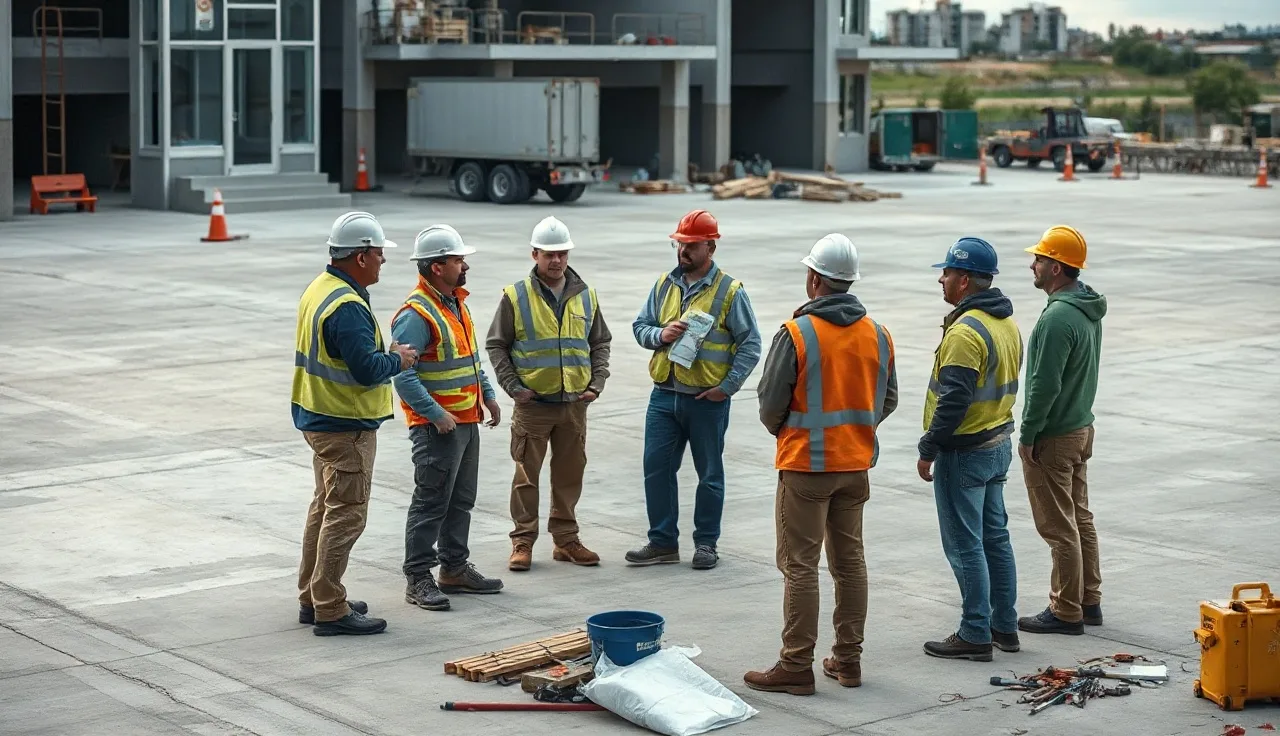
A toolbox talk is a short safety meeting held at the job site before a shift or task starts. The name comes from construction, where crews would gather around the toolbox before picking up tools. Format matters because a bad talk is just noise. Workers tune out, nothing changes on the ground, and if OSHA shows up, a vague sign-in sheet proves nothing.
Format also matters legally. Under 29 CFR 1926.21(b)(2), construction employers must instruct each employee in the recognition and avoidance of unsafe conditions for the work they do [1]. A toolbox talk is one of the main ways small contractors meet that duty. General industry has parallel obligations under 29 CFR 1910.132(f) for PPE training, plus dozens of substance-specific and hazard-specific standards that all require documented employee instruction [2].
Get the format right and a 10-minute talk does real work. Get it wrong and it's a box you checked.
What are the core components of a toolbox talk format?
Every talk that works has six parts, and you can run all six in under 15 minutes.
1. Topic and hazard statement (1 minute) Open with one sentence: what you're covering and why it matters today. Tie it to what the crew is actually doing that shift. "We're pouring the slab on the north side today, so we're talking about concrete skin burns." Specific beats generic every time.
2. Hazard explanation (2 to 3 minutes) Explain the mechanism of injury. Not "concrete is caustic" but that wet concrete has a pH between 12 and 13, that skin contact for 30 minutes or more can cause full-thickness chemical burns, and that workers often don't feel it happening because the concrete is cold [3]. Real detail sticks. Vague warnings don't.
3. Safe work procedures (2 to 3 minutes) Tell them exactly what to do differently. Which PPE to wear. What the inspection step is. What to do if something goes wrong. This part is procedural, not motivational. Step one, step two, step three.
4. Open discussion (2 to 3 minutes) Ask a real question. "Has anyone had a close call with this?" or "What would make it hard to follow this today?" Most supervisors skip this part, and it's the most valuable part. Workers know where the real hazards are. Let them talk.
5. Questions and wrap-up (1 minute) Confirm understanding. Ask if anyone has questions. Keep it quick.
6. Sign-in sheet Every attendee signs, presenter included. Date, time, topic, location. This is your proof the training happened.
How long should a toolbox talk be?
Ten to fifteen minutes is the sweet spot. Go shorter and you can't cover the hazard with enough detail to change behavior. Go longer and you lose the room.
OSHA sets no specific duration for toolbox talks in most standards. NIOSH and industry groups like the Associated General Contractors consistently describe the format as 10 to 15 minutes [4]. Run one topic per talk. When a supervisor tries to cover three things at once, retention drops and workers learn nothing about any of them.
Frequency shifts with industry and risk. Construction sites with active operations often run talks daily. Manufacturing and warehousing tend toward weekly. OSHA's voluntary program guidelines recommend regular safety meetings but leave the cadence to the employer [5]. A weekly talk that actually gets done beats a daily one that turns into a routine nobody listens to.
Does OSHA require toolbox talks, and which standards apply?
No single OSHA regulation says "you must hold toolbox talks." What OSHA has is dozens of training requirements that toolbox talks fulfill, plus the General Duty Clause (Section 5(a)(1) of the OSH Act) requiring a workplace free from recognized hazards [6].
Here are the standards most often satisfied by documented toolbox talks:
| Standard | Who it covers | What it requires |
|---|---|---|
| 29 CFR 1926.21(b)(2) | Construction employers | Instruction on hazard recognition and avoidance |
| 29 CFR 1910.132(f) | General industry (PPE) | Training before PPE use, documented |
| 29 CFR 1910.1200(h) | All industries (HazCom) | Hazard communication training |
| 29 CFR 1926.503 | Construction (fall protection) | Training before work at heights, verified records |
| 29 CFR 1910.147(c)(7) | General industry (LOTO) | Authorized and affected employee training |
Some standards ask for more than a signature. 29 CFR 1926.503 requires the employer to verify that each employee understands the training, more than that training was provided. A sign-in sheet alone may not carry fall protection; you may need a short quiz or an observed competency check [7].
For more on lockout tagout training specifically, the CFR is plain: training must happen before the employee uses a LOTO procedure, and records must be kept [11]. A toolbox talk on LOTO is a good supplement, generally not a substitute for the initial qualification training.
What should a toolbox talk sign-in sheet include?
The sign-in sheet is the one thing OSHA can examine after the talk is over. Keep it simple, keep it complete.
A compliant sheet has:
- Company name
- Date and start time
- Job site or location
- Topic of the talk
- Presenter's name and signature
- Each attendee's printed name and signature
- Space to note any corrective actions promised
That last field is underused. If a worker raises a real hazard during the discussion, write it down. "J. Torres noted the guardrail on Level 2 needs tightening. Action: supervisor to inspect before 2 PM." That note shows an inspector your safety meetings do something instead of just filling a page.
Keep sign-in sheets at least three years. OSHA's recordkeeping rule under 29 CFR 1904 requires injury and illness records to be retained five years, and many training records fall under specific standards with their own retention windows [8]. When you're not sure, five years is a safe default.
Store them in a binder on site and back up a scan to a shared drive. Paper burns, floods, and disappears.
How do you pick the right toolbox talk topics?
The best topics come from your own site. Read your incident reports and near-miss logs first. Whatever caused an injury or almost did last month is the right topic for this week.
After that, use seasonal and task-based triggers. Heat illness talks belong in June, not October. A concrete burn talk makes sense the morning you're pouring, not the morning you're hanging drywall. The closer the topic sits to what the crew is doing that day, the more it lands.
BLS data for 2022 shows the industries with the highest rates of nonfatal workplace injuries are construction, warehousing, and agriculture. Across all industries, falls, slips, and trips account for roughly 18 percent of nonfatal injuries [9]. If you work in any of those three and don't have a fall protection talk on rotation, you're ignoring your biggest exposure.
Need to build a full rotation from scratch? OSHA training resources at osha.gov include dozens of topic outlines organized by industry. They're free and already mapped to standards.
A solid written safety program tells you which topics are legally required. If you don't have one, SafetyFolio's safety program generator builds a topic-mapped program in about 15 minutes and flags which training obligations apply to your work type.
What makes a toolbox talk ineffective, and how do you fix it?
Most bad talks share the same handful of problems.
Reading off a printed sheet without looking up. The crew watches the presenter stare at paper and they stop listening. Know the material well enough to talk, not recite.
Too generic. "Be careful around forklifts" teaches nothing. "If you walk within 10 feet of the loading dock today, the spotter has to have eye contact with you before the forklift moves" teaches something. See our article on forklift certification for the visibility and pedestrian separation requirements under 29 CFR 1910.178.
No two-way conversation. A talk where the supervisor talks and workers nod is a briefing, not a safety meeting. Workers who speak up remember more, follow through more, and flag problems before they turn into incidents.
Holding the talk while people are still moving or equipment is running. Stop work. Get everyone in a circle. Kill the distractions. Ten minutes of real attention beats twenty minutes of half-listening.
Letting absent workers sign later. If someone wasn't in the room, they didn't get the training. Don't allow retroactive signatures. Give the person a makeup briefing and document it separately. This one matters because OSHA has issued citations when employers couldn't prove that specific workers received specific training [1].
Can toolbox talks satisfy OSHA training requirements, or do they have to be formal?
It depends on the standard. Some OSHA standards demand "formal" training with competency verification or written certification. Others simply require that training be provided and documented, which a toolbox talk can meet.
Fall protection under 29 CFR 1926.503 requires a trained person to provide the training, and the employer must verify understanding [7]. A toolbox talk can carry refresher training here, but probably not the initial qualification.
Hazard communication under 29 CFR 1910.1200 requires training at initial assignment and whenever new hazards show up [12]. Recurring toolbox talks on specific chemicals can meet the ongoing obligations. For chemical training specifics, see hazard communication requirements.
Lockout/tagout under 29 CFR 1910.147 requires periodic retraining when there's reason to believe an employee lacks knowledge [11]. A toolbox talk can document that retraining.
As a general rule: use toolbox talks for refresher training and reinforcement, and use structured, documented initial training for first-time instruction on hazard-specific topics. An OSHA letter of interpretation dated March 14, 2002 addressed training adequacy and stated the method of instruction is flexible as long as the training effectively conveys the required information [10].
What toolbox talk templates and free resources are available?
You don't have to write talks from scratch. Here are the free sources worth using.
OSHA's main website (osha.gov) has a publications library with topic-specific guidance covering hundreds of hazards. It's written for workers and adapts easily into a talk outline.
The National Safety Council (nsc.org) publishes toolbox talk outlines by industry. Some are free, others sit behind their membership library.
For construction, the Associated General Contractors (agc.org) and the Associated Builders and Contractors (abc.org) keep toolbox talk libraries for members.
CDC/NIOSH publishes industry-specific hazard guides at cdc.gov/niosh that are well-sourced and easy to turn into a 10-minute talk.
When you use a template, customize it. Swap the generic example for something on your site. Name the actual chemical, the actual machine, the actual height. Generic talks get generic attention.
For OSHA 30 graduates working as supervisors, you have enough background to lead a good talk on almost any common hazard. If you haven't taken it, consider it. The OSHA 30 training curriculum covers the major standards your talk topics should map to.
How do you run a toolbox talk in a language other than English?
If your crew speaks Spanish, Haitian Creole, or another primary language, you have to deliver training in a language they understand. OSHA has said so in enforcement guidance and in national emphasis programs aimed at high-hazard industries with non-English-speaking workforces.
OSHA guidance states that training must be conducted in a manner the employee is able to understand. If a worker doesn't follow English well enough to track a talk delivered only in English, that talk doesn't satisfy the training requirement [6].
Practical options: have a bilingual supervisor or coworker translate in real time, pair bilingual printed handouts with an English verbal delivery, or use OSHA's translated safety materials. OSHA publishes many of its hazard alerts and fact sheets in Spanish at osha.gov.
For mixed-language crews, a bilingual sign-in sheet where workers note their primary language helps document that the language-appropriate version was delivered.
How do toolbox talks connect to a broader written safety program?
A toolbox talk is a delivery mechanism. On its own, it isn't a written safety program. What it does is bring your written program to life at the worker level.
Your written program states your company's policies on fall protection, chemical handling, machine guarding, and every other relevant hazard. Your toolbox talks are where you communicate those policies, explain the reasoning, and confirm everyone understands.
The two work together. If OSHA cites you for a hazard and you can show a written policy, documented toolbox talks covering that hazard, and a sign-in sheet showing the affected workers attended, your defense is far stronger than if you have only one of those pieces.
Haven't built the written program yet? The foundation doesn't take weeks. SafetyFolio can generate a program mapped to your industry and work type, giving you the policy layer your toolbox talks then reinforce.
Once you have both, wire your incident report process back into your talk topics. Documented near-misses and first-aid injuries become your best toolbox talk curriculum.
How do you document and store toolbox talk records properly?
Documentation is the whole point of the sign-in sheet, and sloppy recordkeeping is one of the problems OSHA compliance officers flag most during inspections.
Keep these fields in every record at a minimum: company name, site address, date, start time, presenter name and signature, topic covered (specific enough to be useful), and each participant's printed name and signature. Add anything else if you want, but keep it consistent so you can search and pull records later.
Digital records are fine. Scanned sign-in sheets in a cloud folder work. Safety management software works. The format doesn't matter. What matters is that you can find the record fast when OSHA asks, and that it's legible.
Retention gets complicated because different standards carry different requirements. Under 29 CFR 1910.1020, employee exposure and medical records must be kept 30 years [14]. Under 29 CFR 1926.503, fall protection training certification records must be maintained [7]. A five-year default for general toolbox talk records is reasonable for most small businesses [8].
If your crew turns over fast, get signatures on site. Don't rely on memory or a manager's word that "everyone was there." OSHA inspectors interview individual workers, and if a worker says they don't remember a talk on a topic, the record is your defense.
Frequently asked questions
How often should you do toolbox talks?
There's no single OSHA frequency requirement. Construction sites with active operations typically hold talks daily. General industry and warehousing commonly run weekly. The right cadence is the one workers actually take seriously. Daily talks on low-risk tasks can turn invisible. Weekly talks tied to current work tend to land better. OSHA's voluntary program guidelines recommend regular safety meetings without naming a number.
Does OSHA require a written toolbox talk record?
OSHA never uses the term "toolbox talk" in its standards, but many standards require documented training. A signed attendance record naming the topic, date, presenter, and attendees meets the documentation requirement for most refresher obligations. For standards like 29 CFR 1926.503 (fall protection) that require verified comprehension, a sign-in sheet alone may fall short without notes on competency.
Who should lead a toolbox talk?
The immediate supervisor or foreman usually runs it. They know the day's work and have credibility with the crew. For topics needing specific expertise, like a new chemical or a piece of equipment, bring in the person who knows it best. OSHA doesn't require the presenter to hold a specific certification for most toolbox talk topics, but they must know the material well enough to answer questions.
Can toolbox talks replace formal OSHA training?
For some refresher obligations, yes. For initial, hazard-specific training under standards like 29 CFR 1910.147 (lockout/tagout) or 29 CFR 1926.502 (fall protection systems), toolbox talks generally supplement rather than replace structured initial training. The test is whether the delivery method actually ensures the employee understands. A well-run, documented toolbox talk can pass that test for many refresher requirements.
What topics should you never skip in a toolbox talk rotation?
The topics that match your biggest exposures. For most construction companies, that's fall protection, struck-by hazards, electrical safety, and caught-in/between hazards (OSHA's "Fatal Four" account for roughly 60 percent of construction worker deaths). For warehousing and manufacturing, add forklift and powered industrial truck safety, chemical handling, and machine guarding. BLS data for 2022 show falls, slips, and trips are the leading cause of nonfatal injuries across industries.
How do you make toolbox talks more engaging?
Use a real incident or near-miss from your own site or a recent news story. Ask a genuine question before you explain the answer. Keep the topic narrow enough that there's something concrete to learn in 10 minutes. Rotate who leads; peer-led talks often land better than supervisor-only talks. Skip the script. Workers respond to someone who knows the material, not someone performing compliance.
What is a "tailgate meeting" and is it different from a toolbox talk?
No meaningful difference. "Tailgate meeting" and "tailgate safety meeting" are common terms in construction, especially in western states, for the same short pre-shift safety discussion. 29 CFR 1926.21(b)(2) uses neither term; it simply requires instruction on hazard recognition. The format, documentation, and best practices are identical no matter what you call it.
Can toolbox talks be done virtually or remotely?
Yes. OSHA hasn't restricted training to in-person delivery. Video calls, recorded presentations, and safety apps all work as delivery mechanisms as long as the training is interactive enough for workers to ask questions and show understanding. You still need documentation: a digital attendance record with timestamps, the topic covered, and a way for workers to acknowledge participation. Remote talks work best for office and field admin staff, less well for large active crews.
How long should you keep toolbox talk records?
A five-year default is safe for most small businesses. Some standards run longer: employee exposure records under 29 CFR 1910.1020 require 30-year retention. For general toolbox talk documentation covering refresher topics, five years covers the statute of limitations on most OSHA violations (three years from the inspection in most cases) with margin. When a specific standard is in question, check the retention clause in that regulation directly.
What should you do if a worker misses a toolbox talk?
Give them a makeup briefing before they start the relevant task and document it separately. Don't let late arrivals sign the original sheet retroactively; that creates a false record. A short one-on-one briefing, even three minutes, with a note on the original sign-in sheet ("J. Davis arrived after talk; briefed individually at 7:45 AM by supervisor") meets the requirement and keeps your records honest.
Do toolbox talks need to cover the SDS for chemicals used on site?
Not every talk, but hazard communication training under 29 CFR 1910.1200(h) requires that workers be trained on the chemicals they use, including how to read a safety data sheet and what the hazards are. A talk on a specific chemical should reference the SDS, explain the key hazard sections, and tell workers where the SDS is located. For reading an SDS, our hazard communication article covers the GHS format field by field.
Is there a difference between a toolbox talk for construction vs. general industry?
The format is the same. The applicable standards and topics differ. Construction talks often focus on 29 CFR 1926 Subpart M (fall protection), Subpart Q (concrete), Subpart K (electrical), and the Fatal Four. General industry talks under 29 CFR 1910 lean on machine guarding, LOTO, walking-working surfaces, and HazCom. The sign-in sheet, discussion format, and five to fifteen minute duration apply equally to both.
How do you handle a toolbox talk when workers disagree about a procedure?
Write it down and follow up. If workers raise a legitimate procedural disagreement, that's the talk working as intended. Acknowledge the point, note it on the sign-in sheet as an action item, and get an answer before the next shift if it affects safety. Never shut down a disagreement during a talk. Workers who feel heard bring up problems early. Workers who feel dismissed stop talking, and problems get hidden instead of fixed.
Sources
- OSHA, 29 CFR 1926.21 Safety Training and Education: Construction employers must instruct each employee in the recognition and avoidance of unsafe conditions applicable to their work.
- OSHA, 29 CFR 1910.132 Personal Protective Equipment, General Requirements: General industry PPE training must be documented, verifying that employees understand when and how to use PPE.
- CDC/NIOSH, Skin Exposures and Effects: Wet cement has a pH between 12 and 13 and can cause full-thickness chemical burns with prolonged skin contact.
- NIOSH, Small Business Safety and Health Handbook: Safety toolbox talks are described as brief 10- to 15-minute sessions focused on a single safety topic.
- OSHA, Recommended Practices for Safety and Health Programs (2016): OSHA recommends regular safety meetings as part of an effective safety and health program but does not specify a mandatory frequency.
- OSHA, OSH Act of 1970, Section 5(a)(1) General Duty Clause: Employers must furnish a workplace free from recognized hazards, and OSHA guidance requires training to be delivered in a language employees understand.
- OSHA, 29 CFR 1926.503 Fall Protection Training Requirements: Employers must verify that each employee has been trained and understands fall protection; a certification record must be maintained.
- OSHA, 29 CFR 1904 Recording and Reporting Occupational Injuries and Illnesses: OSHA injury and illness records must be retained for five years; specific training records have retention requirements within individual standards.
- Bureau of Labor Statistics, Injuries, Illnesses, and Fatalities program, 2022: Falls, slips, and trips account for approximately 18 percent of nonfatal workplace injuries in 2022 BLS data; construction, warehousing, and agriculture have the highest overall nonfatal injury rates.
- OSHA Letter of Interpretation, March 14, 2002, Training Method Flexibility: OSHA stated that the method of instruction is flexible so long as training effectively conveys the information required by the applicable standard.
- OSHA, 29 CFR 1910.147 Control of Hazardous Energy (Lockout/Tagout): Lockout/tagout training must be conducted for authorized and affected employees; retraining is required when there is reason to believe an employee lacks required knowledge.
- OSHA, 29 CFR 1910.1200 Hazard Communication Standard: HazCom training must be provided at the time of initial assignment and when new chemical hazards are introduced; training must cover SDS content and chemical hazard information.
- OSHA, Commonly Used Statistics and Construction Focus Four: OSHA's Fatal Four hazards in construction (falls, struck-by, electrical, caught-in/between) account for roughly 60 percent of construction worker fatalities.
- OSHA, 29 CFR 1910.1020 Access to Employee Exposure and Medical Records: Employee exposure and medical records must be preserved and maintained for at least 30 years under this standard.