Last updated 2026-07-09
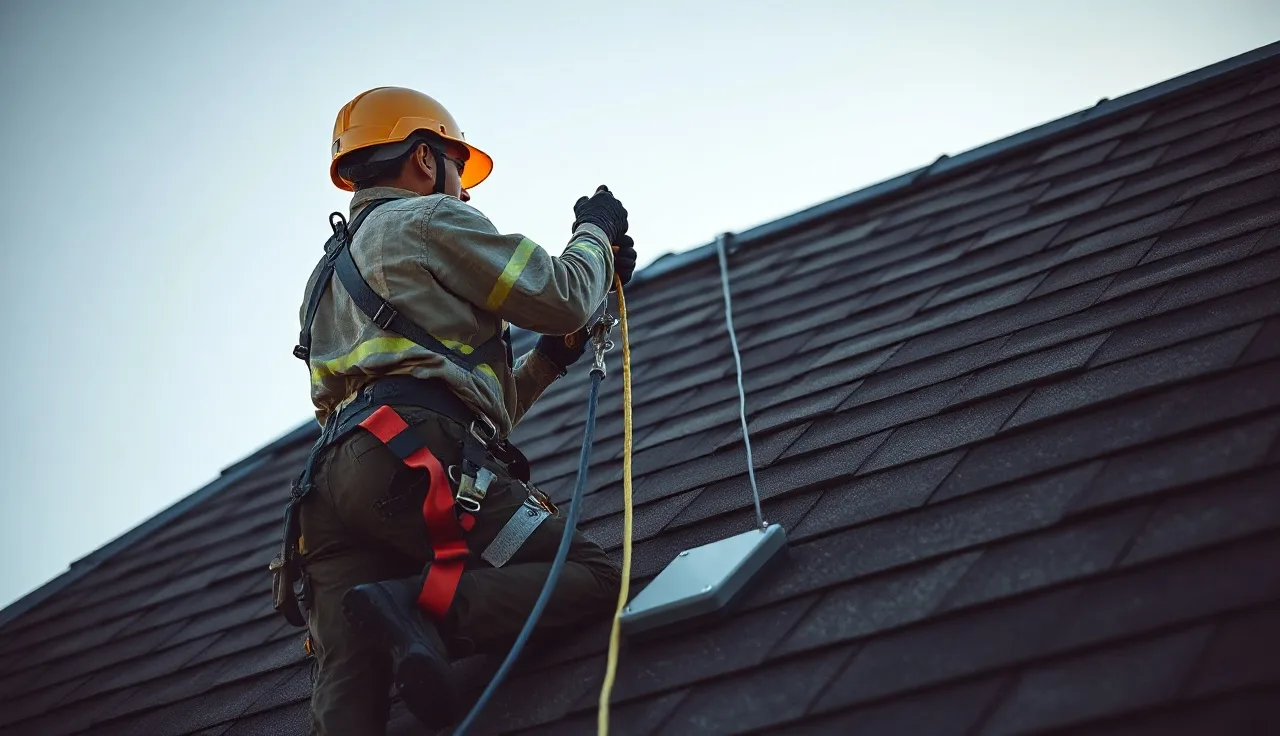
TL;DR
OSHA mandates fall protection at heights of 4 feet in general industry (29 CFR 1910.28) and 6 feet in construction (29 CFR 1926.502). The right gear depends on your work surface, anchor options, and fall clearance. Personal fall arrest systems, guardrails, and safety nets are the three accepted protection methods. Gear must be inspected before each use and retired after any fall.
What are OSHA's fall protection requirements?
OSHA splits fall protection rules across two major standards depending on your industry. General industry workers get protection under 29 CFR 1910.28, which requires fall protection at 4 feet above a lower level. [1] Construction workers fall under 29 CFR 1926.502, which sets the trigger height at 6 feet. [2] Shipyard employment uses 29 CFR 1915.159. Longshoring has its own standard under 29 CFR 1918.
The law does not dictate which method you use. It says you must protect workers from falling and gives you three accepted systems: guardrail systems, safety net systems, and personal fall arrest systems (PFAS). Some situations also allow positioning device systems or travel restraint systems as alternatives. Your job is to pick the method that actually works given your site conditions, more than the cheapest one.
Falls are the leading cause of death in construction. The Bureau of Labor Statistics reported 395 fatal falls to a lower level in construction alone in 2022. [3] Across all industries, falls account for roughly 20 percent of occupational fatalities every year. Those numbers have barely moved in decades of regulation. That tells you the gear is only half the answer. Workers have to actually wear it, and it has to fit the hazard.
OSHA's general industry walking-working surfaces standard (29 CFR 1910 Subpart D) got a big update in November 2016 that pulled it much closer to the construction rules. [9] If your company was leaning on the pre-2016 version, your written program needs a refresh.
What types of fall protection gear does OSHA accept?
There are more options than most small employers realize. Here is a plain breakdown of each system type and where it actually makes sense.
Personal Fall Arrest System (PFAS). A PFAS has three parts: a full-body harness, a connecting subsystem (lanyard or self-retracting lifeline), and an anchorage point. The harness spreads arrest forces across the thighs, chest, and shoulders. A standard shock-absorbing lanyard has to limit arrest force to 1,800 pounds (8 kN) per 29 CFR 1926.502(d)(16). [2] Self-retracting lifelines (SRLs) lock faster and give more freedom of movement than lanyards, which makes them the better pick for most rooftop and structural work. A PFAS is the go-to when guardrails are not practical.
Guardrail systems. Top rail at 42 inches (plus or minus 3 inches), midrail at roughly 21 inches, capable of taking 200 pounds of force applied outward or downward. [1] Guardrails are passive. Workers do not have to do anything to be protected. That is a real advantage. If you can install them, do it. They are almost always the lowest-maintenance option.
Safety nets. Required when workers are more than 25 feet above a surface and neither guardrails nor PFAS are feasible. [2] Nets must sit as close as possible under the work surface but never more than 30 feet below, and they need drop-testing with a 400-pound bag every six months. [11] That is real ongoing maintenance cost.
Positioning device systems. These hold a worker in place on a vertical surface like a wall or form, freeing up both hands. They are not fall arrest systems. A positioning device has to limit free fall to 2 feet and hold twice the worker's weight. Iron workers and form setters use them most.
Travel restraint systems. A rope or lanyard rigged short enough that a worker physically cannot reach an unprotected edge. No fall arrest capacity is required because no fall can happen. Simple, cheap, and often underused.
Controlled access zones and safety monitors. OSHA allows these under narrow conditions for certain leading-edge, pre-cast concrete, and overhand bricklaying work. They demand strict controls and a designated, trained safety monitor. Most small operations should skip this one. The paperwork and oversight burden is heavy for what you get.
What are the height thresholds for different industries?
The trigger height is the single most confusing part of fall protection law for employers who work across industry lines. Here is a reference table.
| Industry / Work Type | CFR Standard | Fall Protection Trigger Height |
|---|---|---|
| General industry (walking-working surfaces) | 29 CFR 1910.28 | 4 feet |
| Construction | 29 CFR 1926.502 | 6 feet |
| Scaffolding (construction) | 29 CFR 1926.451 | 10 feet |
| Steel erection | 29 CFR 1926.760 | 15 feet (with exceptions) |
| Shipyard employment | 29 CFR 1915.159 | 5 feet |
| Longshoring | 29 CFR 1918.85 | Various, by task |
Scaffolding and steel erection carry their own height thresholds that override the general construction 6-foot rule for those specific tasks. [2][10]
Height is not the only trigger. OSHA requires fall protection any time a worker could fall into dangerous equipment, into a vat of hazardous material, or through a hole in a walking surface. A two-foot drop onto exposed rebar counts, and no minimum height applies.
If your workers do both general industry and construction tasks on the same site (think maintenance staff on a construction project), the more protective standard applies unless OSHA has issued specific guidance. When in doubt, use the lower trigger height.
How do you inspect fall protection equipment before use?
OSHA requires a pre-use inspection of every fall protection component, but the standard does not hand you a checklist. It says equipment must be inspected before each use and after any fall. [2] The American National Standards Institute (ANSI) Z359 series fills in the detail OSHA leaves open, and most manufacturers build their inspection guides around ANSI.
For a full-body harness, check the webbing for cuts, fraying, chemical damage, heat damage, and discoloration. Twist the webbing to expose internal fibers. Any broken or cut fibers mean the harness is done. Check every buckle and D-ring for corrosion, cracks, and deformation. The back D-ring should sit centered between the shoulder blades with no sharp bend or gouge. The dorsal D-ring is the only acceptable attachment point for fall arrest.
For lanyards and SRLs, look for cuts in the outer jacket, and confirm the snap hooks lock positively with no bent gate or corroded mechanism. Shock-absorbing lanyards carry a deployment indicator, usually a fabric tag that hangs out once the pack has fired. If that tag is showing, the lanyard is done.
Anchor points get skipped more than any other component. An anchorage used for fall arrest has to support at least 5,000 pounds per attached worker, or be designed and installed by a qualified person with a safety factor of two. [2] Roof anchors, D-bolts, and beam clamps all need a physical check for corrosion, loose fasteners, and the structural soundness of whatever they attach to.
Anything that has arrested a fall comes out of service immediately. Full stop. You can ship it back to the manufacturer for inspection, but you cannot eyeball it and decide it is fine. The energy in a shock-absorbing lanyard is spent after deployment. The harness webbing may hide micro-tears you will never see.
How much does fall protection gear cost?
Prices swing a lot by product category and manufacturer tier. Here is a realistic picture based on current market pricing.
| Equipment | Typical Price Range |
|---|---|
| Full-body harness (basic construction) | $50 to $150 |
| Full-body harness (ergonomic, Class H) | $150 to $400 |
| Shock-absorbing lanyard, 6 ft | $35 to $100 |
| Self-retracting lifeline (SRL), 30 ft | $200 to $600 |
| Horizontal lifeline system (engineered) | $500 to $3,000+ |
| Permanent roof anchor | $50 to $200 per unit (hardware only) |
| Portable beam anchor | $80 to $250 |
| Safety net system (installed) | $2 to $8 per square foot plus labor |
The hardware is not where small employers get hurt. The real cost is time lost to a fall injury or a citation. OSHA's penalty for a serious fall protection violation runs up to $16,550 per violation as of 2024. [4] A repeat or willful violation can hit $165,514. Fall protection has topped OSHA's most-cited construction list for over a decade straight. In fiscal year 2023, OSHA issued 7,762 citations under 29 CFR 1926.501 alone. [5]
A $150 harness plus a $250 SRL for one worker is $400. The average workers' compensation claim for a fall that puts someone in the hospital runs well into five figures. The gear pays for itself in the first week.
Do not buy the cheapest harness on the shelf. Fit matters enormously for both safety and compliance. A harness that fits wrong will not spread arrest forces properly and can hurt someone badly even when it stops the fall. Spend a little more for adjustable leg straps and a chest strap with a clean range of adjustment.
What training does OSHA require for fall protection?
29 CFR 1926.503 requires that a competent person train every worker who might be exposed to fall hazards before that work starts. [7] The training has to cover the specific fall hazards on the job site, the procedures for erecting, maintaining, disassembling, and inspecting fall protection systems, and the limits of each system in use.
OSHA does not require a set number of training hours, a named course, or a certification card. It requires training that actually addresses the hazards the worker will face. Generic online courses rarely clear that bar on their own. Workers need hands-on time with the exact gear they will use: donning a harness correctly, connecting to an anchor, and understanding their fall clearance.
Fall clearance is the piece workers get wrong most. A 6-foot lanyard does not mean you can work 6 feet above the lower level. Add the lanyard length (6 ft), the deceleration distance of a shock-absorbing lanyard (up to 3.5 ft), your height (roughly 6 ft to the D-ring), and a safety margin. Total required clearance for a 6-foot shock-absorbing lanyard usually lands at 18.5 feet or more. If you do not have that clearance below you, switch to a shorter lanyard or an SRL.
Retraining kicks in when the employer has reason to believe a worker does not understand or cannot use the equipment correctly. That is a broad standard, and OSHA inspectors ask workers directly. If your crew cannot explain what a shock-absorbing lanyard does or how to check a harness, you have a training problem.
For a deeper look at OSHA's broader training obligations, the OSHA training requirements article covers the competent person standard and documentation rules.
What is fall clearance and why does it matter so much?
Fall clearance is the minimum vertical distance below a worker's anchor point needed to fully arrest a fall before the worker hits anything. Getting this wrong is how workers die while wearing a harness.
The math for a standard 6-foot shock-absorbing lanyard runs like this:
- Lanyard length: 6 feet
- Maximum deceleration distance (shock pack deployment): 3.5 feet
- Distance from D-ring to feet (worker height minus D-ring position): roughly 5 to 6 feet
- Safety margin: 2 feet
- Total: roughly 16.5 to 17.5 feet of clearance required below the anchor
If the anchor sits at roof level and the worker stands on the roof, the anchor is roughly at dorsal D-ring height. The clearance that counts is below the anchor, not below the worker's feet. Most workers and plenty of supervisors get that backwards.
Self-retracting lifelines (SRLs) shrink the clearance problem in many situations because they lock within inches of a fall starting, so total fall distance is much shorter. A 30-foot SRL with a built-in shock absorber may need only 7 to 9 feet of clearance below the worker's feet. Read the manufacturer's data sheet for the specific SRL you are using. Clearance numbers vary by product.
OSHA's letter of interpretation dated March 28, 2002 says employers must calculate fall clearance from the actual conditions of use, more than the labeled length of the connecting subsystem. [6] Bookmark that one.
What is the difference between a personal fall arrest system and a fall restraint system?
This distinction drives equipment selection, training, and compliance documentation, so get it clear.
A personal fall arrest system (PFAS) stops a fall after it has started. The worker can be at or past the edge when the system fires. It requires a full-body harness. The connector has to limit arrest force to 1,800 pounds. The anchorage has to handle 5,000 pounds per worker. Once a fall is arrested, the worker hangs in suspension and needs rescue.
A fall restraint system (also called a travel restraint system) stops the fall from happening at all. The lanyard or rope is short enough that the worker physically cannot reach the unprotected edge. No arrest force limits apply because no arrest occurs. A body belt is fine in a restraint system even though it is banned for fall arrest. The anchorage only has to hold the static load of the worker.
Restraint systems are simpler and cheaper when the geometry works. The catch is discipline. A worker who clips in with too long a lanyard, or routes it the wrong way, defeats the whole system. If you use restraint, put that geometry check into your training and your pre-use inspection routine, explicitly.
Positioning device systems are a third category. They hold a worker on a near-vertical surface. The device limits free fall to 2 feet and has to hold 3,000 pounds or twice the worker's weight, whichever is greater. [2] These are not interchangeable with fall arrest or restraint systems, and they need their own documentation in your safety program.
How should fall protection be documented in a written safety program?
OSHA does not use the phrase 'written fall protection program' in most of its standards, but several sections require written plans in specific contexts. 29 CFR 1926.502(k) requires a written fall protection plan when a contractor cannot use conventional fall protection (guardrails, nets, or PFAS) because of the nature of the work. [2] That plan has to be prepared by a qualified person and spell out the specific reasons conventional systems are not feasible.
Even when a written plan is not strictly required, having one is smart. A written program documents your hazard assessment, the systems you chose and why, your inspection procedures, your training records, and your rescue plan. If OSHA inspects and finds a worker without protection, a written program with a gap analysis shows good faith. That can move the penalty number even if it does not erase the citation.
Your written program should cover, at minimum: every task where fall hazards exist, the height of each hazard, the protection method chosen, inspection frequency and method, training requirements and records, rescue procedures for suspended workers, and the name of the competent person in charge.
Rescue procedures get left out of most small employer programs. OSHA requires an employer to have a rescue plan for workers arrested in suspension. [2] Harness suspension syndrome (orthostatic intolerance from hanging motionless in a harness) can knock someone unconscious within minutes. You need a plan to get a suspended worker down, and your workers need to know what it is.
If you need to build this program from scratch fast, SafetyFolio's safety program generator walks you through the fall protection section in about 15 minutes and produces documentation aligned to the relevant CFR sections.
For the incident documentation side, see the incident report guide for how to handle reporting obligations when a fall does occur.
What are the most common fall protection citations and how do you avoid them?
Fall protection violations have topped OSHA's most-cited construction list every single fiscal year for at least twelve years running. [5] The top categories are not complicated. They are predictable and preventable.
1926.501: Duty to have fall protection. Workers at or above 6 feet with no protection. Most of these are roofing and framing. Fix: do a daily walk before work starts. If the work is above 6 feet, protection goes in before anyone climbs up.
1926.503: Training. Workers who cannot show they understand fall hazards or how to use their gear. Fix: document hands-on training, more than a sign-in sheet for a video.
1926.502: Fall protection systems. Wrong equipment (a body belt used for fall arrest), weak anchorage, bad harness fit, snap hook gates that do not lock. Fix: a competent person pre-use inspection, every day.
In general industry, 29 CFR 1910.28 violations tied to unprotected holes and floor openings, plus 1910.30 training violations, show up a lot.
Here is the pattern inspectors see most: a small crew rushing a partial day, skipping the fall protection setup because 'it'll only take an hour.' That is exactly when people fall. Short tasks soak up little of the workday but drive a huge share of injury risk per hour. Get the OSHA basics right on the short jobs, more than the long ones.
One tactic worth trying: a competent person sign-off before any elevated work starts. A simple form listing the task, the height, the protection method, and the competent person's name takes two minutes and creates a paper trail that matters if OSHA shows up.
What equipment should a small roofing or construction crew keep on hand?
For a crew of four to six doing residential or light commercial work, a practical kit looks like this.
Each worker needs their own full-body harness. Harnesses are personal fit items. Sharing is a compliance risk because nobody adjusts them right for someone else's body. Budget $100 to $200 per harness for a quality unit with enough adjustment range to cover different workers.
Each worker needs a connecting subsystem. For most roofing work, a 6-foot shock-absorbing lanyard is the baseline. Self-retracting lifelines are better where workers move a lot. Keep both on hand and match the subsystem to the task and the available clearance.
The crew needs anchor options. At minimum, two portable roof anchors for ridge applications and two beam anchors for structural steel. If you work regularly on a flat roof or metal deck, a horizontal lifeline or static line system beats individual anchors.
A rescue kit. At bare minimum, a descent device and a retrieval pole. A suspended worker cannot always self-rescue. You need a way to get them down that does not involve cutting the lanyard.
A storage bag or bin. Gear thrown in a pickup bed gets run over, splashed with chemicals, and bent around tools. Harnesses degraded by pesticides, fertilizers, or acids look fine on the surface and fail under load. Keep gear in a clean, dry bag, away from other equipment.
For a crew of six, a full kit (harnesses, lanyards, SRLs, anchors, and a basic rescue device) runs roughly $2,500 to $4,000. That is less than one workers' comp deductible on a serious fall claim.
What should a written fall protection plan include for OSHA compliance?
This section covers what OSHA specifically requires in a written fall protection plan under 29 CFR 1926.502(k), which applies when conventional fall protection is infeasible or creates a greater hazard. [2] If you are using conventional protection (guardrails, nets, PFAS), this written plan is not technically required, but a written fall protection program is still smart practice that protects you during inspections.
Required elements for a 1926.502(k) plan:
- A statement of why conventional fall protection is infeasible or creates a greater hazard at each specific location
- Alternate measures to be used: safety monitoring, controlled access zones, or other means
- The name of the competent person responsible for implementing the plan
- A description of the surfaces to be traversed and the fall hazards present
- Dates and signatures (OSHA does not require a specific format, but the plan must be site-specific, never generic)
For a broader fall protection program not tied to that exception, add: the rescue and retrieval plan for suspended workers, inspection logs for each piece of equipment, training records with dates and topics covered, and a protocol for retiring damaged or post-fall gear.
Keep equipment inspection records. OSHA does not require a specific form, but in a citation situation, 'we check it every day' with no documentation is worth nothing. A simple log in your truck or on your phone with the date, equipment serial number, and inspector initials takes thirty seconds per piece.
SafetyFolio's safety program generator can produce a site-specific fall protection program in about fifteen minutes, with sections pre-aligned to 1926.502 and 1910.28. It will not replace a qualified person review for complex situations, but it gets small employers to a compliant starting point fast.
Frequently asked questions
At what height does OSHA require fall protection?
It depends on your industry. General industry (warehouses, manufacturing, retail) requires fall protection at 4 feet above a lower level under 29 CFR 1910.28. Construction requires it at 6 feet under 29 CFR 1926.502. Scaffolding triggers at 10 feet regardless of industry. Falls into dangerous equipment or hazardous materials require protection at any height.
Can you use a body belt instead of a full-body harness for fall arrest?
No. OSHA prohibits body belts for personal fall arrest systems. 29 CFR 1926.502(d)(17) explicitly states that body belts are not acceptable as part of a personal fall arrest system. A body belt concentrates arrest forces on the abdomen, which can cause severe internal injuries. Body belts are only permitted in positioning device systems or travel restraint systems, where no fall arrest occurs.
How often does fall protection equipment need to be inspected?
Before each use, at minimum. OSHA requires inspection before each use and after any fall arrest event. Equipment that has arrested a fall must be removed from service immediately, regardless of visible damage. Many manufacturers also specify annual or biannual inspection by a competent person or the manufacturer. SRLs (self-retracting lifelines) typically require manufacturer service every 1 to 3 years depending on use frequency.
What is a competent person in fall protection?
OSHA defines a competent person as someone who can identify existing and predictable hazards in the surroundings and has the authority to take corrective action. For fall protection, that means someone who understands the relevant standards, can evaluate fall hazards at the specific site, can inspect equipment, and has actual authority to stop work or order corrections. A title alone does not make someone competent. They need demonstrated knowledge.
What is the difference between a self-retracting lifeline and a lanyard?
A lanyard is a fixed-length connector, usually 4 or 6 feet, often with a built-in shock absorber. A self-retracting lifeline (SRL) extends and retracts like a tape measure and locks automatically within inches of a fall. SRLs require much less fall clearance than lanyards, allow freer movement, and are generally safer for most elevated work. They cost more upfront but are worth it for frequent use.
What is harness suspension trauma and why does it matter for rescue planning?
Harness suspension trauma (also called orthostatic intolerance) occurs when a worker hangs motionless in a harness after a fall arrest. Blood pools in the legs, reducing circulation to the brain. Unconsciousness can occur within minutes in some individuals. OSHA requires employers to have a rescue plan for suspended workers. Having fall arrest gear without a retrieval plan is a compliance gap and a real safety risk.
Do OSHA fall protection rules apply to workers on ladders?
Ladders are covered under separate standards. In construction, portable ladders fall under 29 CFR 1926.1053 and fixed ladders under 29 CFR 1926.1053(b). Fixed ladders taller than 24 feet require a personal fall arrest system or ladder safety system under updated rules (cages and wells are being phased out). General industry fixed ladder rules are in 29 CFR 1910.28. Portable ladder use does not require a PFAS, but the ladder setup rules apply.
How do you anchor a fall arrest system when there is no structural anchor available?
You have several options. Freestanding counterweighted anchor systems work on flat roofs where penetration is not allowed. Engineered horizontal lifeline systems anchor to structural elements at the roof edge or ridge. For temporary work, mobile anchor carts with ballast systems are available. Any anchor must still meet the 5,000-pound capacity requirement per attached worker, or be certified by a qualified person with a two-to-one safety factor.
What does OSHA require for hole covers and floor openings?
Under 29 CFR 1910.28 (general industry) and 29 CFR 1926.502 (construction), floor holes and openings must be covered or guarded. Covers must be capable of supporting at least twice the weight of workers, equipment, and materials that may be placed on them. Covers must be secured to prevent accidental removal and labeled 'HOLE' or 'COVER.' Unmarked, unsecured covers are among the most common citation triggers during OSHA inspections.
Is OSHA fall protection training required to be documented?
Yes. 29 CFR 1926.503(b) requires employers to certify that training has been done. The certification must include the name of the employee, the date of training, and the signature of the employer or trainer. OSHA does not specify a form, but if you cannot produce this documentation during an inspection, it is as if the training never happened. Keep records for the duration of employment at minimum.
Can a small roofing company use a safety monitor instead of PFAS?
Only under limited conditions. 29 CFR 1926.502(h) allows safety monitoring as an alternative for certain low-slope roofing work, but the safety monitor must be a competent person, have no other duties while monitoring, and be close enough to communicate clearly with workers. The monitor cannot do any other task at the same time. For most small roofers, this option creates more compliance burden than just using a PFAS with roof anchors.
What is the OSHA penalty for a fall protection violation?
As of 2024, OSHA's maximum penalty for a serious violation is $16,550 per violation. A willful or repeat violation can reach $165,514 per violation. Fall protection violations under 29 CFR 1926.501 are the most commonly cited OSHA standard in construction, with 7,762 citations issued in fiscal year 2023. Penalties adjust annually for inflation under the Federal Civil Penalties Inflation Adjustment Act.
How long do fall protection harnesses last?
There is no universal OSHA-mandated service life for harnesses, but most manufacturers recommend retiring a harness 10 years from the manufacture date regardless of condition, and many specify 5 years from first use. Any harness that has arrested a fall, shows webbing damage, has corroded hardware, or cannot be positively identified (missing label) must be retired immediately. When in doubt, retire it. A harness is not the place to save $100.
Sources
- OSHA, 29 CFR 1910.28 Duty to have fall protection: General industry fall protection required at 4 feet above a lower level
- OSHA, 29 CFR 1926.502 Fall protection systems criteria and practices: Construction fall protection at 6 feet; arrest force limit 1,800 lbs; anchorage 5,000 lbs; written fall protection plan requirements; positioning device 3,000 lbs or 2x worker weight; rescue plan requirement
- Bureau of Labor Statistics, National Census of Fatal Occupational Injuries 2022: 395 fatal falls to a lower level in construction in 2022
- OSHA, Penalties page: Maximum serious violation penalty $16,550; willful/repeat maximum $165,514 as of 2024
- OSHA, Top 10 Most Cited Standards FY2023: 29 CFR 1926.501 was the most cited OSHA standard in construction FY2023 with 7,762 citations
- OSHA Letter of Interpretation, March 28 2002, Fall clearance calculations: Employers must calculate fall clearance based on actual conditions of use, not just labeled lanyard length
- OSHA, 29 CFR 1926.503 Training requirements: Construction fall protection training must be by a competent person; certification must include name, date, and trainer signature
- OSHA, 29 CFR 1926.501 Duty to have fall protection (construction): Construction workers must be protected from fall hazards at 6 feet above a lower level
- OSHA, Walking-Working Surfaces Final Rule (29 CFR 1910 Subpart D), November 2016: General industry walking-working surfaces standard substantially updated November 2016
- OSHA, 29 CFR 1926.760 Fall protection for steel erection: Steel erection fall protection trigger height is 15 feet with specific exceptions
- OSHA, Fall Protection in Construction (OSHA 3146): Safety net systems must be installed no more than 30 feet below the work surface and drop-tested every 6 months
- Federal Civil Penalties Inflation Adjustment Act Improvements Act of 2015 (Pub. L. 114-74): OSHA penalties adjust annually for inflation under this law