Last updated 2026-07-09
TL;DR
Class III asbestos work covers repair and maintenance that disturbs asbestos-containing materials without fully removing them. Under 29 CFR 1926.1101 it requires 16 hours of O&M training, half-face P100 respirators at minimum, glove bags or mini-enclosures, and a written exposure determination. Most small jobs don't need an industrial hygienist. All of them need real paperwork.
What exactly is Class III asbestos work?
Class III asbestos work is repair and maintenance that disturbs asbestos-containing material (ACM) or presumed asbestos-containing material (PACM) without a full removal. OSHA splits asbestos construction work into four classes, and Class III sits in the middle of the hazard ladder. [1]
Class I is the worst: removal of thermal system insulation and surfacing ACM. Class II is removal of non-friable ACM like floor tile or roofing. Class IV is custodial, cleaning up debris that might contain asbestos. Class III is everything in between, the repair and maintenance jobs where you cut into or break the material but aren't tearing it all out.
The word that matters is "disturbed." A plumber drilling through a wall next to intact, non-friable floor tile hasn't triggered Class III if he never touches the tile. The moment he's cutting, sanding, scraping, or breaking into ACM or PACM, he's in Class III. Small renovation contractors hit this constantly: pipe fitting in old mechanical rooms, patching drywall with joint compound that might be ACM, pulling a ceiling tile in a pre-1980 building.
OSHA defines ACM as any material containing more than 1% asbestos by weight. [1] PACM is a presumption: thermal system insulation and surfacing material in buildings built before 1981 is presumed to contain asbestos unless an accredited inspector has tested it and cleared it. That presumption alone pulls a lot of commercial renovation into the asbestos rules, whether the contractor knows it or not.
Which OSHA standard governs Class III work and does it apply to small contractors?
Class III work is governed by 29 CFR 1926.1101, OSHA's asbestos standard for construction, and it applies to every construction employer regardless of size. There is no small-business exemption. No "under 10 employees" carve-out. If you employ anyone who disturbs ACM or PACM during renovation, repair, or demolition, this standard is yours. [1]
A separate standard, 29 CFR 1910.1001, covers general industry, meaning maintenance and repair inside manufacturing settings. If your work is construction or renovation, 1926.1101 is the one that governs you. The two overlap but aren't identical, and OSHA enforces them differently.
Here's a piece small contractors miss constantly. The standard reaches beyond the workers who directly handle ACM. It also covers "adjacent employees" who work near the regulated area. [1] If your electrician is running conduit 10 feet from a carpenter disturbing a suspect ceiling, both of them are potentially exposed and both have to show up in your exposure determination.
For how OSHA enforcement actually plays out on the ground, see our osha training overview.
What training is required before doing Class III asbestos work?
Workers doing Class III asbestos work need at least 16 hours of training, delivered in the Operations and Maintenance (O&M) format. Supervisors need 32 hours of O&M training. [1] These aren't optional, and general asbestos awareness training does not count as a substitute.
The 16-hour O&M course has to cover the health effects of asbestos, how to recognize ACM and PACM, the link between smoking and asbestos exposure, respirator use, work practices for Class III jobs including glovebag and mini-enclosure methods, how to set up and tear down a regulated area, and medical surveillance requirements. [1] OSHA also expects workers to be trained on the specific tasks they'll actually do. Someone trained only on pipe lagging shouldn't be sent to disturb ceiling tile without task-specific instruction first.
Training is annual. Not once at hire. Every year. [1] This trips up small contractors more than almost any other requirement, because it stops feeling urgent the day the first class is done.
Most state-accredited O&M courses run through community colleges, union training funds, and private safety training companies. Expect roughly $150 to $400 per person for a 16-hour course as of 2024, though the range moves a lot by region. There's no OSHA-issued accreditation specific to O&M training; it lives under the Asbestos Hazard Emergency Response Act (AHERA) framework and gets administered through state accreditation programs. [2]
Training records have to be kept and handed to employees on request. OSHA requires them kept for one year after training. [1] That's shorter than most asbestos records, but it's a hard requirement, not a suggestion.
What does the written exposure determination requirement actually involve?
Before any Class III work starts, the employer has to make a written "exposure determination" deciding whether workers are or may be exposed above the action level or the permissible exposure limit. Both sit at 0.1 fibers per cubic centimeter as an 8-hour time-weighted average, with an excursion limit of 1.0 f/cc averaged over 30 minutes. [1]
For Class III work, OSHA lets you use a "negative exposure assessment" (NEA) instead of collecting personal air samples on every job. To claim an NEA you have to show the specific operation, materials, and conditions won't push exposures above the action level. OSHA accepts three bases: objective data such as published studies or historical air monitoring for that exact type of work, prior monitoring from comparable jobs, or documented professional judgment. [1]
Here's the honest reality for small contractors. Many Class III jobs do qualify for an NEA when they're done right, with wet methods, glovebag containment, and HEPA vacuums. NIOSH and EPA have published a lot of data on fiber release from common maintenance tasks. But "I didn't think it was a problem" is not an NEA. You need something written that names the basis for your conclusion.
Can't document an NEA? Then you collect personal air samples, which means hiring an industrial hygienist or an air monitoring technician with the right equipment. Professional air monitoring on a small Class III job typically runs $500 to $1,500 per day depending on location and sample count. [3] On a one-day pipe repair that can cost more than the job, which is exactly why the NEA pathway is worth understanding cold.
This is where a written asbestos program earns its keep. A tool like SafetyFolio can build the underlying program structure far faster than starting from a blank page, but the NEA still has to reflect the actual conditions of each job.
What respirator is required for Class III asbestos work?
The minimum for Class III work is a half-face air-purifying respirator with HEPA (P100) filters, giving an assigned protection factor of 10. [1] That's the half-face elastomeric or disposable respirator with the purple P100 cartridges. An N95 dust mask does not meet this requirement, full stop.
When exposures run higher, OSHA requires a more protective respirator. The upgrade points under Table 1 of 1926.1101 are:
| Estimated 8-hr TWA Exposure | Minimum Respirator Required |
|---|---|
| At or below 1 f/cc | Half-face APR with HEPA |
| Above 1 f/cc up to 5 f/cc | Full-face APR with HEPA |
| Above 5 f/cc up to 10 f/cc | Powered air-purifying respirator (PAPR) with HEPA |
| Above 10 f/cc | Supplied-air respirator (pressure-demand) |
Source: 29 CFR 1926.1101, Table 1 [1]
For most small Class III repairs done with wet methods and containment, the half-face APR is enough. But before any worker straps one on, they have to be medically cleared, fit-tested, and trained on use under 29 CFR 1910.134, OSHA's Respiratory Protection Standard. [4] Medical clearance means a physician or licensed health care professional reviews a completed OSHA Respirator Medical Evaluation Questionnaire (Appendix C to 1910.134). It's mandatory and it isn't free, though many occupational health clinics charge $50 to $100 for the review.
Fit testing has to be repeated every year, and again any time a worker's physical condition changes in a way that could affect the seal. [4]
For how respiratory protection fits the wider program, our hazard communication article covers the chemical hazard rules you'll often meet alongside asbestos on old-building jobs.
What work practice controls are required for Class III operations?
Class III work has to be done inside one of two containment approaches under 1926.1101(g)(7): a glovebag system or a mini-enclosure. [1] Those are the mandatory defaults. You can't just wet the material and sweep it up.
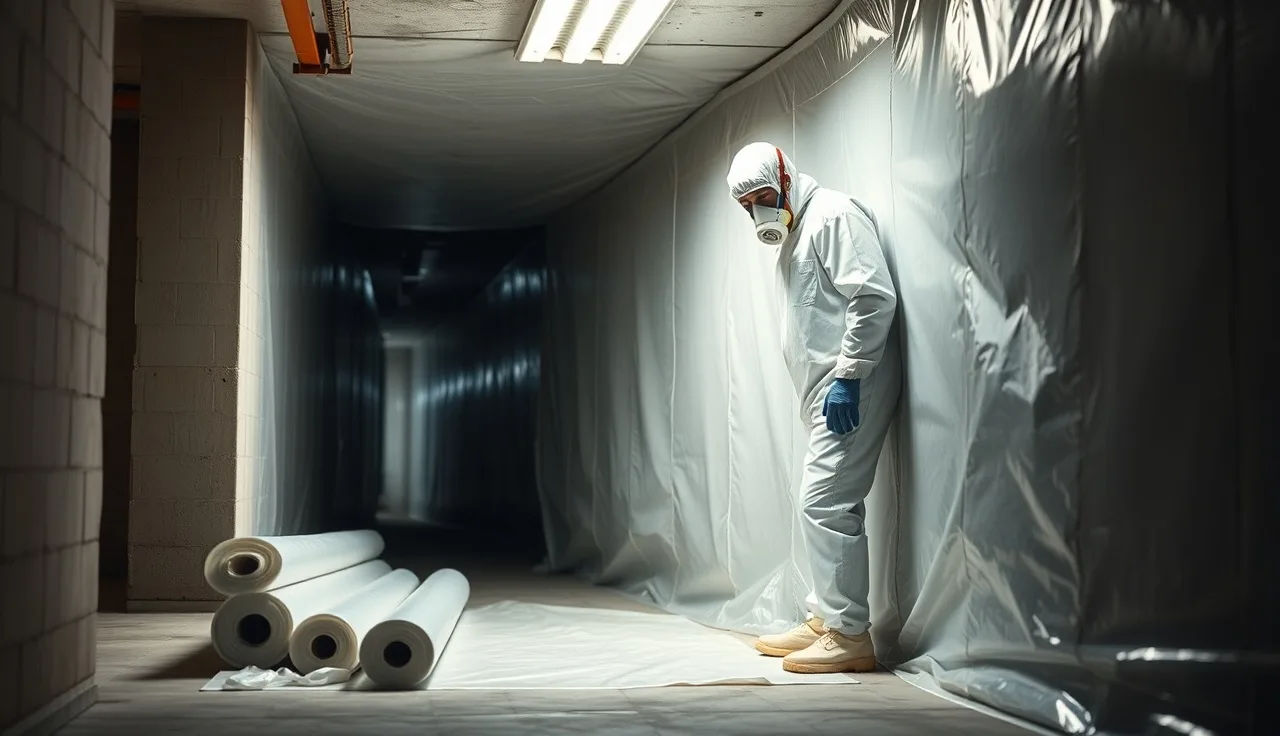
A glovebag is a sealed plastic bag with built-in gloves that wraps the work area, usually for pipe insulation or small sections of ACM. Used right, it keeps fibers contained through the whole disturbance. A mini-enclosure is a small sealed work area built from plastic sheeting, with negative pressure when the job calls for it. Mini-enclosures take more labor but they're necessary when a glovebag won't fit the geometry.
Every Class III job also requires wet methods (keeping ACM wet while you disturb it), HEPA vacuuming of all debris, prompt disposal of ACM waste in labeled, sealed, leak-tight containers, and regulated area boundaries posted with signs that read: "DANGER: ASBESTOS. CANCER AND LUNG DISEASE HAZARD. AUTHORIZED PERSONNEL ONLY. RESPIRATORS AND PROTECTIVE CLOTHING ARE REQUIRED IN THIS AREA." [1]
Decontamination equipment is required for Class III work wherever a regulated area is set up. At minimum that means a way for workers to remove contaminated clothing before they leave the area. Full shower facilities are required only for Class I and II jobs; Class III may need only an equipment room or similar decon area depending on exposure levels. [1]
Disposal is a second regulator's turf. ACM waste falls under EPA NESHAP rules (40 CFR 61, Subpart M) [5] and usually state environmental requirements on top. Waste has to be wetted, sealed in labeled 6-mil poly bags, and taken to a licensed asbestos landfill. Some states require a waste shipment manifest. Check your state environmental agency, because these rules vary a lot.
When is a competent person required on a Class III job?
A "competent person" has to be on site for every Class III asbestos job. [1] This is a formal OSHA designation, more than someone with experience. Under 1926.1101 the competent person must be trained in the nature of asbestos hazards, proper work practices, and the selection and use of protective equipment. If they're supervising, they need the 32-hour O&M training.
For Class III work the competent person has to run a pre-work inspection to size up conditions, identify ACM or PACM, and confirm the controls are in place. They also have to be able to spot hazardous conditions and have the authority to fix them on the spot. [1]
On small jobs the owner-operator can be the competent person, as long as they hold the training and the documentation. That's common and OSHA doesn't prohibit it. What OSHA does prohibit is a competent person in name only, one who isn't actually watching the work.
This requirement also ties into OSHA's general construction standard at 29 CFR 1926.20, which requires a competent person to oversee site safety broadly. [6] Meeting the Class III competent person standard usually satisfies the general construction requirement for that specific hazard.
Do small renovation contractors need a written asbestos program?
Yes, with one caveat. OSHA requires a written asbestos program whenever employees are exposed or may be exposed above the action level. [1] The phrase "may be exposed" covers enormous ground on renovation work in old buildings. If you're doing any Class III work, the honest answer is almost always yes.
The program has to describe the work practices and engineering controls used for each class of asbestos work your company performs, housekeeping procedures, training requirements, medical surveillance requirements, and how you make initial exposure determinations. [1]
This is not a 50-page document. A small contractor who does Class III work occasionally can meet the standard with a clear, specific 5 to 10 page program that hits each required element. What counts is that it matches your actual operations, not that it's thick.
The program has to be available to employees and their designated representatives on request, and it has to be updated when your methods or materials change. [1]
Building this without a consultant is what SafetyFolio's safety program generator is for; it walks you through each required element in a structured format. The point is a program that reflects how you actually work, which an off-the-shelf template rarely does.
What are the medical surveillance requirements for Class III workers?
Medical surveillance under 29 CFR 1926.1101(m) kicks in for workers who are or may be exposed at or above the action level for 30 or more days a year, or exposed above the excursion limit, or wearing negative-pressure respirators. [1]
For small contractors doing occasional Class III work, the 30-day threshold is the whole ballgame. A worker who does fewer than 30 days a year of asbestos-exposure work isn't pulled into surveillance by the exposure criterion alone, though the respirator criterion can still trigger it. Plenty of small renovation crews fall below the 30-day line on the exposure side.
When it does apply, the surveillance program needs a pre-placement physical, periodic exams at least every three years, and an exit exam when an employee leaves. Exams have to include a chest X-ray, medical and work history, and pulmonary function tests. [1]
The employer pays for all of it. Workers get a written statement from the examining physician, and the physician's written opinion goes to the employer. [1] Records have to be kept for the duration of employment plus 30 years, OSHA's standard retention for exposure records tied to carcinogens. [7]
That 30-year figure is not a typo. Asbestos-related disease can take decades to surface, and OSHA's recordkeeping rule for toxic substance exposure is built around that lag.
What does OSHA actually cite small contractors for in Class III asbestos violations?
OSHA enforcement history shows the same handful of Class III citations against small contractors again and again: failing to provide or document annual training, skipping the exposure determination before work starts, not establishing a regulated area with proper warning signs, weak respirator programs (no fit testing or medical clearance), and failing to use proper containment like glovebags. [8]
The money side is real. OSHA's current maximums run up to $16,550 per serious violation and up to $165,514 per willful or repeat violation. [9] Those figures get adjusted for inflation under the Federal Civil Penalties Inflation Adjustment Act. A contractor who skips training, has no written program, and uses bad containment on a single Class III job could realistically face $50,000 or more if OSHA runs a focused inspection.
OSHA also finds asbestos work through its Site-Specific Targeting program and through referrals from state environmental agencies running their own NESHAP inspections. A state inspector who catches improperly disposed asbestos waste will often hand the case to the nearest OSHA area office.
For how OSHA citations and penalties work in general, see our osha overview. If a worker exposure incident happens, check your incident report obligations first.
How does AHERA relate to Class III work requirements?
AHERA, the Asbestos Hazard Emergency Response Act (15 U.S.C. 2641), is an EPA-administered law aimed at schools. It requires inspections, management plans, and O&M programs in K-12 buildings. [2] AHERA is also what set up the training accreditation system for asbestos workers, including the 16-hour O&M course.
For renovation contractors, AHERA matters in two ways. First, if you work in a school building, AHERA requirements stack on top of OSHA 1926.1101. Only AHERA-accredited contractors can perform asbestos work in schools, and the work has to follow the school's AHERA management plan. Second, most states have pushed AHERA-style training accreditation past schools into all public and commercial buildings, which means your state may require state-accredited O&M training even for jobs that have nothing to do with schools.
States run their own accreditation programs. California, New York, Illinois, and most others require state accreditation for workers and supervisors doing any asbestos work, more than school work. Check your state environmental or labor agency for licensing rules on top of OSHA's federal training floor. In many states the state requirement is tougher than the federal minimum. [2]
What records does a small contractor need to keep for Class III jobs?
OSHA's recordkeeping rules for asbestos under 1926.1101(n) cover several categories, each with its own retention clock:
| Record Type | Retention Period | Who Keeps It |
|---|---|---|
| Air monitoring / exposure records | 30 years | Employer |
| Objective data used for NEA | 30 years | Employer |
| Training records | 1 year after training | Employer |
| Medical surveillance records | Duration of employment + 30 years | Employer |
| Written asbestos program | Duration of use + 30 years | Employer |
Source: 29 CFR 1926.1101(n) [1]
The 30-year retention for exposure records is real, and it bites small contractors who sell or close a business. OSHA's standard at 29 CFR 1910.1020 requires exposure records be transferred to NIOSH, or to workers and their representatives, if the employer shuts down or the records would otherwise be destroyed. [7] That obligation doesn't vanish when you sell the company or retire.
For each Class III job, keep at minimum: the written exposure determination or NEA, the names and training status of every worker in the regulated area, the date and location, the type of ACM or PACM disturbed, and the control methods used. A one-page job log that captures those elements is enough.
Training records only have to be kept a year, but there's no real reason to toss them that fast given the 30-year exposure obligation sitting next to them. Keeping training records lined up with exposure records is what protects you if a former worker files a claim decades down the road.
Frequently asked questions
Does Class III asbestos work require a licensed contractor in all states?
Federal OSHA doesn't require a contractor license for Class III work, only specific training and work practices under 29 CFR 1926.1101. Most states layer on their own asbestos licensing or accreditation requirements for any asbestos work in commercial or public buildings. Check with your state environmental or labor agency. California, New York, and Illinois all require state contractor accreditation beyond the federal OSHA minimum.
Can a general contractor's employees do Class III work, or do you need an asbestos abatement subcontractor?
OSHA lets any contractor's employees do Class III work as long as they have the 16-hour O&M training, proper respirators and PPE, correct work practices, a written exposure determination, and a competent person on site. You don't have to subcontract to an abatement firm. Full Class I or II removal of thermal system insulation or surfacing ACM is different and often requires licensed abatement contractors under state law.
What's the difference between Class III and Class IV asbestos work?
Class III covers repair and maintenance where ACM or PACM is directly disturbed. Class IV covers custodial and housekeeping work on surfaces that may contain asbestos but where the worker doesn't disturb the material on purpose. Think of Class IV as cleaning up dust that might hold asbestos fibers. Class IV needs only 2 hours of awareness training; Class III needs 16 hours of O&M. The line turns on whether you're cutting into or breaking the material.
How do you establish a negative exposure assessment for Class III work?
An NEA needs written documentation showing air concentrations will stay below the 0.1 f/cc action level, based on objective data, historical monitoring from identical operations, or professional judgment tied to published data. OSHA accepts published studies on fiber release from specific tasks as support. The documentation has to name the task, the ACM type, and the control methods. It's not a blanket statement for all future work; each job type needs its own NEA basis.
Do workers need fit testing every year even for occasional Class III jobs?
Yes. 29 CFR 1910.134 requires annual fit testing for every worker who has to wear a tight-fitting respirator, no matter how rarely they use it. If a worker might be assigned Class III work during the year, they need a current fit test and current medical clearance. There's no exception for infrequent use. Some small contractors handle this by fit-testing all potentially exposed workers at the start of each project season.
What warning signs are required around a Class III regulated area?
OSHA requires warning signs at all approaches to a Class III regulated area. The signs must read: DANGER: ASBESTOS. CANCER AND LUNG DISEASE HAZARD. AUTHORIZED PERSONNEL ONLY. RESPIRATORS AND PROTECTIVE CLOTHING ARE REQUIRED IN THIS AREA. Under 29 CFR 1926.1101(k)(7), they must be posted at all approaches and legible from a distance that lets a worker read them before entering. Barricade tape alone isn't enough.
Is asbestos awareness training the same as O&M training for Class III work?
No. Awareness training is typically 2 hours and covers recognition and health effects for workers who may encounter but don't disturb ACM. It satisfies the Class IV requirement. Class III workers need 16-hour O&M training that also covers work practices, containment methods, respirator use, and regulated area setup. Using awareness training in place of O&M training is a common and citable OSHA violation.
What happens if you discover unexpected asbestos during renovation work?
Stop work in the affected area immediately and restrict access. If workers may already have been exposed, treat it as a potential exposure event and document it. Have the material tested by an accredited inspector before you go further. If it's confirmed ACM and the disturbance qualifies as Class I, II, or III, comply with the applicable rules before continuing. Pushing ahead after finding suspected ACM opens you to an OSHA willful violation.
Does EPA NESHAP apply to small renovation contractors doing Class III work?
EPA's asbestos NESHAP (40 CFR 61, Subpart M) applies to demolition and renovation. For Class III repair work, NESHAP notification requirements usually don't apply unless the project hits the thresholds (160 square feet, 260 linear feet, or 35 cubic feet of regulated ACM). But NESHAP disposal requirements apply to any ACM waste regardless of project size. Check your state environmental agency, since many states have adopted stricter standards.
How long do asbestos training records need to be kept?
Under 29 CFR 1926.1101(n)(5), employee training records must be kept for one year beyond the end of employment. That's the shortest retention period in the asbestos standard. Air monitoring and exposure records must be kept 30 years. Medical records must be kept for the duration of employment plus 30 years. The mismatch matters: keep training records tied to the exposure records they relate to, even though the formal requirement is only one year.
Can a small contractor self-inspect for ACM before doing Class III work?
You can eyeball whether materials look like they might be ACM, but visual inspection alone can't identify or rule out asbestos. Sampling has to be done by an accredited inspector under AHERA or the state equivalent, and lab analysis has to use polarized light microscopy at an accredited lab. For most commercial buildings, the practical move for a small contractor is to treat all suspect materials as PACM until a qualified inspector tests and clears them.
What PPE beyond respirators is required for Class III asbestos work?
29 CFR 1926.1101(h) requires workers in the regulated area to wear protective clothing: coveralls or similar whole-body garments, gloves, and head coverings. Footwear that can be decontaminated, or disposable shoe covers, is required. Street clothes must not be worn into the regulated area. Contaminated clothing has to come off in the decon area before leaving, go into labeled sealed containers, and be laundered by someone informed about asbestos hazards.
Does the Class III standard apply to residential renovation work?
OSHA standards run on the employer-employee relationship, so they apply to contractors with employees doing residential renovation where ACM is disturbed. Self-employed sole proprietors with no employees aren't covered. Homeowners doing their own work aren't covered either. EPA's renovation, repair, and painting (RRP) rule under TSCA applies to most pre-1978 homes for lead, not asbestos, a separate regulatory layer. State asbestos rules may apply to residential work regardless.
Sources
- OSHA, 29 CFR 1926.1101 Asbestos (Construction): Class III asbestos work definition, training requirements (16/32 hours), respirator table, work practices, regulated area requirements, competent person, medical surveillance, and recordkeeping obligations
- EPA, Asbestos Hazard Emergency Response Act (AHERA): AHERA O&M training accreditation framework and state-administered asbestos accreditation programs
- AIHA, Professional Industrial Hygiene Services Cost Benchmarks: Professional air monitoring costs for asbestos sampling on small renovation jobs
- OSHA, 29 CFR 1910.134 Respiratory Protection: Annual fit testing and medical clearance requirements for tight-fitting respirators
- EPA, 40 CFR 61 Subpart M National Emission Standard for Asbestos: Federal NESHAP requirements for ACM waste disposal during renovation and demolition
- OSHA, 29 CFR 1926.20 General Safety and Health Provisions (Construction): Competent person requirement for construction safety oversight
- OSHA, 29 CFR 1910.1020 Access to Employee Exposure and Medical Records: 30-year retention requirement for toxic substance exposure records and transfer obligation upon employer closure
- OSHA, Asbestos Enforcement Policy and Inspection History: Most frequently cited Class III asbestos violations: training gaps, missing exposure determinations, improper regulated area setup
- OSHA, Civil Penalty Amounts by Violation Type (2024 adjusted): Current OSHA civil penalty maximum of $16,550 per serious violation and $165,514 per willful or repeat violation
- NIOSH, Asbestos Fiber Release During Maintenance Operations: Published data on fiber release rates from common asbestos maintenance tasks used to support negative exposure assessments