Last updated 2026-07-10
TL;DR
A toolbox talk is a short safety meeting held on the jobsite, usually 5 to 15 minutes, focused on one hazard. OSHA doesn't mandate a set format, but regular talks satisfy your training duties under 29 CFR 1926.21. A good talk has a specific topic, three to five key points, a discussion question, and a signed sign-in sheet.
What is a toolbox talk, exactly?
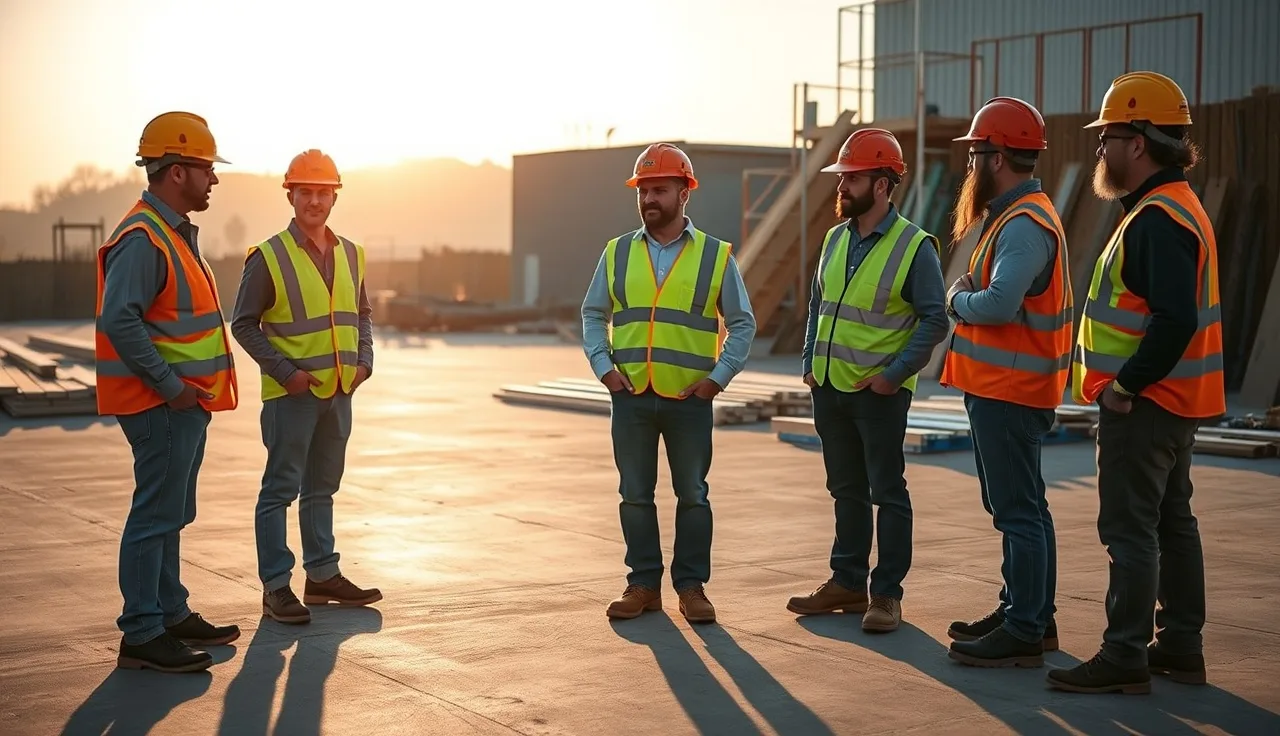
A toolbox talk (also called a tailgate meeting or safety briefing) is a short safety conversation held on the jobsite before work starts or during a break. The name comes from the old habit of gathering around a toolbox. The point is simple. Pick one hazard, talk about it for a few minutes, and let workers ask questions.
These are not formal classroom training. They do not replace OSHA-required training programs for things like lockout tagout or hazard communication. Think of them as maintenance, a way to keep a hazard front of mind before someone gets hurt.
On a small crew, a toolbox talk might be five guys standing next to a pickup truck at 7 a.m. The format doesn't matter. The consistency does.
Does OSHA actually require toolbox talks?
No single OSHA regulation says 'hold weekly toolbox talks.' But that's not the whole picture, and reading it that way gets small employers in trouble.
Several OSHA standards require 'periodic' or 'frequent' safety communication that employers satisfy through toolbox talks. 29 CFR 1926.21(b)(2) requires that the employer 'shall instruct each employee in the recognition and avoidance of unsafe conditions and the regulations applicable to his work environment' [1]. Regular short talks are one of the most practical ways to meet that duty.
If you have a written Injury and Illness Prevention Program or a site-specific safety plan (general contractors often require one on larger projects), that document usually mandates regular safety meetings. Ignoring your own written program is a citation risk in its own right under the General Duty Clause, Section 5(a)(1) of the OSH Act [2].
California, Washington, and other state-plan states go further. California's Injury and Illness Prevention Program standard (Title 8, CCR 3203) requires employers to keep workers informed through 'meetings, trainings, or other means of communication' [3]. If you operate in a state-plan state, check your state's specific rules.
Here's the short version. Toolbox talks aren't optional in practice, even when no rule names them.
Why do small construction crews get hurt more often?
Small employers carry a disproportionate share of construction injuries. The Bureau of Labor Statistics Census of Fatal Occupational Injuries shows that establishments with fewer than 10 employees account for a large share of construction fatalities, and these same employers are the least likely to run a formal safety program [4].
The deadliest hazards are OSHA's 'Fatal Four': falls, struck-by incidents, electrocution, and caught-in/between hazards. Falls alone accounted for roughly 37 percent of construction worker deaths in 2022 [4].
Small crews skip safety meetings because they feel slow. But a 10-minute talk on fall protection before a roofing job is about the cheapest injury prevention there is. No consultant, no software, no cost.
The data isn't perfectly granular for crews under five people, and I'll say that plainly. What the BLS census does show, year after year, is that small construction establishments run higher fatality rates per worker than large ones [4]. That gap is what toolbox talks go after.
How long should a toolbox talk be?
Five to fifteen minutes. Ten is the sweet spot for most topics.
Go longer and you lose the crew. Go under five and you're rushing past details that matter. If a topic needs 30 minutes, you're writing a training session, not a toolbox talk. Split it in two or schedule real training.
One talk covers one hazard or one procedure. Not three. One. Focused, single-topic sessions tend to produce better recall than sessions that cram in several subjects, though the construction-specific evidence here is thin and I won't oversell it. The principle comes from cognitive load research and is standard in occupational health training design [5].
What does a toolbox talk need to include?
You need six things. That's it.
1. A specific topic. Not 'fall safety.' Something like 'ladder setup and the 4-to-1 rule on this site.' The more specific, the better.
2. Why it matters today. Connect the hazard to the actual work. 'We're starting second-floor framing today, which puts everyone within 6 feet of an unprotected edge under 29 CFR 1926.502.' [6]
3. Three to five key points. Keep them short. Bullets are fine. You're talking through them, not reading them.
4. A real example or near-miss. Optional but effective. It doesn't have to be dramatic. 'Last week someone on another site didn't tie off a ladder at the top and it kicked out' is enough to make people listen.
5. A discussion question. Ask the crew something real. 'What do you do if you're handed a ladder with a cracked rung?' Get one person talking out loud and the meeting stops being a lecture.
6. A sign-in sheet. Date, topic, names, signatures. Keep it. More on that below.
How do you write a toolbox talk step by step?
Here's the actual process. You can do this in 20 to 30 minutes.
Step 1: Pick the topic from the day's work. Look at what's scheduled. Pouring a slab? Talk about concrete burns and wet cement skin exposure. Working near traffic? Talk about high-visibility PPE and spotter protocols. Topics tied to real conditions land better than generic ones pulled off a calendar.
Step 2: Find the relevant OSHA standard. You don't need the full regulation, just the citation number so you can point to it if someone asks why the rule exists. OSHA's Construction section at osha.gov has a searchable standards library [7]. Knowing the CFR number also helps during an inspection.
Step 3: Write your three to five key points. Plain language only. If you wouldn't say it that way on the jobsite, don't write it that way. 'Ensure all personnel maintain a minimum clearance distance of 10 feet from energized overhead conductors' is useless. 'Stay at least 10 feet from power lines. Period.' is the same rule, and people actually hear it.
Step 4: Add one specific example. Pull from OSHA's fatality reports at osha.gov, your own crew's history, or last week's near-miss. One or two sentences.
Step 5: Write one open-ended discussion question. Skip yes/no questions. 'What do you check before you trust a scaffold?' gets better answers than 'Do you check scaffolding before you use it?'
Step 6: Print it or read it aloud. For a small crew, reading your notes out loud is fine. No projector needed. Some supervisors keep a laminated card with the key points.
Step 7: Fill out the sign-in sheet. Every time. No exceptions.
Once written, the whole thing is a page or less. If yours runs longer, you're probably combining two talks.
What topics should you cover throughout the year?
Match topics to your work type first, then fill in the OSHA-required areas. Here's a practical structure for a small residential or light commercial crew.
| Category | Example Topics | Relevant OSHA Standard |
|---|---|---|
| Falls | Ladder safety, scaffold inspection, leading edge fall protection | 29 CFR 1926.502 |
| Struck-by | Hard hat use, tool tethering, vehicle backing procedures | 29 CFR 1926.100 |
| Electrocution | Power line clearance, GFCI use, extension cord inspection | 29 CFR 1926.404 |
| Caught-in/between | Trench cave-in, rotating equipment, pinch points | 29 CFR 1926.652 |
| Hazard Communication | Reading SDS sheets, chemical storage, PPE for chemicals | 29 CFR 1910.1200 |
| PPE | Proper fit, inspection before use, replacement criteria | 29 CFR 1926.95 |
| Heat illness | Hydration, shade requirements, recognizing heat stroke | OSHA Heat Illness guidance |
| Hand and power tools | Guards, proper storage, damaged tool reporting | 29 CFR 1926.300 |
| Housekeeping | Trip hazards, material storage, nail boards | 29 CFR 1926.25 |
| Emergency action | Muster points, who calls 911, first aid kit location | 29 CFR 1926.35 |
Cycle through these across the year. A weekly cadence gives you 52 talks, enough to cover everything and repeat the highest-risk categories two or three times. Fall protection and struck-by deserve the repeats. They kill the most workers.
For OSHA training that goes past toolbox talks, workers on larger projects often need documented course completion, including OSHA 30 cards for supervisors.
Do toolbox talks need to be documented, and how long do you keep the records?
Yes. Document every single one. The sign-in sheet is your proof that the training happened.
OSHA's recordkeeping standard at 29 CFR 1904 governs injury and illness logs, and most standards that require training also require records showing who was trained, when, and on what [8]. Even where a record isn't spelled out, documentation protects you during an inspection. A compliance officer can ask whether workers were trained on a specific hazard. A stack of signed toolbox talk sheets with dates and topics is direct evidence that they were.
How long do you keep them? OSHA requires OSHA 300 injury logs to be retained for five years under 29 CFR 1904.33 [8], and many practitioners keep general training records at least that long. For hazardous materials exposure records, the retention requirement runs 30 years under 29 CFR 1910.1020 [9]. For a standard toolbox talk sheet on common construction topics, keeping records five years is a safe minimum.
What the sheet must contain: date, site address, topic covered, the name of the person leading the talk, and signatures or printed names of everyone present. If someone refuses to sign, note it. If someone was absent, note that too.
Keep these in one dedicated binder or folder, paper or digital. An OSHA inspection is not the time to dig through loose sheets in a truck cab.
What makes a toolbox talk fail?
Most bad toolbox talks fail for one of three reasons.
Reading word-for-word from a generic template. Workers tune out the second they realize you printed something off the internet and didn't touch it. Use templates as a starting point, then swap in the example that matches what you're doing that day.
No two-way conversation. If the supervisor talks for eight minutes and nobody else says a word, that's a speech, not a safety meeting. The discussion question isn't optional. Ask it, then wait. Silence is uncomfortable enough that someone answers.
Inconsistency. One talk a month isn't a safety culture. It's a checkbox. Weekly, or before each new phase of work, is the floor that actually changes behavior. Research on safety climate ties the frequency of safety communication to lower injury rates, with construction studies finding that more frequent supervisor-worker safety communication was significantly associated with fewer injuries [5].
A fourth failure mode gets overlooked: holding the talk after work starts. If workers are already on the roof, they're half-listening and half-thinking about the job. Pre-task, every time.
Can you use a free template, or do you need to write from scratch?
Use a template. Writing from scratch every week is a waste of time. OSHA's Construction section at osha.gov has free toolbox talk resources [7], and NIOSH publishes topic-specific guidance that maps straight onto toolbox talk content [10].
Customization is the whole game. A generic scaffold-safety template becomes useful the moment you add the scaffold model you're using, the name of the competent person on your crew, and the date. Two minutes of editing separates a talk that lands from one that gets ignored.
If you're building a full written safety program for your company, more than individual talks, the SafetyFolio safety program generator produces a complete, OSHA-aligned written program in about 15 minutes, and that program becomes the backbone your toolbox talks reference all year.
For the talks themselves, OSHA's free resources are genuinely good. The Construction eTool at osha.gov covers dozens of specific hazard areas with the relevant standards cited [7].
How do toolbox talks fit into your overall OSHA compliance picture?
Toolbox talks are one layer of a larger system, not the whole thing.
Think of compliance as three concentric circles. The outer ring is your written safety program: your hazard communication plan, emergency action plan, and any other written programs specific standards require. The middle ring is formal training, the OSHA-required courses for hazards like confined space entry, electrical work, or lockout tagout. The inner ring, the part you do most often, is ongoing communication. That's where toolbox talks live.
All three rings have to exist. Toolbox talks don't substitute for the written program or for formal training. They're the piece that keeps everything from going stale between formal training cycles.
For small crews with no formal OSHA training at all, toolbox talks are no substitute for getting supervisors through an OSHA 30 course. OSHA 30 gives a supervisor the background to spot hazards and lead an informed talk. Without that base, even well-meant talks miss hazards entirely.
If a worker gets hurt, OSHA looks at your whole program. Signed toolbox talk sheets showing the specific hazard was discussed in the past few months is real evidence you were making an effort. It won't erase a citation when there's a clear violation, but it matters for penalty reduction and good-faith credit [2].
What is a sign-in sheet for a toolbox talk, and what should it say?
The sign-in sheet is your documentation that training happened. Keep it simple.
Required fields:
- Date
- Jobsite name or address
- Topic of the talk
- Name of the person leading the talk (supervisor or foreman)
- Each worker's printed name and signature
- Start time and approximate duration (optional but helpful)
Add a field for 'corrective actions discussed' if a specific hazard came up during the talk. That line takes ten seconds and documents that you responded.
One practical tip: print the sheet with the topic pre-filled the night before. That forces you to commit to a topic ahead of time instead of improvising at 7 a.m., and it takes a step out of the morning scramble.
After an incident, the first thing an OSHA compliance officer asks for is your training documentation. A binder of signed sheets, sorted by date, for the past several years tells them you run a serious operation. It won't make a real violation disappear, but OSHA's penalty reduction criteria include 'good faith' efforts toward compliance, and documented training is direct evidence of that good faith [2].
Frequently asked questions
How often should a small construction crew hold toolbox talks?
Weekly is the minimum most safety professionals recommend, and daily pre-task talks are common on active sites. OSHA's construction standards set no specific frequency, but your general contractor's site safety plan often will. In California and other state-plan states, the IIPP standard requires regular safety communication, and Cal/OSHA enforcement has treated 'regular' as at least weekly for active construction work.
Does every toolbox talk have to be in English?
No. If your crew includes workers whose primary language isn't English, running the talk in their language is both practical and tied to your duty under 29 CFR 1926.21, which requires employees to actually understand the safety instructions they get. OSHA has stated in letters of interpretation that training in a language workers don't understand doesn't satisfy the requirement. Use bilingual workers as co-presenters.
Can a laborer or non-supervisor run the toolbox talk?
Yes. The leader doesn't have to be the foreman. Rotating who leads is a good practice; it builds ownership and often produces more candid conversation. The leader should know the topic well enough to field basic questions. For talks tied to standards that require a 'competent person,' like scaffold inspections or excavation, that competent person should at least be present and involved.
What if a worker skips the toolbox talk?
Note the absence on the sign-in sheet. When they show up, give them a two-minute recap of the topic. Don't skip this. If they're injured by the exact hazard you covered that morning and their absence isn't documented, it looks worse than a record showing you caught them up. Some sites have late arrivals sign the sheet with a note that they got the recap.
Is there an OSHA fine for not doing toolbox talks?
OSHA won't cite you for 'failing to hold toolbox talks' because no standard uses that term. But if an injury occurs and OSHA finds you didn't communicate known hazards, you can be cited under 29 CFR 1926.21 (construction safety training) or the General Duty Clause. Those citations carry penalties up to $16,550 per serious violation as of 2024, with willful violations up to $165,514.
How do you find toolbox talk topics when you run out of ideas?
OSHA's website, NIOSH's construction resources, and your state plan's safety division all publish free topic libraries. Your own near-miss log is the best source; if something almost happened last week, it's the right topic this week. Equipment manufacturers publish safety bulletins that convert straight into talks. After a few years you'll recycle your best topics, and that's fine and expected.
Do toolbox talks count as formal OSHA training?
Generally no. For hazards where OSHA requires 'training' under a specific standard, such as fall protection under 29 CFR 1926.503, respiratory protection under 29 CFR 1910.134, or hazard communication under 29 CFR 1910.1200, the standard specifies content and documentation requirements that toolbox talks alone won't meet. Toolbox talks reinforce formal training. They don't replace it.
What is the 4-to-1 rule for ladders, and is it a good toolbox talk topic?
Yes, it's an excellent topic. The 4-to-1 rule means for every four feet of ladder height, the base sits one foot from the wall, giving roughly a 75-degree angle. It's covered under 29 CFR 1926.1053. It's simple, you can demonstrate it in 30 seconds on a real ladder, and it ties to a leading cause of construction falls. Pair it with extension cord routing and tool placement on the rungs.
How do you run a toolbox talk for a multilingual crew with limited time?
Use visuals; OSHA publishes construction safety posters in Spanish and other languages at osha.gov. Keep verbal content to your three key points and have a bilingual worker translate in real time. Pre-translate your key points in writing so workers still learning English can follow the sheet. The talk runs a few minutes longer, but the alternative is workers who don't understand the hazard.
Should toolbox talks mention specific incidents or near-misses from your own crew?
Yes. A near-miss from your own site is the most effective discussion anchor there is. It's recent, local, and real. Workers who were there engage; workers who weren't pay attention because it could have been them. Handle it without blame: focus on the condition, not the person. 'The scaffold plank shifted because it wasn't end-clipped' is useful. Naming the worker is not.
How detailed should the written toolbox talk document be?
One page is ideal. The document has the topic, three to five bullet-point key facts, one example or statistic, one discussion question, and space for the sign-in section. If you're reading from it, it should take no more than five minutes aloud at a normal pace. The sign-in sheet can be a separate page or the bottom half of the same one.
Do toolbox talks help reduce workers' compensation costs?
The direct causal evidence is limited, but the directional evidence is consistent. OSHA data shows employers with active safety programs report fewer injuries, and fewer injuries lower the experience modification rate (EMR) that drives workers' comp premiums. OSHA found that Voluntary Protection Programs sites, which require active safety communication, had injury rates 52 percent below their industry average. Toolbox talks are one part of that communication.
Can you use a smartphone app to run and document toolbox talks?
Yes, and several exist for construction. The requirement is the same regardless of platform: documented topic, date, site, leader, and worker signatures. Digital signatures satisfy OSHA's documentation expectations the same way paper does; OSHA hasn't specified a medium for training records. The upside of an app is searchability and backup. The downside is that some workers don't have smartphones or aren't comfortable with them.
Sources
- OSHA, 29 CFR 1926.21 - Safety Training and Education: OSHA requires employers to instruct each employee in the recognition and avoidance of unsafe conditions applicable to their work environment under 29 CFR 1926.21(b)(2)
- California DIR, Title 8 CCR Section 3203 - Injury and Illness Prevention Program: California's IIPP standard requires employers to communicate with employees about safety matters through meetings, trainings, or other means
- Bureau of Labor Statistics, Census of Fatal Occupational Injuries, Construction sector data: Falls accounted for roughly 37 percent of construction worker deaths in 2022; small establishments under 10 employees have higher fatality rates per worker than large ones
- ASSP, Professional Safety Journal - supervisor safety communication and injury rates: Frequency of supervisor-worker safety communication was significantly associated with lower injury rates in construction workplaces
- OSHA, 29 CFR 1926.502 - Fall Protection Systems Criteria and Practices: 29 CFR 1926.502 governs fall protection system requirements for construction, including unprotected edges at 6 feet or more above lower levels
- OSHA, Construction Industry Standards and Resources: OSHA provides free toolbox talk resources and the Construction eTool covering dozens of hazard areas with relevant standards cited
- OSHA, 29 CFR 1904 - Recording and Reporting Occupational Injuries and Illnesses: 29 CFR 1904.33 requires OSHA 300 logs to be retained for five years; general training records are commonly retained for the same period
- OSHA, 29 CFR 1910.1020 - Access to Employee Exposure and Medical Records: 29 CFR 1910.1020 requires employee exposure records for hazardous substances to be retained for 30 years
- NIOSH, Construction Safety and Health: NIOSH publishes topic-specific safety guidance for construction that maps directly to toolbox talk content including the Fatal Four hazard categories
- OSHA, Voluntary Protection Programs (VPP): OSHA analysis found that VPP participant sites, which require active safety communication programs, had injury rates 52 percent below their industry average
- OSHA, 29 CFR 1926.503 - Training Requirements for Fall Protection: 29 CFR 1926.503 specifies fall protection training content and documentation requirements that toolbox talks alone do not satisfy
- OSHA, Penalties: As of 2024, OSHA serious violations carry penalties up to $16,550 per violation; willful or repeated violations up to $165,514 per violation