Last updated 2026-07-11
TL;DR
Federal OSHA requires employers to protect workers from heat illness under the General Duty Clause, Section 5(a)(1). Several state plans mandate a written program outright. A compliant plan covers water, shade, rest breaks, an acclimatization schedule, emergency steps, and training. Any farm with even one outdoor worker needs this in writing before heat season starts.
Does a small farm actually need a written heat illness prevention program?
Yes, with almost no exceptions. If you have people working outdoors in warm weather, you're legally obligated to protect them from heat illness under federal OSHA's General Duty Clause, Section 5(a)(1) of the Occupational Safety and Health Act [1]. That clause requires a workplace "free from recognized hazards that are causing or are likely to cause death or serious physical harm." Heat illness qualifies on both counts.
Federal OSHA has no final heat-specific standard yet. A proposed rule was published in 2024 [2]. But the agency has cited dozens of farm employers under the General Duty Clause after heat deaths and hospitalizations. A written program is your best evidence that you took the hazard seriously.
Then there are the state plan states. California's heat regulation, Title 8 CCR Section 3395, requires a written Heat Illness Prevention Plan for all outdoor workers, including farm workers on operations of any size [3]. Washington's outdoor heat rule, WAC 296-62-095, also mandates a written plan [10]. Oregon has its own [11]. Minnesota and Michigan cover outdoor heat too. Operate in a state plan state and you should read your state's rule directly, because it's usually stricter than the federal floor.
Even a two-person operation growing specialty crops needs a written program. Skipping the paperwork doesn't protect you from a citation. It makes one more likely, because you can't prove a program existed at all.
What does OSHA look for in an agricultural heat illness program?
OSHA enforcement guidance and the state standards that exist point at five core pillars, plus training on top.
Water. Workers need cool drinking water close to where they work. California's standard is explicit: one quart per employee per hour [3]. Federal OSHA has cited employers for inadequate water in General Duty Clause cases. "Cool, potable water" is the phrase that shows up in OSHA guidance again and again.
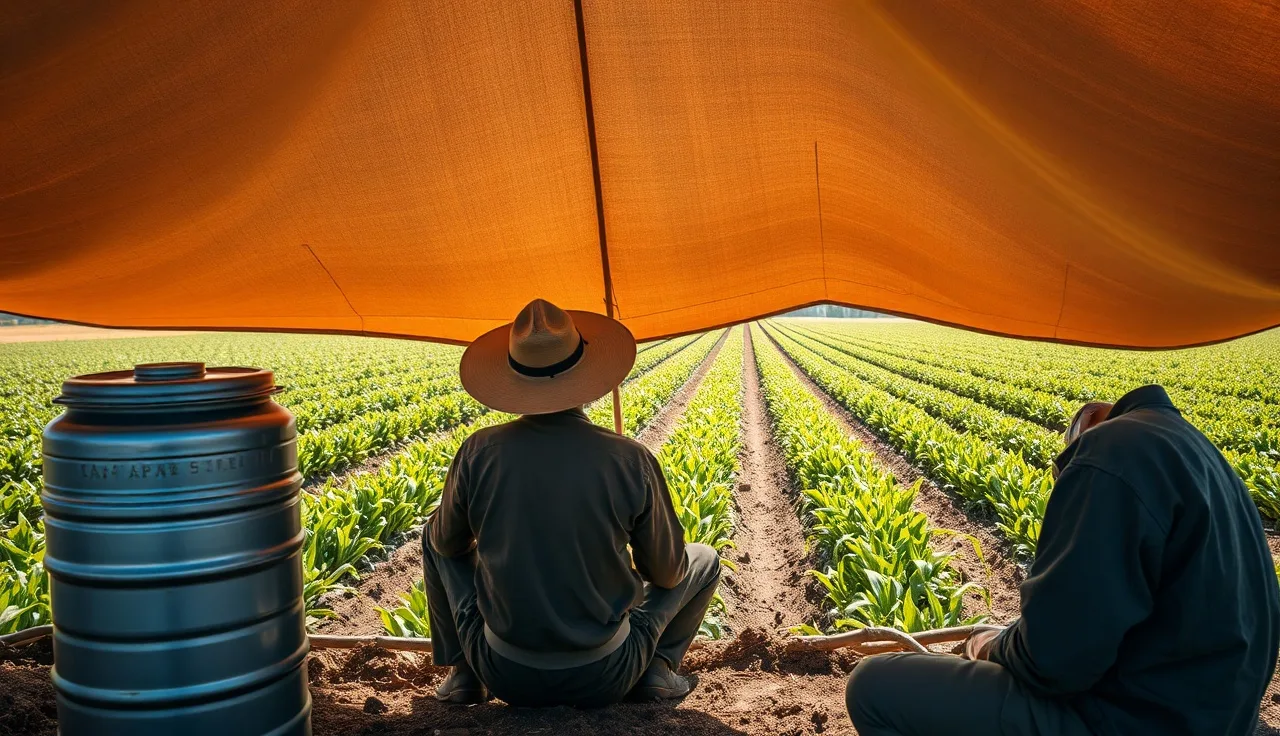
Shade. Employees have to be able to rest in shade whenever they feel the need. The shade has to be open to the air or ventilated, and big enough to fit everyone on a break at once. A tarp strung between two posts counts, as long as it actually blocks the sun.
Rest breaks. Your program names when workers take cool-down rest periods. California requires a cool-down rest of at least five minutes when a worker feels the need, and requires employers to watch workers during those breaks for signs of heat illness [3]. Your plan should also say what triggers mandatory breaks by temperature and heat index.
Acclimatization. This is the piece most small farms miss. New hires, and workers coming back after a week or more away, need a gradual introduction to heat. OSHA guidance recommends a 14-day schedule for new workers, starting at 20 percent of normal workload on day one and building from there [4]. Your written plan has to describe the schedule and name who enforces it.
Emergency response. Spell out what happens when someone shows signs of heat illness. Who calls 911. Who stays with the worker. The address of the nearest emergency room. Rural response times run 20 minutes or more, so your plan has to cover on-site first aid while you wait.
Training sits on top of all five. Supervisors and workers both need it before the first hot day, and you keep the records.
How serious is heat illness risk in farm work, and what does the data say?
Farm workers die of heat illness at rates near the top of any occupation. Bureau of Labor Statistics and NIOSH data both show crop, nursery, and greenhouse workers taking a share of heat deaths far larger than their share of the workforce [5].
NIOSH reviewed occupational heat deaths from 1992 to 2016 and found agriculture, forestry, fishing, and hunting accounted for 36 percent of all heat-related worker deaths, even though the sector employs a small slice of the total workforce [5]. Crop production runs roughly 20 times the all-industry heat fatality rate.
Heat exhaustion is the warning. Heat stroke is the emergency. A core body temperature above 104 degrees Fahrenheit (40 Celsius) can trigger organ failure within minutes. The cruel part: workers deep into heat stroke often can't recognize their own symptoms anymore, which is exactly why coworker and supervisor training matters as much as self-monitoring.
Humidity drives risk as hard as air temperature. The heat index, what it actually feels like, is what your body responds to. At 95 degrees Fahrenheit with 60 percent relative humidity, the heat index hits about 110 degrees Fahrenheit [12]. OSHA's heat index tool, at osha.gov/heat, sorts risk levels and precautions by heat index value [6].
What does a written heat illness prevention program look like in practice?
A workable program for a small farm is not a 40-page binder. For most operations it runs 4 to 8 pages and covers ten sections.
1. Scope and purpose. One paragraph naming which workers, locations, and seasons the program covers.
2. Responsibilities. Name the owner or manager who owns the program, and name the supervisors who monitor workers on each crew or shift. "Management is responsible" fails in an inspection.
3. Water provision. State the minimum available (one quart per person per hour is the California standard and a fair benchmark everywhere), where water sits relative to the work, and who restocks it.
4. Shade provision. Describe the shade, how it's positioned, and how a worker asks for a shade rest.
5. Rest break schedule. Include a table or decision tree tied to the heat index. For example: below 91 degrees, normal schedule; 91 to 103 degrees, a mandatory five-minute rest every hour plus more water; 103 to 115 degrees, limit strenuous work and add breaks; above 115 degrees, consider stopping outdoor work.
6. Acclimatization schedule. A table showing the workload cap for each of the first 14 days for new hires, and a shorter version (seven days is reasonable) for workers returning after more than a week away.
7. Signs and symptoms. Plain language on the difference between heat cramps, heat exhaustion, and heat stroke, and what supervisors and workers do for each.
8. Emergency procedures. The exact steps: recognize the emergency, call 911, give the farm address and access directions (GPS coordinates in rural areas), apply cooling (ice packs to neck, armpits, groin), stay with the worker until EMS arrives. Name the nearest hospital and its address.
9. Training requirements. State that all workers get training before the first hot day and that records are kept at least three years.
10. Program review. State that the program is reviewed and updated each year before heat season, and after any heat-related incident.
Want to skip the blank page? SafetyFolio's safety program generator builds a customized written heat illness prevention plan in about 15 minutes by asking about your farm's actual conditions.
What acclimatization schedule is required for new farm workers?
Acclimatization is how the body adapts to working in heat. It takes roughly 7 to 14 days of gradual exposure. OSHA guidance, built on NIOSH research, recommends new workers start at no more than 20 percent of full workload on day one and add no more than 20 percent each following day [4].
| Day | Maximum workload (% of full) |
|---|---|
| 1 | 20% |
| 2 | 40% |
| 3 | 60% |
| 4 | 80% |
| 5+ | 100% |
California's regulation addresses acclimatization for farm workers directly and requires supervisors to closely observe new workers through their first 14 days [3]. It also requires close observation of all workers during a heat wave, defined as any day expected to hit at least 80 degrees Fahrenheit and run at least 10 degrees hotter than the average high over the preceding five days.
For returning seasonal workers gone more than a week, a shorter re-acclimatization of about seven days is reasonable. Write it into the program explicitly. It's one of the most common gaps inspectors hunt for.
In plain terms: don't put a brand-new hire on the hardest crew, in the worst field, during the hottest week of summer, on day one. Bake the schedule into your onboarding checklist so it actually happens.
What training do farm supervisors and workers need for heat illness prevention?
Training differs for supervisors and workers, and your written program should document both.
Workers need training on the risk factors for heat illness (temperature, humidity, direct sun, physical exertion, lack of acclimatization, certain medications, alcohol use); your procedures for water, shade, and rest breaks; the right to take a preventive cool-down rest; the signs and symptoms of heat illness; how to report symptoms without fear of retaliation; and first aid steps if a coworker appears to be in trouble.
Supervisors need all of that plus more: how to spot early signs of heat illness in workers who aren't self-reporting; how to contact emergency services; the acclimatization policy and how to enforce it; and how to handle a worker who refuses water or rest (document it, then require it anyway as a condition of continued work).
Training happens before the first hot day of the season and before any new hire starts outdoor work. California requires training in a language the worker understands [3]. On farms with Spanish-speaking crews, Spanish-language training is a legal requirement, not a courtesy. OSHA posts free Spanish heat materials at osha.gov/heat.
Keep the records. Write the date, who attended, what you covered, and who taught it. A sign-in sheet stapled to your written program is fine. Inspectors ask for records, and "we go over it verbally every year" is not a defense.
Supervisors who want deeper credentials can look at OSHA training programs and the OSHA 30 course, which cover hazard recognition and emergency response in more detail.
What are the signs of heat stroke versus heat exhaustion, and how should farm programs address each?
Your written program should describe these clearly enough that any supervisor can act without looking anything up.
Heat cramps are painful muscle spasms, usually in the legs or belly. An early warning. Move the worker to shade, give water or a sports drink, rest. Not an emergency by itself, but a signal to watch that person closely.
Heat exhaustion brings heavy sweating, weakness, cool and pale or flushed skin, a fast and weak pulse, nausea or vomiting, and sometimes fainting. The worker is usually still conscious and aware. Move to shade or air conditioning, give cool water, apply cool wet cloths. If symptoms don't improve within 15 minutes, call 911.
Heat stroke is a medical emergency. Look for a body temperature above 103 degrees Fahrenheit, hot and red skin (may or may not be sweating), a rapid and strong pulse, and possible confusion or unconsciousness. Call 911 immediately. While you wait, cool the worker fast by any means available: cold water immersion if you can, ice packs to the neck, armpits, and groin, or wet sheets and fanning. Never give fluids to someone unconscious.
Mixing up heat exhaustion and heat stroke is common and dangerous. When in doubt, treat it as heat stroke and call 911. Put that sentence in your program word for word.
Make sure supervisors know the physical address and nearest cross streets of every field where a crew works, because the first thing a 911 dispatcher asks is where you are. In rural areas, drop GPS coordinates into the program next to the street address.
How do state OSHA heat rules differ from federal OSHA for farms?
Twenty-two states and two territories run their own OSHA-approved plans and can set standards stricter than federal OSHA [7]. Several have done exactly that for outdoor heat.
| State | Key requirement beyond federal | Standard/rule |
|---|---|---|
| California | Written plan, 1 qt water/hr, acclimatization schedule, heat wave provisions | Title 8 CCR § 3395 |
| Washington | Written plan, shade or cooling measures, acclimatization plan | WAC 296-62-095 |
| Oregon | Written plan, water and shade standards, emergency communication | OAR 437-002-0155 |
| Minnesota | Written heat illness prevention procedures | MN OSHA Chapter 5205 |
| Colorado | Proposed rulemaking ongoing as of 2024 | TBD |
Federal OSHA has no heat-specific standard yet, for agriculture or any industry. The rule proposed in August 2024 would create a new subpart for heat injury and illness prevention across industries, but it wasn't finalized as of mid-2025 [2]. The proposal would require written plans, water, rest, and shade provisions much like what California already mandates.
In a state plan state, your state's rule is the floor, not the General Duty Clause. California growers face the most detailed requirements. Washington and Oregon growers are close behind. No matter where you farm, writing to California's standard is a solid way to be confident you've covered the bases federally and in any state.
What records do small farms need to keep related to heat illness prevention?
Record-keeping for a heat illness program is lighter than for many other OSHA programs, but it's still required and it matters during an inspection.
Keep these.
The written program itself. The current version plus at least the prior two years. Date each one so you can show annual review.
Training records. Date, attendees, content, trainer. Three years is a reasonable retention period, and California requires three years for some programs.
Injury and illness records. Any heat illness that causes days away from work, restricted work, medical treatment beyond first aid, or loss of consciousness goes on the OSHA Form 300 log [8]. Farms with 10 or fewer employees are generally exempt from the 300 log unless OSHA or BLS requests records. Keep them anyway, because a heat death triggers a federal investigation regardless of farm size.
Incident reports. For any heat incident, even a near-miss, write an incident report covering what happened, who was involved, the conditions (temperature, humidity, heat index), the treatment given, and the corrective action. This protects you and sharpens the program.
Acclimatization records. A log of new-hire start dates and their schedule. A simple spreadsheet does it.
Store all of this somewhere you can grab it fast. An inspector who shows up after a hospitalization will want the written program, training records, and prior incident reports inside the first hour.
How do you write a heat illness prevention program if you've never done it before?
Start with OSHA's free resources. The osha.gov/heat page has model programs, Spanish materials, and a heat index tool [6]. NIOSH publishes guidance built for agricultural settings. California's Division of Occupational Safety and Health (Cal/OSHA) publishes a sample written plan any farm can adapt, even outside California, because it meets or exceeds what federal OSHA enforces [3].
Here's a realistic path for an owner who just needs it done.
1. Download Cal/OSHA's sample Heat Illness Prevention Plan. 2. Replace placeholder names and locations with your farm's real information. 3. Add your emergency contact numbers, the address and GPS coordinates of each field, and your supervisor names. 4. Write out your acclimatization schedule using the 14-day table above. 5. Have your supervisors read the finished document and sign it. 6. Train your workers before the first hot day, using the document as your outline. 7. Set a calendar reminder to review it next March.
The first pass runs 60 to 90 minutes. After that, annual updates take 15 to 20.
Want something tailored without starting from scratch? SafetyFolio builds a written heat illness prevention program specific to your operation in about 15 minutes, ready to download, sign, and file the same day.
Here's what's a waste of money for most small farms: hiring a safety consultant to write this at $150 to $300 an hour. The program isn't complicated enough to justify that. The free and low-cost tools are genuinely good enough for farms under 50 employees.
What happens if a farm worker gets heat stroke and OSHA investigates?
A heat stroke hospitalization or death pulls OSHA in automatically. Under 29 CFR 1904.39, you must report any work-related hospitalization within 24 hours and any fatality within 8 hours [8]. Failing to report is a separate citation.
Once inspectors arrive, they look for your written program first. No program means a General Duty Clause citation, which as of 2024 carries a proposed penalty of up to $16,550 per serious violation, adjusted annually for inflation [9]. Willful or repeated violations reach $165,514 each.
A death means a harder investigation. OSHA interviews supervisors and coworkers, reviews training records, checks any water and shade logs you kept, and examines the acclimatization schedule. In heat fatality cases, OSHA has proposed penalties of $100,000 or more when there was no written program and workers had no training.
A written program doesn't guarantee a clean inspection. But it shows good faith and gives investigators something to evaluate instead of a blank. An employer with a documented program who had an incident despite following it gets treated very differently from one who had nothing.
For how OSHA inspections run and what to expect, see our OSHA basics coverage.
What's the quickest way for a small farm to get compliant before summer?
The honest short answer: you can be legally compliant in one afternoon.
Step one, write or download your written Heat Illness Prevention Program (this article and Cal/OSHA's sample give you everything). Step two, train your supervisors, about an hour using OSHA's free outline. Step three, train your workers before the first hot day, about 30 minutes per crew. Step four, set up water and shade before anyone goes into the field.
The physical gear costs real money, and that's worth being straight about. A shaded rest area for 10 workers runs from a $50 tarp and poles to a $2,000 portable canopy, depending on what you already own. Water costs almost nothing if you have potable water on-site. Ice for cooling is a few dollars a day. None of this is a reason to skip the program. It's a planning line item.
If acclimatization scheduling feels hard to run day to day, the simplest fix is a laminated card for each supervisor listing which crew members are in their first 14 days and what workload cap applies today. Low tech, easy to audit.
Supervisors who want broader safety knowledge can look at the OSHA 30 training course, which covers hazard recognition, emergency response, and program management across many hazard categories and runs about 30 hours. It isn't required for heat compliance, but it's worth a look for anyone running field crews.
Frequently asked questions
Does a farm with only one or two employees need a written heat illness prevention program?
Yes. Federal OSHA's General Duty Clause applies to any employer with at least one employee, including a sole proprietor with a single seasonal worker. State plan states like California require a written plan regardless of farm size. One worker sick enough to be hospitalized can trigger an OSHA inspection and citations no matter how small the operation.
Is there a free template for an agricultural heat illness prevention program?
Yes. Cal/OSHA publishes a sample Heat Illness Prevention Plan any farm can adapt, even outside California. OSHA's national heat page at osha.gov/heat has free checklists and training materials in English and Spanish. These free templates meet or exceed what federal OSHA enforces under the General Duty Clause, so they're a fine starting point anywhere.
How much water does OSHA require farms to provide to outdoor workers?
California's Title 8 CCR Section 3395 requires at least one quart (roughly one liter) of cool, potable water per employee per hour. Federal OSHA doesn't specify a quantity in its current standards but uses California's one-quart figure as a benchmark in General Duty Clause enforcement. Water has to sit close to workers, not somewhere across the property.
Do migrant and seasonal farmworkers have the same heat protection rights as permanent employees?
Yes. OSHA protections under the Occupational Safety and Health Act cover all employees, including undocumented workers, temporary workers, H-2A visa workers, and day laborers. Migrant and seasonal workers get the same water, shade, rest breaks, acclimatization, and training as anyone else. Retaliation against a worker for reporting heat symptoms is prohibited under Section 11(c) of the OSH Act.
How long does acclimatization take for a new farm worker in heat?
Physiological acclimatization takes roughly 7 to 14 days of gradual exposure. OSHA guidance based on NIOSH research recommends starting new workers at 20 percent of full workload on day one and adding 20 percent each day. California requires close supervision of new workers through their first 14 days. Workers back after more than a week away need a shorter re-acclimatization of about seven days.
What is the heat index level at which OSHA considers risk to be very high or dangerous?
OSHA's heat index risk table calls a heat index of 91 to 103 degrees Fahrenheit 'high risk,' 103 to 115 'very high risk,' and above 115 'extreme or imminent danger.' At very high risk, OSHA recommends extra precautions: limiting strenuous work during the hottest hours, adding rest breaks, and putting a buddy system in place.
Does the heat illness prevention program need to be written in Spanish for farms with Spanish-speaking workers?
California's regulation requires training in a language the worker understands, which means Spanish for most California farmworkers. Federal OSHA's General Duty Clause enforcement also expects hazards to be communicated so workers understand them. A program that exists only in English, on a crew that speaks only Spanish, would not meet the training requirement. OSHA posts free Spanish heat materials at osha.gov/heat.
What is a heat wave and does a farm need special procedures for one?
California's Title 8 CCR Section 3395 defines a heat wave as any day expected to reach at least 80 degrees Fahrenheit and run at least 10 degrees hotter than the average high over the preceding five days. During a heat wave, farms must add precautions: closer monitoring of all workers, not only new ones, and more frequent check-ins. Your written program should address heat wave conditions directly.
Can a farm worker refuse to work in extreme heat, and what should the employer do?
Workers have a protected right to refuse work they reasonably believe poses imminent danger of death or serious physical harm, under OSHA's imminent danger provisions. If a worker refuses in extreme heat, document the refusal and conditions, fix the hazard (add shade, water, breaks, cut workload), and do not terminate or discipline the worker for it. Retaliation for safety complaints is a separate OSHA violation.
How often does the heat illness prevention program need to be updated?
Review it at least once a year before heat season, usually late winter or early spring. Also update after any heat incident, after a change in work locations or crew size, or when your state's rules change. Date each version so an inspector sees the program has been maintained. Annual review is good practice even when nothing changed.
What are the OSHA penalties for heat illness violations in agriculture?
OSHA cites heat violations under the General Duty Clause as serious violations, up to $16,550 per violation as of 2024, adjusted annually for inflation. Willful or repeated violations reach $165,514 each. In heat fatality cases, total proposed penalties have topped $100,000. Prompt abatement and good-faith cooperation can reduce penalties, but the baseline is steep.
Does a farm need to have a heat illness plan even if temperatures rarely exceed 90 degrees?
Heat illness risk starts lower than most people expect, especially with high humidity. OSHA's risk table flags heat index values above 91 degrees Fahrenheit as high risk, and the heat index can hit that when air temperature is in the low 80s with heavy humidity. Acclimatization is a risk factor on its own, apart from peak temperature. Most U.S. farm regions see conditions that call for a plan during growing season.
What first aid should be on-site for heat illness, and does OSHA specify what's required?
OSHA doesn't publish an exact first aid list for heat, but enforcement expects you to be able to cool a worker fast while waiting for EMS. At minimum: cool drinking water, ice packs or a cooler of ice for external cooling (neck, armpits, groin), and a phone that works at the site. Where cell coverage is unreliable, a backup communication plan (radio, satellite phone) belongs in the written program.
Are there federal funds or grants to help small farms pay for heat illness prevention infrastructure?
OSHA's Susan Harwood Training Grant Program funds nonprofits to deliver free safety training to small employers, including heat training for farm workers. USDA Rural Development programs sometimes support infrastructure. Some state agriculture departments run cost-share programs. None directly reimburse shade structures or cooling gear, but free training resources cut the real cost of compliance.
Sources
- OSHA, General Duty Clause, Section 5(a)(1) of the Occupational Safety and Health Act: Federal OSHA requires employers to protect workers from recognized hazards likely to cause death or serious physical harm, including heat illness, under the General Duty Clause.
- OSHA, Proposed Rule: Heat Injury and Illness Prevention in Outdoor and Indoor Work Settings, Federal Register August 2024: Federal OSHA published a proposed heat injury and illness prevention rule in August 2024; it had not been finalized as of mid-2025.
- OSHA, Occupational Exposure to Heat and Hot Environments: Revised Criteria 2016 (NIOSH Publication 2016-106): OSHA and NIOSH acclimatization guidance recommends new workers start at 20 percent of full workload on day one and increase by 20 percent per subsequent day over a 14-day schedule.
- NIOSH, Work-Related Heat Illness Surveillance, United States 1992-2016: Agriculture, forestry, fishing, and hunting accounted for 36 percent of all heat-related worker deaths from 1992 to 2016 despite employing a small fraction of the total workforce.
- OSHA, Heat Index and Resources, osha.gov/heat: OSHA's heat index risk table categorizes heat index values above 91°F as high risk, 103-115°F as very high risk, and above 115°F as extreme or imminent danger.
- OSHA, State Plans Program: Twenty-two states and two territories operate OSHA-approved state plans and can set standards stricter than federal OSHA; California, Washington, and Oregon have explicit outdoor heat standards.
- OSHA, Injury and Illness Recordkeeping and Reporting Requirements, 29 CFR 1904.39: Employers must report work-related hospitalizations within 24 hours and fatalities within 8 hours under 29 CFR 1904.39.
- OSHA, OSHA Penalties: OSHA serious violations carry proposed penalties up to $16,550 per violation as of 2024 (adjusted annually); willful or repeated violations can reach $165,514 per violation.
- Washington State Department of Labor and Industries, WAC 296-62-095 Outdoor Heat Exposure: Washington State's outdoor heat exposure rule WAC 296-62-095 requires a written plan, shade or cooling measures, and an acclimatization plan for outdoor workers.
- Oregon OSHA, OAR 437-002-0155 Heat Illness Prevention: Oregon's heat illness prevention rule OAR 437-002-0155 requires a written heat illness prevention plan, water and shade standards, and emergency communication procedures.
- CDC/NIOSH, Heat Stress in the Workplace: A Guide for Employers: At 95°F with 60% relative humidity, the heat index reaches approximately 110°F, significantly elevating physiological risk for outdoor workers.