Last updated 2026-07-10
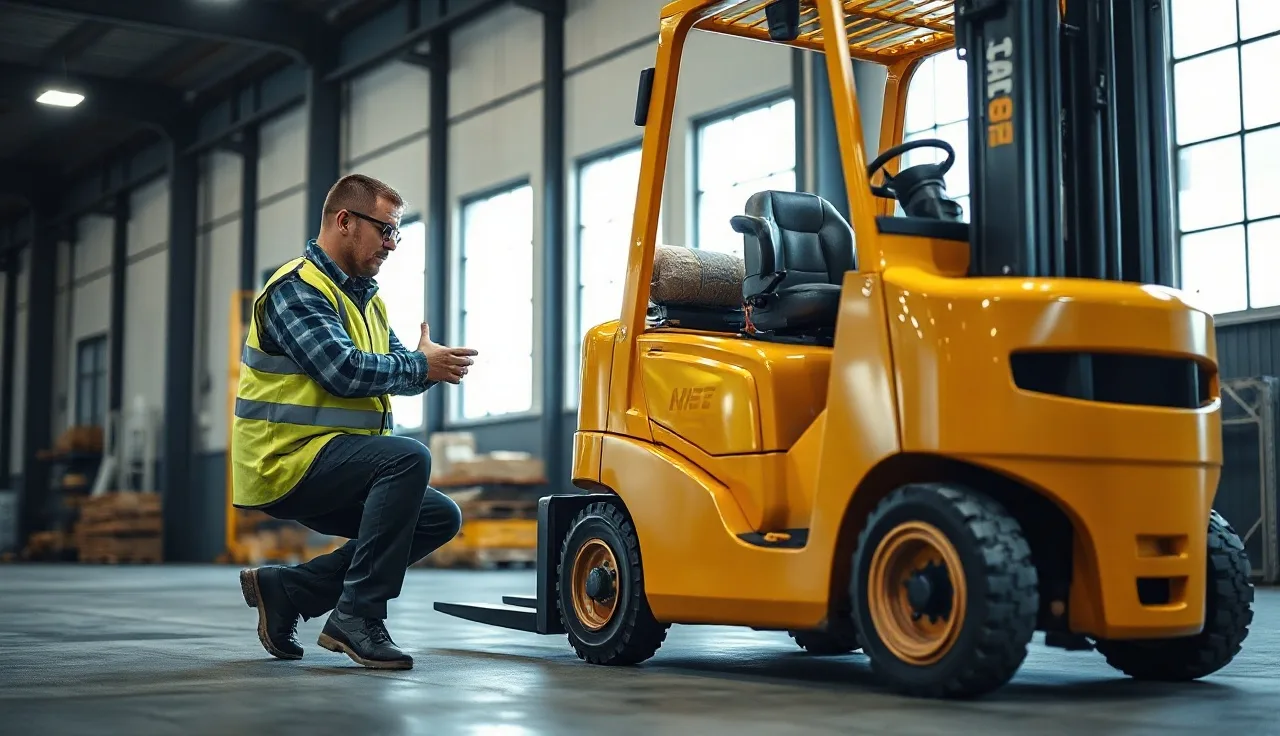
TL;DR
OSHA's 29 CFR 1910.178(q)(1) requires powered industrial trucks to be inspected before each shift, or every 12 hours for round-the-clock operations. The check covers operational systems and safety systems. The standard never mentions written records, but OSHA expects documented proof of compliance, and missing paperwork is one of the easiest citations an inspector can write.
What does OSHA actually require for forklift inspections?
OSHA requires that every forklift is examined before it goes into service, and stays parked if the exam turns up anything that makes it unsafe. The governing rule is 29 CFR 1910.178(q)(1): "Industrial trucks shall be examined before being placed in service, and shall not be placed in service if the examination shows any condition adversely affecting the safety of the vehicle." [1] That's the whole standard, quoted word for word. It says nothing about checklists, paper forms, or how long to keep anything. OSHA left the how deliberately open.
In practice, the inspection happens before every shift. A warehouse running two shifts inspects each truck twice a day. For a 24-hour operation, the standard swaps the shift trigger for a clock trigger: every 12 hours. [1]
The check must include items listed in the operator manual and catch any condition that could make the truck unsafe. OSHA fills the gaps the regulation leaves open through its powered industrial trucks eTool and through letters of interpretation. [2]
Run forklifts outdoors or in rough conditions? Add a post-shift walkthrough. The standard doesn't require it, but 29 CFR 1910.178(q)(2) says trucks with defects found during use come out of service right away, so a two-minute end-of-shift look catches what an operator noticed mid-shift before the next crew inherits a damaged machine. Cheap insurance.
To see how this rule fits a facility's bigger picture, our OSHA overview shows where standards like this one land inside a written safety program.
What items must be on a forklift pre-shift inspection checklist?
OSHA never publishes a universal checklist. 29 CFR 1910.178(q) points to the truck's manufacturer manual and requires checking "the condition of the industrial truck." [1] OSHA's eTool and training materials fill in a working list that mirrors what inspectors look for during citations. [2]
Split the check in two: items you verify with the truck off, and items you verify with the power on.
Pre-start (truck off)
| Inspection Item | What to Look For |
|---|---|
| Fluid levels (oil, coolant, hydraulic fluid, battery water) | Low levels, leaks, contamination |
| Fuel system / battery | LPG hose cracks, battery cable fraying, electrolyte leaks |
| Tires and wheels | Cuts, chunking, low pressure, loose lug nuts |
| Forks and carriage | Cracks, welds, blade wear, heel wear exceeding 10% of original thickness [3] |
| Mast and chains | Wear, stretch, cracks, lubrication |
| Overhead guard | Missing, bent, cracked |
| Load backrest extension | Present and secure |
| Nameplate / data plate | Readable and attached |
| Seatbelt or restraint | Functional, not frayed |
| Fire extinguisher (if required by type) | Fully charged, accessible |
Operational checks (engine/power on, in a safe area)
| Inspection Item | What to Look For |
|---|---|
| Steering | Excessive play, pulling to one side |
| Service brakes | Stopping distance, grab, feel |
| Parking brake | Holds on rated slope |
| Inching/control pedals | Smooth engagement, no sticking |
| Hydraulic controls (lift, tilt, attachments) | Smooth, no drifting, correct speed |
| Horn | Audible |
| Lights (travel, warning, strobe) | Functional |
| Hour meter | Reading and recording |
| Unusual noises or vibration | Note and investigate |
Fork wear earns extra attention. The Industrial Truck Association says forks should be retired once the blade or shank thickness wears to 90% of original, meaning 10% wear. [3] Most operators never measure this until something goes wrong. Toss a caliper or a go/no-go gauge in your inspection kit if your forks run heavy loads every day.
Electric forklifts add battery steps: check electrolyte after charging, inspect cables and connectors, look for terminal corrosion, confirm the battery restraint is secure. A swollen or leaking battery is an immediate out-of-service condition, no debate.
Using attachments (clamps, rotators, slip-sheets)? Each one gets inspected like the base truck. The data plate changes with the attachment, so your form should note which attachment was mounted during each inspection.
Does OSHA require written forklift inspection records?
No, the regulation never says you must keep written records. 29 CFR 1910.178(q) is silent on paperwork. [1] Here's the catch that surprises small businesses: during an OSHA inspection or after an incident, you have to show that pre-shift inspections happened. If you can't, the compliance officer has no reason to believe they did.
OSHA letters of interpretation have addressed this sideways. The agency's position is that documentation is the only practical way to prove compliance with the pre-shift requirement, and citations under 1910.178(q)(1) routinely list missing records as evidence of non-compliance. [2]
So the honest answer is keep records anyway. Every inspection, written or electronic. At minimum each record shows the date, shift, truck ID or serial number, operator's name, and a pass/fail result for each point. Any defect needs a description, a note on whether the truck came out of service, and the date and name of whoever fixed it or cleared it to run again.
How long do you keep them? 1910.178 sets no retention period. Most safety pros keep forklift logs at least a year, longer if your industry adds requirements. OSHA's recordkeeping rule under 29 CFR 1904 requires injury records for five years, so any inspection record tied to an incident should stay for five too. [4] Some attorneys treat three years as a defensible baseline for routine logs.
Electronic records are fine. A spreadsheet, a tablet form, or a fleet app all work as long as records are retrievable, tamper-evident, and stored somewhere they survive a dead laptop.
What happens if a forklift fails inspection?
It comes out of service, full stop. 29 CFR 1910.178(q)(2) says: "If the deficiency is of a nature that the vehicle presents a hazard, the vehicle shall be taken out of service until restored to safe operating condition." [1]
Out of service means out of service. The truck gets tagged (many facilities use a physical lock or a visible "DO NOT OPERATE" tag), and no operator moves it for any reason, including a trip to the shop, without clearing it through maintenance first. This is where lockout tagout procedures apply during repairs, especially when the truck needs servicing with the power source engaged.
Document the whole chain: the defect, the out-of-service call, the repair, and the return-to-service clearance. Your form needs a field for each. Some companies run a two-part form, where the operator fills out the inspection and a supervisor or mechanic signs off on the repair before the truck goes back to work.
Minor defects that don't create an immediate hazard (a small oil drip that isn't hurting performance, a horn a little quieter than usual) still get noted and scheduled for repair. Skipping the note is how a small issue turns into a citation or an injury.
How do forklift inspections connect to operator training and certification?
Inspections and training live under the same standard but count as separate requirements. 29 CFR 1910.178(l) requires operators to be trained and evaluated before they run a forklift, and that training must cover pre-operation inspection. [5] An operator who was never taught what to look for is a double exposure: the employer can be cited under both (l) and (q).
Training is where a lot of small businesses under-invest. The standard requires training on the specific truck types an operator will use, not generic forklift training. Trained on a sit-down counterbalance and now driving a reach truck? Additional training is required. [5]
Our forklift certification guide walks through exactly what operator training has to cover and how to document it.
The Bureau of Labor Statistics ties forklifts to roughly 85 fatal work injuries a year in the United States, plus about 34,900 serious injuries annually. [6] Pre-shift inspection is one of the few controls that catches the mechanical defects behind those numbers before an operator ever climbs in.
OSHA also requires re-evaluation every three years, and sooner whenever an operator is seen driving unsafely, is in an incident or near-miss, or gets assigned a different truck type. [5] Your inspection records can surface patterns worth flagging: the same operator missing defects, the same truck developing the same fault. Both should trigger a re-evaluation or a maintenance review.
What's the right format for a forklift inspection form?
There's no federally mandated form. OSHA publishes no official template, and 1910.178 names no form number. What matters is that the form covers every inspection point for your truck type and pushes the operator to record defects clearly.
A good form has: truck ID and hour meter reading, date and shift (or time), operator's printed name and signature, a checklist with each item as its own row, a pass/fail column for each item, a defect description field, an out-of-service checkbox with date and who was notified, and a repair sign-off.
Keep it to one page. Longer forms get skimmed. An operator running a pre-shift check at 5:45 AM in a cold warehouse fills out a one-page form correctly far more often than a three-page one.
Many manufacturers tuck a blank inspection form into the truck's documentation packet. Those are a fine starting point. Industry groups like the Industrial Truck Association publish guidance on inspection elements, and OSHA's eTool has a checklist framework you can adapt. [2]
Run multiple truck types (sit-down counterbalance, stand-up reach, order pickers, pallet jacks)? Build a separate form for each. The inspection points for an electric pallet jack differ meaningfully from a propane counterbalance.
Building this documentation from scratch is where a lot of small businesses stall out. SafetyFolio's safety program generator builds a customized forklift inspection form and written program in about 15 minutes, matched to your truck types and documentation preferences, no consultant required.
What are OSHA's most common forklift citation violations?
OSHA's powered industrial truck standard, 29 CFR 1910.178, lands in the top 10 most frequently cited OSHA standards year after year. [7] The specific violations that show up most often:
| Violation | CFR Reference | Typical Fine Range (2024) |
|---|---|---|
| Operator training not completed or documented | 1910.178(l) | Up to $16,131 per serious violation [8] |
| Pre-shift inspection not performed or documented | 1910.178(q)(1) | Up to $16,131 per serious violation [8] |
| Truck not removed from service when defective | 1910.178(q)(2) | Up to $16,131 per serious violation [8] |
| Seatbelt not used or not functional | 1910.178(e) | Up to $16,131 per serious violation [8] |
| Traveling with load elevated | 1910.178(n)(4) | Up to $16,131 per serious violation [8] |
OSHA adjusts its maximum penalties every year for inflation. As of January 2024, the ceiling for a serious violation is $16,131 per violation. Willful or repeated violations can reach $161,323 each. [8]
The inspection citation is unusually easy for OSHA to prove. An inspector shows up, asks for the last 30 days of inspection logs, and you either have them or you don't. Compare that to an ergonomics citation, which takes observation and analysis. Missing inspection records are an instant citation with no gray area.
A repeat violation, meaning the same standard cited again within five years of a prior citation, is penalized at ten times the normal rate. A warehouse that gets cited for missing logs, cleans it up, slides back into old habits, and gets re-cited can face a $161,000 penalty for the same paperwork failure.
How should forklift inspection records be stored and organized?
Paper or digital, both work. The real question is whether you can put your hands on a record when you need it, which means a defined filing system, not a pile of forms in a drawer.
For paper, a 3-ring binder per truck, organized by month, does the job. Label each binder with the truck ID and the year. Keep completed binders accessible (not buried in storage) for at least a year.
For digital, options run from free (a shared Google Sheet with one tab per truck) to paid fleet platforms. Digital records are searchable, reachable remotely, and harder to lose. The tradeoff is that operators need a consistent way to submit the inspection, which means a tablet or phone at the truck, or a kiosk near the shift-start entrance.
Whatever you pick, somebody has to check that inspections are actually getting submitted. A missing entry isn't only a compliance gap. It often means the inspection never happened, or an operator started a shift without touching the truck.
Your inspection records feed straight into your incident reporting. When a forklift is in an injury, the first thing anyone (OSHA, your insurance carrier, a plaintiff's attorney) asks for is the maintenance history and inspection records for that exact truck. A clean record showing steady inspections and quick repairs is a real asset. A gap-riddled or missing record is the opposite. Our incident report guide covers what to document when something goes wrong.
Do forklift inspection requirements differ for different types of trucks?
The core rule, inspect before each shift, applies to every powered industrial truck under 29 CFR 1910.178 no matter the type. [1] What changes is the specific inspection items, which shift with the power source and the truck design.
OSHA sorts powered industrial trucks into seven types (Type I through Type VII) based on design, indoor or outdoor use, and whether they run in hazardous locations. [9] The inspection form for each type should reflect those differences.
LPG (propane) forklifts: Check the tank for dents and cracks, inspect the hose and connections for leaks (soapy water if you suspect one), confirm the tank is secured, check the regulator and relief valve.
Electric forklifts and reach trucks: Battery water levels (check only after charging, never before), electrolyte condition, cable and connector integrity, battery restraint, charging contacts. Electric trucks drop the fuel-system checks and add battery-specific ones.
Order pickers and narrow-aisle trucks: Fall protection is its own concern. Operators working at height need a full body harness clipped to the truck's anchor point. Inspect the harness and lanyard during the pre-shift check.
Rough terrain forklifts: Tougher tire inspection, extended fluid checks, and stabilizer checks if equipped.
Electric pallet jacks (walkies) still fall under 1910.178 as powered industrial trucks. Plenty of small businesses assume pallet jacks are exempt. They aren't, though the checklist is shorter.
The manufacturer's manual is the authoritative source for type-specific items, and 29 CFR 1910.178(q) points to it directly. No manual for an older truck? The manufacturer or a dealer can usually supply one, and many are posted on manufacturer websites.
What does a compliant forklift written program look like beyond the checklist?
The pre-shift checklist is one piece of a compliant powered industrial truck program. 29 CFR 1910.178 requires several other documented elements that inspectors expect to see together.
A complete written program usually includes: a policy statement naming who owns the program, operator training procedures and competency evaluation records, a list of authorized operators for each truck type, pre-shift inspection procedures with the forms, a defect reporting and out-of-service procedure, a maintenance and repair log per truck, a fueling and charging safety procedure, and traffic rules for pedestrians and trucks in your facility.
The authorized-operator list matters more than most employers realize. OSHA's training standard requires training specific to the truck type, and you have to prove each authorized operator was trained and evaluated on the truck types on your list. [5]
OSHA also requires that forklifts be modified or altered only with the manufacturer's approval, and that the data plate be updated when a change (like adding an attachment) alters the truck's rated capacity. [1] The data plate line on your checklist isn't only about legibility. It's about the plate being accurate for the current setup.
Our OSHA training guide covers how facility-wide training requirements shape the context your forklift program sits inside. A program that lives in a binder no one opens is technically compliant and practically useless. Build it so the people driving forklifts every day can find what they need in under a minute.
Frequently asked questions
How often is a forklift required to be inspected under OSHA?
29 CFR 1910.178(q)(1) requires inspection before each shift. For operations running 24 hours continuously, the standard specifies at least every 12 hours. A three-shift facility with 5 forklifts needs 15 documented inspections every 24 hours. There's no annual or monthly cycle that substitutes for the pre-shift requirement.
Does OSHA provide an official forklift inspection checklist form?
No. OSHA doesn't publish or require a specific form. The powered industrial trucks eTool gives guidance on what to include, but employers build their own. The form should match the truck type, reflect the manufacturer's inspection guidance, and include space to document defects and their resolution. Many truck manufacturers include a sample checklist in the operator manual.
Can an operator fail a forklift inspection and keep using the truck?
No, if the defect affects safety. 29 CFR 1910.178(q)(2) requires the truck to come out of service when a deficiency makes it hazardous. Minor issues that don't create an immediate hazard can sometimes allow limited use pending repair, but that judgment must be documented and the defect fixed promptly. When in doubt, take it out of service.
Who is responsible for conducting the forklift pre-shift inspection?
The standard puts the obligation on the employer to ensure inspections happen, but in practice the operator assigned to the truck runs the pre-shift check. The operator should be trained on the procedure as part of forklift operator training under 29 CFR 1910.178(l). A supervisor or lead can inspect if the operator changes mid-shift, but each shift needs its own inspection.
Are electric pallet jacks subject to the same OSHA inspection requirements as forklifts?
Yes. Powered industrial trucks under 29 CFR 1910.178 include electric pallet jacks. They require pre-shift inspection, and operators must be trained and evaluated. The checklist is shorter than for a sit-down counterbalance, but the inspection obligation and documentation expectation are the same. Manual (non-powered) pallet jacks are not covered by 1910.178.
What should I do if my forklift inspection records are incomplete or missing?
Start building accurate records going forward, today. You can't retroactively document inspections that never happened, and fabricating records is worse than having none. Run an internal audit to size the gap, put a corrective action plan in writing, and set up a system that makes daily documentation realistic for your operators. If OSHA shows up, honest acknowledgment of a corrective action in progress beats no explanation.
How long should forklift inspection records be kept?
1910.178 doesn't set a retention period. The most common guidance from safety practitioners is at least one year for routine daily logs. Records tied to an injury, near-miss, or equipment failure should be kept at least five years to match OSHA's injury recordkeeping rule under 29 CFR 1904. Check with your insurance carrier too. Some policies set their own retention expectations.
What are the fines for not doing forklift inspections?
A serious violation of 29 CFR 1910.178(q) carries a maximum penalty of $16,131 per violation as of January 2024. Willful or repeated violations can reach $161,323 each. OSHA can cite each truck or each shift as a separate violation, so the total climbs fast in a larger facility. Missing inspection records are among the easiest violations for a compliance officer to document.
Can forklift inspections be done using a mobile app or tablet?
Yes. OSHA accepts electronic records. A tablet form, a mobile app, or a shared digital spreadsheet satisfies the documentation requirement as long as records are retrievable and accurate. The practical advantage is that digital submissions timestamp automatically, which removes any question about whether inspections happened at the right time. Make sure the device and software are reachable before shift start.
What should a forklift inspection record include at minimum?
At minimum: truck ID or serial number, date and shift or time, operator's name and signature, a result for each inspection item (pass/fail or yes/no), a written description of any defects found, a note on whether the truck was taken out of service, and a repair sign-off when defects are corrected. Adding the hour meter reading helps track maintenance intervals and tie defects to usage.
Do outdoor or rough-terrain forklifts need to be inspected differently?
The same pre-shift obligation applies, but the checklist items differ. Rough-terrain forklifts require more detailed tire inspections (pneumatic tires that may puncture, tread wear on uneven surfaces), extended hydraulic fluid checks, and inspection of stabilizers and four-wheel drive components if applicable. Always follow the manufacturer's manual for type-specific points, which OSHA's standard cross-references explicitly.
Is a forklift inspection the same as a forklift maintenance inspection?
No. The daily pre-shift inspection is an operator-level safety check, not a maintenance service. Maintenance inspections are more thorough, done by a qualified mechanic, and happen on a scheduled interval based on hours of use or calendar time (the manufacturer's manual sets the intervals). Both are required, but they serve different purposes. Your written program should address both and keep records for each separately.
What should happen when a forklift inspection reveals a safety defect?
The operator records the defect on the form, notifies a supervisor or maintenance right away, and the truck comes out of service if the defect creates a hazard under 1910.178(q)(2). A visible tag or physical lock keeps other operators off it. Maintenance assesses and repairs the issue, then signs off on the return-to-service. Document the entire sequence on the same record as the original inspection.
Sources
- OSHA, 29 CFR 1910.178 - Powered Industrial Trucks: Industrial trucks shall be examined before being placed in service; if a deficiency makes the vehicle a hazard it shall be taken out of service; 24-hour operations require inspection every 12 hours.
- OSHA, Powered Industrial Trucks eTool: OSHA eTool provides inspection checklist guidance and compliance information for powered industrial trucks.
- Industrial Truck Association, Fork Inspection Guidance: Forks should be removed from service when blade or shank thickness has worn to 90% of original dimensions (10% wear limit).
- OSHA, 29 CFR 1904 - Recording and Reporting Occupational Injuries and Illnesses: OSHA requires injury and illness records to be retained for five years.
- OSHA, 29 CFR 1910.178(l) - Powered Industrial Trucks Operator Training: Operators must be trained and evaluated on the specific type of truck they will operate; re-evaluation required every three years and after observed unsafe operation, an incident, or assignment to a different truck type.
- Bureau of Labor Statistics, Census of Fatal Occupational Injuries: Forklifts are involved in approximately 85 fatal work injuries per year and roughly 34,900 serious injuries annually in the United States.
- OSHA, Top 10 Most Frequently Cited Standards: 29 CFR 1910.178, powered industrial trucks, consistently ranks among OSHA's top 10 most frequently cited standards.
- OSHA, Penalties: As of January 2024, the maximum penalty for a serious OSHA violation is $16,131 per violation; willful or repeated violations can reach $161,323 per violation.
- OSHA, 29 CFR 1910.178(b) - Truck Classifications: OSHA classifies powered industrial trucks into seven types (Type I through Type VII) based on design characteristics and operating environment.