Last updated 2026-07-09
TL;DR
A fall protection kit bundles the personal fall arrest gear that OSHA expects: a full-body harness, a shock-absorbing lanyard or self-retracting lifeline, and the connectors that tie it together. OSHA requires fall protection at 4 feet in general industry (29 CFR 1910.28) and 6 feet in construction (29 CFR 1926.502). Kits run $80 to $500 or more depending on components and rating.
What is a fall protection kit and what does it include?
A fall protection kit is a pre-assembled set of personal fall arrest system (PFAS) components sold together so the parts are compatible and tested as one system. Buying pieces separately looks like a way to save money. It's a real problem inspectors flag, because mismatched gear can fail in ways no single-component test predicts.
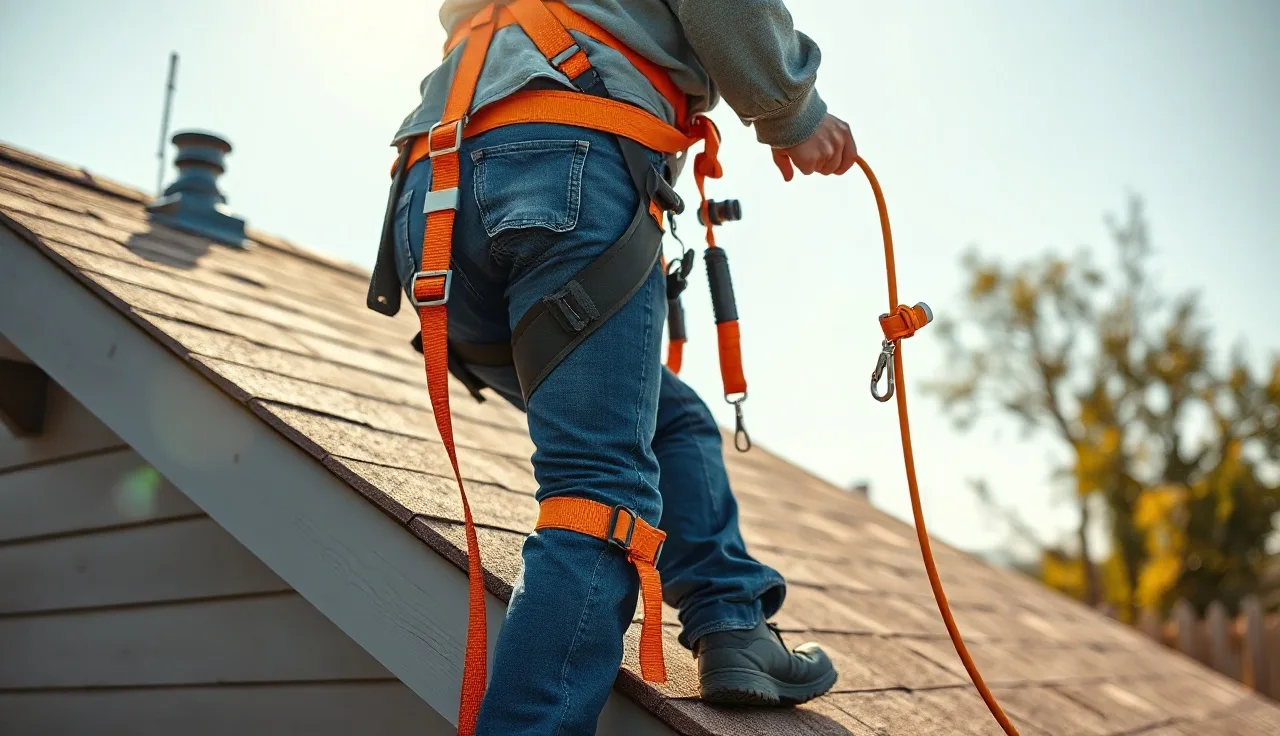
Most kits include three core pieces: a full-body harness, a connecting component (a shock-absorbing lanyard, a self-retracting lifeline, or a combination), and a connector or dorsal ring hardware. Higher-end kits add a storage bag, a harness inspection card, and sometimes a positioning lanyard.
The harness is the piece that actually catches you. It spreads arrest forces across your thighs, chest, and shoulders so no single body part takes the whole load. The lanyard or self-retracting lifeline (SRL) limits free-fall distance and the force your body absorbs during arrest. The anchor connects the system to a structural point rated for the load, generally at least 5,000 pounds per attached worker or a design signed off by a qualified person [1].
What a kit doesn't include is the anchor itself. That's a fixed structural feature, not portable gear. If your site has no certified anchor points, no kit fixes that. You need a qualified person (a licensed engineer in most states) to assess and certify anchor locations before workers clip in.
What does OSHA require for fall protection?
OSHA's fall protection rules sit in two main standards. General industry workplaces like warehouses, manufacturing plants, and retail back-of-house fall under 29 CFR 1910.28, which requires employers to protect workers from fall hazards at 4 feet or more above a lower level [2]. Construction sites fall under 29 CFR 1926.502, and the trigger height is 6 feet [3].
Those numbers are floors, not ceilings. Some situations set a different bar. Scaffolding in construction triggers protection at 10 feet. Stairways and ladders have their own subsections. Residential construction sometimes gets a different compliance path.
OSHA's personal fall arrest requirements are blunt: the system must limit maximum arresting force to 1,800 pounds, bring the worker to a complete stop, and hold free fall to 6 feet or less [3]. It also has to be rigged so a worker can't free fall more than 6 feet or hit a lower level. That last point trips up small employers who buy the right kit and then anchor it too low.
Fall protection lands near the top of OSHA's most-cited list every single year. "Fall Protection, General Requirements" (1926.501) is the agency's number one cited standard [4]. One citation can cost thousands. A willful violation runs up to $156,259 per instance as of 2024 [4].
If you're also managing OSHA paperwork and written programs, a tool like SafetyFolio can generate a site-specific fall protection plan in about 15 minutes. That matters because a written plan is required any time you use fall protection other than guardrails or a PFAS under 1926.502(k) in construction.
What are the different types of fall protection kits?
Fall protection kits are not interchangeable, and buying the wrong type for the job is a common mistake. Four categories cover almost everything a small crew will need.
Lanyard-based kits pair a full-body harness with a 6-foot shock-absorbing lanyard. These are the cheapest and most common option, starting around $80 to $150. The catch: a 6-foot lanyard plus a 3.5-foot deceleration distance plus your body height means you need a lot of clearance below the work surface to arrest before you hit the ground. Low-clearance jobs can't use these safely.
Self-retracting lifeline (SRL) kits swap the fixed lanyard for a retractable unit that locks within inches of a fall starting. They give you more freedom to move and work in lower clearance. A quality SRL kit runs $200 to $500. SRLs come in cable (steel or galvanized) and web versions, plus leading-edge rated versions for workers who might go over an unprotected edge.
Confined space and rescue kits are a different animal. They're built for vertical entry and retrieval more than arrest, and they usually include a tripod, winch, and retrieval line. These fall partly under 29 CFR 1910.146 (confined spaces), more than the fall protection standard [5].
Positioning and work-positioning kits let workers lean back against a structure to work hands-free. They are not fall arrest systems on their own. They must be backed by a separate fall arrest system.
| Kit Type | Typical Price | Best For | Clearance Needed |
|---|---|---|---|
| Shock-absorbing lanyard kit | $80 to $180 | Roofing, steel erection, high clearance | 18.5 ft or more |
| SRL kit (web) | $180 to $350 | General construction, lower clearance | Varies by SRL model |
| SRL kit (cable, leading-edge) | $300 to $550 | Floor work, unprotected edges | Model-specific |
| Confined space/rescue kit | $600 to $2,000+ | Manholes, tanks, silos | Vertical entry |
| Positioning kit | $100 to $250 | Utility poles, towers | Not a PFAS alone |
How do falls actually injure and kill workers?
Falls are the leading cause of death in construction and a top cause across every industry. The Bureau of Labor Statistics counted 865 fatal falls in U.S. workplaces in 2022, and 395 of those were in construction [6]. Fatal construction falls have hovered between 320 and 400 per year for most of a decade, despite years of OSHA enforcement.
Nonfatal fall injuries are far more common and carry their own price tag. The National Safety Council puts the average workers' compensation cost of a same-level fall injury near $47,000, with elevated falls running higher [7]. A single fall hospitalization can top $100,000 in direct medical costs alone, before lost productivity, retraining, and higher insurance premiums.
The risk isn't spread evenly. Roofing, structural steel erection, and framing carry the highest death rates per 100,000 workers. But warehouses, retail stockrooms, and maintenance crews on ladders and aerial lifts drive a big share of nonfatal injuries that often go underreported or misclassified. If your workers ever climb a ladder more than 4 feet off the ground, this is a real exposure for your business.
How do you inspect a fall protection kit before each use?
OSHA requires personal fall arrest equipment to be inspected before each use by the person who's going to wear it [1]. This is not a once-a-month supervisor sweep. It's a before-you-clip-in check, every time.
Harness inspection covers five areas: hardware (D-rings, buckles, and snap hooks for cracks, corrosion, sharp edges, or deformation), webbing (cuts, abrasion, fraying, chemical damage, heat damage, and UV degradation that shows as a chalky surface or color change), stitching (broken or missing stitches at load-bearing points), labels (the manufacturer's label must stay legible and attached), and overall condition.
Lanyard and SRL inspection adds three things: the energy absorber (a deployed absorber means the unit already caught a fall and must be retired, full stop), the snap hooks (the keeper has to seat fully and the gate must not open under finger pressure), and the lifeline cable or web for kinks, cuts, and fraying.
Anything that fails inspection comes out of service on the spot. Tag it, quarantine it, and either ship it to the manufacturer for evaluation or destroy it so nobody grabs it out of a bin later. This sounds obvious. The OSHA inspection reports on OSHA.gov are full of cases where damaged gear stayed in service anyway.
An annual third-party inspection by a competent person is manufacturer and industry practice even for gear that passes daily checks. Some manufacturers void warranties without documented annual inspections. Keep the records. If an incident happens, proof that the equipment was checked regularly is your defense.
What are the rules for retiring and replacing fall protection equipment?
This is where small employers lose money trying to save it. There's no universal expiration date printed on harnesses and lanyards, so people assume old gear is fine as long as it looks okay. That's wrong.
Manufacturers set service life based on how the materials break down. Nylon and polyester webbing degrade from UV exposure, chemical contact, and repeated loading. The major manufacturers (3M/DBI-SALA, MSA, Honeywell Miller) recommend retiring harnesses 10 years after the manufacture date regardless of use, and some set shorter intervals for tough exposure. Check the label for the manufacture date and the published service life.
Automatic retirement triggers are non-negotiable:
- Any harness or lanyard that caught a fall. Arrest forces stretch and damage webbing and hardware in ways you can't see.
- A deployed shock absorber on a lanyard (the tear-away pack will have opened).
- Any item that fails a pre-use inspection for damage.
- Any item with a missing or illegible manufacturer label (OSHA requires labels to stay legible).
- Any item with unknown history. Buy used fall protection and you're buying liability.
The practical takeaway: budget for replacement. A harness that sees heavy roofing or construction use might need replacing every 2 to 3 years on condition alone, even if it never caught a fall. Stretching service life past what the manufacturer specifies isn't worth the risk or the citation.
What training does OSHA require before workers use fall protection kits?
OSHA requires that workers who might face fall hazards be trained by a qualified person [9]. Training has to cover the nature of the fall hazards in the work area, how to erect, maintain, disassemble, and inspect fall protection systems, and the limits of the equipment.
For construction, 29 CFR 1926.503 says training must be "task and site specific," and the employer has to verify it with a written certification record [9]. As the standard puts it, the employer must "prepare a written certification record" listing the employee's name, the training dates, and the trainer's signature. General industry carries similar requirements under 1910.30 [10].
"Qualified person" in OSHA's language means someone with the recognized training, degree, knowledge, or experience to solve fall protection problems. For training, that could be a safety manager who finished an OSHA 30 course and has hands-on fall protection experience, or an outside trainer from a safety firm or an equipment maker.
Training isn't a one-and-done event. Retraining is required when the employer thinks a worker doesn't understand the training, when the workplace changes enough to make prior training obsolete, or when the type of fall protection changes.
Documentation is the part small employers skip most. Written records with the employee's name, the date, and the topics covered protect you in an inspection and in a lawsuit. Keep them. Our guide on osha training covers documentation in more depth.
How much does a fall protection kit cost, and is it tax deductible?
Entry-level kits with a basic harness and a 6-foot shock-absorbing lanyard start around $80 to $120 at safety distributors and big retailers like Grainger or Amazon Business. That tier is fine for occasional ladder or scaffold work at low-to-moderate heights where clearance is adequate.
Mid-range kits with a better harness (more adjustment points, real padding for all-day wear) and a web SRL run $200 to $350. That's what most residential construction and general maintenance crews should be wearing if workers spend real time at height.
High-end kits with leading-edge rated SRLs, cable lifelines, and ergonomic harnesses run $400 to $600 or more per worker. Specialty kits for confined space entry or tower climbing can pass $1,000.
For a five-person crew, a realistic budget for mid-grade kits, an anchor system, and initial training runs $2,000 to $4,000. That's a one-time cost, and it almost certainly beats a single fall-related workers' comp claim, which averages around $47,000 [7].
On taxes: safety equipment bought for business use is generally deductible as an ordinary and necessary business expense under Section 162 of the Internal Revenue Code, or eligible for Section 179 expensing. Talk to your accountant about your specific situation. The IRS has no carve-out that makes safety gear non-deductible.
What's the difference between a fall protection kit and a fall restraint system?
These terms get mixed up constantly, and the difference matters because they protect workers in different ways. One catches you after you fall. The other stops you from falling at all.
A fall arrest system catches you after you fall. It arrests the fall, absorbs the energy, and limits the force sent to your body. A full-body harness with a shock-absorbing lanyard is the classic example. You can still fall, but the system stops you before you reach a lower level.
A fall restraint system keeps you from reaching the fall hazard in the first place. It's rigged so the lanyard or lifeline is short enough that the worker physically can't reach the unprotected edge. No fall happens, so there's no arrest force to manage.
Restraint sounds simpler, and it often is, but it demands precise rigging. Put the anchor in the wrong spot, or let a worker tie off at the wrong D-ring or adjust the system wrong, and they can reach the edge and fall wearing gear that wasn't set up to arrest a fall. OSHA accepts fall restraint as a fall protection method in general industry under 1910.28, but only when it's designed and rigged correctly.
Plenty of marketed "fall protection kits" work for either application depending on the rigging. The training for each is different. A worker on a restraint system needs to understand exactly what the system is and isn't doing.
What anchor requirements apply to fall protection kits?
The kit is only half the system. The anchor is where everything connects to the building or structure, and the requirements are specific and non-negotiable.
OSHA 29 CFR 1926.502(d)(15) requires personal fall arrest anchorages to be "capable of supporting at least 5,000 pounds (22.2 kN) per employee attached," or to be designed as part of a complete system by a qualified person at a safety factor of at least two [3]. "Capable of supporting" means the structural member, more than the hardware bolted to it.
Common anchor types include permanent I-bolt and D-ring anchors installed by a licensed engineer, beam clamps that grab structural steel, temporary roof anchors, and horizontal lifeline systems that link multiple anchor points. Horizontal lifelines get complicated because the force at each anchor rises as the line sags, so a qualified person has to design them.
Portable anchor straps like roof peak anchors are popular in residential roofing. They work when installed correctly on a structural member and when you respect the manufacturer's rated load. Many are rated at 5,000 pounds for a single user when properly installed on a structural member. Check the manufacturer's documentation, and confirm the rafter or ridge beam can actually carry the load.
What workers cannot use as anchors: standard eye bolts not rated for fall arrest, ventilation stacks, conduit, anything not confirmed structural, and guardrail systems. If your site has unusual conditions, OSHA's letters of interpretation on anchor requirements are worth reading [1].
How do you write a fall protection plan for your worksite?
A written fall protection plan is required under 29 CFR 1926.502(k) for construction whenever you use fall protection other than conventional guardrails or personal fall arrest, such as on surfaces where conventional protection is infeasible [3]. Even when the rule doesn't strictly require one, a written plan is good practice. It documents your hazard assessment, your equipment decisions, and your training, which protects you in a citation or a lawsuit.
A basic site-specific plan covers seven things: the fall hazards you identified (specific locations, heights, and edge conditions), the protection method chosen for each hazard, the anchor system and its load rating, the person designated as competent person for fall protection, training verification, inspection procedures, and the rescue plan for a suspended worker.
The rescue plan is the piece most often missing. OSHA and manufacturers both warn that suspension trauma (harness hang syndrome) can turn into a medical emergency within minutes of a worker hanging in a harness after a fall arrest [8]. You need a plan to retrieve a suspended worker fast, and workers who might be suspended need to know to move their legs to keep blood flowing until rescue arrives. A plan that says "call 911" is not adequate for a worker hanging 20 feet up.
If writing a site-specific plan sounds like a slog, SafetyFolio's safety program generator walks you through the required elements for your industry and produces a compliant written program in about 15 minutes.
For incidents that happen despite your controls, knowing how to file an accurate incident report is the next step.
What are common mistakes employers make with fall protection kits?
Read enough OSHA inspection citations and the same mistakes surface again and again. Here are the ones that show up most.
Buying the kit but not training workers. Gear in a bag in the truck does nothing. Workers need to know how to inspect, don, and correctly anchor the system before they ever use it at height. OSHA has cited employers for exactly this: the equipment existed, the training didn't.
Anchoring to non-structural components. Conduit, ductwork, junction boxes, and roof-mounted equipment are not anchor points. Sounds obvious. Happens all the time.
Ignoring total fall distance. A 6-foot shock-absorbing lanyard needs roughly 18 to 19 feet of clearance (6 feet of free fall, 3.5 feet of deceleration, plus the worker's height and D-ring position). Clip a 6-foot lanyard to an anchor level with your feet on a 15-foot surface and you'll hit the ground or a lower level in a fall.
Reusing arrested-fall equipment. A harness or lanyard that caught a fall is done. Period. No exceptions.
Skipping the written plan. In a construction inspection, the missing written fall protection plan is a separate citation from any equipment violation.
Letting gear live in a truck bed for years. UV, temperature swings, and spilled truck-bed chemicals (fuel, solvents) break down webbing faster than normal use. A harness baking in a sunny truck bed for three summers can fail a condition inspection without ever catching a fall.
Our article on lockout tagout covers a related set of equipment-based safety programs that share the same inspection and documentation logic.
Frequently asked questions
At what height does OSHA require fall protection for general industry workers?
OSHA's general industry standard 29 CFR 1910.28 requires fall protection when workers face a fall of 4 feet or more to a lower level. Walking-working surfaces are the main context. Some environments like scaffolding or hoist areas set different thresholds, so check the subsection that matches your exact situation.
Can a worker use a body belt instead of a full-body harness for fall arrest?
No. OSHA prohibits body belts for personal fall arrest. Under 29 CFR 1926.502(d)(16), a body belt cannot be part of a personal fall arrest system because it concentrates all arrest force on the abdomen, which can cause internal injury or let a worker slip out. Full-body harnesses are required for fall arrest.
How often should fall protection equipment be formally inspected?
OSHA requires inspection before each use by the user. Industry practice, backed by most major manufacturers, adds a formal annual inspection by a competent person. Any equipment that fails inspection, or that caught a fall, comes out of service immediately, no matter where you are in the inspection schedule.
What is suspension trauma and why does it matter for fall protection planning?
Suspension trauma (harness hang syndrome) is a medical emergency that can develop within minutes when a worker hangs motionless in a harness after a fall arrest. Blood pools in the legs and stops returning to the heart. Workers can lose consciousness and suffer cardiac events. Your rescue plan has to account for fast retrieval, and workers should be trained to pump their legs to keep circulation going.
Is a self-retracting lifeline better than a shock-absorbing lanyard?
For most jobs, yes. An SRL limits fall distance to a few inches instead of 6 feet, so it works in lower clearance and sends less total force to the body. It also lets you move more freely. The trade-off is cost: SRLs run $150 to $400 more than basic lanyard kits. For workers spending real time at height, the SRL is usually the better buy.
Can I use a fall protection kit on a ladder?
Standard personal fall arrest doesn't work well on portable ladders because there's rarely an adequate anchor at height. Fixed ladders over 24 feet require a ladder safety system (a cage, a fixed ladder safety system, or a PFAS) under 29 CFR 1910.28(b)(9). Portable ladder safety comes mostly from proper setup, the 4-to-1 angle rule, and three-point contact, not a harness kit.
What's the minimum anchor strength for a fall protection system?
OSHA requires anchorages for personal fall arrest to support at least 5,000 pounds per attached employee under 29 CFR 1926.502(d)(15). As an alternative, a qualified person can design the anchor as part of a system with a safety factor of at least two. The structural member itself has to meet that load, more than the hardware attached to it.
How much does a complete fall protection kit cost?
Entry-level harness-plus-lanyard kits start around $80 to $120. Mid-grade kits with a self-retracting lifeline run $200 to $350. High-end leading-edge rated or specialty kits reach $500 to $600 per worker. A full setup for a five-person crew including anchors and training typically runs $2,000 to $4,000, a fraction of the average cost of a single fall-related workers' comp claim.
What documentation is required for a fall protection program?
Construction employers need a written fall protection plan (29 CFR 1926.502(k)) when using non-conventional protection, written training certification records (29 CFR 1926.503(b)), and equipment inspection logs. General industry requires training documentation under 29 CFR 1910.30. Everywhere, keep written records of hazard assessments, equipment inspections, and anchor certifications.
Can I buy used fall protection equipment to save money?
Bad idea. You can't verify the history of used fall arrest gear: whether it caught a fall, how it was stored, or whether it's been repaired. OSHA requires equipment to meet manufacturer specifications, and manufacturers consistently advise against fall protection with unknown history. The liability and safety risk far outweigh the savings.
Do fall protection rules apply to work on aerial lifts and scissor lifts?
Yes. Workers in aerial work platforms (boom lifts) must wear a full-body harness connected to the anchor inside the bucket per OSHA 29 CFR 1926.453(b)(2)(v). Scissor lifts are treated differently: the guardrail system is the primary protection and a harness isn't always required, though company policy and the manufacturer often require one. Check your specific lift's manual.
What is the difference between a competent person and a qualified person in fall protection?
In OSHA's language, a competent person can spot fall hazards and has the authority to correct them, based on training or experience. A qualified person holds recognized credentials (often an engineer's license or equivalent) to design fall protection systems. You need a competent person on-site for inspections and supervision, and a qualified person to design horizontal lifelines, custom anchors, or plans for complex sites.
How long is fall protection equipment good for?
There's no single OSHA-mandated expiration date. Most manufacturers set a maximum service life of 10 years from the manufacture date for harnesses and lanyards, regardless of condition. Some set shorter intervals for heavy use. Any equipment that catches a fall is retired immediately. UV and chemical exposure can cut service life well below the manufacturer's maximum.
Sources
- OSHA, Personal Fall Protection Systems (29 CFR 1910.140): Anchorages must support at least 5,000 pounds per attached employee; equipment must be inspected before each use
- OSHA, Walking-Working Surfaces and Fall Protection (29 CFR 1910.28): General industry fall protection required at 4 feet or more above a lower level
- OSHA, Fall Protection Systems Criteria and Practices (29 CFR 1926.502): Construction fall protection required at 6 feet; PFAS must limit arresting force to 1,800 lbs and free fall to 6 feet; anchorages must support 5,000 lbs; body belts prohibited for fall arrest; written fall protection plan required
- OSHA, Top 10 Most Cited Standards: Fall Protection General Requirements (1926.501) consistently ranks as the most-cited OSHA standard; willful violation penalties up to $156,259 per instance
- OSHA, Permit-Required Confined Spaces (29 CFR 1910.146): Confined space entry and retrieval requirements, including retrieval systems
- Bureau of Labor Statistics, Census of Fatal Occupational Injuries 2022: 865 fatal falls in U.S. workplaces in 2022; 395 in construction
- National Safety Council, Injury Facts: Work Injuries and Costs: Average workers' compensation cost of a fall injury estimated at approximately $47,000; elevated falls run higher
- OSHA, Safety and Health Information Bulletin: Suspension Trauma/Orthostatic Intolerance: Suspension trauma can develop within minutes of a worker being suspended in a harness; workers should move legs to maintain circulation pending rescue
- OSHA, Fall Protection Training Requirements (29 CFR 1926.503): Fall protection training must be task and site specific; employer must maintain a written certification record with employee name, training dates, and trainer signature
- OSHA, Training Requirements for Walking-Working Surfaces (29 CFR 1910.30): General industry fall protection training requirements for workers exposed to fall hazards