Last updated 2026-07-09
TL;DR
OSHA requires personal fall arrest anchors to support at least 5,000 pounds per attached worker, or be designed by a qualified person to a 2:1 safety factor (29 CFR 1926.502). On roofs above 6 feet in construction, or above 4 feet in general industry, you need an engineered anchor, a correctly rigged connector, and pre-use inspection. No anchor is legal without documented load capacity.
What does OSHA require for roof fall protection anchors?
Every anchor point on a roof needs a documented load rating. That's the whole rule in one sentence. The core standard is 29 CFR 1926.502(d)(15): anchorages for personal fall arrest must be "capable of supporting at least 5,000 pounds (22.2 kN) per employee attached, or shall be designed, installed, and used under the supervision of a qualified person as part of a complete personal fall arrest system which maintains a safety factor of at least two." [1]
That 5,000-pound figure is a floor, and it doesn't bend. The alternative, a 2:1 safety factor designed by a qualified person, just means the system's calculated maximum arresting force has to be no more than half the anchor's rated capacity. Most small contractors are better off buying to the 5,000-pound number than paying an engineer to design to the ratio.
General industry (29 CFR 1910.140) uses the same 5,000-pound-per-person standard or the same qualified-person alternative. [2] Which standard you fall under depends on what you're doing. Roofwork counts as construction under 1926 Subpart M. Rooftop HVAC maintenance counts as general industry under 1910. It matters because the trigger heights differ: construction kicks in at 6 feet above a lower level, general industry at 4 feet for walking-working surfaces, and rooftops count.
Guardrails are a separate path out. Install a compliant guardrail system at the roof edge and you may not need anchors at all. Under 1926.502(b), a guardrail top rail sits at least 42 inches high (plus or minus 3 inches), takes 200 pounds of outward or downward force at the top rail, and the midrail handles 150 pounds. [1] The catch is that guardrails need permanent or semi-permanent installation, and plenty of building owners won't allow it and plenty of short-term roofing jobs can't justify it.
Here's the trap. If a structural engineer or competent person hasn't verified that the anchor and its substrate can take the load, you don't have a compliant system, no matter what the product label says.
What are the different types of roof anchors?
Roof anchors split into four practical categories, and picking the wrong one is one of the most common mistakes small contractors make.
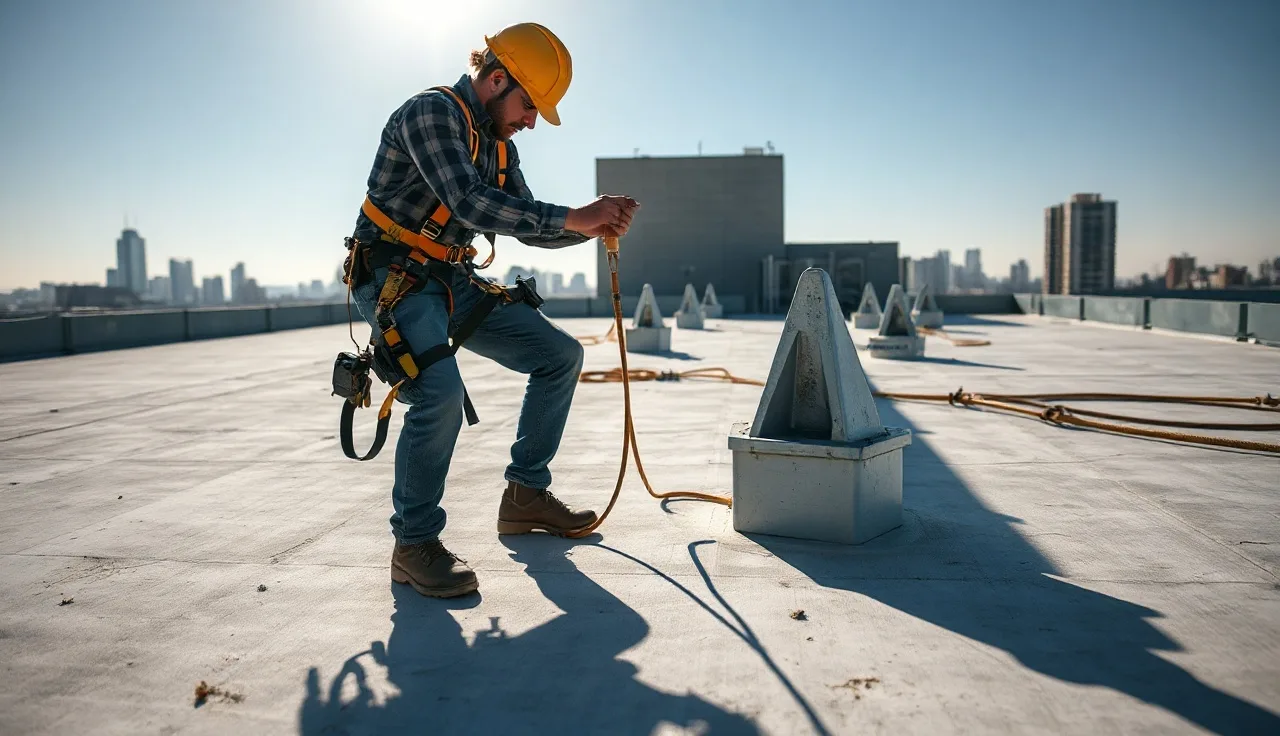
Permanent anchors are welded, bolted, or cast into the roof structure during construction, or added later with engineering sign-off. These are usually the safest bet because the load path is designed in advance. Common types include D-ring plates bolted through the deck, sleeve anchors set into concrete decks, and pedestal-style anchors that bolt to structural members below the membrane. They need periodic inspection and recertification, usually every year.
Temporary or portable anchors clamp, strap, or hook onto existing structure. A portable beam anchor grips structural steel or a wood beam through the decking. A strap anchor loops around an HVAC curb or another roof feature. Maintenance crews who bounce between facilities love them. The trap is that portability doesn't make the load-path problem disappear. Someone still has to confirm the thing the anchor grabs can take 5,000 pounds. A strap looped around an HVAC curb that's bolted with four 3/8-inch lag screws into rotted wood nailers is not a 5,000-pound anchor. It's a story you tell the OSHA investigator.
Parapet or wall anchors bolt through a parapet and use the wall as the structural element. They work on masonry or reinforced-concrete parapets in good shape. Many older masonry parapets are not in good shape, and you can't know without a core sample and a structural review.
Dead-weight or ballast anchors sit on the roof surface and rely on weight alone. These are genuinely controversial. OSHA hasn't banned them, but a competent person has to verify that the ballast calculation accounts for the dynamic shock load of a falling worker, more than static weight. I'd treat them as a last resort and demand engineering documentation before anyone clips in.
The right type depends on your deck material (metal, concrete, wood), how often crews get on the roof, how many workers tie off at once, and whether the owner allows penetrations. For frequent access (weekly or more), permanent engineered anchors almost always win on cost per use over time.
How much weight does a roof anchor need to hold?
5,000 pounds per attached worker. That's the number from 29 CFR 1926.502(d)(15), it's what almost everyone cites, and it's the right starting point. [1] But the number hides some physics worth knowing.
The 5,000 pounds is a static load rating for the anchorage as a structural element. It is not the force a falling worker actually generates. A free-fall arrest on a 6-foot shock-absorbing lanyard with a 200-pound worker produces roughly 900 to 1,800 pounds of arresting force, depending on the deceleration device. OSHA caps the maximum arresting force on the body at 1,800 pounds for a full-body harness under 1926.502(d)(16). The 5,000-pound anchor rating is a huge safety margin stacked on top, built to cover anchor degradation, dynamic amplification, and the fact that inspectors can't yank-test every anchor in the field.
When a qualified person designs to the 2:1 alternative, they calculate the maximum arresting force for the specific worker weight, fall distance, and deceleration device, then confirm the anchor is rated to at least twice that. This path shows up most in engineered horizontal lifeline systems, where a single 5,000-pound anchor sized for one person would be nowhere near enough.
Horizontal lifelines are where small businesses walk into real trouble. End anchors on these systems often need 10,000 to 15,000 pounds or more because the catenary tension effect multiplies the force at the ends geometrically. Buy a cheap cable kit without reading the anchor spec and you've built something that looks compliant and isn't. Get the manufacturer's anchor load specifications for any lifeline system. The anchor load is not the worker load.
Who is qualified to install and inspect roof anchors?
OSHA uses two terms that mean different things, and mixing them up causes real compliance problems. One requires a license in practice. One doesn't.
A "competent person" under 29 CFR 1926.32(f) is someone "capable of identifying existing and predictable hazards in the surroundings or working conditions which are unsanitary, hazardous, or dangerous to employees, and who has authorization to take prompt corrective measures to eliminate them." [3] A competent person can run daily pre-use inspections, spot deficiencies, and pull equipment from service. No professional engineering license needed.
A "qualified person" under 29 CFR 1926.32(l) is someone "who, by possession of a recognized degree, certificate, or professional standing, or who by extensive knowledge, training, and experience, has successfully demonstrated his ability to solve or resolve problems relating to the subject matter, the work, or the project." [3] For anchor design under the 2:1 path, and for horizontal lifeline design, OSHA interpretation letters have consistently pointed to a qualified person, which in practice usually means a licensed professional engineer for structural connections to a building.
For typical permanent anchor installation, most manufacturers require a licensed installer or, at minimum, someone who finished the manufacturer's training. Use an unqualified person and you can void the warranty and blow the OSHA standard in one move. For temporary anchor deployment (clamping a portable anchor to a beam, say), a competent person who understands the load requirements can usually verify the connection.
Annual inspection of permanent roof anchors almost always needs someone with credentials, and many manufacturers require recertification by a qualified person after any fall event. If your anchor caught a fall, it comes out of service until inspected and recertified or replaced. That's not optional.
Your crews who use fall protection daily also need osha training on the specific equipment in use, including how to inspect it before each use and how to recognize an anchor that's been compromised.
What roof deck types can support a fall protection anchor?
Deck material decides which anchors work and what engineering documentation you'll need. Here's the practical breakdown.
| Deck Type | Common Anchor Options | Key Structural Concern |
|---|---|---|
| Steel deck (metal pan) | Through-bolt to structural steel below; specialized metal deck anchors | Deck ribs alone won't take 5,000 lbs; must connect to framing |
| Concrete (cast-in-place or precast) | Sleeve anchors, cast-in inserts, epoxy anchors | Concrete strength (PSI), rebar proximity, edge distance |
| Wood frame/plywood | Through-bolt to rafters or ridge board | Wood condition, species, fastener pullout capacity |
| EPDM/TPO membrane over insulation | Penetrating anchors through to deck; membrane patch required | Moisture intrusion at penetration if not properly flashed |
| Built-up / modified bitumen | Same as membrane; hot-applied systems complicate penetrations | Flashing and waterproofing at the anchor base |
| Lightweight concrete | Limited; requires core sample to verify actual PSI | Lightweight mixes often far weaker than assumed |
The single biggest mistake I see is treating the roofing membrane or insulation layer as if it's structural. It is not. Any anchor that terminates in foam insulation or membrane without reaching the structural deck or framing is not a 5,000-pound anchor, no matter how solid it looks bolted down.
On metal deck roofs, the steel ribs can carry some load in specific orientations, but most safety engineers will want the anchor bolted through to a structural steel beam or bar joist. The deck manufacturer's data will give you cantilever and uplift ratings, but those numbers are for gravity and wind, not dynamic fall arrest. Don't confuse the two.
Older buildings add unknowns: concrete of unknown strength, deteriorated wood, corroded steel. If you're installing permanent anchors in a building older than about 30 years and you don't have the original structural drawings, a structural engineer's site visit is worth the $500 to $1,500 it typically runs before you put anyone's life on those anchors.
What are the OSHA inspection and recordkeeping requirements for roof anchors?
Pre-use inspection of every personal fall arrest component by a competent person, before each shift. That's the baseline under OSHA's fall protection standards. [1] For anchors, that means checking for visible corrosion, deformation, loose fasteners, damage at the connector, and any sign the anchor took a load in a prior fall.
Beyond daily checks, permanent roof anchors should get documented periodic inspections, usually annual. OSHA doesn't name a fixed recertification interval in 1926 Subpart M, but the manufacturer's instructions are legally incorporated by reference under the personal fall arrest rules, and most manufacturers specify annual professional inspection. ANSI/ASSE Z359.2, the managed fall protection program standard published by the American Society of Safety Professionals, recommends annual inspection of all anchor points by a qualified person with records retained. [4]
After any fall arrest event (the system actually caught a falling worker), the anchor comes out of service immediately and stays out until a qualified person inspects and recertifies it or it gets replaced. This is one of those rules that gets ignored under job-site pressure, and it's exactly what OSHA asks about after an incident.
Keep a file for each permanent anchor: installation date, installer credentials, load rating documentation, and the dates and findings of every periodic inspection. There's no OSHA form for this. A simple log with those fields is enough. If OSHA shows up after an incident and asks for proof your anchor was rated and inspected, you want paper in hand, not a story. If you're building a written fall protection program, SafetyFolio's safety program generator can spin up the documentation templates so you're not starting from a blank page.
For incident report purposes, any roof fall, including a stopped one, needs evaluation for recordability under 29 CFR 1904. An arrested fall that causes injury is recordable. Even one that doesn't may be worth a hard look at your program.
What is a written fall protection plan and when do you need one for roof work?
A written fall protection plan is required under 29 CFR 1926.502(k) when you choose a method other than conventional fall protection (guardrails, personal fall arrest, or safety nets) for certain leading-edge, precast concrete erection, or residential construction operations. [1] For most routine roofwork, a written plan isn't mandatory under 1926 Subpart M. It's still smart, and OSHA recommends it.
Where the plan IS required by name: leading-edge and residential construction work under 1926.502(k) where conventional systems are infeasible or create a greater hazard, and low-slope roof work using a safety monitoring system, which triggers a written plan under 1926.502(h). [1]
Any employer doing regular rooftop work should have a written plan anyway, for three reasons. It shows due diligence if OSHA investigates an incident. It forces a real hazard assessment before anyone climbs up. And it's the document that ties your anchor location map, rescue procedures, and equipment inspection records into one place.
A compliant plan is site-specific, prepared by a qualified person, and identifies each fall hazard, the measure for each hazard, how those measures get implemented, and the name of the qualified person. It has to be available on site. Generic plans pulled off the internet are close to worthless here because they can't be site-specific.
If your crews do rooftop HVAC, solar, or maintenance, stand up a lockout tagout program for rooftop equipment alongside the fall protection plan. Plenty of rooftop tasks carry both hazards at the same time, and it's cheaper to address them together.
How do you set up a personal fall arrest system correctly on a roof?
The anchor is one piece of three. A complete personal fall arrest system under OSHA's standard is the anchor, the body support (a full-body harness), and the connecting subsystem (lanyard, self-retracting lifeline, or deceleration device). All three work together or none of it is compliant.
For the connector, the calculation that matters is free-fall distance plus deceleration distance plus the worker's height, measured against the clearance to the lower level. Under 1926.502(d), the system has to be rigged so a worker can't free-fall more than 6 feet and can't hit a lower level. [1] This is where rooftop anchor placement goes wrong most often. Someone bolts a perfectly good anchor in the middle of a flat roof, a worker clips a 6-foot lanyard and walks to the edge, and the geometry of how the lanyard feeds means the real free-fall exceeds 6 feet before anything engages.
Run the math. With a standard 6-foot shock-absorbing lanyard, you need at least 18.5 feet of clearance below the anchor to avoid hitting the lower level: 6 feet of free fall, 3.5 feet of deceleration, roughly 6 feet for the worker, plus a safety margin. Self-retracting lifelines cut free-fall to about 2 feet and total fall distance to roughly 8 to 10 feet, which makes them far more workable on roofs with limited clearance below.
Placement matters for swing falls too. Position the anchor so the worker stays between the anchor and the roof edge, never with the anchor behind them. Swing-fall hazards (the worker pendulums into a parapet or a rooftop unit) are a real injury source that OSHA's rules don't fully quantify but that a competent person has to address in the plan.
Harness fit sits just outside the anchor topic, but a perfectly rated anchor attached to a badly fitted harness is still a dangerous system. Full-body harnesses are required for fall arrest, body belts are prohibited under 1926.502(d)(16), and both harness and connectors get inspected before each use. [1]
How common are roof fall deaths, and what does the injury data say?
Falls are the leading cause of death in construction, and roofs are the most common place they happen. The Bureau of Labor Statistics reported that falls, slips, and trips accounted for 395 of the 1,069 construction fatalities in 2022. [5] OSHA's enforcement data shows fall protection (29 CFR 1926.501) as the single most-cited standard in construction, year after year, with thousands of violations annually. [6]
The roof anchor failure that shows up in OSHA investigations is rarely a dramatic anchor pull-out. More often, workers die because there was no anchor at all, the anchor was clipped to something that wasn't structural (a vent pipe, a conduit run), or the lanyard was too long to keep the worker off the lower level. OSHA's fatality and catastrophe records include many cases where an anchor product was sitting on the roof but wasn't rigged to the worker at the time of the fall. Equipment that exists but isn't clipped in saves nobody.
Small employers take the hardest hit. NIOSH research finds that residential roofing workers, who overwhelmingly work for employers with fewer than 10 employees, die from falls at rates several times higher than commercial roofers where formal safety programs are the norm. [7] The pattern holds across years: company size tracks with fall protection compliance, and non-compliance tracks with fatalities.
The money is real too. In fiscal year 2023, OSHA issued 7,621 citations under 29 CFR 1926.501 alone. [6] Serious citations run several thousand dollars each, and willful violations reach $161,323 per violation under 2024 penalty levels. [11]
What does a roof anchor installation cost, and is it worth buying vs. renting?
Cost swings hard on anchor type, roof material, and whether engineering review is in the mix. Here's what to budget.
A basic permanent D-ring anchor plate, hardware included, runs $50 to $200 for the product alone. Add installation labor ($150 to $400 per anchor for a qualified installer on a straightforward flat roof) and a single permanent anchor lands at $200 to $600 installed, before any engineering. Need a structural engineer to review the connection on an older building or a tricky substrate? Add $500 to $1,500 for a site visit and a stamped letter.
Portable and temporary anchors range from about $80 for a basic beam anchor to $400 to $600 for a quality portable roof anchor system with straps and rated connectors. You still have to verify the structural element you're attaching to, and that verification isn't free.
Horizontal lifeline systems, which let a worker travel along a length of roof instead of tethering to one point, run $800 to $3,000 for cable and hardware, plus engineered end anchors. They pay off when multiple workers need lateral mobility on a roof for long stretches.
Here's the calculation that matters. For a roofing or maintenance contractor who's on roofs monthly, permanent anchors at key access points almost always beat renting or rebuying temporary systems on total cost per use. Renting a temporary anchor system runs $25 to $75 per day through tool rental outfits, which adds up fast at twice a week.
Then factor in penalty exposure. A serious fall protection citation runs several thousand dollars, and a willful violation can hit $161,323. [11] One fatality brings investigation, litigation, and workers' comp costs that swamp any anchor budget you'll ever write. The anchor is the cheap part.
If you're formalizing safety programs across several hazard types, SafetyFolio's program generator covers fall protection plan requirements alongside your other written programs, so you build one complete system instead of a stack of loose documents.
What are the most common OSHA violations related to roof anchors?
Based on OSHA's published enforcement data under 29 CFR 1926.501 and 1926.502, roof anchor violations cluster into a short list. [6] Learn these five and you've covered most of what inspectors write up.
First is no fall protection at all. Workers on roofs above 6 feet with no guardrail, no personal fall arrest, no safety net. This is the most common and the least defensible. It's almost always a willful or serious citation.
Second is improper anchorage. The anchor exists but it's tied to something that isn't structural: an HVAC duct, a vent flange, a parapet nobody evaluated. Inspectors look hard at what the lanyard or SRL is actually clipped to, more than whether the worker is wearing a harness.
Third is inadequate clearance. The anchor sits in the wrong spot or the lanyard is too long, so a falling worker hits the lower level or the deck before the system arrests them. That's a rigging failure, not an anchor failure, but it gets cited under the anchorage and system performance rules.
Fourth is no competent person. Employers who can't name a trained competent person responsible for fall protection on the site get cited under the 1926.502(d) requirements that tie the competent person to system selection and daily inspection.
Fifth is missing documentation. No inspection records, no load rating paper for the anchors, no written fall protection plan where one is required. Missing paper won't prove a violation by itself, but it's devastating after an incident when OSHA asks you to show your work.
If this is your first OSHA inspection or you're trying to see the full scope of what OSHA reviews, a grounding in osha basics puts the fall protection rules inside the wider compliance picture.
Do state OSHA plans have different roof anchor requirements?
Yes, and it can bite you. Twenty-two states and two territories run their own OSHA-approved state plans, which must be at least as effective as federal OSHA. [8] Some go further.
California's Cal/OSHA (Title 8 CCR) has historically run stricter on parts of fall protection, including requiring roofing employers to keep written fall protection programs even on smaller jobs where federal OSHA allows an exception. Cal/OSHA's penalty structure is adjusted separately from the federal levels too.
Washington State's Labor and Industries (L&I) tracks the federal construction fall protection standards closely but layers on extra training documentation requirements beyond the federal minimum for high-hazard work.
Michigan OSHA requires fall protection training to be documented in more detail than the federal standard spells out for some roofwork categories.
Florida, Texas, and most southeastern states operate under federal OSHA jurisdiction, so federal 1926 Subpart M applies directly with no state overlay for private employers.
The practical move: if you work in a state plan state, look up that state's construction fall protection requirements before you assume federal OSHA is your only reference. Most state plan standards are posted on the state agency's site. For a state plan employer, meeting federal 1926.502 is necessary but may not be enough. OSHA.gov keeps an updated state plan directory with contacts. [8]
Frequently asked questions
Can I use a vent pipe or HVAC unit as a roof anchor?
No. A vent pipe or HVAC curb is almost never rated for 5,000 pounds of dynamic load. These are plumbing or mechanical connections to the building, not structural elements designed for fall arrest. Clipping to a vent pipe is one of the most common anchor failures OSHA sees in fatal fall investigations. Your anchor must connect to a structural element, verified by a competent or qualified person, with documented load capacity.
How often do roof anchors need to be inspected?
Pre-use inspection by a competent person is required before each shift. Permanent roof anchors also need periodic professional inspection, typically annual, per manufacturer requirements that are legally incorporated into OSHA's standard. After any fall arrest event, the anchor must come out of service immediately until a qualified person inspects and recertifies or replaces it. Keep written records of every periodic inspection, including date, inspector credentials, and findings.
What is the difference between a competent person and a qualified person for fall protection?
A competent person (29 CFR 1926.32(f)) can identify hazards and has authority to correct them. No professional license required. A qualified person (29 CFR 1926.32(l)) has a recognized degree, certificate, or demonstrated expertise in the specific technical area. For anchor design under the 2:1 safety factor path, or for horizontal lifeline design, a qualified person is required, which in practice usually means a licensed professional engineer for structural connections.
Does OSHA require fall protection on low-slope roofs?
Yes. On low-slope roofs (4:12 pitch or less) in construction, 29 CFR 1926.502 requires guardrail systems, safety net systems, or personal fall arrest for work within 6 feet of the edge. One alternative allowed for low-slope roofs only is a safety monitoring system combined with a warning line at least 6 feet from the edge, but workers inside the warning line must still be monitored. The warning-line and monitor option is not available for steep-slope roofs.
What is the minimum height that triggers roof fall protection requirements?
Under 29 CFR 1926.501 (construction), fall protection is required at 6 feet above a lower level. Under 29 CFR 1910.28 (general industry), the trigger is 4 feet for most walking-working surfaces, rooftops included. If workers are doing construction on a roof 5 feet off the ground, construction standards apply and the 6-foot trigger governs. If they're doing maintenance at the same height under general industry, the 4-foot trigger applies.
Can I use a body belt instead of a harness for roof fall protection?
No. Under 29 CFR 1926.502(d)(16), body belts are explicitly prohibited as part of a personal fall arrest system. Body belts can injure or kill during a fall arrest because of the concentrated force on the abdomen. Full-body harnesses are required for fall arrest. Body belts may still be used for travel restraint systems, which keep a worker from reaching the fall hazard, but never for arresting a fall.
How many workers can be tied off to a single roof anchor?
That depends on the anchor's rated capacity and design. OSHA requires 5,000 pounds per attached employee. If an anchor is rated for 5,000 pounds total and two workers attach, you need one rated for 10,000 pounds, or a qualified person must certify the system maintains a 2:1 safety factor per worker. Many permanent single-point anchors are designed for one worker only. Check the manufacturer's rating and never exceed it.
What happens if a roof anchor actually arrests a fall?
Remove the anchor and all connected components (lanyard, harness, connectors) from service immediately. Don't put them back until a qualified person inspects and recertifies each component. Most manufacturers require shock-absorbing lanyards used in a fall arrest to be replaced outright. Document the incident, evaluate whether an OSHA recordable or reportable event occurred, and review your fall protection plan for any gap the incident exposed.
Are temporary ballast-style roof anchors OSHA compliant?
They can be, but only with engineering documentation. Ballast anchors rely on weight to resist fall forces. A qualified person must verify the ballast calculation accounts for dynamic shock loads, more than static weight. OSHA hasn't banned ballast anchors, but they're frequently misused and underengineered. Most experienced safety professionals treat them as a last resort and require a stamped engineering calculation before use.
What is the penalty for not having fall protection on a roof?
As of 2024, OSHA's maximum penalty for a serious violation is $16,131 per violation. Willful or repeated violations can reach $161,323 per violation. Fall protection is OSHA's most-cited construction standard. After a fatality, OSHA often issues willful citations at maximum penalties, and the employer also faces workers' compensation claims and civil litigation. The full cost of a fatality to a small employer regularly exceeds $1 million in total exposure.
Do I need a written fall protection plan for every roofing job?
Not always, but it's often the smart move. A written plan is explicitly required under 29 CFR 1926.502(k) for specific operations like leading-edge work where conventional systems are infeasible, and under 1926.502(h) when using a safety monitoring system on a low-slope roof. For most routine roofwork with conventional protection, it isn't legally required but is strongly recommended. It shows due diligence and forces a real hazard assessment before work begins.
What training do workers need before using a roof fall protection system?
Under 29 CFR 1926.503, each employee exposed to fall hazards must be trained by a qualified person before using fall protection systems. Training must cover the nature of fall hazards, correct procedures for erecting and disassembling systems, proper use of the specific equipment, and the employer's fall protection plan. Retraining is required when a worker is seen using equipment improperly or after a near-miss or fall event.
Can a roofer use a rope grab instead of a shock-absorbing lanyard?
Yes. A rope grab with a vertical lifeline is a compliant connecting subsystem if the rope, grab device, and anchor all meet 29 CFR 1926.502(d). The lifeline must be a minimum 5/8-inch synthetic fiber rope or meet equivalent performance requirements. Rope grabs arrest falls by gripping the rope under load. They're common in steep-slope roofing where a vertical anchor above the worker is practical. The same clearance math applies: fall distance plus deceleration must not contact a lower level.
Sources
- OSHA, 29 CFR 1926 Subpart M (Fall Protection), including 1926.501 and 1926.502: Anchorages must support at least 5,000 lbs per attached employee or be designed by a qualified person with a 2:1 safety factor; personal fall arrest required at 6 feet in construction; body belts prohibited for fall arrest; maximum arresting force 1,800 lbs; guardrail height and strength requirements.
- OSHA, 29 CFR 1910.140 (Personal Fall Protection Systems, General Industry): General industry personal fall arrest anchor requirement: 5,000 lbs per attached employee or qualified-person designed 2:1 safety factor system.
- OSHA, 29 CFR 1926.32 (Definitions, Construction): Definitions of competent person and qualified person under the construction standards.
- American Society of Safety Professionals, ANSI/ASSE Z359.2 Minimum Requirements for a Comprehensive Managed Fall Protection Program: ANSI/ASSE Z359.2 recommends annual inspection of anchor points by a qualified person with retained records.
- Bureau of Labor Statistics, Census of Fatal Occupational Injuries 2022: Falls, slips, and trips accounted for 395 of 1,069 construction fatalities in 2022; falls are the leading cause of construction deaths.
- OSHA, Top 10 Most Cited Standards FY2023: 29 CFR 1926.501 (fall protection) was the most-cited construction standard in FY2023 with 7,621 citations issued.
- NIOSH, Falls in the Workplace (NIOSH Fall Injury Prevention): Residential roofing workers, predominantly employed by small employers, have fall fatality rates several times higher than commercial roofers with formal safety programs.
- OSHA, State Plans Directory: 22 states and 2 territories operate OSHA-approved state plans that must be at least as effective as federal OSHA.
- OSHA, 29 CFR 1926.503 (Training Requirements, Fall Protection): Each employee exposed to fall hazards must be trained by a qualified person before using fall protection systems, covering hazards, equipment use, and employer's fall protection plan.
- OSHA, 29 CFR 1910.28 (Duty to Have Fall Protection, General Industry): General industry fall protection required at 4 feet above a lower level for most walking-working surfaces including rooftops.
- OSHA, Penalties Inflation Adjustments (2024): As of 2024, maximum serious violation penalty is $16,131; maximum willful or repeated violation penalty is $161,323.