Last updated 2026-07-09
TL;DR
A toolbox talk is a short, informal safety meeting held on a construction site before a shift or task, usually 5 to 15 minutes long. OSHA does not mandate a specific toolbox talk schedule for most construction work, but several 29 CFR 1926 standards require topic-specific training that toolbox talks help satisfy. Run consistently, they are one of the cheapest injury-prevention tools you have.
What is a toolbox talk in construction?
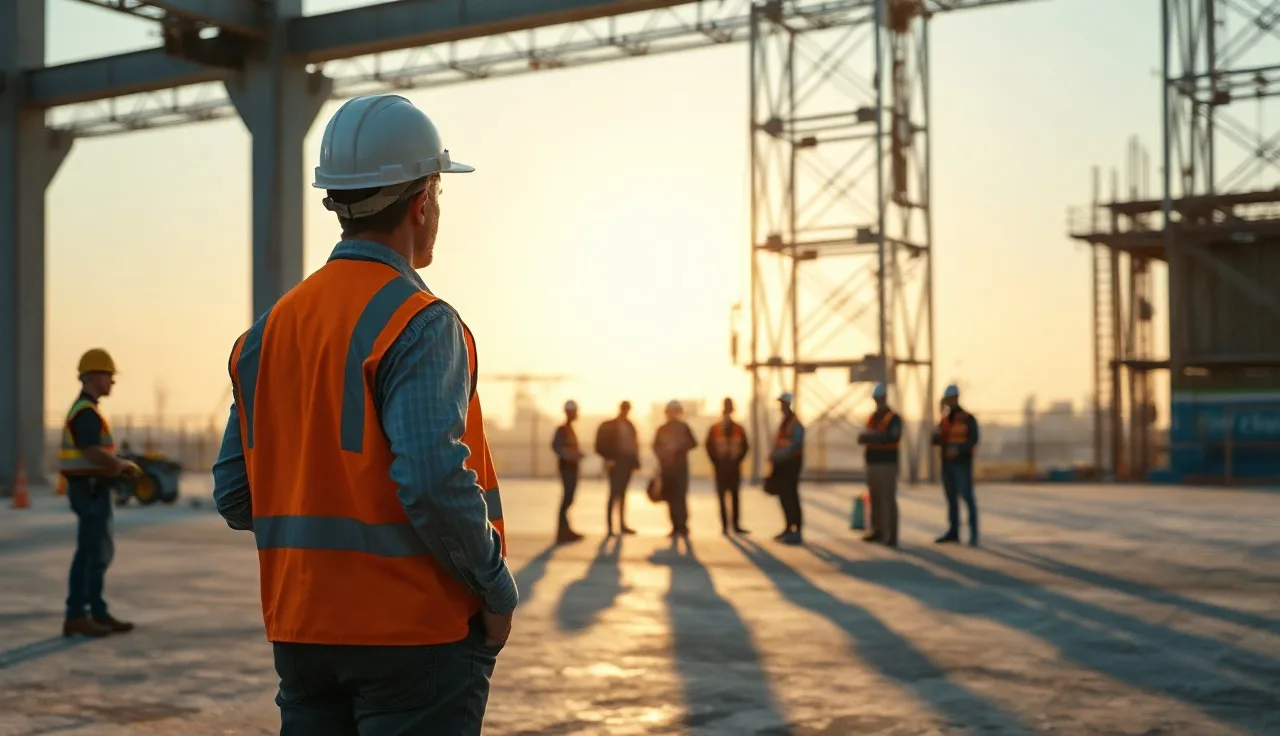
A toolbox talk is a short safety conversation held at the jobsite, usually at the start of a shift or right before a specific task begins. The name comes from the old habit of gathering the crew around a toolbox. Nobody's in a classroom. Nobody's watching a video. You're standing on the deck or in the parking lot, the crew is in front of you, and you spend five to fifteen minutes on one specific hazard.
The format exists because construction kills people at a rate office jobs never approach. The Bureau of Labor Statistics counted 1,075 construction fatalities in 2022, nearly 20% of all private-industry fatal work injuries that year [1]. The four leading causes, which OSHA calls the Fatal Four, are falls, struck-by incidents, electrocution, and caught-in/between hazards. Toolbox talks keep those hazards front of mind on the day they're most likely to hurt someone.
A good toolbox talk isn't a lecture. Name the hazard. Describe what goes wrong. Explain the control. Then ask the crew if they've seen it on this job. The questions are what make it stick.
Does OSHA require toolbox talks for construction?
No OSHA regulation says "you must hold weekly toolbox talks." That gap trips up a lot of small contractors. The actual requirement is scattered across 29 CFR 1926, the construction standards, as task-specific and hazard-specific training mandates [2].
A few examples:
- 29 CFR 1926.503 requires fall protection training for any worker exposed to fall hazards, delivered by a competent person, before the worker is exposed.
- 29 CFR 1926.21(b)(2) requires employers to instruct each employee in the recognition and avoidance of unsafe conditions.
- 29 CFR 1926.602(d) requires training for powered industrial truck operators, though 29 CFR 1910.178 is the more detailed standard usually cited for forklifts [3].
Toolbox talks are how many employers deliver that ongoing instruction. They won't replace the initial formal training required for falls, scaffolding, or forklifts. They're the recurring reinforcement layer. OSHA compliance officers look for evidence that training happened and that hazard communication was ongoing. A signed toolbox talk log is exactly that kind of evidence.
In a state with its own OSHA-approved plan (California, Michigan, Washington, and about 25 others), check your state's construction standards. Some add specificity. Cal/OSHA's injury and illness prevention program rule under Title 8, Section 3203, effectively demands regular safety meetings [4].
Here's the honest bottom line: OSHA won't cite you for skipping toolbox talks by name, but it can cite you for failing to train workers on a specific hazard, and toolbox talks are the most practical way to document that you did the training.
How often should construction toolbox talks happen?
Once a week, same day, ideally tied to a new task or a change in site conditions. That's the schedule most safety professionals run, and it works. Weekly frequency keeps safety visible without burning out the crew's attention.
Some high-hazard phases call for more. Steel erection, work over water, a heavy pour: a short pre-task talk every single morning is reasonable and easy to defend. Pre-task planning talks (sometimes called Job Hazard Analysis briefings) overlap with toolbox talks here, and that overlap is fine.
The Associated General Contractors of America and the National Safety Council both recommend a weekly meeting at minimum on construction sites [5]. Plenty of general contractors now write documented weekly toolbox talks into subcontractor agreements as a contract term, which is a contract obligation, not an OSHA one.
Frequency should scale with what's happening on your site. Near-miss on Tuesday? That's your Wednesday topic. Don't wait for the scheduled day.
What are the most important construction toolbox talk topics?
The best topics are the ones tied to what the crew is doing that week. Generic talks about "staying safe" do almost nothing. A talk about the specific trench your crew opens tomorrow, the soil on that site, and the right shoring method: that one saves lives.
Still, certain topics come up again and again because the hazards do. Here's a practical breakdown:
| Topic | Relevant OSHA Standard | Why It's High Priority |
|---|---|---|
| Fall protection | 29 CFR 1926.502 | Falls account for ~36% of construction deaths [1] |
| Struck-by hazards | 29 CFR 1926.601 | Second-leading Fatal Four category |
| Forklift / telehandler safety | 29 CFR 1910.178 | ~85 forklift fatalities per year industry-wide [6] |
| Forklift-pedestrian interaction | 29 CFR 1910.178(l) | Most struck-by incidents involve pedestrian zones |
| Scaffold safety | 29 CFR 1926.451 | ~4,500 scaffold injuries per year per OSHA data [12] |
| Lockout/tagout | 29 CFR 1910.147 | Applies when construction workers service equipment |
| Electrical / assured grounding | 29 CFR 1926.404 | Electrocution is the third Fatal Four item |
| Trenching and excavation | 29 CFR 1926.652 | Cave-ins kill faster than almost any other hazard |
| Heat illness | 29 CFR 1926.21 | OSHA's proposed heat standard expected 2025-2026 |
| Hazard communication / SDS | 29 CFR 1926.59 | Required for any chemical use on site |
| PPE selection and fit | 29 CFR 1926.95 | Commonly cited in inspections for improper use |
| Hand and power tool safety | 29 CFR 1926.301 | High frequency of hand injuries |
You don't need to cover everything in one month. A 52-week calendar rotates through the big hazards several times and still leaves room for site-specific topics.
How do you run a forklift safety toolbox talk on a construction site?
Forklift and telehandler incidents deserve their own section because they kill people in a specific, preventable way that supervisors keep underestimating. OSHA's powered industrial truck standard at 29 CFR 1910.178 applies when forklifts are used on construction sites, and it requires operators to be formally evaluated and certified before they operate one [3]. A toolbox talk is not a substitute for that certification. If your operators aren't certified, fix that first. You can read what that process involves at forklift certification.
What a forklift toolbox talk covers is the stuff that kills pedestrians and bystanders more than operators. The talk should hit:
- Designated pedestrian paths and how workers know where the forklift will travel
- Blind spots: forklifts have terrible visibility with a load raised, and operators depend on spotters near corners and doorways
- Speed limits on the site and the physics of stopping distance (a loaded 6,000-lb forklift at 5 mph takes longer to stop than it looks)
- Horn use at intersections and before exiting structures
- No riders, ever
- What to do if the forklift tips: stay in the cab, brace, don't jump
- Daily pre-operation inspection, because brake failure on a slope is a whole different category of bad
For a forklift pedestrian safety toolbox talk, the most effective move is to walk the crew to the actual travel path on your site before the talk. Point at the blind corner. Show them where the operator can't see them. Abstract warnings don't register the way a physical demonstration does.
Nobody has clean data on how many construction forklift incidents involve untrained bystanders versus trained operators. OSHA's fatality investigation records consistently show pedestrian strikes as a leading mechanism [6]. The pedestrian angle is where the toolbox talk earns its ten minutes.
What should a toolbox talk document look like?
Documentation isn't optional if you want the talk to mean anything legally. From OSHA's perspective, an undocumented toolbox talk is a meeting that never happened.
A basic toolbox talk form includes:
1. Date, time, and location 2. Topic covered 3. Name and signature of the presenter 4. A list of attendees with printed names and signatures 5. A short summary of what was discussed (two to four sentences is plenty) 6. Any corrective actions mentioned or follow-ups assigned
Keep these records for at least three years. OSHA's records guidance suggests training records tied to specific standards (like 29 CFR 1926.503 for fall protection) should be kept for the duration of employment or longer, depending on the standard [2]. When in doubt, keep it longer.
If your crew includes workers with limited English, document the language the talk was delivered in and whether a bilingual speaker or interpreter was present. OSHA has stated in letters of interpretation that training must be in a language and vocabulary workers can understand, and that applies to toolbox talks used to satisfy training requirements [7].
Digital sign-in works fine, whether that's a shared tablet or a QR code linking to a form. The signature is what counts.
How long should a construction toolbox talk be?
Five to fifteen minutes. Under five and you haven't said enough to matter. Over fifteen and you've lost the crew.
The sweet spot is about eight to ten minutes: two minutes on what the hazard is and where it shows up on this specific site, three minutes on the controls, two minutes on what failure looks like (a fraying lanyard, a cracked hard hat shell, a forklift horn that cuts out), and two minutes of open questions.
If a topic genuinely needs more time, like scaffold erection before a major phase, that's a formal training session, not a toolbox talk. Label it correctly so your documentation reflects the right type of training.
Who should lead construction toolbox talks?
The foreman or site superintendent usually runs the toolbox talk. For OSHA purposes, this person should be a "competent person" as defined in 29 CFR 1926.32(f), meaning they can identify existing and predictable hazards and have authority to take prompt corrective action [2].
You don't need a safety consultant or a certified safety professional to run a toolbox talk. You need someone who knows the hazard, knows the site, and has credibility with the crew. A foreman who spent ten years as an ironworker lands a fall protection talk better than any outside presenter ever will.
Rotate presenters now and then. When a crew member leads a talk, they have to learn the topic well enough to present it, and that's a learning multiplier. It also tells the crew that safety is their responsibility, not a management checklist.
For topics that touch specialized equipment or chemistry, bring in the equipment manufacturer's rep or the material supplier. That's free, and it adds credibility to the talk.
What makes a toolbox talk actually effective vs. a waste of 10 minutes?
Most toolbox talks fail for one of three reasons. The presenter reads from a generic handout. The topic has nothing to do with what the crew is doing that day. Or the meeting becomes a ritual nobody believes in.
Effective talks share three traits. They're specific to the work happening today or this week, not generic advice from a binder. They include a question that forces engagement, not "any questions?" which always gets silence, but "where on this site do you think you'd most likely get hit by falling material?" And they address something the crew has actually seen: a near-miss from last week, a worn piece of equipment, a condition that changed overnight.
The research on safety meetings is imperfect. Nobody has run a proper randomized controlled trial on toolbox talks specifically. The closest evidence comes from work in the Journal of Construction Engineering and Management associating frequent, brief safety meetings with lower incident rates on jobsites, but causality is hard to isolate because safer companies tend to do more of everything right [8]. Take that as directional, not definitive.
The mechanism is clearer than the trial data. A toolbox talk that names a specific hazard the workers can see that morning makes that hazard salient for the rest of the day. Behavioral research on hazard salience shows people attend to risks they've recently thought about. That's the whole theory of change, and it's enough to justify ten minutes a week.
If you run a small company and writing weekly topics is the bottleneck, SafetyFolio's safety program generator produces site-specific toolbox talk content in minutes instead of leaving you staring at a blank page every Sunday night.
Can toolbox talks count toward OSHA-required training?
Sometimes, partially, with conditions. This is one of the most misunderstood questions in construction safety.
Training requirements under 29 CFR 1926 often specify initial training before exposure, and some require a competent person to conduct it, with documentation of topics covered and worker comprehension. A five-minute toolbox talk generally can't substitute for the initial training required under standards like 29 CFR 1926.503 (fall protection), 29 CFR 1926.454 (scaffold training), or the full powered industrial truck evaluation under 29 CFR 1910.178(l).
What toolbox talks can do is satisfy the ongoing refresher and awareness component. OSHA requires retraining under 29 CFR 1926.503(c) whenever a supervisor has reason to believe a worker lacks the skill or understanding previously demonstrated. A documented toolbox talk showing specific fall protection content was reviewed is evidence of that ongoing instruction.
For workers who want broader safety knowledge, an osha 30 course covers the major construction standards in depth. Toolbox talks and formal training are complementary, not interchangeable. You need both.
If you have workers who need to understand OSHA's structure before any of this makes sense, a quick read on what does OSHA stand for gives them the foundation.
How do toolbox talks fit into your overall written safety program?
A written safety program is the document that sets your company's safety policies, procedures, and responsibilities. Toolbox talks are one delivery mechanism inside that program. They're how the written policies reach workers on a Tuesday morning.
Your written program should name toolbox talks directly: how often they happen, who runs them, how they're documented, and how they connect to your hazard identification process. If your program doesn't mention them, an OSHA inspector reviewing it after an incident will notice the gap.
The toolbox talk log also feeds your incident report process. If a worker gets hurt and you can show a toolbox talk covered that exact hazard two days prior, you've demonstrated due diligence. No documentation demonstrates the opposite.
For topics involving chemicals, your toolbox talk should tie back to the Safety Data Sheets your hazard communication program requires you to keep. Telling workers about a chemical hazard while the SDS sits locked in a trailer they've never seen is half a program.
If your written safety program is thin or nonexistent, that's the bigger problem. Toolbox talks built on a weak foundation beat nothing, but not by much. SafetyFolio's safety program generator builds the underlying framework so the toolbox talks have something real to reinforce.
What free toolbox talk resources are actually worth using?
Plenty of free toolbox talk libraries exist online, and the quality swings wildly. Here's an honest read on the sources worth your time.
OSHA's website publishes safety and health topics pages for specific hazards, each with enough information to build a solid talk [2]. The content is authoritative and current. The catch is it isn't formatted as a ready-to-deliver talk, so you have to adapt it.
CPWR (the Center for Construction Research and Training) publishes free, translated toolbox talk resources built for construction, including Spanish-language versions [9]. CPWR is funded by NIOSH and focuses entirely on construction. Their materials are practical and field-tested.
The Oregon OSHA consultation program publishes a large library of free toolbox talk templates written at a reading level most workers can follow [10]. Oregon OSHA is an approved state plan, and their materials meet federal OSHA standards.
The National Safety Council also publishes topic guides, though some of the deeper resources are member-only [5].
Avoid the generic content mills that recycle the same 50 topics with no site-specific guidance and no citations to actual standards. You can spot them fast: they never cite a single CFR number.
For lockout tagout talks specifically, OSHA's 29 CFR 1910.147 standard page is the best starting point, because the definitions alone (energy control, affected employee, authorized employee) need to be taught correctly.
Frequently asked questions
Does OSHA require weekly toolbox talks on construction sites?
No specific OSHA regulation mandates weekly toolbox talks by that name. But 29 CFR 1926 contains dozens of training requirements for specific hazards, and ongoing instruction is expected under 29 CFR 1926.21(b)(2). Many general contractors require weekly talks as a contract condition. Weekly frequency is the industry standard and the easiest way to document ongoing hazard awareness.
How do I document a toolbox talk to satisfy OSHA?
Use a simple sign-in sheet with the date, topic, presenter name, a brief summary of what was discussed, and signatures from every attendee. Keep these records at least three years, longer for topics tied to standards with specific retention rules. OSHA treats undocumented training as training that didn't occur, so the paperwork matters as much as the meeting itself.
What should a forklift pedestrian safety toolbox talk cover?
Cover designated pedestrian travel paths, forklift blind spots (especially with a raised load), site-specific speed limits, horn use at intersections, the no-riders rule, and the correct response if a forklift tips. Walk the crew to the actual forklift travel path on your site and point out where operators can't see pedestrians. Tie the talk to your site layout, not generic advice.
Can a toolbox talk substitute for formal OSHA-required training?
Only partially. Standards like 29 CFR 1926.503 (fall protection) and 29 CFR 1910.178(l) (forklift operation) require initial training that a short toolbox talk can't satisfy on its own. Toolbox talks work well as documented refresher and reinforcement training after the initial formal instruction is completed and recorded.
How long should a construction toolbox talk be?
Five to fifteen minutes. Eight to ten is the practical sweet spot: enough time to explain the hazard, describe the control, walk through warning signs, and take a question or two. Under five minutes usually misses key details. Over fifteen and most workers have checked out. If a topic needs more time, schedule a formal training session instead.
Who is qualified to lead a construction toolbox talk?
The foreman or site superintendent is the typical presenter, and OSHA expects them to meet the 'competent person' definition under 29 CFR 1926.32(f): they can identify hazards and have authority to correct them. You don't need an outside consultant. Rotating crew members as presenters now and then is a legitimate learning technique and builds broader ownership of site safety.
What are the Fatal Four hazards and which toolbox talk topics address them?
OSHA's Fatal Four are falls, struck-by incidents, electrocution, and caught-in/between hazards, which together account for roughly 60% of construction fatalities. Falls map to fall protection talks (29 CFR 1926.502), struck-by maps to forklift, overhead work, and flagging talks, electrocution maps to electrical safety and GFCI talks, and caught-in/between maps to trenching, excavation, and machinery guarding topics.
What topics should be covered in a construction site safety toolbox talk calendar?
A 52-week calendar should cycle through the Fatal Four hazards several times and include fall protection, scaffolding, forklift safety, forklift-pedestrian interaction, trenching, electrical safety, lockout/tagout, heat illness, hand tool safety, PPE selection, hazard communication, ladder safety, and struck-by hazards, plus any site-specific topics triggered by recent near-misses or changing conditions.
Do toolbox talks need to be in Spanish or other languages?
Yes, if your workers primarily speak another language. OSHA has stated in letters of interpretation that training, including ongoing safety instruction, must be conducted in a language and vocabulary workers can understand. Document the language the talk was delivered in and note if a bilingual speaker or interpreter assisted. CPWR publishes free Spanish-language construction toolbox talk materials.
What is the difference between a toolbox talk and a Job Hazard Analysis briefing?
A Job Hazard Analysis (JHA) briefing is task-specific and tied to a written JHA form that breaks a job into steps and identifies hazards at each step. A toolbox talk is broader and can cover any safety topic. In practice they overlap: a toolbox talk before a concrete pour might walk through the JHA for that task. Document both separately.
How do toolbox talks reduce workers' compensation costs?
Preventing one lost-time injury can save tens of thousands of dollars in direct and indirect costs. The Liberty Mutual Workplace Safety Index estimates the direct cost of the most disabling workplace injuries in construction runs into billions annually. Documented toolbox talks also demonstrate employer due diligence, which can affect claims outcomes and the experience modification rate that drives your insurance premiums.
Can I use pre-written toolbox talk templates, or do they need to be custom?
Pre-written templates are a fine starting point, but a generic template delivered with no reference to your site, current task, or recent incidents is far less effective than a site-adapted version. Best practice: use a template for structure and regulatory accuracy, then spend two minutes adapting it to what the crew is actually doing that week before you deliver it.
What happens if OSHA inspects and I have no toolbox talk records?
Missing records alone may not trigger a citation if the inspection isn't tied to a specific training standard. But after an incident or a complaint, where the relevant standard required training (like fall protection under 29 CFR 1926.503), the absence of documentation is strong evidence of a violation. Serious citations can carry penalties up to $16,550 per violation as of 2024 [2].
Sources
- Bureau of Labor Statistics, Census of Fatal Occupational Injuries 2022: 1,075 construction fatalities in 2022, nearly 20% of all private-industry fatal work injuries
- OSHA, Construction Standards (29 CFR 1926): 29 CFR 1926 training requirements including 29 CFR 1926.21(b)(2) and 29 CFR 1926.503; OSHA penalty levels
- OSHA, Powered Industrial Trucks Standard 29 CFR 1910.178: 29 CFR 1910.178(l) requires operator training and evaluation before forklift operation
- California DIR, Cal/OSHA Title 8 Section 3203 IIPP: Cal/OSHA Title 8 Section 3203 requires regular safety meetings as part of a written IIPP
- National Safety Council, Construction Safety Resources: NSC recommends at minimum weekly safety meetings on construction sites
- OSHA, Powered Industrial Trucks fatality and injury data: Approximately 85 forklift-related fatalities per year industry-wide; pedestrian strikes are a leading mechanism
- OSHA, Letter of Interpretation: Training in a language workers understand: OSHA letters of interpretation state training must be conducted in a language and vocabulary workers can understand
- Journal of Construction Engineering and Management, Safety Meeting Research: Frequent, brief safety meetings were associated with lower incident rates on construction jobsites
- CPWR - The Center for Construction Research and Training, Toolbox Talks: CPWR publishes free construction toolbox talk materials including Spanish-language versions, funded by NIOSH
- Oregon OSHA, Safety Meeting and Toolbox Talk Resources: Oregon OSHA publishes a free library of toolbox talk templates meeting federal OSHA standards
- OSHA, Scaffolding Safety Topics: Approximately 4,500 scaffold-related injuries occur annually in construction per OSHA data