Last updated 2026-07-09
TL;DR
A toolbox talk is a short safety meeting (5 to 15 minutes) held at or near the job site before a shift or task. OSHA doesn't require them by name in most industries, but they're the cheapest way a small business cuts injuries. Match the topic to the day's hazards. This guide covers topic selection, legal footing, format, and frequency, backed by OSHA standards and BLS injury data.
What is a toolbox talk and why does it matter for small businesses?
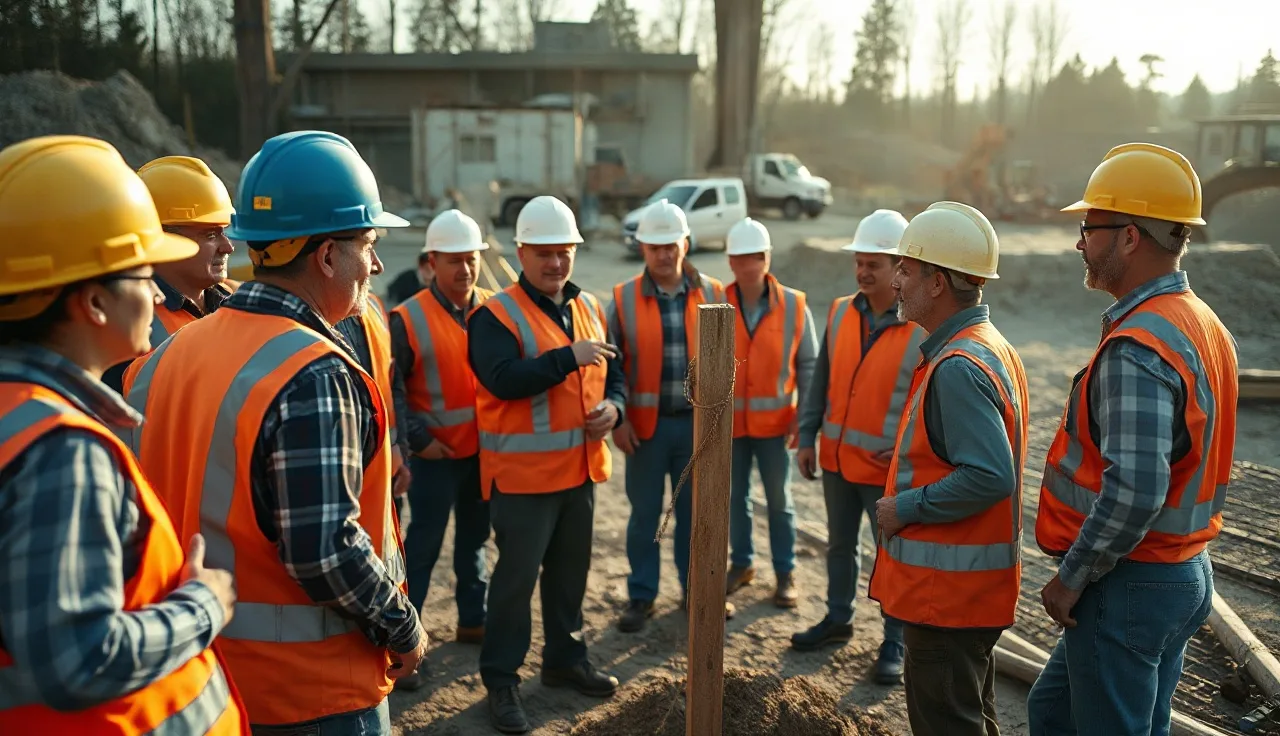
A toolbox talk is a short safety conversation held with a small crew right before work starts or before a specific task begins. Five to fifteen minutes. Standing around the tailgate, the shop floor, or the break room. No slide deck required.
The name comes from construction, where workers gathered around an open toolbox to talk through the day's hazards. The format spread to manufacturing, warehousing, landscaping, healthcare, and pretty much every trade where people face physical risk.
Here's why the format earns its keep at a small company. Small employers, those with fewer than 50 workers, account for roughly half of all occupational fatalities in the U.S. according to Bureau of Labor Statistics data [1]. Those same employers have the least access to full-time safety staff. A daily or weekly toolbox talk gives a small operation a steady safety touchpoint without paying for a safety manager.
The research case is real. A meta-analysis in the Journal of Safety Research found that safety communication frequency is inversely related to injury rates, meaning operations that talk about safety more often get hurt less often [2]. Nobody has clean data on toolbox talks by themselves, but the direction of the finding holds across the literature.
One more payoff: talks leave a paper trail. If OSHA inspects your site or a worker files a comp claim, documented toolbox talks show you were running an active safety program. That evidence matters.
Does OSHA require toolbox talks?
No single OSHA standard says "you must run toolbox talks." The honest answer is more layered than that.
The General Duty Clause, Section 5(a)(1) of the Occupational Safety and Health Act, requires employers to provide a workplace free from recognized hazards. So if toolbox talks are a recognized industry practice for controlling a hazard, and in construction they usually are, skipping them can be cited under the General Duty Clause during an inspection.
Several specific standards also require pre-task safety communication that looks exactly like a toolbox talk:
- 29 CFR 1926.21(b)(2) requires construction employers to "instruct each employee in the recognition and avoidance of unsafe conditions."
- 29 CFR 1926.651(k)(1) requires daily inspections of excavations and adjacent areas before workers enter, with findings passed to workers. That's a mandated trench safety talk in everything but name [10].
- 29 CFR 1910.132(f) requires PPE training before workers use the equipment.
- Lockout tagout under 29 CFR 1910.147(c)(7) requires employee training on energy control procedures [12].
OSHA's own construction compliance resources describe toolbox talks as a best practice for meeting training requirements [3]. CalOSHA, one of the more aggressive state plans, names toolbox talks directly in its injury and illness prevention program guidance.
So they aren't a standalone legal requirement for most employers. They are the mechanism you use to satisfy several specific training rules. Miss them and you're exposed on more than one front.
How often should you hold toolbox talks?
Construction contractors run them daily, or before each major task change. That's the industry standard, and for high-hazard work it's the right cadence. General industry runs weekly most often. Monthly is the floor, and below that you lose the reinforcement that makes these meetings work.
Frequency should track hazard spikes too. A landscaping crew in July needs heat illness talks far more often than in October. A warehouse ramping for peak season should add forklift traffic and ergonomics topics as temporary workers arrive. Confirm forklift certification requirements before you put new operators on equipment during a hiring surge.
A rule that actually works: hold a talk whenever the site, task, crew, or weather creates a hazard your workers haven't faced recently. Daily in construction. Weekly in most shops. Immediately when something changes.
Document every one. Date, topic, presenter, attendees. Keep those records at least three years to match OSHA's recordkeeping period under 29 CFR 1904 [4].
What are the best safety topics for toolbox talks?
The best topic is the one that matches what your crew is doing today or this week. Some topics show up again and again in injury data and inspection records, though, and those make a strong backbone for a full-year calendar.
Here's the breakdown by category.
Fall protection Falls are the leading cause of death in construction and a top injury source in general industry. OSHA's 29 CFR 1926 Subpart M covers fall protection in construction. Good talk topics: when fall protection is required (6 feet in construction, 4 feet in general industry per 29 CFR 1910.23), ladder inspection, scaffold use, and leading edge work [5].
Struck-by and caught-in/between hazards Struck-by incidents are the second most common fatal construction event. Forklift and pedestrian separation, overhead load awareness, machine guarding under 29 CFR 1910.212, and PPE like hard hats and high-vis vests all make solid talks.
Trench and excavation safety Trenching is one of the most reliably deadly construction hazards. OSHA records roughly 40 to 50 excavation-related fatalities a year [6]. A trench safety talk should cover the competent person requirement under 29 CFR 1926.650-652, soil classification, protective systems (sloping, shoring, trench boxes), and the flat rule against entering an unprotected trench 5 feet or deeper. This one deserves its own talk before every excavation job, every time.
Hazard communication and chemical safety If your workers handle chemicals, hazard communication talks tie straight to the legal requirement under 29 CFR 1910.1200. Cover SDS access, label reading, and the right PPE for the specific chemicals on site.
Lockout/tagout Any facility with machinery should run this one regularly, especially when new equipment arrives or new workers join. Tie it directly to 29 CFR 1910.147.
Electrical safety Grounding, GFCI use, extension cord inspection, overhead line clearances. Electrical accidents cause about 160 workplace deaths a year in the U.S. [1].
Heat illness and cold stress Seasonal but serious. OSHA cites heat illness under the General Duty Clause because there's no specific heat standard for most industries yet (a proposed rule was published in 2024). Cover water, rest, shade, and the difference between heat exhaustion and heat stroke.
Ergonomics and manual material handling Musculoskeletal disorders make up roughly 30% of workplace injuries requiring days away from work, per BLS [1]. Lifting technique, team lifts, and tool selection are immediate, practical topics.
Fire safety and emergency action Exit awareness, extinguisher locations and use (the PASS technique), and assembly points. Tie it to your written emergency action plan under 29 CFR 1910.38.
Incident reporting Workers need to know how to report a near miss or injury without fear of payback. Walk through your incident report process at least once a year.
Personal protective equipment PPE talks land when they're specific: the right glove for this chemical, the right respirator for this dust. Generic PPE talks lose people fast. Specificity wins.
How do you build a toolbox talk topic calendar for the year?
A full year of topics sounds like heavy planning. It's about two hours of work up front.
Start with your injury and near-miss log. Whatever hurt someone, or nearly did, goes near the top. This is the single most useful input, and most employers skip it.
Next, pull your OSHA 300 log if you keep one (required for establishments with 11 or more employees in most industries under 29 CFR 1904) [4]. Read the injury types and body parts. Strains and lacerations are telling you where your highest-frequency hazards live.
Then map your work calendar. Seasonal work, new projects, equipment deliveries, and big crew changes all flag when specific topics are due. A concrete pour in February calls for a cold stress talk. New spray equipment calls for a respirator and SDS talk the morning it first runs.
Fill the rest with OSHA's top-cited violations for your industry, published every year on OSHA's website [3]. In construction, fall protection, scaffolding, and ladders repeat annually. In general industry, lockout/tagout, machine guarding, and hazard communication never leave the list.
A realistic weekly schedule for a small construction contractor might run like this:
| Week | Topic | CFR Hook |
|---|---|---|
| 1 | Fall protection basics | 29 CFR 1926 Subpart M |
| 2 | Ladder inspection | 29 CFR 1926.1053 |
| 3 | Heat illness prevention | General Duty Clause |
| 4 | Struck-by: overhead loads | 29 CFR 1926.502 |
| 5 | Trench safety toolbox talk | 29 CFR 1926.652 |
| 6 | PPE selection and fit | 29 CFR 1926.95 |
| 7 | Electrical safety basics | 29 CFR 1926.403 |
| 8 | Hazard communication and SDS | 29 CFR 1910.1200 |
Repeat, rotate, and update as conditions shift. Twelve to fifteen unique topics cycling quarterly is a reasonable annual program.
What is the right format for a toolbox talk?
Keep it simple. Complicated formats wreck attendance quality, because the supervisor delivering the talk gets anxious about doing it wrong and either reads word for word (boring) or skips it entirely.
A good toolbox talk has four parts:
1. The hazard. One or two sentences: what can hurt someone here? 2. Why it matters. A quick stat, a reference to something that happened on a similar job, or just the honest reason. 3. The safe practice. Specific and actionable: "check your harness D-ring before you climb, every time." 4. Questions and sign-off. Ask the crew. Don't just talk at them.
The sign-off is where most people underinvest. Ask a real question: "Has anyone seen anything on this job that could cause a fall that we haven't handled yet?" That does two things. It surfaces real hazards you might have missed, and it turns your workers into participants instead of an audience.
OSHA's own free toolbox talk templates follow this structure [3]. A one-page printout with the topic, key points, and a signature line for attendees covers your documentation needs.
Aim for 5 to 15 minutes. If a topic needs 30 minutes to cover properly, it isn't a toolbox talk. It's a training session, and it should be scheduled that way, with sign-in sheets and competency records to match your OSHA training requirements.
Who should lead a toolbox talk?
The immediate supervisor is the right person almost every time. Not a safety director on speakerphone. Not a printed handout passed around without a word. The person actually running the job that day.
This matters for a couple of reasons. Workers trust their direct supervisor more than an outside safety person on anything that touches their daily work. The supervisor also knows the specific conditions: the mud on the ramp, the low-hanging conduit, the new hire who hasn't run this machine before.
For supervisors who get nervous leading talks, especially newer ones, a simple printed guide helps. Keep a binder of one-page topic sheets. The supervisor reads the key points, adds one observation from the site, and asks the crew a question. That's the whole job.
Small shops where the owner is also the supervisor should just own it. Workers can smell a performance. An owner who says "I almost got hurt this way once, here's what we do differently now" lands harder than any scripted message.
If you have crew members who speak English as a second language, they need the key points in their language. OSHA publishes Spanish-language toolbox talk materials [3]. This isn't optional when it affects comprehension. 29 CFR 1910.1200(h)(1) requires training in a language workers understand, and courts have read that standard broadly [11].
How do you document toolbox talks to satisfy OSHA?
Documentation doesn't have to be complicated, but it does have to exist. A worker complaint or an OSHA inspection is a rough time to learn you have no records.
At minimum, every toolbox talk record should include:
- Date
- Topic covered
- Name of the person who led the talk
- Names and signatures of everyone who attended
- Any follow-up noted (hazards identified, corrective steps assigned)
A paper sign-in sheet works. So does a shared Google Form if your crew carries phones. The format matters far less than the consistency.
How long do you keep records? OSHA's general rule under 29 CFR 1904 is five years for the injury log, though the three-year retention many programs cite comes from older guidance [4]. Keep training and toolbox talk records at least three years as a safe baseline, and five to be safe. Some standards demand longer: 29 CFR 1910.1020 requires employee exposure records for 30 years. If your talk documented exposure-related training, hold it accordingly.
Store records where you can actually find them. A folder in the supervisor's truck is not a system. A shared drive, an office binder, or a safety platform all beat that. If you're building a full written safety program and want your talk logs to slot into a documented system, SafetyFolio's safety program generator builds the framework in about 15 minutes, and your talk records drop right in.
What are the most common mistakes employers make with toolbox talks?
Running the same talk every month without rotating topics. Workers tune out fast once they've heard the same words in the same order a few times. Build a calendar and follow it.
Treating documentation as optional. The talk happened, nobody signed anything, and six months later there's a comp dispute. Signatures take 90 seconds and carry real weight.
Making it one-directional. A supervisor who talks for ten minutes and takes zero questions hasn't held a toolbox talk. He's given a speech. The most useful information often shows up in the crew's questions.
Picking topics with nothing to do with today's work. If the crew is finishing interior drywall, a trench safety talk is wasted breath. Match topic to task.
Ignoring the hazards workers raise. If someone flags a concern during a talk and it sits for two weeks, people stop flagging concerns. That's the exact opposite of what you want.
Using the talk as a disciplinary tool. "I'm doing this because too many of you skip PPE" poisons the room. Keep the talk on hazard and protection, not blame.
Skipping the talk when the crew is running behind. That's usually the morning corners get cut and someone gets hurt.
How do toolbox talks fit into a full written safety program?
A toolbox talk is the daily execution layer of a written safety program. The written program sets the policy, the standards, the procedures. The talk is how those procedures stay alive in workers' heads under real field conditions.
OSHA's Recommended Practices for Safety and Health Programs, published in 2016, names worker participation and hazard communication among the core elements of an effective program [7]. Toolbox talks are the most practical mechanism for both.
If you need to build a written program alongside your talk calendar, OSHA's free resources are a real starting point. OSHA's small business page has industry-specific guidance that maps straight onto talk topics.
If you're also investing in formal supervisor training, an OSHA 30 course gives supervisors the background to lead talks with actual authority. They'll know the CFR references, the hazard controls, and the inspection triggers that make a talk credible instead of scripted.
Toolbox talks alone aren't a safety program. They're one part. Hazard assessments, written procedures, incident investigation, and recordkeeping all have to exist too. But for most small businesses, starting with consistent toolbox talks is the highest-value first move, because they hit your top injury risks while you build out the rest.
Where can you find free toolbox talk templates and resources?
Several sources give you genuinely useful free material, not marketing pages with a topic list stapled on.
OSHA's website hosts a library of free toolbox talk documents organized by hazard type [3]. Plain English, one to two pages each, with talking points and a signature block. Start here.
The National Institute for Occupational Safety and Health (NIOSH) publishes safety alerts and fact sheets that convert directly into talk content [8]. Their construction and agriculture resources are especially practical.
Many state workers' comp funds publish free toolbox talk libraries for their policyholders. The Washington State Department of Labor and Industries runs one of the deepest topic libraries out there [9]. Even if you're not in Washington, the materials are public and well-organized.
The Associated General Contractors of America and the National Safety Council both keep topic libraries, though some content sits behind membership.
For trade-specific content, manufacturer safety data and industry associations often publish topic-specific guides. An equipment rental company's aerial lift safety guide can anchor a solid 10-minute talk.
A note on quality: skip templates so generic they'd apply to any workplace anywhere. The more specific a template is to your actual hazards, the more it earns its place. If it says "always follow your company's procedures" without naming the procedures, it isn't doing much.
How do toolbox talks reduce injury rates, according to research?
The direct research on toolbox talks specifically is thinner than you'd hope. Most studies look at safety meetings, safety climate, or communication frequency in general. Nobody has run a randomized controlled trial on toolbox talks, and nobody's going to.
Here's what the research does say. Organizations with higher safety communication frequency have measurably lower injury rates. A 2012 analysis in the Journal of Safety Research found that "safety-specific communication was significantly related to safety performance" across industries [2]. The effect held regardless of company size.
BLS data shows construction's total recordable incident rate dropped from about 5.9 per 100 workers in 2003 to around 2.9 in 2022 [1]. You can't credit that entirely to toolbox talks. But consistent pre-task safety communication is a named piece of contractor safety programs in the segments that improved fastest, including union construction.
On excavation deaths, OSHA has documented that most trench fatalities happen where either no protective system was in place or workers entered without a competent person's inspection [6]. A trench safety talk that hits those exact points, held before every dig, addresses the documented cause of most deaths. That's about as clean a prevention case as you'll find anywhere in safety.
OSHA's own Recommended Practices document states that "workers should be encouraged to report hazards without fear of reprisal" and treats regular safety meetings as a core mechanism for exactly that [7].
If you want to pull all of this together, the talk records, the written procedures, the training documentation, into one OSHA-compliant package, SafetyFolio builds custom written safety programs in about 15 minutes. The toolbox talk log templates are included.
Frequently asked questions
How long should a toolbox talk be?
Five to fifteen minutes is the standard range. Ten minutes hits the sweet spot for most topics: long enough to cover the hazard, the safe practice, and a question or two, short enough that workers stay engaged. If a topic genuinely needs 30 minutes, schedule it as formal training with proper documentation rather than calling it a toolbox talk.
Are toolbox talks legally required by OSHA?
No single OSHA standard mandates toolbox talks by name. But several specific standards, including 29 CFR 1926.21(b)(2) in construction and 29 CFR 1926.651(k)(1) for excavations, require pre-task safety communication that a toolbox talk satisfies. Skipping them in a high-hazard industry also risks General Duty Clause citations where toolbox talks are a recognized industry practice for controlling a known hazard.
What should a trench safety toolbox talk cover?
It should cover the competent person requirement under 29 CFR 1926.650, daily inspection of the excavation and adjacent area before anyone enters, soil classification and what it means for the protective system, the specific system in use (sloping, shoring, or a trench box), and the flat rule against entering an unprotected excavation 5 feet or deeper. Run this talk before every excavation job.
How do you document a toolbox talk for OSHA purposes?
Record the date, topic, presenter's name, and a signature from every attendee. Note any hazards raised and any corrective actions assigned. Keep records at least three years to match OSHA's recordkeeping period under 29 CFR 1904. A paper sign-in sheet is fine. A digital form works too, as long as you can produce it during an inspection.
What are the top 10 toolbox talk topics for construction?
Based on OSHA's annual top-10 citation list and BLS fatality data, the highest-value construction topics are: fall protection, ladder safety, scaffold safety, struck-by hazards, trench and excavation safety, electrical safety, lockout/tagout, heat illness prevention, PPE selection and use, and hazard communication. Rotate through these monthly at minimum and add task-specific topics as conditions change.
Can a toolbox talk count as OSHA-required training?
Sometimes, but only if it meets the specific training requirements of the applicable standard. A 10-minute talk meets 29 CFR 1926.21's broad instruction requirement. It does not meet the full training requirements of 29 CFR 1910.147 (lockout/tagout), which require demonstrated understanding and documented competency. Use toolbox talks to reinforce formal training, not to replace it when the standard demands more.
How do you make toolbox talks more engaging for workers?
Ask real questions instead of reciting bullet points. Reference something specific to your actual site: the mud on the ramp, the new machine, last week's near miss. Invite workers to share what they've seen. Keep the vocabulary plain. If you have workers who speak English as a second language, run key points in their language. OSHA has Spanish materials. Workers engage when the talk is clearly about their real day.
Who is responsible for leading a toolbox talk?
The immediate supervisor or crew leader in almost every case. They know the day's conditions and the crew personally. Safety directors and owners can step in now and then, but handing the daily talk to someone who isn't running the job cuts credibility and engagement. Supervisors who complete an OSHA 30-hour course have the background to lead talks with authority on the relevant standards.
What topics should you cover for a new worker's first week?
New workers face disproportionately higher injury risk, especially in the first month. Priority topics for week one: emergency procedures and exit locations, the specific PPE their tasks require and how to use it, reporting procedures for near misses and injuries, the site's highest-consequence hazards (falls, electrical, struck-by, or whatever fits), and who their go-to person is for safety questions. Document all of it.
How many toolbox talk topics do you need for a full year?
Running weekly talks, you need roughly 50 sessions a year. You don't need 50 unique topics. Cycling 15 to 20 core topics quarterly is reasonable, with seasonal and task-specific additions as needed. Injury prevention research supports repeating high-risk topics over chasing novelty. What matters is that workers can recall and apply the content, not that every week breaks new ground.
Are there free toolbox talk templates available?
Yes. OSHA's website has free downloadable toolbox talk documents organized by hazard type. NIOSH publishes safety alerts that convert easily into talks. Many state workers' comp agencies, including Washington State's Department of Labor and Industries, keep open-access topic libraries. Skip templates so generic they don't reference your actual hazards. Specificity is what makes a talk useful.
Do toolbox talks need to be in Spanish or other languages?
If workers don't understand English well enough to act on safety information, yes. OSHA's hazard communication standard at 29 CFR 1910.1200(h)(1) requires training in a language workers understand, and courts have applied it broadly. OSHA publishes Spanish-language toolbox talk materials. For other languages, bilingual crew members can help, but the key safety points must reach every worker in a way they can actually use.
What's the difference between a toolbox talk and a safety meeting?
A toolbox talk is short (5 to 15 minutes), informal, held at or near the work area, and focused on one hazard or task. A safety meeting is longer (30 to 60 minutes), scheduled ahead, may cover several topics, and usually involves more structured presentation and documentation. Both have a place. Toolbox talks are daily or weekly practice. Safety meetings are where you handle program updates, incident reviews, and policy changes.
How do you handle workers who don't take toolbox talks seriously?
First, make the talks worth taking seriously. Disengaged crews usually mean the talk isn't relevant to their work or is too scripted. Second, make attendance non-negotiable and document it every time. Third, involve workers: ask one to lead a talk on a hazard they know well. When a worker becomes the subject matter expert for a session, both their engagement and the crew's attention jump.
Sources
- Bureau of Labor Statistics, Census of Fatal Occupational Injuries and Nonfatal Occupational Injuries and Illnesses: Small employers account for roughly half of all occupational fatalities; electrical accidents cause about 160 deaths per year; musculoskeletal disorders account for roughly 30% of days-away-from-work cases; construction TRIR fell from ~5.9 in 2003 to ~2.9 in 2022
- Journal of Safety Research, safety communication and safety performance meta-analysis (2012): Safety-specific communication was significantly related to safety performance across industries and company sizes
- OSHA, Construction Safety and Health Resources and Toolbox Talks: OSHA describes toolbox talks as a best practice for meeting construction training requirements and publishes free toolbox talk templates, including Spanish-language materials
- OSHA, Recordkeeping Rule 29 CFR Part 1904: OSHA requires employers to retain injury and illness records; 29 CFR 1904 governs recordable criteria and retention
- OSHA, Fall Protection in Construction 29 CFR 1926 Subpart M: Fall protection is required at 6 feet in construction under 29 CFR 1926 Subpart M and at 4 feet in general industry under 29 CFR 1910.23
- OSHA, Trenching and Excavation Safety: OSHA records roughly 40-50 excavation-related fatalities per year; most occur where no protective system was in place or a competent person did not inspect before entry
- OSHA, Recommended Practices for Safety and Health Programs (2016): OSHA's Recommended Practices names worker participation and hazard communication as core elements; states workers should be encouraged to report hazards without fear of reprisal and treats regular safety meetings as a core mechanism
- NIOSH, Construction Safety Resources and Alerts: NIOSH publishes safety alerts and fact sheets for construction and agriculture that can be used as toolbox talk source material
- Washington State Department of Labor and Industries, Safety Meeting and Toolbox Talk Resources: Washington State L&I maintains a public library of toolbox talk topics available to employers
- OSHA, Excavation Standard 29 CFR 1926.650-652: 29 CFR 1926.651(k)(1) requires daily inspections of excavations and adjacent areas before workers enter, with findings communicated to employees
- OSHA, Hazard Communication Standard 29 CFR 1910.1200: 29 CFR 1910.1200(h)(1) requires that hazard communication training be conducted in a language and vocabulary workers understand
- OSHA, Control of Hazardous Energy (Lockout/Tagout) 29 CFR 1910.147: 29 CFR 1910.147(c)(7) requires documented employee training on energy control procedures before workers service or maintain equipment